Eramosa Brown Marble Slab: Linear Grain, Cross-Cut Options, and Furniture Use
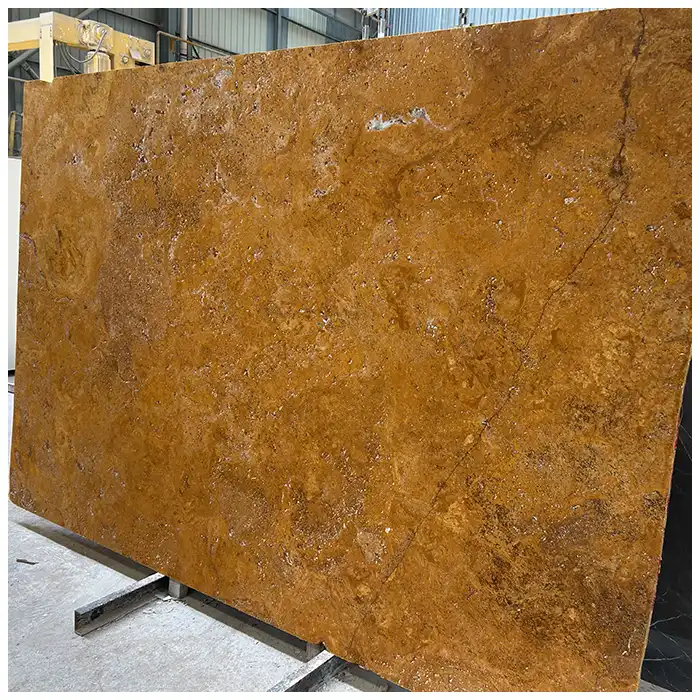
An Eramosa face once stopped me because it looked almost quiet enough to be timber. Tobacco lines ran in disciplined layers, but small fossil and mineral interruptions kept the surface unmistakably stone. Along the edge, those layers became thin pages pressed together over geological time.
For an eramosa brown marble slab, cut direction controls the first impression. Vein-cut material emphasizes length and order. Cross-cut material may reveal broader movement. I compare both against the object before choosing the slab, finish, and edge.
True luxury is something you never get tired of looking at. The linear option achieves that through calm repetition, provided joints, bases, and nearby wood do not compete with it.
Distinguish Vein Cut from Cross Cut in Eramosa brown marble slab
At a long dining table, I let my eye travel along the long tobacco-brown grain. I confirm direction with full-face images while the slab can still be seen as one geological field. The risk appears when a cross-cut sample is mistaken for vein cut. Across a long dining table, crystals, healed fissures, and mineral bands change tempo; the selected area must still hold together at wall, table, or fireplace scale.

My layout record keeps base and fixing drawing and repair map. One holds the compositional decision and the other tells the workshop how to maintain it. A spare piece can preserve the visual weight first found in cross-cut clouded figure.
From another angle, I revisit the companion orientation. I place arrows on every piece and read companion orientation for changes in depth, resin, texture, and mineral structure. The danger is that a cross-cut sample is mistaken for vein cut. At a long dining table, the detail must still belong after joints, openings, edges, and supports enter the composition.
I place this reading within Luxury Natural Stone Slabs Guide, where full-face character, finish, fabrication, scale, and authentic material value remain connected.
Use Linear Grain to Control Proportion
I lower my viewpoint toward the long tobacco-brown grain. I compare crops at scale and read long tobacco-brown grain for changes in depth, resin, texture, and mineral structure. That moving view can reveal that cross grain makes a long top feel shorter. At a narrow console, the detail must still belong after joints, openings, edges, and supports enter the composition.
When I inspect a narrow console, I let the taupe interval set the pace of the slab. I place arrows on every piece while the slab can still be seen as one geological field. A small crop can conceal the fact that cross grain makes a long top feel shorter. Across a narrow console, crystals, healed fissures, and mineral bands change tempo; the selected area must still hold together at wall, table, or fireplace scale.
In Eramosa brown marble, I look for the mineral depth and full-face movement that will remain persuasive after cutting and installation.
Pour eramosa brown marble slab, confirm the selected supply’s cut direction.
Choose Scale for Furniture
While viewing a reception edge, I read the cross-cut clouded figure from edge to edge. I compare crops at scale while the slab can still be seen as one geological field. The composition weakens if small crops become striped. Across a reception edge, crystals, healed fissures, and mineral bands change tempo; the selected area must still hold together at wall, table, or fireplace scale.
I preserve finish sample and directional companion inventory. Their shared orientation gives later pieces a direction to follow. The next fabricator can follow grain along table length without flattening its movement.
The second reading concerns the taupe interval. I choose calm areas for small furniture and read taupe interval for changes in depth, resin, texture, and mineral structure. I become cautious when small crops become striped. At a reception edge, the detail must still belong after joints, openings, edges, and supports enter the composition.
| Decision point | Evidence to inspect | Release condition |
|---|---|---|
| Cut direction | Full vein-cut and cross-cut faces | Description matches the figure |
| Proportion | Grain arrows on furniture | Direction supports length |
| Bord | Eased, laminated, mitred alignment | Thickness reads intentionally |
| Structure | Size, thickness, support, fixing zones | Support avoids weak features |
| Finition | Touch, reflection, repair, cleaning | Surface suits close use |
The Hard-Won Lesson in eramosa brown marble slab: A wood-grain effect can run the wrong way
A long dining top cut with bands across its width remains beautiful, yet repeated cross lines visually shorten the table and fight a linear base. The stone is not defective; the crop ignored the object.
The Lesson: Draw the grain arrow on the furniture plan first.
Design Edges That Respect Layers
Then I study the cross-cut clouded figure. I mock up full edge thickness and read cross-cut clouded figure for changes in depth, resin, texture, and mineral structure. The crop loses authority if edge build-up repeats lines unnaturally. At a mitred corner at seated height, the detail must still belong after joints, openings, edges, and supports enter the composition.
As I look at a mitred corner at seated height, I stand back before tracing the fine fossil interruption. I choose calm areas for small furniture while the slab can still be seen as one geological field. Without this reading, edge build-up repeats lines unnaturally. Across a mitred corner at seated height, crystals, healed fissures, and mineral bands change tempo; the selected area must still hold together at wall, table, or fireplace scale.
With eramosa brown marble slab, let grain support the proportion of the object.
Coordinate Base Support and Direction
During a check of a top under a pendant, I compare the quiet and force around the grain along table length. I mock up full edge thickness while the slab can still be seen as one geological field. An isolated photograph misses how mitres break layered reading. Across a top under a pendant, crystals, healed fissures, and mineral bands change tempo; the selected area must still hold together at wall, table, or fireplace scale.
The cutting release carries care test and piece grain arrows. The pair keeps fabrication from reducing the slab to disconnected dimensions. Later interventions do not have to reinterpret the intent behind laminated edge direction.
Walking past the face, I watch the fine fossil interruption. I align mitres with layers and read fine fossil interruption for changes in depth, resin, texture, and mineral structure. The light exposes whether mitres break layered reading. At a top under a pendant, the detail must still belong after joints, openings, edges, and supports enter the composition.
I study Eramosa brown marble tile under side light before deciding where its crystalline passages should meet an edge, joint, or support.
Test Finish, Touch, and Side Light
At close range, I inspect the grain along table length. I coordinate support before drilling and read grain along table length for changes in depth, resin, texture, and mineral structure. This matters because base positions meet natural features. At a honed surface touched by hand, the detail must still belong after joints, openings, edges, and supports enter the composition.
While reviewing a honed surface touched by hand, I map the grain across a console before choosing a crop. I align mitres with layers while the slab can still be seen as one geological field. The finished object suffers when base positions meet natural features. Across a honed surface touched by hand, crystals, healed fissures, and mineral bands change tempo; the selected area must still hold together at wall, table, or fireplace scale.
Before the crop is released, I return to Luxury Natural Stone Slabs Guide and ask whether the detail still preserves the larger natural-stone composition.
Reserve Direction-Compatible Companions
Returning to a replacement leaf beside the top, I follow the laminated edge direction across the whole face. I coordinate support before drilling while the slab can still be seen as one geological field. Ignore that rhythm, and dark finish hides repair evidence. Across a replacement leaf beside the top, crystals, healed fissures, and mineral bands change tempo; the selected area must still hold together at wall, table, or fireplace scale.
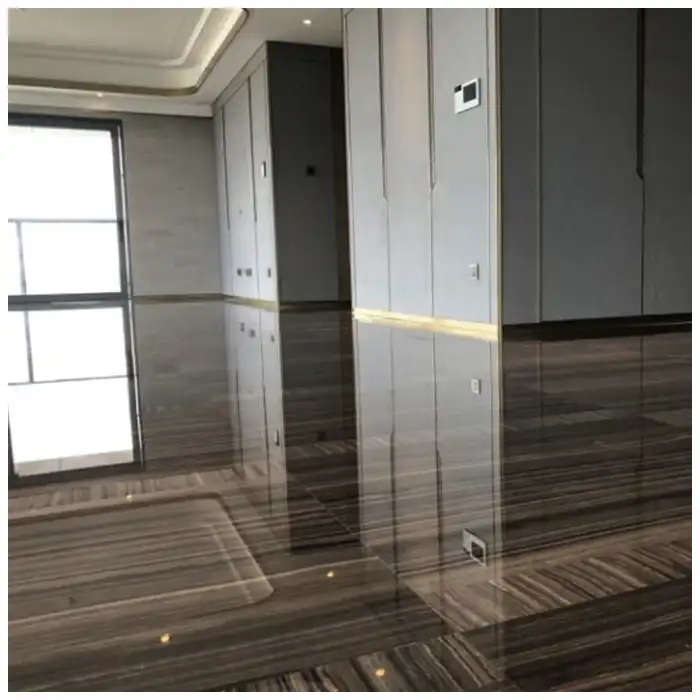
Before fabrication, I pair cut-direction identification and edge mock-up. The first protects the visual intention; the second converts it into a usable shop reference. Returns and later additions can continue the direction established by base support line.
I examine the grain across a console. I review finish under grazing light and read grain across a console for changes in depth, resin, texture, and mineral structure. A face-on image may hide the fact that dark finish hides repair evidence. At a replacement leaf beside the top, the detail must still belong after joints, openings, edges, and supports enter the composition.
When Linear Stone Behaves like Structure
Direction changes apparent proportion
Lengthwise lines extend an object; crosswise bands divide it.
Edge design exposes geology
The side reveals layers and makes careless build-ups obvious.
Nearby timber needs restraint
Similar grain in wood and stone can harmonize or compete.
Extension leaves need direct companions. A removable leaf must match color, thickness, direction, and the point where lines meet the fixed top. Lay both closed and extended positions in the slab study.
Commercial names help buyers find material, while geological classification may vary by source and test. Request current technical data and inspect the actual slabs. Beauty does not excuse vague performance claims.
I always return to the complete slab after studying a detail. With eramosa brown marble slab, a close photograph can explain a repair, crystal, or vein edge, but it cannot show how that mark balances the rest of the face. The release set needs both distance and intimacy: one view for composition, another for geological and fabricated details that remain visible.
I take one last look at the taupe interval from a reception edge, and I choose calm areas for small furniture. I retain scaled furniture crops because small crops become striped. The added angle tests whether the crop can carry its place in the complete object recorded by scaled furniture crops.
From a mitred corner at seated height, I revisit the grain along table length, and I confirm direction with full-face images. I retain finish sample because rough texture traps dining residue. I want the finished edge and support to preserve what the record for finish sample says the slab first revealed.
The composition at a top under a pendant brings me back to the mitred corner continuity, and I review finish under grazing light. I retain cut-direction identification because small crops become striped. The composition must survive cutting without losing the reason preserved in cut-direction identification.
Before fixing the layout, I study the honed tactile response at a honed surface touched by hand, and I mock up full edge thickness. I retain base and fixing drawing because rough texture traps dining residue. A beautiful detail still has to serve the larger geological movement fixed by base and fixing drawing.
My final side-light pass at a replacement leaf beside the top crosses the taupe interval, and I place arrows on every piece. I retain care test because small crops become striped. The entry for care test protects the relationship between mineral character and form.
At full-object scale in a long dining table, I reconsider the grain along table length, and I test cleaning on selected texture. I retain scaled furniture crops because rough texture traps dining residue. Only after the record for scaled furniture crops is complete does the crop move from admiration to fabrication.
Before release, I return to the mitred corner continuity at a narrow console, and I align mitres with layers. I retain finish sample because small crops become striped. That view tests whether the detail still belongs after fabrication and beside finish sample.
I take one last look at the honed tactile response from a reception edge, and I compare crops at scale. I retain cut-direction identification because rough texture traps dining residue. The added angle tests whether the crop can carry its place in the complete object recorded by cut-direction identification.
From a mitred corner at seated height, I revisit the taupe interval, and I reserve companions by direction. I retain base and fixing drawing because small crops become striped. I want the finished edge and support to preserve what the record for base and fixing drawing says the slab first revealed.
Frequently Asked Questions
1. Is an Eramosa brown marble slab always vein cut?
No. Material may be offered in different orientations. Confirm the actual full face rather than relying on its commercial name.
2. Does Eramosa look like wood?
Many vein-cut faces show long brown and taupe lines reminiscent of timber, but mineral and fossil features remain distinctly stone.
3. Is it suitable for dining tables?
It can be when slab, finish, thickness, edge, support, repairs, and care suit the dimensions and use.
4. Which finish works for furniture?
Polish gives depth; hone softens it; texture changes touch and cleaning. Test current material for the exact use.
5. What if a replacement runs in another direction?
Photograph pieces together, stop fabrication, and compare direction, batch, finish, and companion-stock records before accepting it.
Quick-Reference Checklist for eramosa brown marble slab
- Confirm vein or cross cut.
- Draw grain arrows.
- Compare crops at actual scale.
- Mock up edges and mitres.
- Coordinate support zones.
- Store companions by direction.
Final Conclusion
Eramosa succeeds when cut direction, proportion, edge, support, finish, and companion stock reinforce the same quiet linear idea. The grain must belong to the object. The final decision on eramosa brown marble slab must stay attached to the evidence that production and site teams can verify.
The veins will tell you which way the piece wants to run, and MQ STONE draws that answer before a furniture cut is made.
References
- Marbre, Wikipedia.
- Standard Terminology Relating to Dimension Stone, ASTM International.
- Standard Specification for Marble Dimension Stone, ASTM International.
- Stone Selection and Use Guidance, Natural Stone Institute.
- Natural Stone Finishes Technical Guidance, Natural Stone Institute.
- Materials and Design Coverage, Dezeen.
- Search Essentials, Google Search Central.