Magma Blue Quartzite: Full-Slab Color Zones, Finish Choice, and Feature-Wall Composition
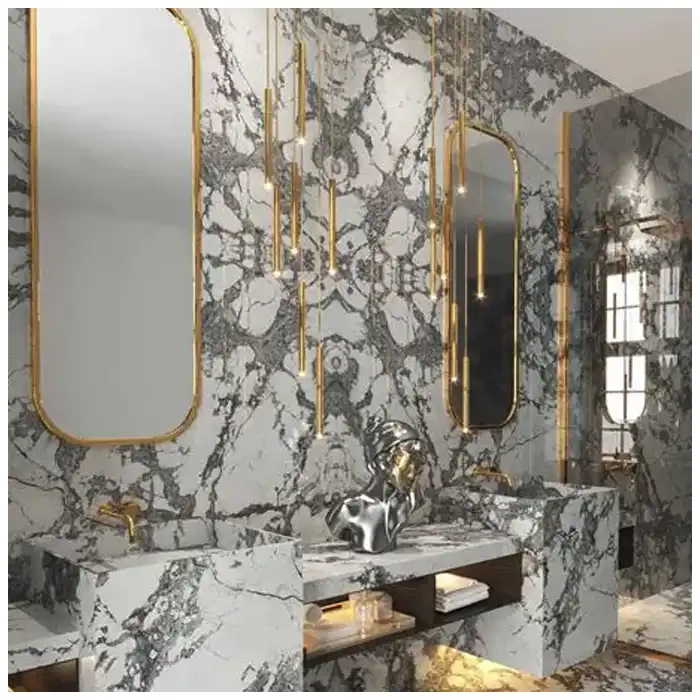
A blue passage often appears electric under warehouse halogens but settles into deep charcoal once installed against a matte wall surface. The perceived balance between blue, charcoal and green-grey zones changes with the light source, the direction it arrives from, the surface finish, the viewing angle and the materials standing next to the wall, meaning a single photograph cannot capture the material’s full behavior in varying interior conditions.
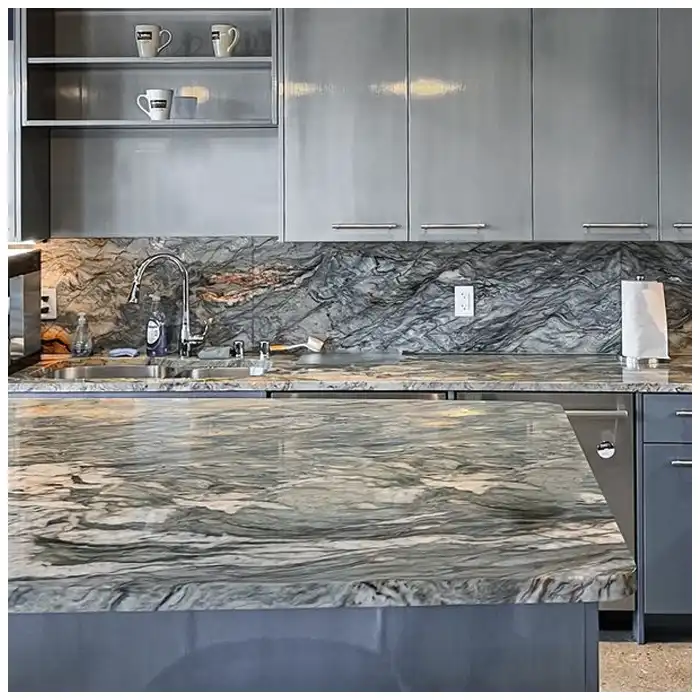
Magma Blue quartzite requires a full-face color map before a feature-wall elevation divides it into panels.
Design longevity relies on visual rhythm rather than immediate impact. The wall must guide the eye through tonal and textural transitions, ensuring the composition remains legible after the initial novelty fades, treating the stone as a sequence rather than a singular highlight.
Map the Full Slab before Naming the Focal Zone in Magma Blue Quartzite
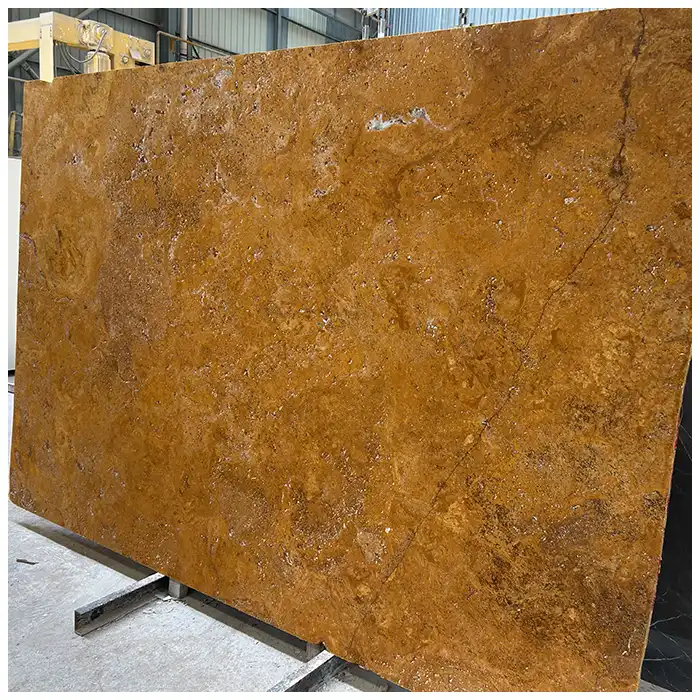
The entire slab face is examined to trace the continuity of blue mineral bands. Crop selection demands an understanding of how these bands interact with the surrounding grey and black matrix. Isolating a vibrant section while ignoring adjacent neutral zones frequently yields a disjointed appearance post-installation. The chosen segment must preserve structural and visual coherence within the broader geological pattern. Crucially, this coherence is judged not just against the raw stone, but against the specific ambient lighting of the installation site. A zone that appears balanced under warehouse halogens may lose contrast against a matte wall surface under warm residential LEDs. Therefore, the evaluation includes the intended viewing distance; details that disappear at the intended viewing distance should not control the primary composition. Joint setout further complicates this judgment, as seams can sever the perceived flow of mineral bands if they cut abruptly across the visible movement of the slab. Finally, the selected finish changes surface reflectance and perceived contrast, meaning a polished surface may amplify blue saturation while a honed finish softens it, requiring the color zone assessment to be dynamic rather than static.
The fabrication dossier incorporates a full-face map alongside raking-light photographs. These records direct the workshop in maintaining the intended visual flow. Offcuts from green-grey transition zones are retained to ensure future repairs or expansions match the original material’s tonal weight.
Darker charcoal areas undergo inspection under both diffuse and directional lighting. This process reveals differences in crystal scale, colour balance and surface texture that influence perceived depth. Because finishing alters light reflection, dark zones may appear flatter or deeper depending on the polish level. These variables must align with the final joint layout and edge profiles.
A common error involves approving the focal zone first and treating the remainder as filler. The reverse approach is standard practice: quiet zones define the value of the blue, requiring selection with the same rigor as the photogenic passages.
Compare Polish and Texture under Project Light
Green-grey transition zones are analyzed to identify subtle shifts in mineral composition. Proposed panel cuts overlaid on the slab image reveal whether joints disrupt key visual movements. In high-end interiors, these interruptions require planning to ensure the stone’s natural flow persists across seams and around architectural elements. Matching a companion slab to the feature field requires more than tonal similarity; it demands a rhythmic correspondence. The companion piece should echo the directional energy of the primary slab without competing for attention. If the feature wall relies on vertical banding, the companion slab should support that axis through its visible mineral movement. Differences in crystal scale, colour balance and surface texture between the two slabs can create visual dissonance under raking light, so samples are compared side-by-side at the actual installation height. This ensures that the transition from the focal wall to the adjacent surfaces feels like a continuous geological narrative rather than two separate purchases.
The charcoal background is evaluated to establish overall tonal balance. Finish comparisons under varied lighting expose how polish influences the visibility of blue hues. Small samples often miss the full range of mineral variation; therefore, the selected area must show consistent quality and cohesion at full architectural scale.
A finish effective on a close-range table may flatten on a distant wall. Candidate finishes are judged at the specific viewing distance the occupant will occupy.
Per Magma Blue quartzite, polish and texture are compared on the zone positioned at eye level, rather than the slab’s most dramatic area, as this band constitutes the daily visual experience.
Set Panel Joints around the Actual Movement
The selected face is reviewed from two viewing angles under the room’s intended light before the green-grey transition is traced from edge to edge, ahead of drawing panel lines. The object is overlaid on the real slab photograph while the material remains visible as a unified geological field. Composition suffers if a panel joint severs critical mineral movement. Quartz grains, healed fissures, and mineral bands shift tempo across the sample, requiring the selected area to maintain integrity at the scale of the finished wall elevation.
Scaled crops and finish references are documented to guide subsequent fabrication. Consistent orientation preserves the stone’s visual direction. Fabricators replicate textured finishes accurately without compromising the natural movement of mineral bands.
Polished surfaces inspected under side lighting reveal variations in depth and texture. These findings integrate with fabrication limits to prevent openings from eliminating focal points. The final composition accommodates joints, edges, and supports while retaining essential visual characteristics.
| Decision point | Evidence to inspect | Release condition |
|---|---|---|
| Color map | Blue, charcoal, green-grey, and quiet zones | Elevation uses transitions intentionally |
| Finish study | Polished and textured samples in project light | Chosen finish supports the selected viewing distance |
| Joint layout | Panel breaks, returns, and opening edges | No joint arbitrarily cuts the principal movement |
| Material condition | Natural lines, fills, and treated zones | Visible features are assigned deliberately |
| Companion slabs | Adjacent faces, sequence, and reserve condition | Wall has enough material for its intended rhythm |
The Hard-Won Lesson in Magma Blue quartzite: A blue center can leave the rest of the wall without a reason
A design team isolated one bright blue patch for the centre of a large elevation. Surrounded by unrelated darker pieces, the wall appeared as an inserted image rather than a continuous natural field. The crop was beautiful; the composition was not.
The Lesson: Choose the full sequence around the focal color before approving the focal color itself.
Use Openings to Frame Rather than Remove Color
Textured finish samples undergo study. The selected zone is photographed with its orientation arrow, examining changes in depth, resin, texture, and mineral structure. Authority is lost if the wall appears overly busy at close range. Under grazing light, details must remain coherent after joints, openings, edges, and supports enter the composition.
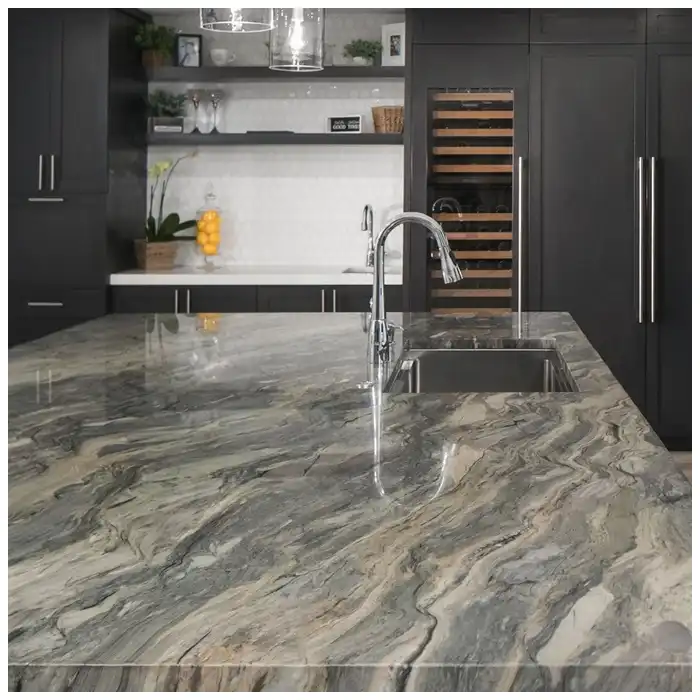
Full faces viewed under grazing light require stepping back before tracing polished faces under side light. Mineral features and fabrication limits remain on one drawing while the slab is perceived as a unified geological field. Without this perspective, openings risk removing the entire focal passage. Crystals, healed fissures, and mineral bands shift tempo across the face; the selected area must hold together across the full wall elevation.
Per Magma Blue quartzite, finish approval does not rely on photographs alone. Samples must sit in room light at the actual viewing distance before the panel schedule is released.
Read the Wall from Entry and Close Range
Fabrication tables are checked before the first cut, comparing quiet and force around textured finish samples. Selected zones are photographed with orientation arrows while the slab remains a unified geological field. Isolated photographs fail to capture how walls appear busy at close range. Crystals, healed fissures, and mineral bands change tempo across the table; the selected area must hold together across the full wall elevation.
Cutting releases include movement maps and fabrication overlays. This pairing prevents fabrication from reducing the slab to disconnected dimensions. Subsequent interventions avoid reinterpreting the intent behind openings within the elevation.
Vertical feature-wall joints are observed while walking past the face. Full-face reviews precede cut approval, examining joints for changes in depth, resin, texture, and mineral structure. Lighting reveals whether natural features sit on light-catching panel edges. Details laid out on the fabrication table must survive every joint, opening, edge, and support demanded by the elevation.
The selected slab is reviewed under side light to determine how crystalline passages approach edges, joints and supports. The Luxury Natural Stone Slabs Guide provides the broader material-selection context for that review.
Keep Natural Lines and Repairs in the Composition
Openings within the elevation are inspected at close range. The whole slab is read before crop selection, followed by an examination of the opening for shifts in depth, resin, texture, and mineral structure, as the opening dictates what structure the viewer perceives. This step is critical because companion faces are often chosen after the strongest slab has been cut. At wall scale, viewed from the entry, details must remain coherent once joints, openings, edges, and supports enter the elevation.
Large wall compositions viewed from the entry require mapping vertical feature-wall joints before crop selection. Full-face reviews precede cut approval, maintaining the slab as a unified geological field. Finished objects suffer when natural features sit on light-catching panel edges. Crystals, healed fissures, and mineral bands change tempo across the composition; the selected area must hold together across the full wall elevation.
Before crop release, comparisons with Natural Quartzite vs Marble-Look Sintered Stone verify whether details preserve the larger natural-stone composition.
Reserve Companion Faces before Fabrication
Returning to a full slab in a quiet warehouse aisle, an opening within the elevation has to be followed across the whole face. The whole slab is read before a crop is chosen, while the face can still be seen as one geological field rather than a set of panels. Ignore that rhythm, and a companion face is chosen after the strongest slab has already been cut. Across a full slab in a quiet warehouse aisle, the mineral movement shifts pace; the selected area must still hold together across the full wall elevation.
Before fabrication, the full-face study and the side-light photograph are paired. The first protects the visual intention; the second converts it into a usable shop reference. Returns and later additions can continue the direction established by a natural quartz seam.
A bookmatched pair of faces is examined next. The face is compared under diffuse and grazing light, and a bookmatched pair is read for changes in depth, resin, texture and mineral structure. A face-on image may hide the fact that a crop isolates color without the slab’s surrounding balance. Standing at the full slab in a quiet warehouse aisle, the detail still has to belong once joints, openings, edges and supports enter the elevation.
Where Magma Blue Quartzite Loses Its Depth
Color needs its surrounding field
A bright mineral passage often reads best when quieter areas let the eye arrive there naturally.
Finish changes the wall’s tempo
Polish may deepen reflection while texture can quiet it. The selected condition needs a real-light comparison.
Joints are visible drawing lines
Treat them as part of the composition and not as an afterthought to the most photogenic slab crop.
The wall starts with color zones and their transitions across the complete natural face, and every later decision has to respect that sequence.
Finish choice needs real samples in the room light, because polish and texture read differently in a room than they do on a screen.
Joint planning must place seams and openings around the material movement, not around convenient panel dimensions alone; when the two conflict, the panel size changes.
One last look goes to a charcoal quiet field viewed from two angles, with the mineral feature and the fabrication limit kept on one drawing. A scaled crop is retained because a panel joint slices the most important mineral movement. The added angle tests whether the crop can carry its place in the complete object recorded by scaled crop.
From a full face under grazing light, a textured finish sample is revisited, and the selected zone is photographed with its orientation arrow. I retain full-face study because a crop isolates color without the slab’s surrounding balance. The finished edge and support should preserve what the full-face record says the slab first revealed.
Later in the approval record, the product route for exotic quartzite slabs belongs on the same sheet as the color map and the finish samples. That note stays with the signed record.
The related decision is documented in Exotic Quartzite Slab Selection. It belongs in the same signed record.
For an operational comparison, keep Exotic Quartzite Finish Selection. The record carries it forward.
The next material or project question belongs with Quartzite Bookmatch vs Flow Match: Let the Slab Set the Wall Rhythm. Both sit with the signed approval.
Per Magma Blue quartzite, the signed evidence must describe the physical condition that the next team will actually receive.
Frequently Asked Questions
1. How should Magma Blue quartzite be selected for a feature wall?
Review the whole face, map color zones and natural features, overlay the wall geometry, compare finish samples in relevant light, and reserve enough companion material.
2. Does a polished finish make blue quartzite brighter?
It can change reflection and perceived depth, but the effect depends on the actual slab, texture, mineral structure, light direction, and viewing distance.
3. Can a feature-wall joint cross a blue vein?
It can if the composition and fabrication detail support it, but the placement should be deliberate on a scaled elevation rather than left to cutting convenience.
4. Why does blue quartzite look different at night?
Artificial light has a different color and direction from daylight. Test the selected face in the intended project lighting before final approval.
5. What should happen if the delivered slab differs from the approved color range?
Photograph the full face under comparable light, hold fabrication, compare the material with the signed full-face and batch records, then resolve allocation before cutting.
Quick-Reference Checklist for Magma Blue quartzite
- Map the full slab color zones before drawing panel sizes.
- Compare finish samples under the actual project light.
- Overlay joints and openings on the real slab face.
- Record natural lines and treated areas in the chosen elevation.
- Reserve companion faces before the focal slab is cut.
Final Conclusion
Magma Blue quartzite earns its place when the wall lets its dark and bright passages speak in sequence, not all at once. The final decision on Magma Blue quartzite must stay attached to the evidence that production and site teams can verify.
The veins will tell you where the wall should pause. MQ STONE listens to that full-face rhythm before turning a rare quartzite into panels.
References
- Quarzite, Wikipedia.
- Standard Terminology Relating to Dimension Stone, ASTM International.
- Natural Stone Finishes Technical Guidance, Natural Stone Institute.
- Stone Selection and Use Guidance, Natural Stone Institute.
- Materials and Design Coverage, Dezeen.
- Search Essentials, Google Search Central.