Onyx Slabs in Two Kinds of Light: What the Face Reveals before Fabrication
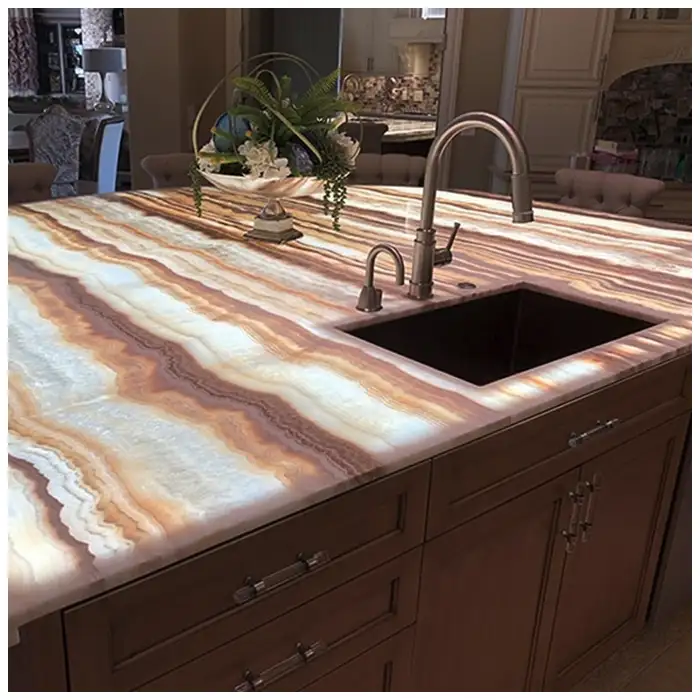
Switch off the warehouse lamps and place a broad light behind a pale onyx face. The cream field opens into amber water, fine bands become suspended lines, and a cloudy zone that looked flat gains depth. Then a resin patch appears. I never approve onyx slabs from reflected light alone.
I judge each face twice: once with light falling onto it, then again with light passing through it. The unlit view controls the stone when the lighting system is off. Transmission reveals hidden density, repairs, backing, and the way joints or supports may become visible.
What Onyx Slabs Are in Architectural Stone Work
The word onyx can cause confusion. The gemological material described in the English 오닉스 entry is a banded form of chalcedony. Much architectural stone sold as onyx is a softer, translucent calcite or aragonite-rich decorative stone formed by mineral deposition. That distinction matters for fabrication and care.

I do not use the name to promise performance. I ask for source information, physical characteristics relevant to the project, actual slab condition, treatment, and fabricator assessment. Calcite-rich material can react with acidic liquids and needs use-specific cleaning guidance.
The permanent comparison Natural Quartzite vs Marble-Look Sintered Stone: The Definitive Comparison for Premium Interiors explains why real mineral depth differs from a printed manufactured pattern. Onyx makes that difference obvious because transmitted light moves through the material rather than stopping at the surface image.
The color is a geological record, not a paint code
Layers form as mineral-rich water deposits material over time. Changes in chemistry, inclusions, voids, and growth conditions create bands, clouds, crystalline passages, and color shifts. Natural onyx translucency follows those differences unevenly.
A 바닐라 오닉스 석판 may hold soft cream bands that glow honey-gold under warm light. In the unlit room, the same face can read cooler and quieter. I want both states accepted because a lighting circuit will not remain on every hour.
Read Every Full Face in Reflected and Transmitted Light
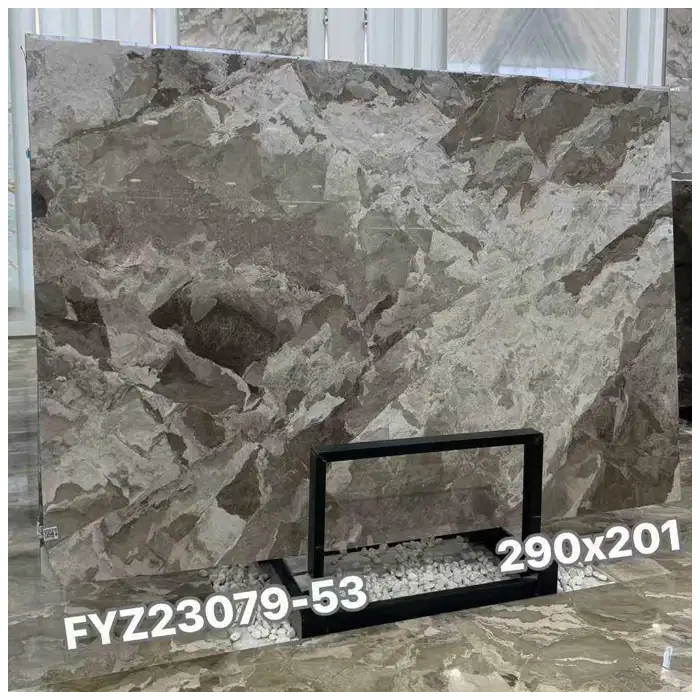
I start with a square, color-managed full-face photograph that shows the slab ID and scale. Then I make a transmitted-light map. A small lamp behind one corner can exaggerate beauty and hide dark zones; a broad, controlled source gives a more honest reading.
The backlit onyx selection file marks bright fields, dense passages, fissures, repairs, mesh, resin changes, edge zones, and any feature that may interfere with the proposed crop. A slow video helps because the eye catches brightness transitions that a single exposure compresses.
The How Lighting Changes Colorful Marble, Quartzite, and Onyx Slabs provides a wider method for colorful stone. For this material, I add one fixed camera position with the light off, reflected light on, and transmitted light on. Those three states belong together.
| Review layer | What I record | Why it changes the design | Reason to pause |
|---|---|---|---|
| Unlit full face | Background, bands, repairs, finish, natural fissures | The room still needs a resolved surface when backlight is off | Material only works in one dramatic photograph |
| Transmitted-light map | Bright, medium, dense, and opaque zones | Determines crop, diffuser, source spacing, and joint visibility | Hot spots or dark islands break the composition |
| Treatment map | Resin, mesh, patches, filled openings | Treatment can change color and light transmission | Repair flashes or creates a hard-edged shadow |
| Thickness map | Measured points and local transitions | Transmission and fabrication may change across the face | Unexplained variation affects panels or edges |
| Layout overlay | Panel joints, cuts, openings, returns, bookmatch | Places visual movement and technical interfaces | A joint cuts the main cloud or vein without intent |
| Edge and support trial | Profile, polish, backing termination, bearing | Close views reveal construction and color depth | Edge looks unrelated or support telegraphs through light |
| Service plan | Diffuser access, ventilation, cleaning, replacement | The assembly must remain maintainable | Stone has to be destroyed to reach the lighting system |
The dark zone belongs on the drawing before the light box is built
Place the architectural elevation over the transmitted-light map, not over the most flattering front photograph. A dense mineral passage may be beautiful as an anchor near the edge and distracting across the center of a reception wall. Mark the joints, service openings, supports, and dominant sightlines. Then decide whether the dark passage is composition, shadow, or a reason to choose another face.
Approve the complete light map and crop together; never design the panel from one glowing corner.
Choose a Color Family without Losing the Individual Face
White, vanilla, green, pink, orange, blue, black, and rainbow descriptions help organize stock. They do not replace slab selection. Two green faces can differ in cloud scale, white calcite passages, rusty inclusions, transparency, and the strength of their dark lines.
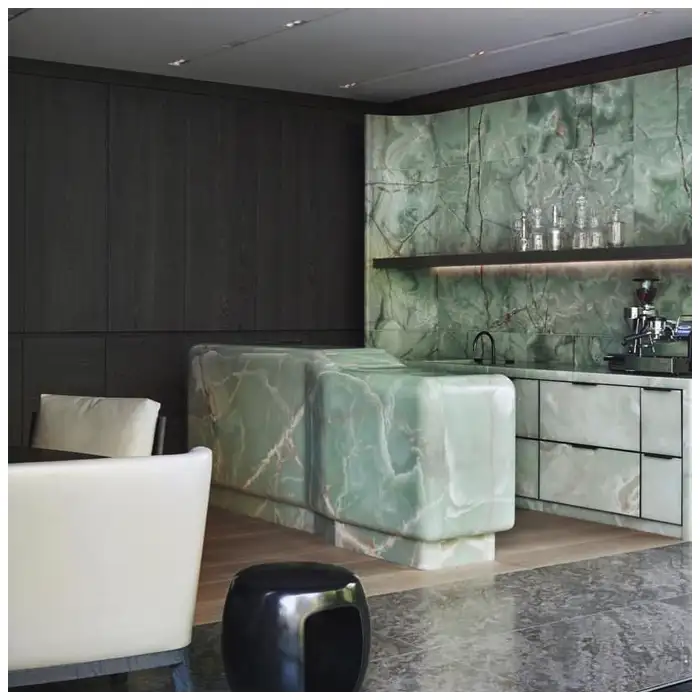
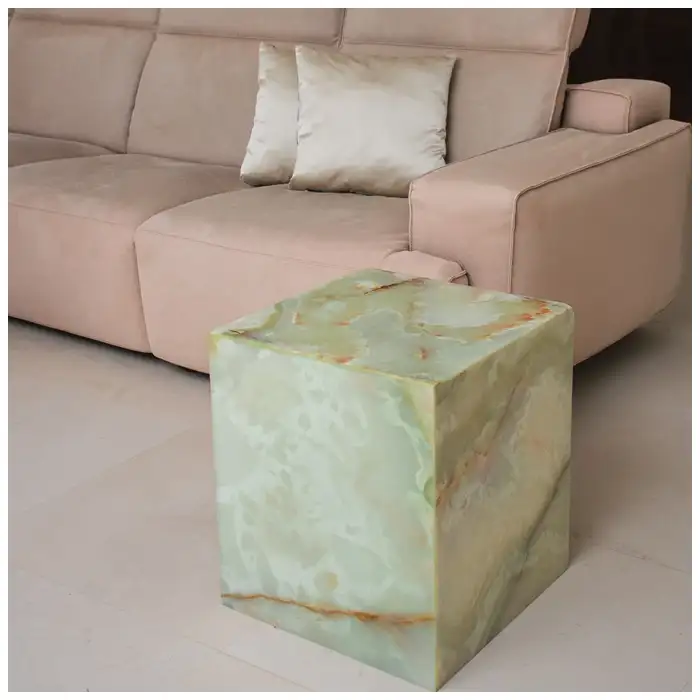
A 그린 오닉스 face can resemble mineral clouds seen through shallow water. I place the room’s stone, metal, timber, and upholstery samples beside it in both light modes. The green may cool sharply under one source and become yellow-green under another.
Approval of onyx slabs is therefore face-specific. The project record must identify the exact slabs, intended orientation, finish, and accepted color response.
True luxury survives the light switching off
I avoid choosing a face that depends entirely on backlight. When the source is off, the stone should still carry proportion, movement, and surface quality. True luxury is something you never get tired of looking at, including the quiet hours.
A Snow White Onyx can offer pale crystalline depth, but a fully white expectation is dangerous. Mineral bands and cloudy density are part of the material. The full face sets the honest range.
Green stone needs a closer reading because one face may move from pale celadon to olive as the source changes. Following Green Onyx Slab Selection from Quiet Stone to Backlit Wall follows that shift through full-face color, crop, edge detail, room scale, and the final lit assembly.
BODY PARAGRAPH B
Insert after the fabrication paragraph under “Map Thickness, Resin, Mesh, and Natural Fissures”.
The reverse side deserves its own record before any cutting line is accepted. Reading Onyx Slab Resin and Fiberglass Backing before Cutting examines how mesh termination, resin-rich areas, adhesive contact, cutouts, and exposed edges can alter the daytime face and the transmitted image.
RELATED PROJECT GUIDES
Replace the entire existing Related Project Guides section with this code.
Map Thickness, Resin, Mesh, and Natural Fissures
Thickness changes light transmission, weight, edge proportion, and fabrication. I measure the actual face and record local treatment. A nominal figure does not tell me where resin has pooled, where mesh ends, or where a crystalline opening intersects a cutout.
Onyx slab fabrication starts with that reverse-side evidence. The fabricator determines cutting, reinforcement, backing, adhesives, edge work, handling, and support for the selected material and application. I do not transfer a method from quartzite or ordinary marble.
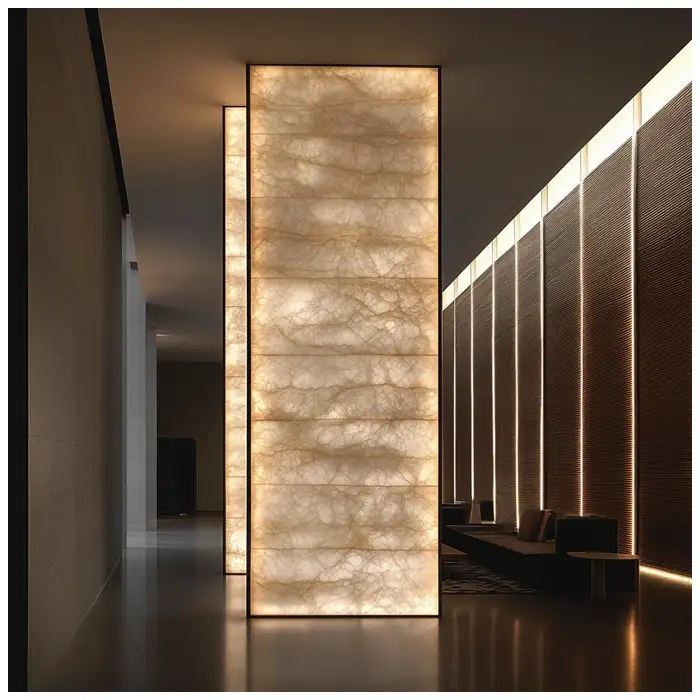
The surface and reverse should be photographed before cutting. Under transmitted light, some resin-filled areas become warmer or more opaque. A fiberglass grid can become visible if the diffuser and source are too close or if the stone is especially translucent.
Plan Bookmatching, Joints, and Openings on the Light Map
Bookmatching can turn bands into wings, clouds, waves, or a central mineral spine. The mirrored relationship must be judged in the lit and unlit states. One half may transmit more strongly even when the veins align.
The Onyx Wall Panels: What to Confirm Before a Backlit Feature Wall Order carries this into a wall assembly. It covers panel dimensions, diffuser, supports, joints, service access, and the evidence needed before an order is released.
A 레인보우 오닉스 석판 may contain several color bands that compete for the center. I often prefer an off-center crop that lets the strongest passage enter the composition rather than splitting it mechanically at a bookmatch line.
Joint placement changes light before it changes pattern
A physical joint can create a dark line, a bright gap, or a change in diffusion. I mock up the complete layer stack, including stone, backing, adhesive where relevant, joint treatment, support, cavity, diffuser, source, and viewing distance.
The veins will tell you where the composition wants to turn. The assembly tells you where it can. Good work happens when those two answers meet before cutting.
Match Applications to Touch, Light, and Maintenance
Feature walls allow broad transmitted compositions and limited touch. Bars and counters put joints, edges, liquids, and cleaning close to the user. Tables add hand contact, base support, moving light, and transport. Fireplace surrounds introduce project-specific heat and assembly questions that need responsible technical review.
Onyx slabs should not be treated as universal worktops. The selected use, expected liquids, maintenance, edge exposure, support, and repair tolerance decide whether the material belongs there.
The Semi Precious Stone Slabs and Onyx Wall Panels: How I Compare Light, Color, and Depth helps compare onyx with agate and other translucent decorative materials. I use it when the design wants depth but has not yet decided which mineral family provides the right scale and character.
Approve Lighting, Support, and Service as One Assembly
The light source, diffuser, cavity depth, stone transmission, support shadow, ventilation, controls, electrical access, and replacement route need a full mock-up. The stone supplier cannot decide the electrical system alone; the lighting designer and responsible trades must participate.
I view the mock-up from the nearest and farthest normal positions. At close range I inspect pixels, supports, resin, joints, scratches, and edge polish. From farther away I judge brightness balance, composition, and whether the wall becomes a luminous sign rather than stone.
Natural Quartzite vs Marble-Look Sintered Stone: The Definitive Comparison for Premium Interiors keeps the material choice grounded. A manufactured panel can offer repeatable printing and controlled format. Natural onyx offers real depth, but it asks the project to accept and manage individual geology.
When Lit Onyx Does Not Match the Approved Mock-Up
First, photograph the entire assembly in lit and unlit states with exposure held consistent. Second, stop further panel installation, lighting adjustment, or surface treatment in the affected zone. Third, compare slab IDs, transmitted-light maps, thickness, backing, diffuser, source spacing, controls, and mock-up records with the stone and lighting teams.
A correction may involve controls, diffusion, source layout, cleaning, surface work, reassignment, or panel replacement. I do not choose before the evidence shows whether the difference comes from stone, treatment, fabrication, assembly, or light.
Keep Transmitted-Light Evidence beside the Slab Map
I record natural onyx translucency as a range across the numbered face, not as one bright close-up. Dense bands and pale clouds need equal representation in the project file.
을 위한 backlit onyx selection, I compare the complete lit arrangement with the unlit face. The composition must remain intentional when controls dim or the source is switched off.
Before onyx slab fabrication, I place cut lines, joints, openings, and supports over the transmission map. This prevents a dark structural shadow from crossing the visual center by accident.
Frequently Asked Questions
1. What are architectural onyx slabs made from?
Many decorative stones sold as architectural onyx are translucent calcite- or aragonite-rich materials formed by mineral deposition. They differ from the silicate gemstone definition of onyx, so identify the actual stone and assess it for the intended use.
2. Can all onyx slabs be backlit?
No. Transmission varies across and between faces. Dense zones, thickness, resin, repairs, backing, mesh, supports, and the lighting assembly can limit or change the effect. Test the exact full face and proposed build-up.
3. What photographs are needed before buying onyx?
Request labeled full-face views in reflected light, broad transmitted-light maps, close views of fissures and repairs, reverse-side treatment, thickness measurements, edge trials, and layout overlays for the proposed application.
4. How should onyx slabs be selected for a backlit wall?
Approve the unlit face, transmitted-light map, panel crop, bookmatch, joints, thickness, resin, backing, edge, support shadow, diffuser, source spacing, controls, service access, and the complete physical mock-up.
5. What should happen first if installed onyx shows hot spots or dark bands?
Photograph the full wall in lit and unlit states, stop further installation or adjustment, and compare slab maps, treatment, thickness, diffuser, supports, source layout, controls, and mock-up evidence before selecting a correction.
Quick-Reference Onyx Slab Approval Checklist
- Photograph every numbered face in reflected light and with a broad transmitted-light source.
- Map bright, medium, dense, repaired, resin-treated, backed, and fissured zones.
- Overlay joints, bookmatches, openings, returns, supports, and visible edges on the light map.
- Measure thickness and produce a representative edge and treatment trial.
- Build the stone, joint, backing, diffuser, source, support, and controls into one mock-up.
- Approve the material when lighting is on and off from normal viewing distances.
- Record cleaning, service access, replacement logic, and retained reference pieces.
Final Conclusion
Onyx slabs reveal their real character through two complete views: the mineral face in ordinary light and the hidden structure under transmission. Select exact slabs, map treatment and density, plan the crop, and prove the whole lit assembly before fabrication.
MQ STONE keeps the light map beside the slab map because this stone has waited for millions of years, and one bright photograph should not decide its future.

References
- Dimension Stone Design Manual, Natural Stone Institute.
- Natural Stone Institute Technical Bulletins for Translucent Stone, Natural Stone Institute.
- ASTM C97 Standard Test Methods for Absorption and Bulk Specific Gravity of Dimension Stone, ASTM International.
- ASTM C880 Standard Test Method for Flexural Strength of Dimension Stone, ASTM International.
- IES Lighting Handbook, Illuminating Engineering Society.
- Stone Conservation: Principles and Practice, Getty Conservation Institute.
- Search Essentials: Creating Helpful, Reliable, People-First Content, Google Search Central.