Natural Stone Dining Table: Materials, Thickness, Edge and Base Support
I first touched a pale quartzite table slab in a fabricator’s yard just after sunrise. The surface felt cool, but a low beam entered the edge and woke a network of fine crystals beneath the polish. The pattern did not sit on top like ink. It seemed to continue inward. This stone has been waiting for millions of years… and that morning it was waiting for someone to choose where the dining-table edge should pass.

The architect wanted a thin floating top. I wanted the veins kept whole. The furniture engineer wanted a wider support frame. The veins will tell you… They show where the visual center lives, but they do not calculate a safe span. True luxury is something you never get tired of looking at, and a lasting table needs beauty and structure to agree.
Choose the Stone Dining Table Material by Body, Not Photograph
A stone dining table can be marble, quartzite, onyx, granite, or another natural material, but the name alone does not define performance. I examine mineral structure, fissures, resin or backing observations, thickness availability, finish, edge treatment, and the support proposed for the actual top.
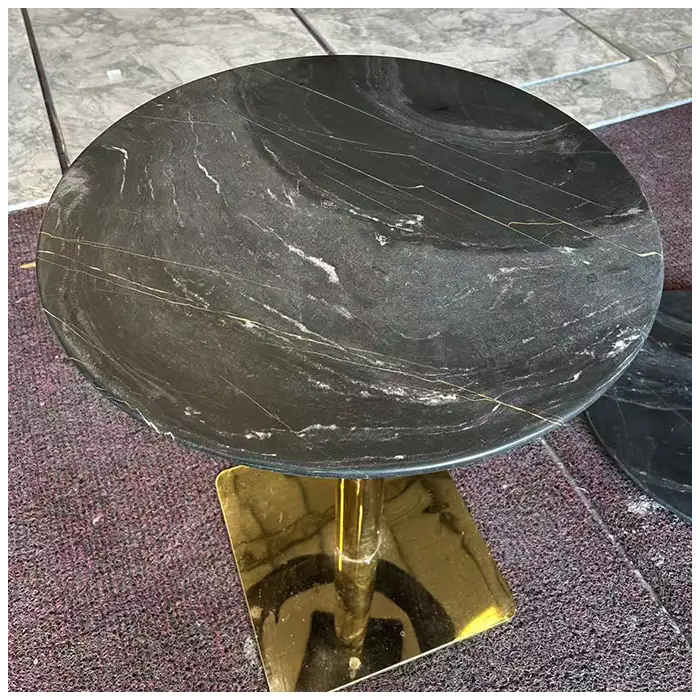
The round marble dining table shows how a circular cut changes vein composition. Long movement becomes an arc, and the edge reveals a continuous band around the room. Marble offers a soft mineral depth, yet it also asks the owner to accept etching and patina according to use.
Quartzite can carry interlocking quartz crystals formed through heat and pressure. Under raking light, those crystals can flash like frost beneath water. The veins will tell you… They suggest how to orient the top, while testing and professional fabrication determine whether the chosen face suits the design.
Read a Natural Stone Table Top at Full Scale
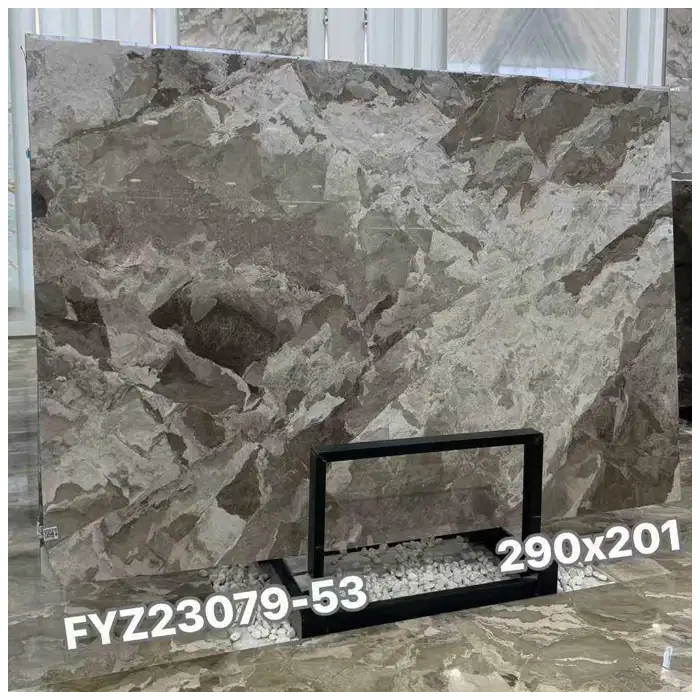
A natural stone table top must be selected from the full slab or mapped block faces. I mark chair sightlines, the main approach, place settings, and the likely center of the room. One dense vein may belong at an end, across the center, or outside the cut entirely.
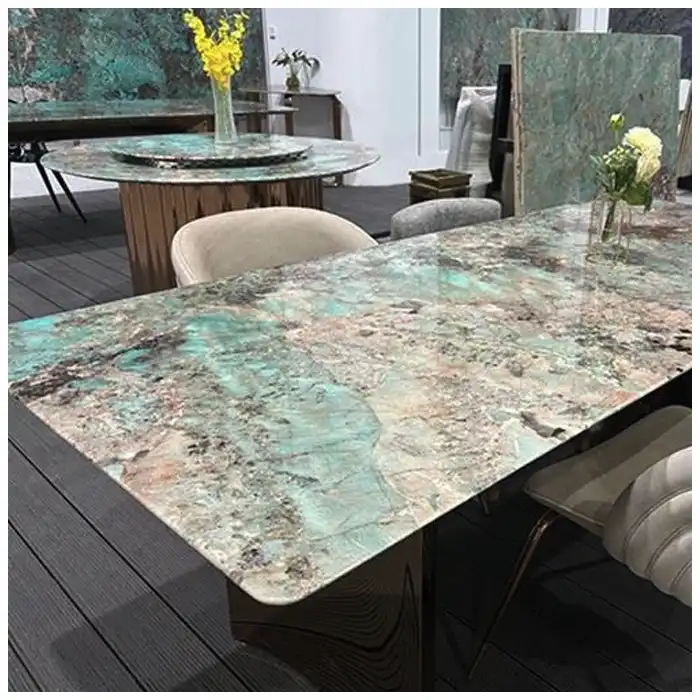
An Aqua Vulcan quartzite table can carry blue-green depth and mineral turbulence that changes with angle. In quiet light it may read like dark water. Under a pendant, small crystalline planes answer one by one.
This stone has been waiting for millions of years… I do not reduce that history to a thumbnail. We photograph the whole face, overlay the finished shape, and inspect the edge path before cutting.
Coordinate Stone Table Thickness and Edge Expression
Stone table thickness is both real and perceived. A solid edge shows the true body. A built-up or mitered edge may create a deeper visual band, but the fabrication, internal support, joints, and handling method must be designed for the selected material.
I run my hand along the edge. A small easing can feel calmer than a sharp arris, especially at chair positions. A rounded profile catches light gradually and reveals mineral depth; a crisp edge makes pattern transitions more graphic.
The 럭셔리 대리석 스톤 테이블 is not made more meaningful by thickness alone. True luxury is something you never get tired of looking at. Proportion should follow the top size, base, room, and material character.
Design Dining Table Base Support Around the Actual Top
Dining table base support controls bearing, span, cantilever, overturning stability, and how people place their knees and chairs. I give the engineer or responsible fabricator the top dimensions, material, thickness, cutouts, estimated mass, edge build-up, and intended use.
A small pedestal can make stone appear weightless, but the hidden frame may need a much larger footprint. I do not publish universal cantilever numbers because natural variation, top geometry, support stiffness, connections, and testing change the answer.
The existing Luxury Stone Table Tops: Color, Edge, Light, and Base Details Before Production keeps visual and structural decisions in the same conversation. Beauty suffers when a table rocks or flexes.
I also compare the selected face with Custom Stone Furniture: What Marble Dining Table Photos and Edges Reveal Before Production before the final cut fixes the edge path.
Choose Finish for Touch, Patina and Dining Use
A dining table is touched more than a wall. Hands rest on the edge, plates slide, glasses leave rings, and light travels across the face at a low angle. I compare polished, honed, and textured samples with the actual stone because finish changes color depth and the way small marks appear.
Marble owners need to understand etching and patina. Sealer can help manage staining, but it does not make calcite immune to acidic food. Quartzite needs correct identification and stone-specific care rather than assumptions based on a commercial label. Onyx asks for even more deliberate protection and support.
I do not turn those facts into fear. A table can age beautifully when the project chooses the material with open eyes. The first faint mark on a well-used honed top may become part of its life; the same mark on a client expecting a mirror-perfect surface may become a dispute.
Prototype the Table Under the Room Light
I place the selected edge, base finish, chair material, and lamp condition together. A blue quartzite may become almost black under weak warm light, while a pale crystal band suddenly catches a narrow beam. Onyx can reveal clouds and layers only when the light reaches the body at the right angle.
The prototype also tests human scale. I sit at the table, cross my legs, touch the underside, pull a chair, reach toward the center, and place weight where a diner naturally leans. An elegant photograph cannot tell me whether the apron presses a knee or the edge feels harsh.
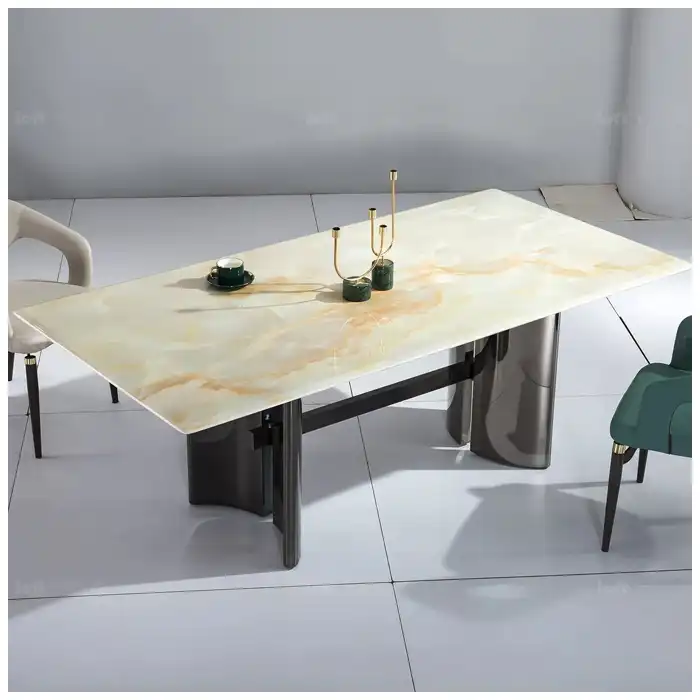
The 마노 테이블 탑 offers another kind of mineral composition, assembled from translucent sections rather than one quarried slab face. Its optical depth, resin system, support, edge, and lighting need product-specific coordination.
The veins will tell you where the eye wants to travel. The prototype tells you whether the body can live with that decision every day.
I photograph that prototype from every principal seat. A composition balanced from the entrance may place one dense mineral band directly in front of a diner. There is no wrong answer, but the choice should be conscious.
Curated Table for Material and Furniture Decisions
| Material character | Visual reading | Edge question | Support conversation |
|---|---|---|---|
| 마블 | Soft calcite depth and veining | Patina, touch, visible movement | Protect spans and handling |
| 규암 | Crystalline body and nonrepeating flow | Crystal reveal and arris detail | Use actual slab and geometry |
| 오닉스 | Layered translucency and glow | Light path through the edge | Engineer backing and support |
| Semi-precious | Mineral fragments and optical depth | Joint and resin expression | Coordinate system-specific construction |
The Hard-Won Lesson: The Beautiful Base Was Too Small for the Real Top
A dining-table concept used a narrow sculptural pedestal beneath a long quartzite top. The rendering looked balanced, but the first physical assembly showed uncomfortable movement at the ends and poor resistance to someone leaning on a corner. The team widened the concealed support frame, adjusted the base connection, and kept the visible pedestal proportion. The stone did not need to become visually heavy; the hidden structure needed to become honest.
The Lesson: Engineer the support around the actual slab, geometry, connections, and use before approving the visible base.
Understanding Natural Stone Tables in Today’s Design Market
Why does real stone feel different from a printed surface?
Minerals occupy a three-dimensional body. Veins cross the edge, crystals respond at different angles, and no second slab repeats the same history. Manufactured surfaces may offer controlled patterns and declared properties, but their visual structure comes from a designed process.

How should a designer choose between materials?
Start with the room, use, desired patina, light, top geometry, support, and willingness to select an individual face. I compare actual samples and slabs rather than arguing from names alone.
What if the assembled table moves or the top shows distress?
Photograph the full table, underside support, connection points, level condition, and close issue. Stop use and adjustment. Contact the supplier or responsible fabricator with the approved slab, shop drawings, support design, and inspection records.
The broader comparison belongs in Natural Quartzite vs Marble-Look Sintered Stone: The Definitive Comparison for Premium Interiors. Material authenticity and engineered predictability create different design values.
Frequently Asked Questions
1. What is the best material for a stone dining table?
There is no universal winner. Compare the actual slab, expected use, maintenance, desired patina, edge, size, support, light, and fabrication guidance. Marble, quartzite, onyx, and other stones create different visual and practical relationships.
2. How thick should a natural stone table top be?
Thickness depends on material, dimensions, support system, edge design, connections, handling, and engineering. A deeper-looking mitered edge is not the same as a uniformly solid top. Use project-specific professional design.
3. Can a stone table have one central pedestal?
It can when the complete base, hidden frame, connection, top, stability, and intended loads are designed together. The visible pedestal size alone does not prove adequate support.
4. Should veins run along or across the table?
Either may work. I place the full shape on the slab and judge the main approach, seating views, edge path, joints, and room axis. The chosen direction should feel intentional.
5. What should I do first if a stone table rocks or shows a crack?
Photograph the whole table, floor contact, underside, supports, connections, and close issue; stop use or adjustment; then contact the supplier or responsible fabricator with original drawings and inspection records.
Quick-Reference Checklist for a Natural Stone Table
- Select the complete numbered slab before fixing the cut.
- Overlay the finished shape and principal sightlines.
- Coordinate real thickness, edge build-up, and underside.
- Give the support designer actual top data and intended use.
- Test chair, knee, and corner-loading conditions physically.
- Photograph the finished top and support before handover.
Final Conclusion
A natural table succeeds when the stone is allowed to remain itself and the structure quietly does its work. I choose the face at full scale, trace the edge through its mineral movement, and ask the base to support the real object rather than the rendering.
The stone dining table becomes lasting furniture when material, thickness, edge, light, and support agree. This stone has been waiting for millions of years… the veins will tell you where to begin, and true luxury is something you never get tired of looking at; that is the patience I bring to every MQ STONE table decision.

References
- Dimension Stone Design Manual, Natural Stone Institute.
- Natural Stone Care and Cleaning Guidance, Natural Stone Institute.
- ASTM C170 Standard Test Method for Compressive Strength of Dimension Stone, ASTM International.
- ASTM C880 Standard Test Method for Flexural Strength of Dimension Stone, ASTM International.
- ASTM C97 Standard Test Methods for Absorption and Bulk Specific Gravity of Dimension Stone, ASTM International.
- Natural Stone Technical Guidance, Stone Federation Great Britain.
- ASTM C1242 Standard Guide for Selection, Design, and Installation of Dimension Stone Attachment Systems, ASTM International.
- ANSI/BIFMA X5.5 Desk and Table Products, Business and Institutional Furniture Manufacturers Association.