Sintered Stone Dining Table vs Natural Quartzite Table
I remember a designer placing a pale sintered sample on top of a Cristallo quartzite slab. The sample was even and precise. Beneath it, light entered the quartzite edge and caught tiny interlocking crystals, as if frost had formed inside clear water. This stone has been waiting for millions of years… and no printed repeat could reproduce that exact moment.
I did not tell her one material was automatically right. The veins will tell you… They reveal what natural stone offers, while the technical literature tells you what the manufactured surface is designed to do. True luxury is something you never get tired of looking at, and sometimes control serves the room better than rarity.
What a Sintered Stone Dining Table Offers
The manufactured table begins with a specified slab system. Color, pattern, thickness options, surface finish, UV statements, fabrication, edge treatment, support, and warranty conditions belong to the selected manufacturer’s documents. I do not transfer claims from one brand to another.
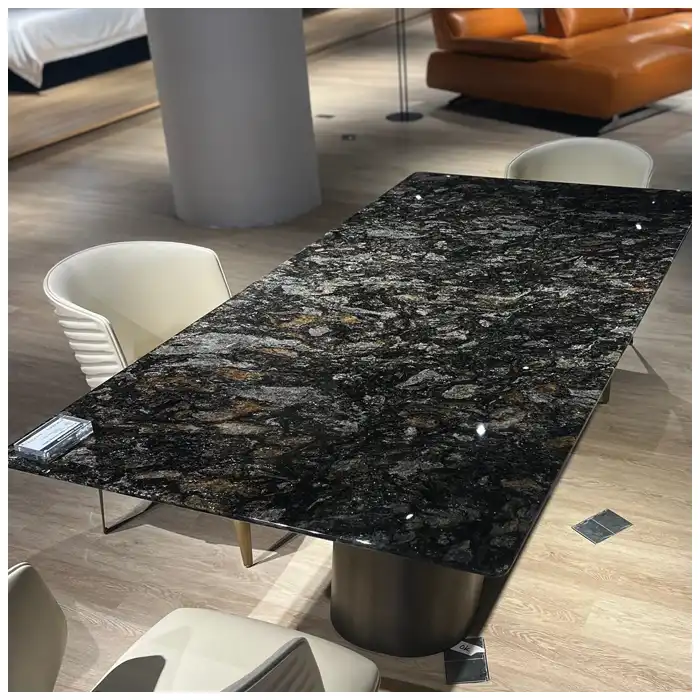
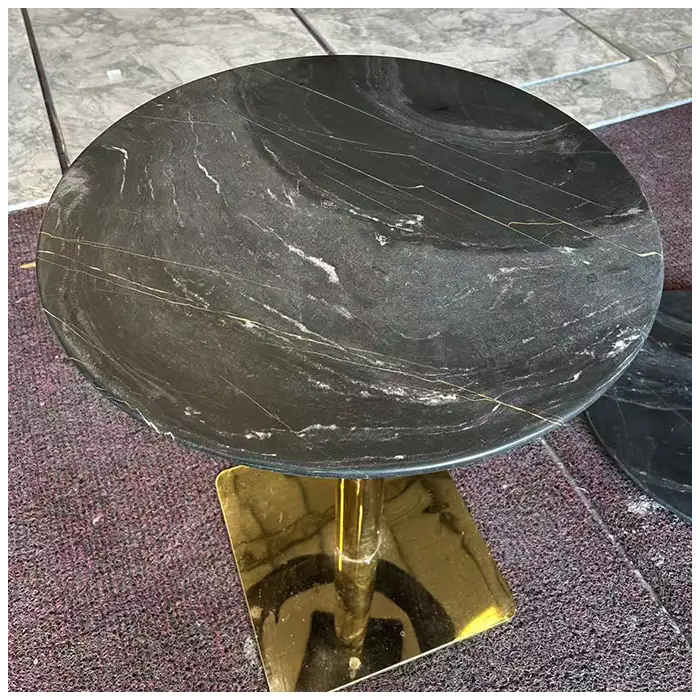
The black sintered stone dining table shows how a controlled dark face can support a graphic furniture concept. The designer should inspect the edge and any miter because the face pattern may not continue through the body like a natural vein.
Repetition helps when a restaurant or coordinated development needs many related tables. Yet repeatability is not geological depth. It is a different design promise.
How a Natural Quartzite Table Holds Light
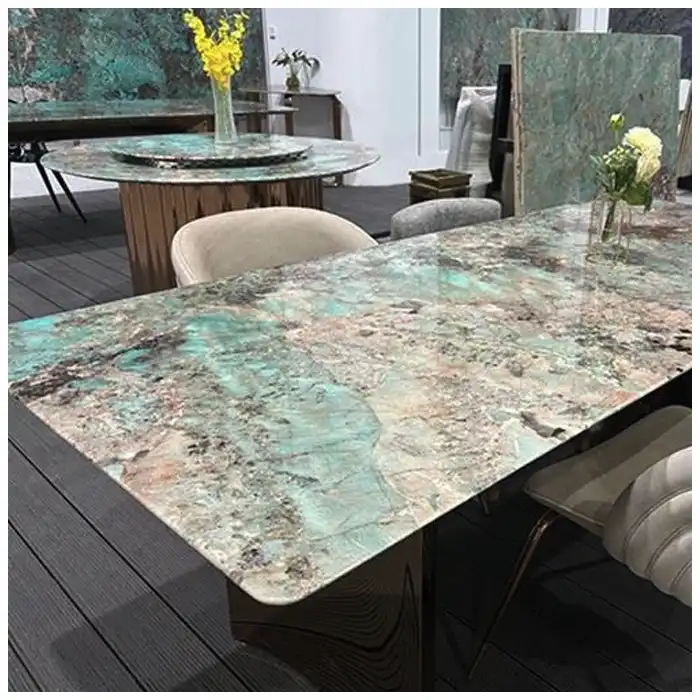
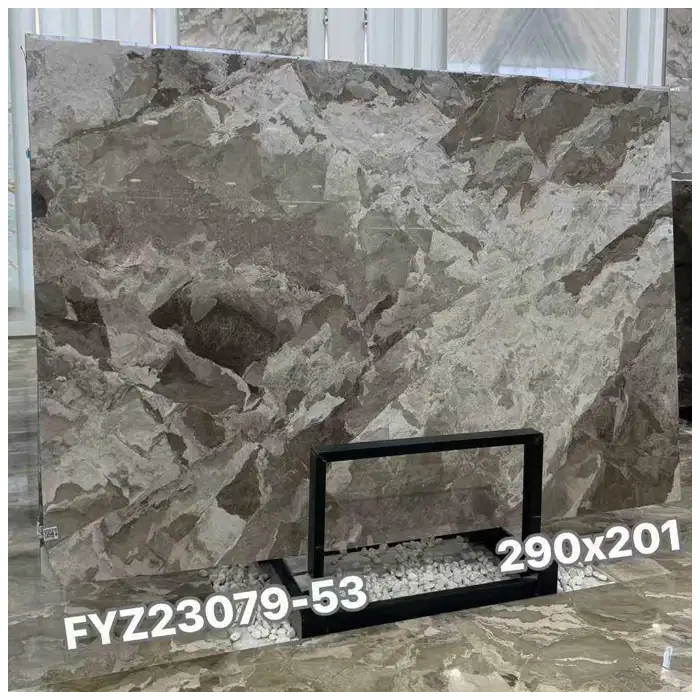
A natural quartzite table comes from sandstone transformed by heat and pressure until quartz grains recrystallize into an interlocking body. Mineral impurities and deformation create veins, color bands, and clouds that travel through the slab.
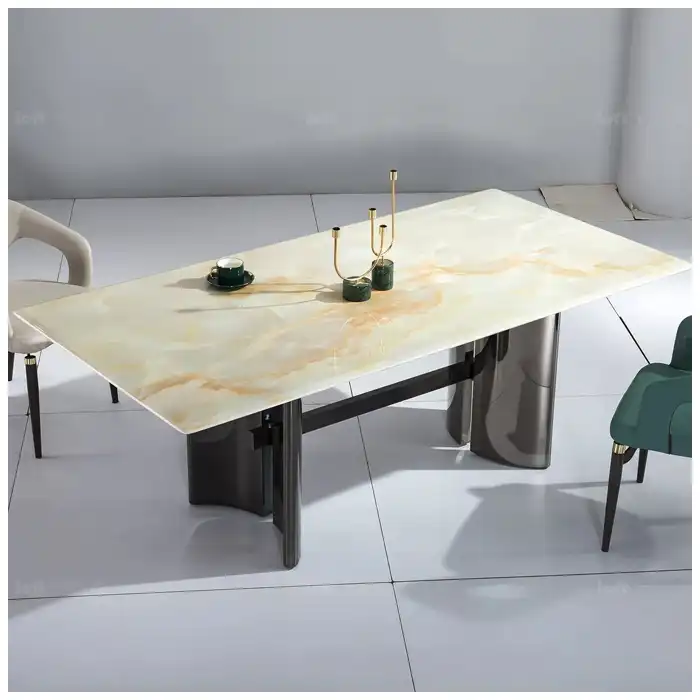
The Dover White quartzite table may appear calm from across the room, then reveal fine crystalline movement under a low pendant. The surface is not merely white with lines; it is a mineral field with changing optical response.
This stone has been waiting for millions of years… Selection therefore matters. Two slabs of the same commercial name can create different tables, and that individuality is often the point.
Compare Edges, Pattern and Repair Expectations
Marble-look sintered stone may carry a designed vein on the face. At cut edges or miters, alignment depends on pattern placement and fabrication. Natural quartzite reveals its real body at the edge, though each slab also carries features that require professional inspection.
The veins will tell you… They indicate where a natural edge should pass. With a manufactured face, I map the print, joints, and edge build-up. Neither material benefits from careless cutting.
Repair and replacement are different too. A manufactured pattern may be reordered if still available, but batch and product changes can occur. Natural replacement requires a compatible new slab; exact repetition is impossible. The project should decide whether continuity or individuality carries more value.
Coordinate Support with the Selected Material System
Both options need a base and support designed around actual dimensions, thickness, connections, mass, edge build-up, and use. Thin appearance does not remove structural responsibility.
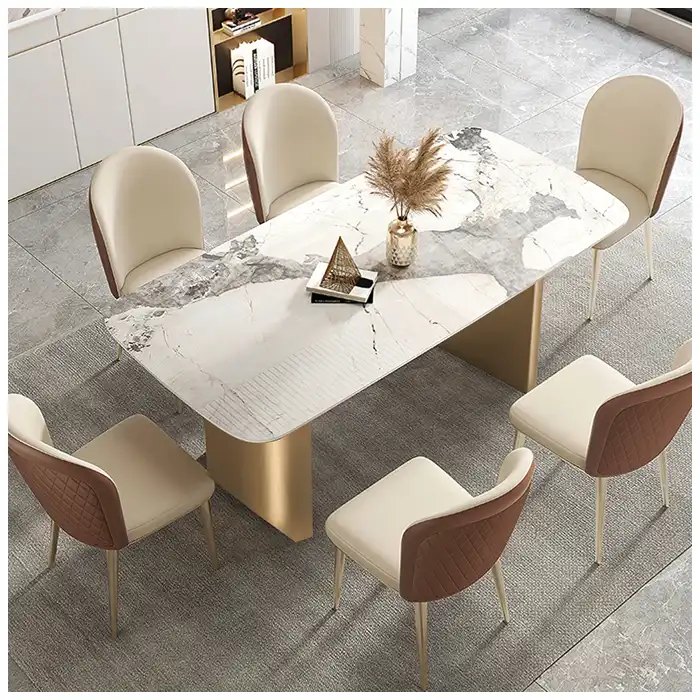
The Calacatta white sintered stone dining table needs fabrication and support that follow its selected system. A quartzite top needs stone-specific inspection and professional design. I do not use one hidden frame rule for both.
The full argument sits in Natural Quartzite vs Marble-Look Sintered Stone: The Definitive Comparison for Premium Interiors. True luxury is something you never get tired of looking at; it can include restraint, honesty, and a material chosen for the right reason.
I use Stone Table Supplier Guide for Marble Dining Tables, Coffee Tables, and Custom Bases to carry that material choice into a physical edge, base, and approval sequence.
Compare Outdoor Light, UV Exposure and Product Declarations
A table near full-height glazing receives a different light cycle from one deep inside a restaurant. Natural quartzite generally carries mineral color through its body, but specific stones can still change in appearance through weathering, surface treatments, resins, or contamination. The project must assess the actual material and exposure.
For sintered surfaces, I read the selected manufacturer’s current declarations about UV, thermal behavior, stain resistance, cleaning, edge fabrication, and exterior suitability. I do not borrow one brand’s claims for another slab. A product name and thickness belong in the specification.
Direct sun also changes visual judgment. A high-contrast print may read flatter in hard daylight, while quartz crystals produce small shifting flashes. At night, the same top may become a quiet silhouette. I approve the table in the light cycle the room will actually experience.
Plan Maintenance and Replacement Honestly
A manufactured top can offer a defined cleaning system and repeated visual language, but later replacement depends on product continuity and batch availability. I retain the product code, color, finish, thickness, fabrication drawing, and a representative sample.
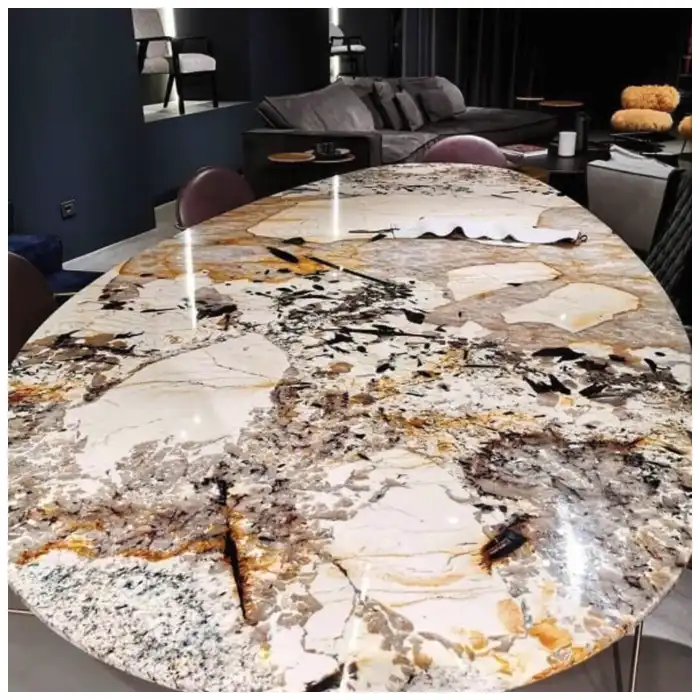
A natural top cannot be duplicated exactly. For a major project, a compatible spare slab or offcut may help with future repairs, though storage and identification must be planned. The difference is philosophical as well as practical: replacement aims for visual compatibility, not repetition.
The Taj Mahal quartzite shows how a calm natural palette can remain individual. Fine beige-gold movement drifts through a crystalline body without becoming a repeating graphic. This stone has been waiting for millions of years… a spare from the same group may echo it, never clone it.
Use a Full-Scale Edge and Corner Mock-Up
I ask to see the face, long edge, corner, underside transition, and base connection together. Sintered material may need a miter strategy that keeps the designed face believable. Quartzite needs an edge chosen from the actual mapped slab so a dark band or fissure does not surprise the furniture team.
At the corner, touch matters. A mathematically sharp line can feel unfriendly. A small easing may protect use without weakening the visual precision. The chosen detail belongs in a physical sample and drawing.
True luxury is something you never get tired of looking at. It is also something you do not regret touching.
Decide What the Project Means by Consistency
Consistency can mean identical tables, a related family, or one focal object surrounded by quieter companions. Sintered material can support controlled repetition when the same product and layout remain available. Natural quartzite can support a family through related color and scale while allowing every top to be individual.
I ask the designer to write that intention. Without it, one person may reject natural variation while another expects it. The approval set then includes either a pattern-placement standard or numbered full-slab maps.
For a restaurant, table replacement may matter more than singularity. For a private dining room, the irreplaceable slab may be the reason the table exists. Neither priority is shallow. Problems begin when the team says “luxury” without defining what it values.
The veins will tell you how far natural relationships can be carried across several tops. They will never promise copies.
That honest difference belongs in the design brief from the start.
Luxury stone furniture succeeds when material truth, edge construction, support, and room light agree. I use the full-scale mock-up to settle that relationship.
I judge luxury stone furniture again from seated height, where the edge and underside matter more than the overhead rendering. The body must reward close attention.
Comparison Table for Dining Table Decisions
| Decision | Sintered surface | Natural quartzite | Verify before release |
|---|---|---|---|
| 패턴 | Designed and controlled | Unique mineral movement | Full slab and finished shape |
| Edge | System and print alignment | Real body and vein crossing | Physical edge sample |
| Light | Surface reflection | Crystal and mineral depth | Room-relevant lamp |
| Replacement | Depends on product continuity | Requires compatible new face | Spare or future strategy |
The Hard-Won Lesson: The Edge Revealed the Difference the Rendering Hid
A flagship table rendering used a marble-look face with a deep waterfall edge. When the first mitered sample arrived, the printed vein stopped awkwardly and the edge read as a constructed box. A natural quartzite sample beside it carried mineral movement through the cut. The team redesigned the sintered edge for honesty and selected quartzite for the single focal table.
The Lesson: Approve a physical edge and full-size pattern layout before choosing a surface from the face image alone.
Understanding Natural and Manufactured Table Surfaces in Today’s Design Market
Is natural always more luxurious?
Not automatically. Rarity cannot rescue poor selection, weak support, or the wrong room. Natural stone offers individual mineral depth; manufactured surfaces offer designed control. Value comes from using each truthfully.
Which works better for repeated furniture?
A controlled surface may simplify repetition, while natural stone creates individual pieces. The choice depends on the project concept, product data, maintenance, replacement plan, and willingness to approve each face.
What if the delivered table differs from the approved sample?
Photograph the full top, edge, underside, label, and close difference under agreed light. Stop assembly or use. Contact the supplier with the approved sample, slab or pattern layout, drawings, and inspection record.
I return to Natural Quartzite vs Marble-Look Sintered Stone: The Definitive Comparison for Premium Interiors because the difference is not a slogan. It appears in body, edge, light, repeat, and time.
Frequently Asked Questions
1. Is a sintered stone dining table better than natural quartzite?
Neither is universally better. Compare controlled repetition, mineral individuality, edge design, product-specific technical data, UV exposure, support, maintenance, replacement strategy, and the room’s design intention.
2. Does sintered stone veining continue through the edge?
It depends on the selected product and edge construction. Many marble-look patterns are concentrated on the face, so inspect a physical edge or mitered sample and map pattern placement before fabrication.
3. Why does quartzite show more depth under light?
Quartzite contains interlocking mineral crystals and natural features within a three-dimensional body. Their orientation and composition respond differently as light and viewing angle change.
4. Can both materials use the same table base?
Do not assume so. Actual top dimensions, thickness, mass, edge build-up, material system, connections, stiffness, stability, and use must inform project-specific support design.
5. What should I do if the finished edge differs from approval?
Photograph the complete table, edge path, underside, and close difference under agreed light; stop assembly or use; then contact the supplier with the sample, layout, drawings, and inspection record.
Final Conclusion
I do not ask a manufactured surface to pretend it is geology, and I do not ask a rare slab to behave like a repeated pattern. I study the face, edge, light, support, and future use, then choose the truth the room needs.
A sintered stone dining table offers control; quartzite offers an unrepeatable mineral body. This stone has been waiting for millions of years… the veins will tell you what cannot be printed, and true luxury is something you never get tired of looking at; MQ STONE keeps that distinction visible without turning it into a sales slogan.

References
- Dimension Stone Design Manual, Natural Stone Institute.
- Natural Stone Care and Cleaning Guidance, Natural Stone Institute.
- ASTM C170 Standard Test Method for Compressive Strength of Dimension Stone, ASTM International.
- ASTM C880 Standard Test Method for Flexural Strength of Dimension Stone, ASTM International.
- ASTM C97 Standard Test Methods for Absorption and Bulk Specific Gravity of Dimension Stone, ASTM International.
- Natural Stone Technical Guidance, Stone Federation Great Britain.
- ASTM C1242 Standard Guide for Selection, Design, and Installation of Dimension Stone Attachment Systems, ASTM International.
- ANSI/BIFMA X5.5 Desk and Table Products, Business and Institutional Furniture Manufacturers Association.