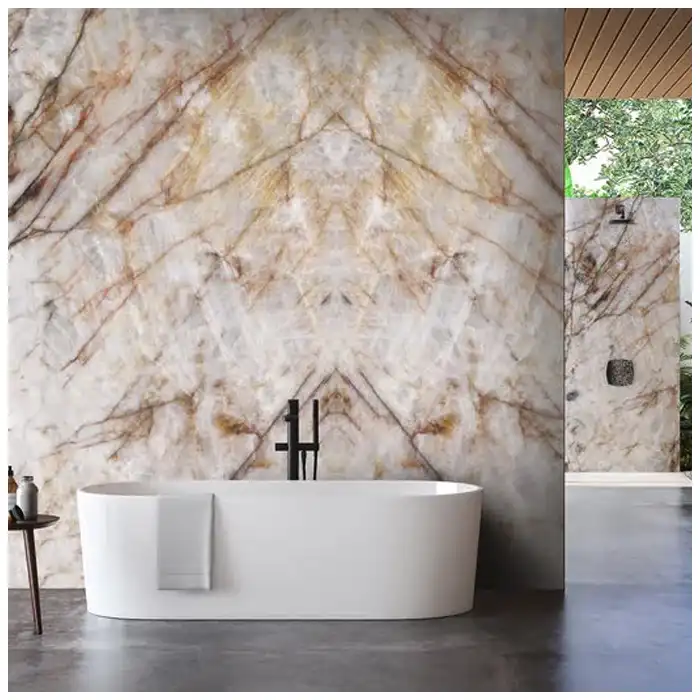
Quick Summary: Arabescato Marble Slabs for Dining Rooms and Interior Feature Walls
ألواح رخام أرابيسكاتو are natural Italian white marble panels with interlocking grey veins, irregular oval formations and contrasting white areas. Originating from the Apuan marble region, Arabescato is used for apartment dining room walls, custom dining tables, bookmatched feature panels and interior marble tiles. MQ STONE’s catalogue includes large slab references of 2400mm+ × 1400mm+ and 2000mm+ × 1000mm+, alongside polished slabs in several thicknesses. Cut-to-size tiles include 305 × 305mm, 300 × 600mm, 400 × 400mm and 600 × 600mm. The distinctive looping vein pattern is the principal consideration when selecting slabs for adjoining panels.
Arabescato Italian Marble Slabs for Apartment Dining Rooms and Feature Walls

Arabescato Marble is distinguished by grey veins that curve, intersect and sometimes enclose irregular white areas. Instead of following one continuous diagonal direction, the darker markings often form a network of rounded or elongated shapes across the slab.
This pattern is particularly interesting in a dining room, where a stone wall may be viewed directly from the table. Large Arabescato panels retain the relationship between the white spaces and surrounding grey mineral lines. Smaller tiles divide those formations into separate sections and create a different visual rhythm.
Natural Arabescato comes from the Apuan marble region of Tuscany, Italy. Different commercial selections, including Arabescato Corchia and Arabescato Vagli, can vary in background tone, vein density and mineral colouring. The particular selection matters more than assuming every Arabescato slab has an identical pattern.
For an apartment dining room, the grey-vein composition can be positioned behind a sideboard, within a recessed wall or across a full-height surface. A slab with a relatively open white centre may provide a quieter setting for furniture, while closely intersecting veins create a more prominent decorative wall.
Arabescato works with light oak, walnut, dark metal and neutral upholstery because its white and grey minerals introduce contrast without requiring another strong colour. The decorative effect comes from the scale and distribution of the natural stone pattern, not from an applied surface design.
Arabescato White Marble Slab Selection for Bookmatched and Vein-Matched Walls

Arabescato’s distinctive mineral loops make slab arrangement especially important on large interior walls. One slab may have several broad grey formations crossing its centre, while another contains a dense network of smaller veins around open white sections.
The selection process begins with the proportions of the finished wall. A wide reception backdrop can accommodate horizontal movement across several panels. A narrow, full-height apartment wall often benefits from an arrangement that keeps the strongest grey formations within the main viewing area.
Bookmatched Arabescato Marble Panels
Bookmatching is possible when corresponding slab faces provide a suitable mirrored relationship. The grey veins may form symmetrical loops or open shapes around the central joint. A convincing composition depends on consecutive material and correct face orientation, rather than simply placing two similar slabs together.
Continuous Vein-Matched Layouts
Where symmetry is not required, adjacent slabs can be arranged so their grey mineral movement travels across the installation. This approach is useful for dining room walls extending around a corner or for long decorative surfaces where a mirrored centre would be visually restrictive.
The position of joints deserves particular attention. A dark vein ending abruptly at a panel edge can make the transition conspicuous, while adjoining pieces with compatible vein direction produce a more connected appearance.
For panel layouts with doors, lighting recesses or built-in shelving, the slab photographs should be reviewed together with the architectural elevation. Cutting through the central portion of a distinctive grey loop can change the overall character of the composition.
Arabescato Marble Slab Sizes, Tile Dimensions and Surface Specifications
MQ STONE’s original Arabescato catalogue lists full slabs, narrower slab formats, polished tiles and stair components. Sizes are presented below in millimetres, with slab thickness separated from surface finish. The finished dimensions of natural stone depend on the selected block and cutting plan.
| اسم المنتج | Arabescato Marble Slabs and Polished Tiles |
| مادة | Natural Italian Arabescato White Marble |
| Stone Origin | Italy — Apuan marble region, Tuscany |
| Commercial Varieties | Arabescato Marble; regional selections include Arabescato Corchia and Arabescato Vagli |
| Colour and Pattern | White to warm-white background with interlocking grey veins, curved lines and irregular oval formations |
| Main Jumbo Slab Reference | 2400mm+ × 1400mm+ |
| Additional Large Slab Reference | 2000mm+ × 1000mm+ |
| Long Slab Reference | 2400–3200mm length × approximately 1200mm width |
| Narrow Slab Formats | 1800mm+ length × 600mm or 700mm+ width |
| Polished Slab Thickness References | 16mm, 18mm and 20mm; selected 30mm slab formats |
| Square Tile References | 305 × 305mm, 400 × 400mm and 600 × 600mm |
| Rectangular Tile Reference | 300 × 600mm |
| Tile Thickness References | 10mm, 12mm and 20mm catalogue references |
| Stair Tread References | 900–1800mm lengths × approximately 300–350mm depths |
| Stair Riser References | 900–1800mm lengths × approximately 140–170mm heights |
| Main Surface Finish | مصقول |
| Alternative Finish | Honed; selected brushed or textured surface processing where suitable |
| Finished Product Forms | Marble slabs, dining table tops, bookmatched panels, interior floor and wall tiles, vanity tops and stair components |
| Primary Applications | Apartment dining rooms, residential feature walls, hotel interiors, bathroom wall cladding, interior flooring and custom stone furniture |
Polished Arabescato White Marble Slabs for Dining Tables and Interior Furniture

A dining table offers a different way to view Arabescato Marble. Instead of spreading the vein pattern vertically across a wall, the finished top presents a horizontal section of the stone at close range. The curved grey lines become more noticeable around table edges and across open white areas.
For a rectangular dining table, the principal grey formations can run along the length of the top or cross its shorter dimension. A lengthwise arrangement often preserves more of the natural slab movement. A crosswise pattern can create a stronger central visual feature, especially on a table with a relatively simple base.
Round and oval tables introduce another consideration: the cutting outline changes which portions of the original slab remain visible. A grey mineral loop located near the edge of a rectangular blank may disappear when the corners are removed to form an oval.
Tabletop Edge Profiles and Support
A straight eased edge leaves the visible stone thickness relatively simple. Mitred construction can create a thicker appearance, but the edge pieces and joints must suit the table geometry. Large marble tops need a stable base and adequate support so that the stone does not rely on narrow unsupported sections.
The position of natural veins and any filled mineral boundaries also matters around fixing points or cutouts. Fabrication drawings should show the stone outline, support arrangement and any required openings before machining begins.
Polished Arabescato can make a strong dining table surface, but it is still natural marble. Acidic foods and drinks may produce etch marks, while heavy impacts near the edge can cause chipping. Its suitability depends on accepting the maintenance characteristics of calcitic stone rather than expecting engineered-surface performance.
Arabescato Marble Polished Tiles for Apartment Floors and Bathroom Walls

Arabescato Marble Tiles retain the white-and-grey composition of the parent slab but display it at a different scale. A 305 × 305mm tile may contain only part of a large grey loop, whereas a 600 × 600mm piece reveals more of the curved mineral formation.
In apartment dining and living areas, larger tiles can reduce the number of joints crossing the grey pattern. This is particularly noticeable where the stone contains broad white sections separated by dark mineral lines.
A 300 × 600mm rectangular format can establish a directional layout along a hallway or living room. Square modules create a more regular joint grid. Tile orientation and colour grouping affect the overall appearance because the grey veins are irregular rather than uniformly distributed.
Polished Tiles for Dry Interior Flooring
Polished Arabescato has a reflective surface that accentuates grey-vein contrast. It can be considered for appropriate residential floors, but a glossy finish should not be taken as evidence of wet-slip suitability. The finished tile must meet the relevant floor safety specification.
Honed Marble for Wall and Bathroom Applications
Honed Arabescato reduces strong reflections and leaves the grey markings visible with a softer surface appearance. On bathroom walls, this can make the pattern easier to coordinate with mirrors, metal fittings and other reflective elements.
Where marble tiles are installed in wet areas, a suitable waterproofing system remains necessary behind the stone. The polished or honed marble face, grout joints and surface sealer do not replace waterproofing within the wall or floor assembly.
Arabescato Marble Finish Selection for Walls, Floors and Stone Furniture
| صقل الأسطح | Visual Effect | Application Consideration |
| مصقول | Reflective white background with stronger definition of grey loops and mineral lines. | Dining tables, interior feature panels, vanity tops and suitable dry floor areas. |
| شحذ | Low-sheen surface with subdued reflections and a softer grey pattern. | Apartment walls, bathroom cladding and selected floor finishes subject to performance assessment. |
| نحى | Light surface texture that changes the reflection across individual mineral areas. | Selected decorative walls and architectural details where the stone is suitable for the processing method. |
Arabescato Marble in an Apartment Dining Room Interior
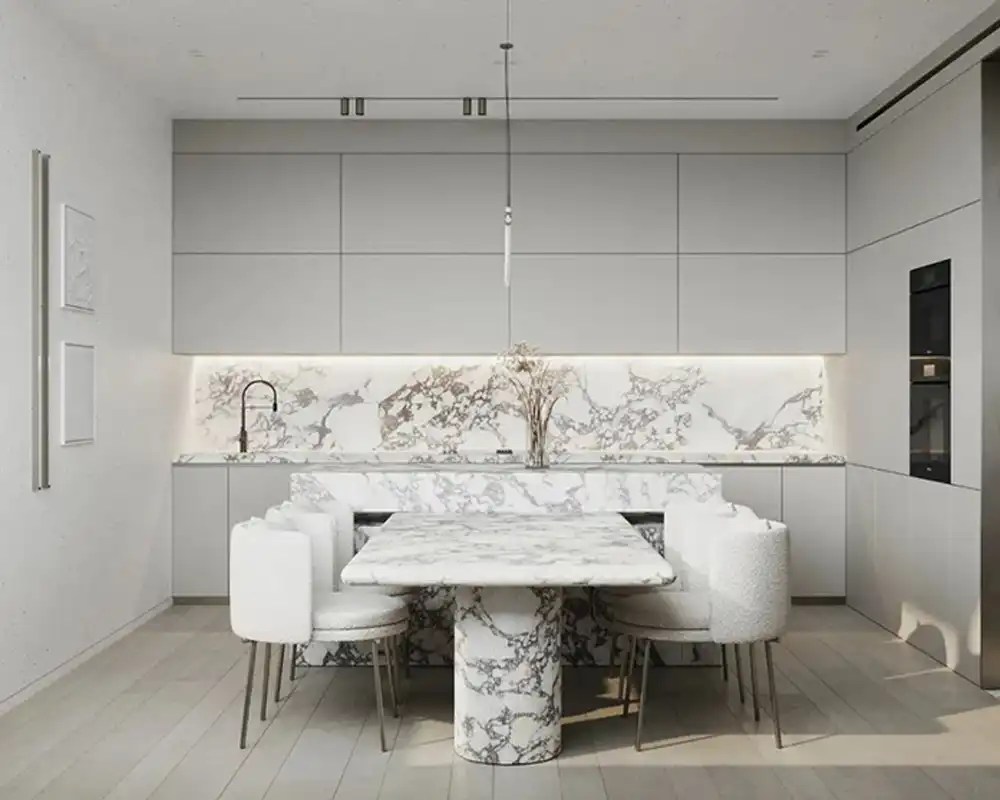
The Arabescato Marble apartment dining room image shows the type of interior setting where this stone’s curved grey pattern can become a principal decorative feature. A dining room is especially suitable for appreciating the relationship between the wall surface, table proportions and surrounding finishes.
In a compact dining area, placing the strongest Arabescato pattern on one wall can establish a clear focal point without covering every surface in heavily veined stone. Other walls may remain plain, allowing the looping veins to be read as a coherent composition rather than fragmented decoration.
The height and width of the wall determine how the pattern should be cropped. A floor-to-ceiling panel retains long grey formations, while a horizontal stone section above a sideboard reveals a different part of the same slab structure.
Lighting should also be considered when selecting the finish. A polished panel can reflect pendant lights and windows, while a honed surface reduces glare. In either case, full-slab selection is more useful than relying on a small sample that shows only one isolated grey vein.
Arabescato Italian Marble Physical and Mechanical Properties
Published technical testing for a natural Italian Arabescato Marble specimen provides the following reference measurements. The figures apply to the tested material and should not be regarded as certified results for the current MQ STONE inventory or every Arabescato quarry selection.
| Material Property | Reference Result | Test Standard | Technical Relevance |
| كثافة واضحة | 2710 kg/m³ | EN 1936 | Reference for stone weight and preliminary panel load assessment. |
| Open Porosity | 0.30 ± 0.03% | EN 1936 | Accessible pore volume in the tested stone. |
| أمتصاص الماء | 0.11% | EN 13755 | Moisture absorption, not a guarantee against stains or damp-related changes. |
| قوة العاطفة | 17.8 ± 2.9 MPa | EN 12372 | Reference bending strength relevant to panel and fabricated slab assessment. |
| قوة الضغط | 87.4 ± 7.2 MPa | EN 1926 | Laboratory compression performance of the reference specimen. |
| Mohs Hardness | 3 | Reference classification | Indicative surface hardness of this calcitic marble. |
| Wet Slip Resistance | Not established in the reference | Finish-specific testing | The selected floor finish requires testing for its intended conditions. |
Reference limitation: these measurements describe one natural Arabescato selection. Differences between quarry varieties, blocks and processing treatments may affect physical performance. The figures are not MQ STONE batch certification and are not allowable design loads for installed stone components.
Arabescato Marble Compared with Four White and Contrasting Marble Collections
Arabescato is identified by its interlocking grey veins and irregular rounded formations. The following MQ STONE collections show different degrees of contrast, background colour and vein direction, influencing their suitability for dining room walls, countertops and interior floor designs.
| Comparison | ألواح رخام أرابيسكاتو | ألواح رخام الباندا | رخام كالكوتا بورجيني | رخام اريستون الأبيض | بلاطة رخام فولاكاس |
|---|---|---|---|---|---|
| Natural Appearance | White background with interlocking grey loops and irregular oval mineral patterns | Predominantly white stone with bold black bands and dramatic contrast | White to creamy ivory with sweeping grey and golden veins | Bright white background with restrained grey mineral details | White marble with soft grey, violet-grey or beige-toned linear veins |
| Product Form | Polished slabs, dining table tops, bookmatched panels and tiles | Large slabs, feature panels, countertops and decorative tiles | Polished slabs, kitchen islands, wall panels and interior tiles | White marble slabs, countertops and wall panels | Marble slabs, floor tiles, vanity tops and interior panels |
| Dining Room Design | Grey-loop feature walls and patterned stone dining tables | Strong black-and-white feature surfaces | Warm grey-gold dining room accents and table tops | Lighter white surfaces with minimal visual movement | Softly veined dining room floors and walls |
| Feature Wall Pattern | Interlocking grey formations that can form complex bookmatched compositions | Graphic black veins with large white spaces | Flowing grey-gold veins and broad white fields | Predominantly white architectural surfaces | Softer linear movement with understated contrasts |
| Flooring Application | Polished white tiles with distinctive curved grey veins | High-contrast black-and-white decorative flooring | White flooring with warm grey and golden mineral accents | Bright, relatively consistent white interior floor appearance | White and soft grey modular marble floors |
| Fabrication Priority | Curved vein arrangement, slab pairing and placement on table outlines | Black-vein orientation and large-panel composition | Gold-vein positioning and countertop cutouts | White-background grading and restrained vein matching | Grey-vein continuity and surface colour consistency |
| Design Positioning | Decorative Italian white marble with complex arabesque veining | Bold graphic black-and-white stone | Warm grey-gold Italian white marble | Bright white marble with quieter mineral detail | Soft linear white-and-grey marble |
Installing Arabescato Marble Panels and Interior Flooring
The installation method for Arabescato depends on whether the stone is used as a large wall panel or a floor tile. Full-height panels require support and fixing suitable for their dimensions and weight. Where a mirrored pattern is used, joints must be positioned according to the approved wall composition.
Arabescato can contain natural mineral boundaries, small pores and processed areas. Some slabs may also have reinforcing mesh or resin treatments. The fabricator needs to account for these features when selecting adhesives, machining edges and preparing panels for installation.
White marble may be sensitive to moisture-related discolouration, particularly if unsuitable setting materials or installation conditions are used. A suitable light-coloured adhesive system and a sufficiently dry, stable substrate are important for interior tile work. Wet-area walls need their own waterproofing construction.
For polished flooring, the actual finished surface must meet the applicable slip requirements. Movement joints, perimeter clearances and bedding coverage should be designed according to the tile format and floor system rather than omitted for visual continuity.
Arabescato Marble Slab Inspection and Packing
Arabescato requires visual inspection across the complete slab face. The density and direction of the grey loops vary naturally, so material intended for a common wall should be grouped according to the selected colour range and planned arrangement.
Polished surfaces should be examined for finishing marks, visible resin repairs and the condition of exposed edges. Marble table tops require additional checks around curved edges, fixing positions and any natural fissures that intersect narrow areas.
For shipment, polished slabs need suitable support and protective separation. Bookmatched wall pieces and custom-cut panels should retain their installation identification so that the approved grey-vein sequence can be followed when the stone is unpacked and installed.
Cleaning Arabescato Marble Tables, Walls and Floors
Clean Arabescato with a pH-neutral product suitable for natural marble. On floors, remove loose grit before washing to limit abrasion of the polished surface. Dining tables should be protected from acidic food, wine and citrus spills, which may cause visible etching. Avoid vinegar, acidic bathroom descalers and abrasive cleaning powders. An appropriate impregnating sealer may reduce some absorption-related stains but will not prevent scratching or acid etching. For dining tables, use coasters and protective mats where food and drink are frequently served. Maintain wall joints and wet-area waterproofing independently of the marble surface.
FAQs About Arabescato Marble Slabs and Tiles
What is Arabescato Marble?
Arabescato Marble is a natural Italian white marble with interlocking grey veins, curved mineral lines and irregular oval formations. It is used for interior feature walls, dining tables, polished tiles and architectural stone panels.
Where does Arabescato Italian Marble come from?
Arabescato Marble originates from the Apuan marble region of Tuscany, Italy. Commercial varieties include Arabescato Corchia and Arabescato Vagli, which can have different vein patterns and background colours.
What sizes are available for Arabescato Marble Slabs?
MQ STONE’s catalogue includes large slab references of 2400mm+ × 1400mm+ and 2000mm+ × 1000mm+, along with long slab formats reaching approximately 2400–3200mm in length.
What thicknesses are listed for Arabescato White Marble Slabs?
The catalogue references polished slabs in 16mm, 18mm and 20mm thicknesses, with selected 30mm slab formats. Finished thickness should be specified together with the required slab size.
Can Arabescato Marble Slabs be bookmatched?
Yes. Suitable corresponding slab faces can create mirrored bookmatched wall patterns. The result depends on the grey-vein arrangement and available slab sequence.
Is Arabescato Marble suitable for dining tables?
Arabescato Marble can be fabricated into rectangular, round and oval dining table tops. The cutting outline, vein placement, edge profile and structural support must be considered, and the marble requires protection from acidic spills and impacts.
What sizes are available for Arabescato Marble Polished Tiles?
Catalogue tile formats include 305 × 305mm, 300 × 600mm, 400 × 400mm and 600 × 600mm, with 10mm, 12mm and 20mm thickness references.
Can Arabescato Marble Tiles be used on bathroom floors?
Arabescato tiles can be considered for bathroom applications, but the selected finish must meet the relevant floor safety requirements. Wet-area construction also requires proper waterproofing and compatible setting materials.
What physical properties are published for Arabescato Marble?
A published natural Arabescato reference reports apparent density of 2710 kg/m³, open porosity of 0.30 ± 0.03%, water absorption of 0.11%, flexural strength of 17.8 ± 2.9 MPa and compressive strength of 87.4 ± 7.2 MPa. These are representative sample values, not MQ STONE batch-certified results.
How should polished Arabescato Marble be maintained?
Use pH-neutral natural stone cleaners, remove abrasive grit and wipe acidic spills promptly. Avoid acidic descalers and abrasive products. Sealing may reduce certain stains but does not prevent acid etching or scratches.
Recommended White and Contrasting Marble Slabs

ألواح رخام الباندا
High-contrast black-and-white marble for bookmatched walls, countertops and graphic interior panels.

رخام كالكوتا بورجيني
Italian white marble with grey-gold mineral movement for kitchen islands and feature walls.

رخام اريستون الأبيض
Bright white marble slabs with restrained grey markings for vanity tops and interior panels.

بلاطة رخام فولاكاس
White marble with soft grey veins for bathroom walls, flooring and custom vanity surfaces.

Arabescato Marble Slabs for Dining Room Walls and Custom Stone Furniture
Arabescato is distinguished by the way its grey veins enclose and separate irregular white areas. A dining room feature wall benefits from a panel layout that keeps those formations legible across the finished elevation. A stone dining table requires the pattern to be positioned within its cutting outline, particularly when the top is round or oval. These two applications use the same marble differently, with slab arrangement and finished geometry determining which parts of the natural pattern remain visible.
Arabescato Marble Project Enquiry
Share your slab dimensions, dining table drawings, wall elevations or tile schedule for an Arabescato Marble quotation.