
Stone Dining Table Size Guide: Seating, Top Thickness, and Base Footprint

Length and width are only the outer limits of a dining table. Usable seats depend on chair width, place settings, end conditions, base location, knee clearance, serving reach and the room left behind pulled-out chairs. Stone adds mass, edge depth and support demands that must be resolved with the exact slab and furniture structure. MQ STONE turns those inputs into a measured approval sequence, keeping scale tied to real bodies and mineral proportion instead of relying on a generic seat-count chart.
Round Stone Dining Table: Diameter, Center Base, Seating, and Vein Direction
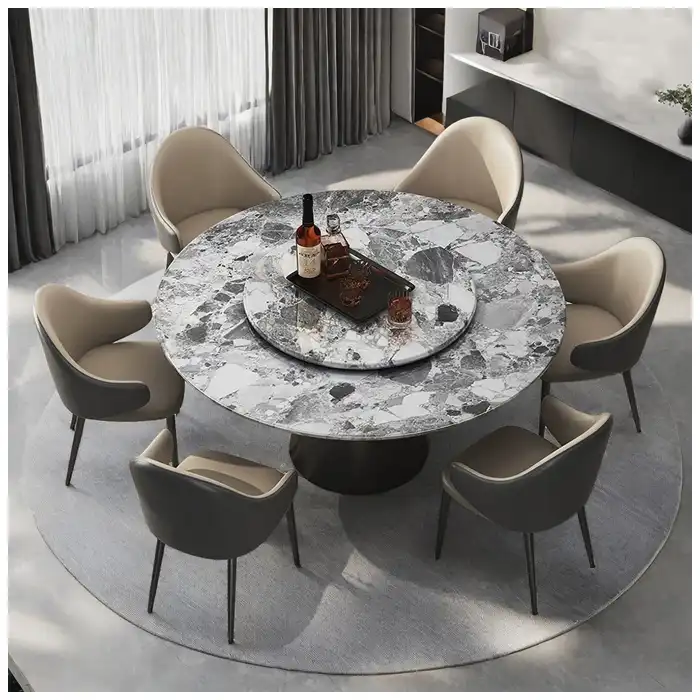
A circular table removes the safe front and back of a rectangular slab. Every chair sees the edge, every vein approaches the perimeter differently and the center base must provide support without occupying the same space as knees and feet. This study maps the circle over the full slab, checks diameter against real place settings and treats the pedestal as both a visible sculpture and part of a larger support system. MQ STONE keeps mineral movement, balanced seating and physical stability together so the circle remains convincing from every direction.
Leathered Quartzite Slabs: Where Texture Helps and Where It Does Not

Leathering can turn quartzite from a reflective image into a surface with measurable relief. Hard crystalline bands may remain high while other mineral zones recess, so one small offcut cannot represent the whole slab. Approval needs samples from the calm field, strong vein, mixed zone, and any treated feature that enters the cut pieces. The proposed edge must be made at full thickness, then checked under grazing light and with the intended cleaning method. That record distinguishes deliberate texture from an uneven finishing process across tables, counters, consoles, or wall panels.
Luxury Natural Stone Slabs for Walls, Furniture, and Light

The most memorable natural stone is not chosen by color name alone. Alex Zheng reads mineral depth, vein movement, translucency, finish, and structural limits across quartzite, marble, onyx, travertine, feature walls, and stone furniture. It follows the full face through bookmatching, edge design, support, lighting, and fabrication, keeping attention on what the finished room can preserve.
Natural Quartzite Table Tops for Dining Tables, Coffee Tables, and Premium Interiors
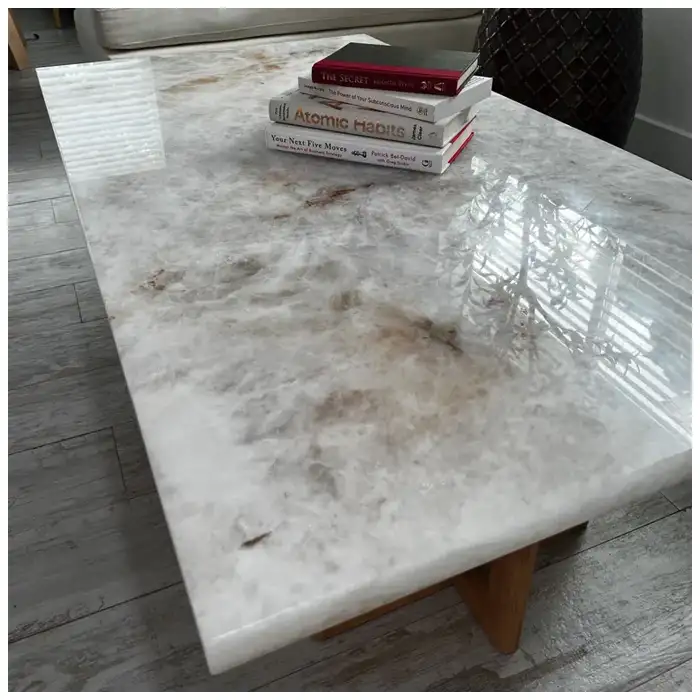
Stone furniture is returning to design conversations because a table is no longer just a surface for objects. In hotels, villas, galleries, and private dining rooms, the stone itself becomes part of the room’s identity. Natural quartzite brings depth, mineral movement, and light behavior that printed surfaces struggle to repeat. This MQ STONE guide uses Alex Zheng’s material-led approach to explain how quartzite table tops should be selected, supported, edged, and compared with manufactured stone alternatives.
Colorful Statement Stone Guide: Green, Blue, Burgundy, Quartzite, Marble, and Stone Furniture

Colorful statement stone needs a clear project role before any slab is reserved. Green marble, blue marble, burgundy stone, quartzite, onyx, and stone furniture surfaces can all lead a room, but each one needs different lighting, layout, edge, and surrounding material choices. This MQ STONE guide connects the full decision path: material gallery review, slab photos, bookmatch potential, fabrication details, stone table options, feature walls, counters, and project application records. It helps keep dramatic material selection controlled and easier to quote.