Arabescato Corchia Console Table: Slim Profiles, Edge Weight, and Wall-Side Support
The first question is simple: where does an Arabescato Corchia console table change the finished result rather than merely the drawing? A console asks a marble slab to stand close to a wall as a narrow, legible strip, and every choice about proportion, edge, and bearing shows up within that short distance. I would rather settle those points in the first review, while a drawn line, a slab allocation, or a cabinet part can still move without cost. A recorded decision travels better than an assumption repeated by three trades.
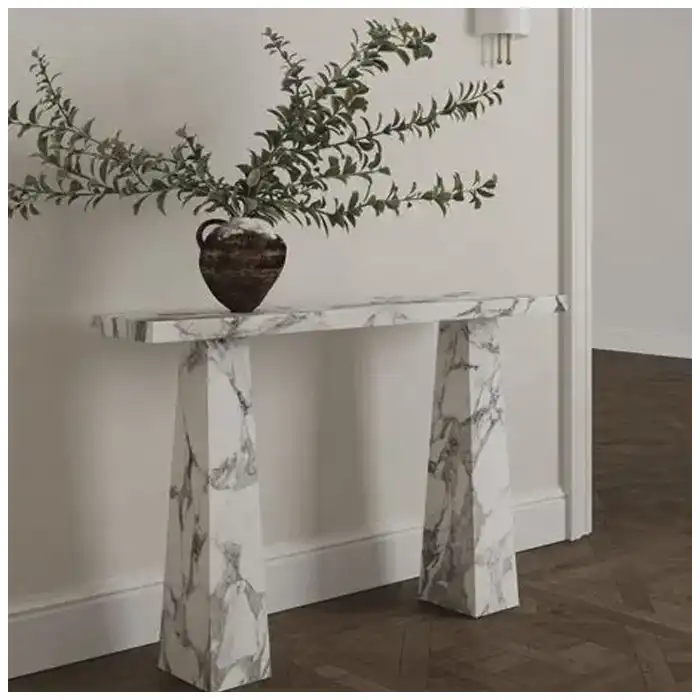
Read the slim proportion before the stone is cut
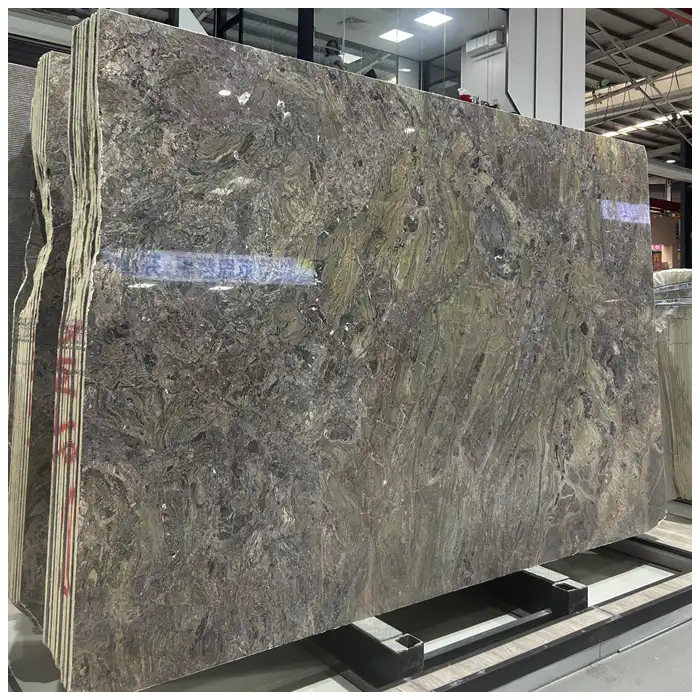
An Arabescato Corchia console table is deliberately shallow, and that narrow footprint changes how grey movement is seen. A vein that fills a wide kitchen island becomes a single long gesture here, running toward the wall or along it. When I check a slab for a console, I look at what one horizontal band of the face will do once the depth is reduced, not at the whole sheet of marble.
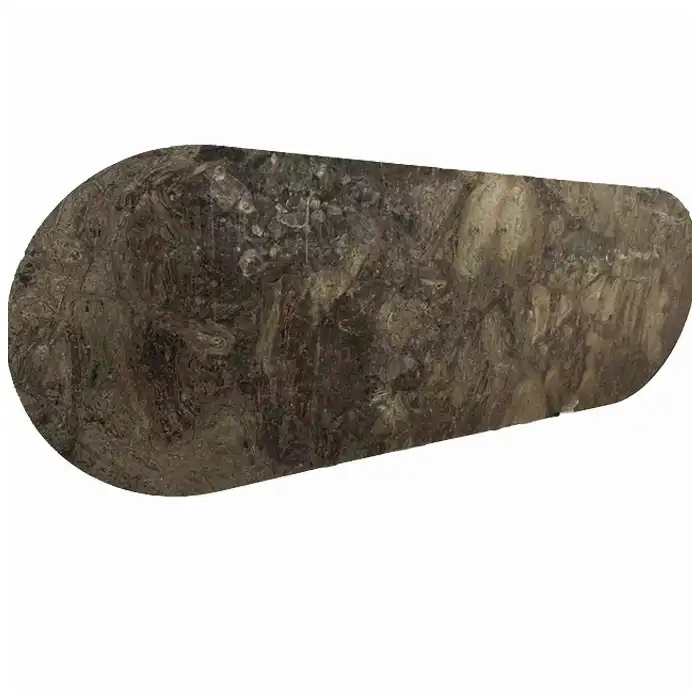
Proportion sets the visual weight of the piece. A top that reads elegant in elevation can look heavy when the depth is only a third of the length, and a very thin top can look fragile if its supports are spaced too far apart. I prefer to sketch the finished length, depth, and thickness at true scale against the wall line, then choose the edge profile and the base spacing on that drawing rather than in the abstract.
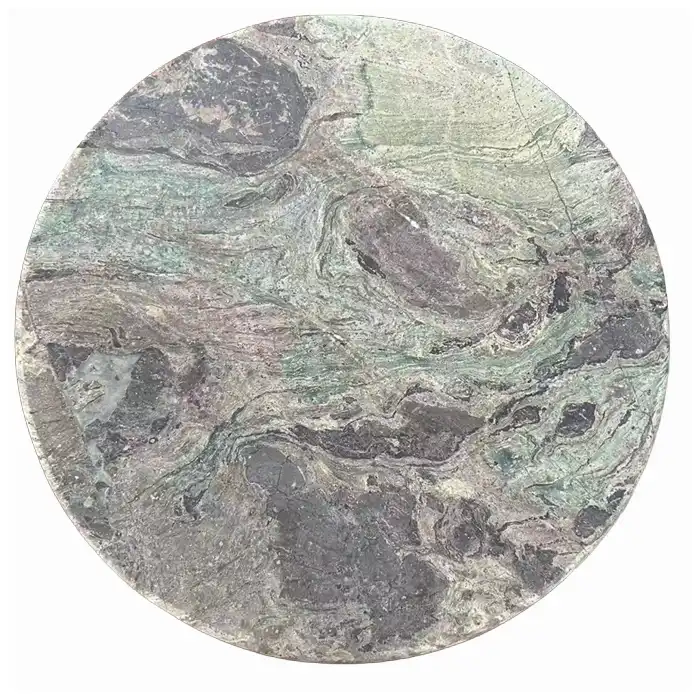
Natural features behave differently at console scale. A small filled line that disappears on a large countertop may dominate a shallow strip, and a colour break can fall exactly where the eye travels along the top. The question is not whether the feature exists, but whether it sits where the composition can carry it. If it cannot, that slab belongs to another piece of the project.
I also read the slab with its neighbour pieces in mind. A console top is often cut from the same bundle as a splashback, a table, or a vanity, and the order of cutting decides which part of the face reaches the console. Reserving the strongest gesture for the console and sending the quieter remainder elsewhere is a decision I want on paper before the saw starts.
Grain continuity matters at the corners. Where the top meets a return or a splashback, I try to keep the direction of the veins consistent so the eye does not jump at the joint, and the drawing records which way each face is oriented. On a narrow strip, a small shift in orientation is more noticeable than it would be on a wide surface, so I check the return and the front face as a pair.
Choose the edge for the weight it shows from the side
On an Arabescato Corchia console table, the edge type decides how much visual thickness a thin top appears to carry. A straight edge shows the true slab thickness and reads calm and architectural; a mitred return folds the material downward so a thin top can gain the presence of a much thicker one from most viewing angles; a bevel or chamfer softens the transition and catches light along a highlight line. None is automatically better, and the right answer depends on the room.
I judge edges from where the console is actually seen. A console in a wide hallway is usually viewed from several metres away and slightly above, so the top surface and the front return matter most; one placed beside a dining chair is seen closer, at seated height, where a sharp underside and a deep mitre read very differently. Holding a physical edge sample at that height tells me more than a profile detail on a screen.
A slim profile also exposes what a heavier top would hide. The underside, the shadow line where the top meets the wall, and the front edge all become part of one narrow picture. I ask for the edge and the front face to be reviewed together under the light the room will really have, because a polished return can shine beside a honed field and split the reading of a single piece of stone.
Edge choice is also a handling decision. A mitred return needs a clean, square joint and careful packing for transport, while a bevel is more forgiving at the corners but still shows any chipping along the line. When the edge and the protection plan are agreed at the same time, the piece that arrives on site matches the sample that was approved.
Small details on the edge deserve the same care as the profile itself. A slight easing at the arris, a consistent radius, and a clean polish at the mitre all affect how the light moves along the front of the top. I keep the tools and the finishing sequence in the record, because a repeated edge is what makes two ends of the same console look as if they belong to one piece.
| Review point | What to confirm | Record |
|---|---|---|
| Edge profile | Mitred, bevel, or straight | Hold a full-size sample at seated height |
| Top proportion | Length, depth, and thickness at scale | Keep on the approved elevation |
| Wall-side support | Bracket type and bearing line | Note on the support drawing |
| Wall reveal | Even gap along the whole length | Photograph before the top is fixed |
The Hard-Won Lesson: A slim top that looked sound in elevation bowed after styling
A long thin console can read perfectly in a drawing and still feel wrong under real load. The common version of this problem appears when the edge and the marble are agreed early but the bracket spacing is left to the joiner, and the top takes a slight bow once books and a lamp settle near the middle. The stone has not moved. The support layout has.
The Lesson: approve the load path and the specimen edge together, at the depth and span the console will really have.
Plan the hidden bracket and the reveal at the wall
Wall-side support is where an Arabescato Corchia console table is most often underestimated. A floating look usually hides a steel or timber frame, a wall plate, or a pair of brackets, and the top needs a predictable bearing line rather than a few points of contact. I ask for the support drawing to show where the stone actually rests, how the load reaches the wall, and how any concealed fixing can be reached later if it needs adjustment.
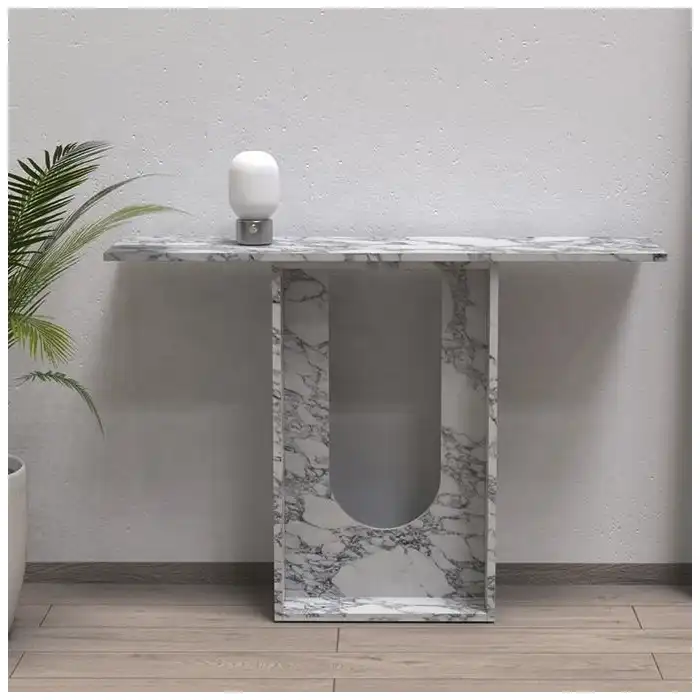
The reveal against the wall is a design decision, not a tolerance to be filled at the end. A deliberate shadow gap of a few millimetres can make a top look as if it floats, while a gap that varies along the length shows every irregularity in the wall. Where the wall is not straight, the console line inherits that movement, so I set an even reveal and check it with a straightedge before the top is fixed.
Movement and access belong in the same conversation. Natural stone and the wall behind it will expand and contract at different rates, and a rigid connection at every point can load the slab where it is weakest. Leaving a measured reveal, allowing a small amount of play, and keeping any service or fitting reachable keeps the piece serviceable long after the room is finished.
Hidden supports should still be documented. Once the top is in place, nobody can see how it is held, so the drawing that shows the frame, the bearing, and the fixings becomes the only record. I keep that drawing with the slab map so a later repair or re-fit does not have to reverse-engineer the support from the outside.
Check clearance and visual weight after the room is furnished
An Arabescato Corchia console table rarely stands alone. Chairs tuck under an Arabescato Corchia console table in a hallway, a walkway passes in front of it, and objects collect on the top at the centre of the eye. The clearance for a chair back and the width of the traffic route are part of the stone decision, because they fix how much of the top is ever seen as uninterrupted material and how much is shadowed or hidden.
I look at the visual centre after a normal amount of styling. A bowl, a lamp, and a framed picture can pull attention away from a vein that was meant to lead the composition, or they can frame it. When I set the slab crop, I try to keep the strongest movement where the objects will leave it visible, and to place quieter material where daily items will sit.
Walkway clearance also protects the edge. A console that crowds a route invites knocks and scuffed corners, and a top that oversails a base without enough set-back is easy to catch. If the room is tight, I would rather reduce the depth of the top, or round the exposed corner slightly, than let the finished edge become the part of the stone that pays for the lack of space.
The final judgement is quiet. Step back to the entry, glance along the wall, and look again from close range with the objects in place. If the top still holds its line and the edge still reads at the right weight, the decision was sound. If not, it is far kinder to the stone to adjust the composition on paper than to ask a finished marble surface to cover a detail that was never resolved.
Take the approved sample to the wall
The Arabescato Corchia console table decision is not finished when the drawing is approved, and the wall it stands against is part of that decision. Before cutting, I like to see the chosen slab or a large sample standing against the actual wall, at the height it will sit and under the light the room will keep. The change between a bench and a wall is often larger than expected, because the wall gives the stone a background and the floor gives it a base line.
Viewing the sample in place also settles the reveal. A gap that looks generous in a drawing can look tight once the skirting, the socket, or the adjacent joinery is there. Standing at the wall with the sample lets me check how the grey movement relates to the door frame, the window, and any fixed fitting that will frame the piece.
The check should include a chair and a realistic amount of styling. A chair pulled up to the console shows whether the front edge sits at a comfortable height and whether the strongest vein stays visible above the backrest. A tray and a lamp show where the objects will sit and how much quiet material the composition needs around them.
I record that final wall check with a photograph and a short note, then keep it with the slab map and the support drawing. When the fabricator and the installer work from the same picture, the piece that is fixed on site is the piece that was seen at the wall, not the one that was approved on a bench.
None of this replaces the drawing; it confirms it. A sample at the wall is the last free chance to catch a proportion that feels wrong only in three dimensions, and it costs far less than re-cutting a finished top. When that check is recorded, the next team works from evidence rather than from a memory of how the room felt on approval day.
Questions We Hear Before Release
1. How deep should an Arabescato Corchia console table be?
Depth follows the room and the use: a hallway console usually stays shallow, while one beside seating may need more depth for a lamp and a tray. Set depth, edge, and bracket spacing at true scale before cutting.
2. Does a mitred edge make a thin top look heavier?
It can, because the return folds the material downward and the eye reads more thickness from the side. Confirm the effect with a full-size edge sample at the height the console will be seen.
3. How should the wall-side support be verified?
Ask for a support drawing that shows the bearing line, the load path into the wall, and how any concealed fixing can be reached later. Check the even wall reveal with a straightedge before fixing.
4. What clearance should be kept in front of the console?
Leave enough room for a chair back and a clear walkway, then look at how much of the top stays visible once the route and the daily objects are in place.
5. What if the installed console looks too heavy or too thin?
Photograph the finished edge and wall reveal from the main approach and at seated height, then compare them with the approved sample and elevation before any correction is agreed.
Quick-Reference Checklist
- Sketch the top at true scale against the wall line.
- Choose the edge profile on a full-size sample, not on a screen.
- Confirm the bracket or frame bearing along the whole length.
- Set an even reveal at the wall and check it with a straightedge.
- Photograph the styled top from the main approach before handover.
Final Conclusion
An Arabescato Corchia console table is a small stage for a large piece of geology. MQ STONE keeps Arabescato Corchia console table tied to the slim proportion, the edge weight, and the hidden support that decide how the finished piece reads beside a wall.
References
- Dimension Stone Design Manual, Natural Stone Institute.
- ASTM C503/C503M, Standard Specification for Marble Dimension Stone, ASTM International.
- Natural Stone Institute Resource Library, Natural Stone Institute.
- Kitchen & Bath Planning Guidelines, National Kitchen & Bath Association.
- Architectural Stone Guidance, Stone Federation Great Britain.
- Marble, Wikipedia.