Arabescato Corchia Staircase: Tread Direction, Nosings, and Landings
I run my hand along the cut edge of a marble tread before I look at the stair from below. The face tells you one thing. The nose tells you another. On Arabescato Corchia, a grey line can travel quietly across a broad tread and then become a sharp mark when it reaches the edge. That is where the stone stops being a floor finish and becomes an object somebody touches as they climb.
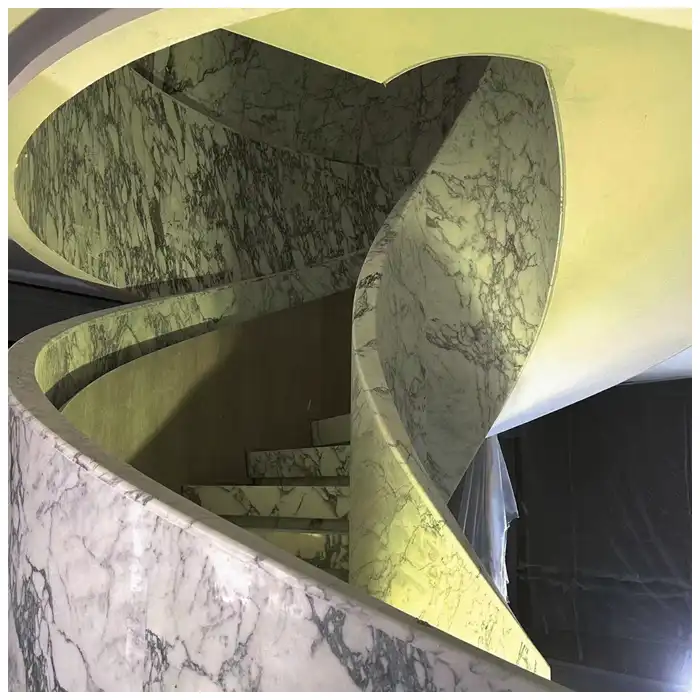
An Arabescato Corchia staircase asks more from a slab layout than a flat room does. The material is broken into a rhythm of treads, risers, and landings. Every step changes the viewing angle. Light slides across the nosing, catches the riser, then disappears on the next tread. This stone has been waiting for millions of years, so it is worth giving its strongest movement a place that can hold it.
The task is not to make every tread dramatic. True luxury is something you never get tired of looking at. A staircase needs rest between moments of movement. A good sequence lets the eye travel upward without making the feet feel as if they are stepping through a row of unrelated fragments.
Read the stair from the route, not from one tread
Start where a person enters the stair. The first few steps often carry the strongest visual weight because they are seen from the lobby, corridor, or landing beyond. I lay out the approach view first, then trace how the movement continues toward the upper level. A beautiful tread placed in the middle of a run may be wasted if the first landing has no relationship to it.
Stand at the bottom and look up. Then stand at the top and look down. The grey movement can appear entirely different from those two positions. A branching line that looks calm from below may become a hard interruption when seen from the landing. The veins will tell you where the slab wants to move, but the route tells you whether that movement helps the stair.
Do not separate the landing from the run during allocation. The landing is where the eye pauses and changes direction. It may need a broader, calmer field than the treads, or it may carry the main bookmatched moment of the stair. Both choices can work. The mistake is treating it as a leftover rectangle after the visible steps have already consumed the slab.
Arabescato Corchia staircase layout begins on the full slab
Small cut diagrams are not enough for a material with broad grey movement. Place tread lengths, landing geometry, side pieces, and risers over full-slab photography. Mark the visible nose of each tread and the first sightline from both directions. A cut that looks economical in an abstract layout may put the strongest vein at the edge of every second step.
Allow for the fact that the stair uses more than horizontal faces. A tread may look quiet from above but reveal a dense edge once its nosing is finished. A riser can either continue the tread’s movement or create a deliberate visual break. Decide that relationship before cutting. Do not wait until the pieces are stacked beside the fabricator’s saw.
An Arabescato Corchia staircase needs that full-slab discipline because every cut changes its viewing angle. The same vein can read soft on the tread and exacting at the nose.
Where a large landing turns the path, test more than one allocation. One option may let a grey line turn with the person. Another may create a composed pause before the next flight. I do not choose by habit. I choose by the way the stone reads at the actual scale of the stair.
Keep the visible nose in the drawing
A stair tread has a working face and an edge that stays in view from below. Mark both on the cutting layout. The marble stair nosing can carry a line, a resin fill, a small natural feature, or a repair that was quiet on the horizontal face. The finished edge needs approval as part of the stone composition and as part of the fabrication quality check.
Use risers as a decision, not an afterthought
Some stairs use a matching riser, some use a darker material, and some hold the riser back from the tread to create a shadow. Each approach changes how much of the Arabescato is visible in motion. If the riser is marble, decide whether the line continues, shifts, or deliberately stops. A vague answer becomes a random one after installation.
Nosings need both visual and physical review
The edge profile affects how light breaks across the tread and how the stair feels under a hand. A crisp edge may suit a precise architectural scheme, but it makes small chips and filled areas more visible. A softened edge can take light more gently, yet it still needs a clean, consistent finish. The profile should be reviewed on the selected stone, not only on a generic material sample.
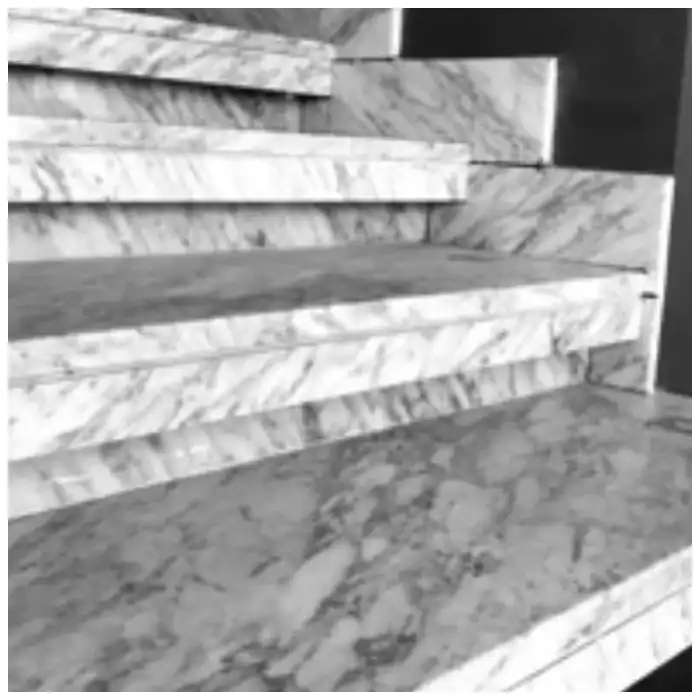
Look closely at the material near the nosing. A natural fissure, resin-filled feature, or sharp vein may be acceptable in a broad field but not at a high-contact edge. I am not saying a staircase must be blank white. That would miss the whole point of Arabescato Corchia. I am saying the edge needs a different standard because it is touched, lit, and exposed to impact.
An Arabescato Corchia Marble Slab should be reviewed for those edge zones before the best face is committed to the main tread field. The veins will tell you where a cut will become powerful. The fabricator still has to decide whether that power belongs on a landing, a riser, or a vulnerable nose.
Give the landing its own visual role
A landing is not merely the space between flights. It is the place where a person stops, turns, and often looks back. A calm landing can let a lively tread run settle. A stronger landing can become the focal point of a lobby stair. The correct choice depends on the surrounding architecture, daylight, and the amount of movement already present in the run.
At a wide landing, a bookmatched condition may be worth considering if the slab supports it. At a tight landing, a single uninterrupted field may feel better. Do not force a symmetrical pattern because the geometry happens to be rectangular. The material should look chosen, not pressed into a pattern it does not naturally want to make.
Side light matters here. Daylight from a stairwell window can expose a polished landing differently from the lower treads. Warm wall light can deepen a grey vein at night. I would view the allocated pieces in the intended lighting conditions before deciding that a landing is quiet enough or dramatic enough.
For an Arabescato Corchia staircase, the landing is the place to test the evening light as well as the daytime view. A field that behaves well at noon can become too active when the stairwell lamps switch on.
Protect the sequence through fabrication and installation
Number every tread, riser, and landing piece by installed sequence, not only by size. Similar pieces can be swapped easily in a workshop or at site. The placement drawing should show the walking direction, visible edge, and relevant slab allocation. A stair is unforgiving when one rotated tread interrupts the run in the middle.
Ask for a dry assembly of the critical run where the material has strong movement, difficult turns, or a major landing. The goal is not to build the whole staircase on the factory floor. The goal is to see the view that would be most expensive to change later. A few pieces laid in sequence can reveal a wrong edge or awkward line before crates are closed.
During installation, protect the finished nosings from trade traffic. A good slab allocation cannot survive a chipped edge and a rushed repair without changing the visual result. Keep the first completed flight available for inspection under the installed light before the same sequence is repeated elsewhere.
An Arabescato Corchia staircase should be reviewed at that first flight from below, above, and beside the landing. If one visible nose has changed the rhythm, correct the allocation before it becomes the repeated condition.
What the allocation table needs to settle
| Stair condition | What the slab layout must show | What can go wrong |
|---|---|---|
| First approach | Visible treads from the lower floor | The entry view starts with unrelated fragments |
| Nosing | Finished edge and nearby vein condition | A dense line or repair becomes obvious at the edge |
| Riser | Whether movement continues or stops | Random changes between tread and vertical face |
| Landing | Turning view, side light, and seam position | A major pause feels visually crowded |
| Installation order | Piece mark, direction arrow, and drawing grid | A rotated tread breaks the planned sequence |
The Hard-Won Lesson: Do not allocate a stair as a pile of rectangles
A common mistake is to select the prettiest individual rectangles from a slab and call the stair solved. After installation, the strong grey lines hit the front of several treads while the landing receives a dull leftover. Nothing is technically wrong with the pieces. The route has simply been ignored, so the material no longer reads as one architectural journey.
An Arabescato Corchia staircase cannot be judged by a stack of separate samples. It must be judged by the way its steps collect into one visible route.
The Lesson: Lay out the first view, every visible nose, and each landing before you choose a single tread face.
Reading Arabescato Corchia staircase as an architectural path
Floor layout and stair layout are related but not identical
A flat floor gives the veins a stable viewing plane. A stair changes the angle at every step. Keep that distinction in mind when comparing the allocation with Arabescato Corchia Floor Layout: Vein Direction, Tile Scale, and Doorway Transitions. A floor pattern cannot simply be cut into treads without losing its original logic.
That is why an Arabescato Corchia staircase needs a separate allocation drawing rather than a reduced version of the floor plan. The edge, riser, and landing create new visual responsibilities.
Natural stone carries depth that printed surfaces cannot imitate
The permanent parent Luxury Natural Stone Slabs and Furniture: Complete Guide to Materials, Applications, Edges, Lighting, and Support places this choice in the wider question of real material depth. The visual change at a polished edge, a landing, and a side-lit riser comes from the stone itself, not from a repeated printed pattern.
When the installed run feels broken
Photograph the flight from both approach directions, stop the next installation sequence, and compare the piece marks with the approved full-slab layout and dry assembly. Contact the supplier with those records before rotating, recutting, or repairing a visible tread. A quick local change can disturb the entire route.
When an Arabescato Corchia staircase feels broken, the next action is not to hide the one awkward tread. It is to compare the whole sequence with the approved route.
Questions project teams ask before release
1. Should Arabescato Corchia veins run in the same direction on every tread?
Not necessarily. The aim is a coherent route, not identical strips. The full slab, visible nosings, risers, and landing view should be reviewed together. Some stairs need a gentle continuation; others need a deliberate pause at a landing.
2. How should marble stair nosings be selected?
Review the actual edge zone before finishing. Check nearby veins, fills, natural features, and how the profile catches light. A condition that is acceptable in the tread field may be too exposed at a high-contact finished edge.
3. Should risers match the tread face?
They can, but the relationship must be selected. A matching riser can continue the movement; a quieter riser can calm the stair; a shadow detail can create separation. The decision belongs on the full allocation drawing rather than at installation.
4. Why should the landing be allocated with the treads?
The landing is often the visual pause and turning point. Its size, light, and seam position affect how the whole run reads. Using it as a leftover field can make the stair feel disconnected even when individual treads are attractive.
5. What should happen if a tread is installed in the wrong direction?
Photograph the piece, keep the next sequence on hold, and compare the installed direction with the approved drawing and slab layout. Contact the supplier with the original records before moving or recutting the tread. Do not bury the discrepancy under a local repair.
Quick-Reference Checklist for Arabescato Corchia staircase
- Lay out treads, risers, noses, and landings on the full slab before cutting.
- Review the stair from both approach directions under intended light.
- Mark the visible nosing and orientation on every cut drawing.
- Inspect edge zones for veins, fills, and natural features before profiling.
- Dry-assemble the critical landing or stair run before packing.
- Keep the first completed flight protected until visual approval is signed.
Final Conclusion
An Arabescato Corchia staircase should carry a person upward without forcing them to decode a new pattern at every tread. I would map the visible noses and landings before choosing the most dramatic cuts, because the veins will tell you where the stone wants to move. At MQ STONE, I trust that patience more than a stack of individually pretty rectangles.
References
- Marble, Wikipedia.
- Natural Stone Institute Dimension Stone Design Manual, Natural Stone Institute.
- ASTM C503 Standard Specification for Marble Dimension Stone, ASTM International.
- Stone and Architecture: Material Selection Guidance, Stone Federation Great Britain.
- Interior Stone Care and Protection, Natural Stone Institute.
- Search Essentials, Google Search Central.