Bookmatched Arabescato Corchia: When Symmetry Helps the Room
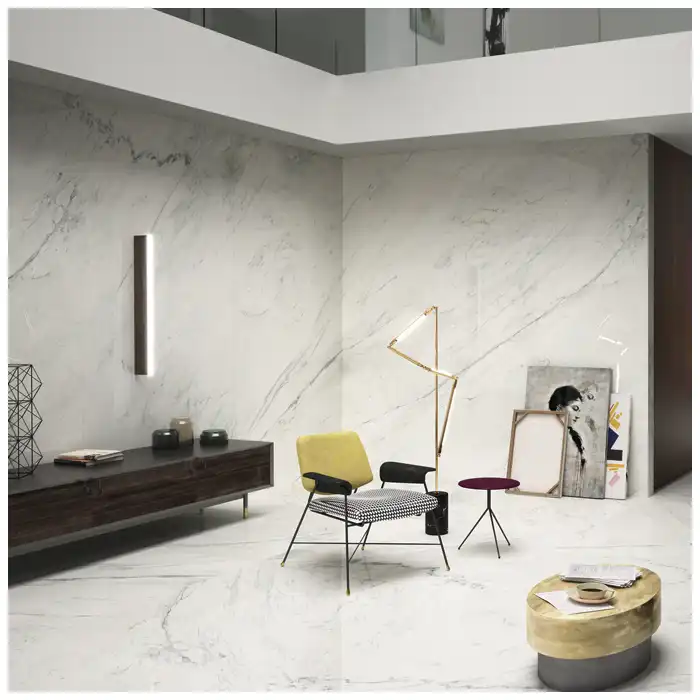
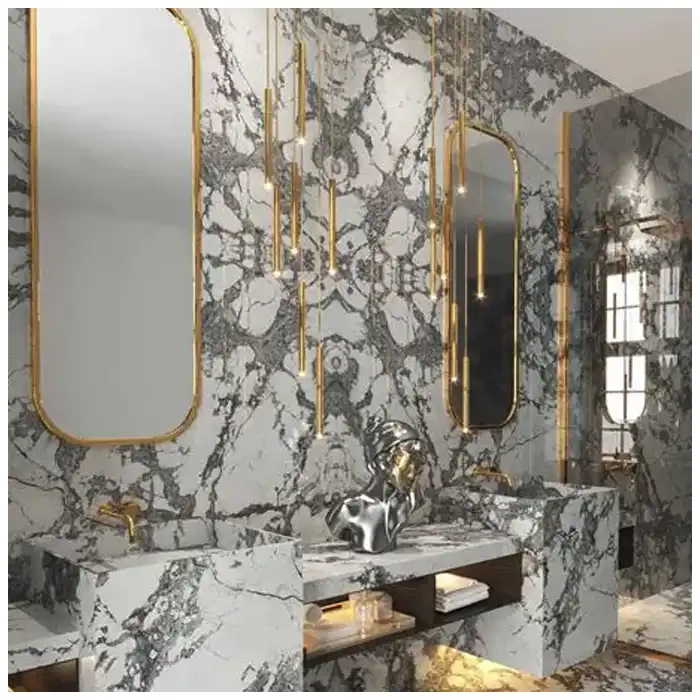
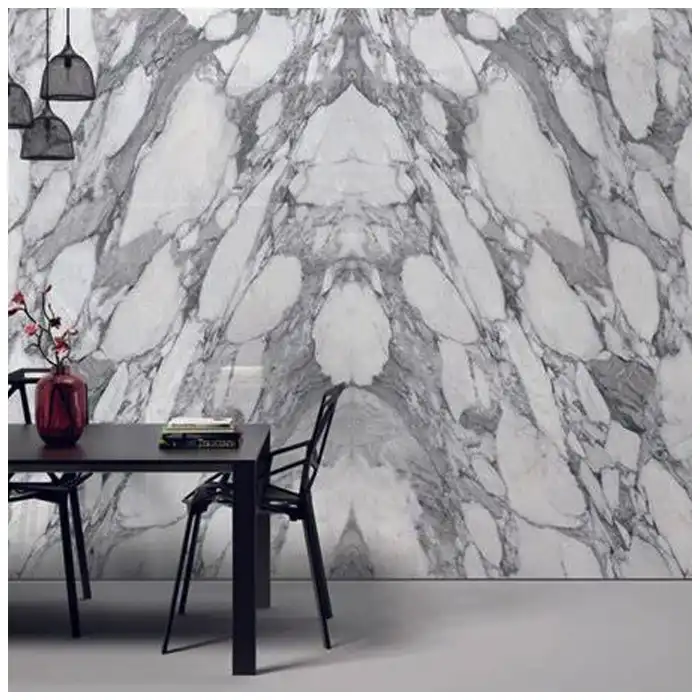
Two adjoining Corchia faces can open into something unexpectedly quiet. The dark mineral band divides at the saw cut and returns on the opposite side, while a pale cloud spreads outward like breath on glass. Move back several metres, though, and the same pair may become a hard black V that dominates every object below it. That change in scale is the decision. I do not call the reflected option better until I have seen it on the wall, with the doorway, ceiling line and furniture drawn over the stone.
What bookmatched Arabescato Corchia actually means
A true bookmatch normally comes from adjoining faces in a cutting sequence opened like pages. The reflection follows the interior of the block, less the material removed by the saw. Ask for slab and bundle identification and the finishing-face plan. Two visually similar slabs may coordinate well, but they are not a documented bookmatch merely because a rendering mirrors one image.
The paired Arabescato Corchia marble slabs need one photograph that shows both complete faces under the same conditions. Cropped images can hide an undertone shift, repaired edge or reduction in usable area. I want a scale reference, slab numbers, top arrows and an indication of which surfaces will receive the final finish.
Bookmatched Arabescato Corchia retains natural differences across the centre. The saw kerf removes a thin layer, and features can change through the block. A small discontinuity is not proof of false sequencing. The buyer should approve the actual pair rather than rely on a promise of perfect bilateral symmetry that natural stone may not provide.
Compare the bookmatch with the flow
A flow match keeps the major movement travelling in one direction across adjacent panels. It may suit a long wall, corridor or room where the architecture already has a strong centre. Bookmatching creates a reflected centre and can stabilise a broad elevation. I place both options on the drawing before asking which is more dramatic. Drama is cheap when it ignores the room.
An Arabescato Corchia bookmatch can gather attention at a reception desk or central artwork. If the wall’s main object sits off axis, that same symmetry may fight it. A flow match can guide the eye toward the object instead. Composition should respond to entrances, seating and light, not to the assumption that mirror patterns always signal higher value.
Use Quartzite Bookmatch vs Flow Match: Let the Slab Set the Wall Rhythm to understand the two pattern strategies, then return to the selected marble. Quartzite and marble differ in mineralogy and care. The visual planning method transfers; the material expectations do not transfer without review.
I also test a quieter pair. The loudest black-and-white reflection often wins the first screen meeting, but it may tire the room after furniture, signage and art arrive. True luxury is something you never get tired of looking at. Sometimes that means the central vein whispers and the smaller grey branches reward a closer view.
Put the architecture over the stone
Bookmatched Arabescato Corchia needs every fixed opening shown at its finished size. Doors, screens, niches, access panels, sockets and light fittings remove or interrupt the drawing. Overlay them before nesting. If the strongest crossing sits behind a television, the installed wall will not resemble the approved slab image.
The ceiling and floor lines matter too. A suspended ceiling may cover the top of a full-height panel, while skirting or a raised floor removes the bottom. Use the final visible area rather than the nominal wall dimension. I mark the concealed zones in a different colour so nobody mistakes them for part of the composition.
With bookmatched Arabescato Corchia, a centre joint can align to the room axis, but it also has to align to buildable panel sizes and the attachment design. Do not shift a joint for appearance without checking the support and substrate. Conversely, do not let an arbitrary module divide the only viable reflection when another engineered joint arrangement is possible. The design team must resolve both.
A full-height Arabescato Corchia marble panel may include local fills or reinforced areas. Map them under raking light. The fabricator decides whether a feature affects machining, handling or the intended fixing. A dark natural vein is not automatically a crack, and an invisible resin repair is not automatically irrelevant. Location gives each observation meaning.
Scale changes the strength of symmetry
At slab distance, the eye follows small mineral details. At room distance, it sees large dark and light masses. Print or project the elevation at a useful scale and stand where the visitor will first see it. Then approach the wall. A good layout should hold together at both distances without needing an explanation of the chosen pattern.
A four-panel Arabescato Corchia bookmatch can create two mirrored pairs, one larger kaleidoscopic centre or another sequence depending on the faces. Each option needs actual slab evidence. A digital repetition of one pair may imply material that does not exist. Count the available adjoining faces and reserve them before designing the final repetition.
Horizontal orientation changes the reading again. A diagonal band that rises vertically may become a broad horizon across a low wall. The stone’s internal structure has not changed, but the architecture has given it another direction. Check whether the chosen orientation fits usable slab dimensions and any directional test or fabrication information.
The selection approach in How to Choose Statement Slabs for Countertops, Walls, and Furniture helps compare visual scale across applications. For this wall, I would go further and attach the slab crop to the final elevation revision. A beautiful full face remains only raw material until its visible boundaries are fixed.
The centre joint deserves close inspection
Bring the adjoining faces together with spacers representing the intended joint. Look at the dominant vein first, then at the pale field. If the colour shifts abruptly at the centre, a mirrored line may emphasize rather than hide it. Adjusting the crop can help, but do not crop away required edge allowances or move into a rejected zone.
The final finish affects the joint. Polished faces reflect the viewer and room, which can make a slight plane difference more obvious. Honed faces diffuse light, but an inconsistent hone across the pair can produce separate levels of grey. Process both faces under controlled conditions and compare them together before cutting the remaining panels.
For bookmatched Arabescato Corchia, the centre may also contain a mitred internal or external corner rather than a flat joint. A corner is not a mirror plane. The return needs its own source and direction, and the viewer sees it from changing angles. Model the corner with physical pieces or a dimensioned layout instead of bending a flat image around it.
Joint colour should support the stone without pretending to erase the separation. Test the chosen material against the polished or honed edge and check compatibility with marble. A colour selected from a screen may dry differently. The installer follows the specified joint system; the visual team approves its relationship to the actual pair.
Light can flatten or deepen the pattern
Diffuse daylight lets the white field and fine grey threads remain visible. Strong grazing light can reveal surface waviness, fills and polish variation. A spotlight may deepen one black band while washing out a pale one. I study the wall under the intended fixture positions, not under a row of warehouse lamps chosen only because they make every slab look rich.
The marble feature wall layout should include fixture locations and beam direction. A light centred on the bookmatch can reinforce symmetry. An off-axis wash may make one half look stronger. This is sometimes a lighting-design issue, not a stone mismatch. Keep the same illumination when comparing panels and document it before approving corrective work.
Bookmatched Arabescato Corchia does not become translucent because a dramatic photograph appears luminous. Marble may transmit some light at thin edges or in certain crystalline zones, but a conventional wall panel is not an onyx lightbox. Test the actual stone and thickness if transmission matters. Do not sell reflected polish as backlighting.
Fabrication should preserve the sequence
The final bookmatched Arabescato Corchia nesting plan identifies slab, face, panel position, top direction, joint and usable boundary. It should also show allowances for edge processing and attachment work. I want each cut component traceable to the approved elevation. If production optimises yield by moving a panel, the visual sequence changes and needs another decision.
Large panels require project-specific handling, lifting and support. The responsible fabricator and engineer use actual dimensions, thickness, stone information and site access. I avoid universal size limits. A panel that can be fabricated may still be impractical to turn through the building or lift into its final wall position.
If the design uses Bookmatch White Marble as a product reference, confirm that the reserved faces are specifically Arabescato Corchia and match the approved record. Category language can help browsing; it cannot replace slab identity. Every layout needs physical marks that follow the pieces through finishing and packing.
Protect those marks without contaminating bond areas. Stage the panels in installation order and keep a printed or digital orientation map with the crew. One swapped pair can invert the visual centre. The installer should be able to check the sequence before applying adhesive or engaging concealed fixings.
When symmetry is the wrong answer
Reject the bookmatch when the reflected centre overwhelms the room’s function. A lobby already filled with art and signage may need calmer movement. A narrow wall can make a broad V feel compressed. The stone is not at fault; the selected arrangement is asking it to do too much.
Required openings can destroy the reflection. Reject the bookmatch when the remaining pieces lose their relationship. Moving a door or service panel for stone aesthetics may not be possible. A flow match or independent panel composition can use the same slabs more honestly. I prefer a deliberate asymmetry to a broken mirror that still carries the bookmatch label.
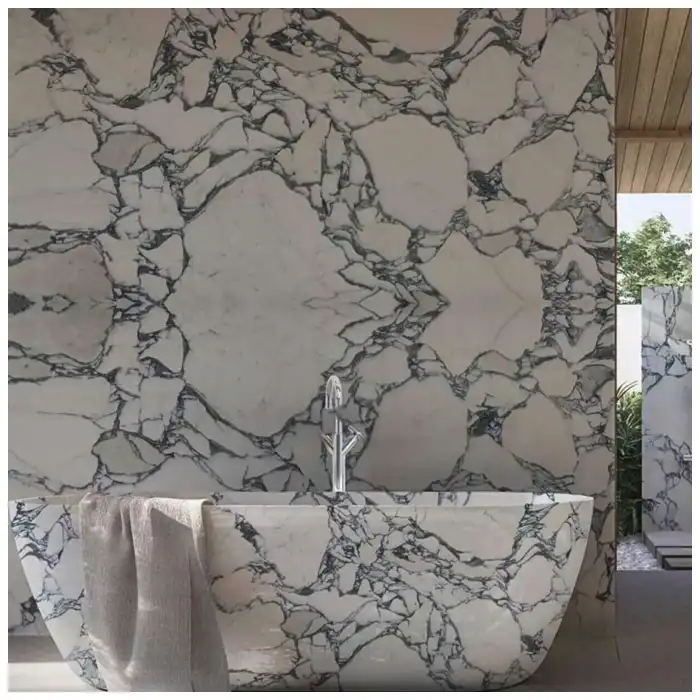
The physical slab sequence can also rule out the proposed mirror arrangement. Digital mirroring cannot create another adjoining slab. If a later replacement is likely, discuss spare material and acceptable alternatives before fabrication. Natural stone cannot offer indefinite pattern replication.
A compressed screen view is the last warning. Do not approve the layout until the designer sees it at architectural scale. The smaller the screen, the easier it is for strong symmetry to appear controlled. Review the full layout at architectural scale and retain an approved physical finish reference. The stone deserves a decision made at the size in which it will live.
Natural variation is part of the value
Luxury Natural Stone Slabs and Furniture: Complete Guide to Materials, Applications, Edges, Lighting, and Support gives the broader context for this wall choice. Manufactured marble-look panels can repeat a designed graphic with controlled production variation. Natural marble records mineral change through its body. Cut an edge, open an adjoining face or move raking light across it, and the pattern continues to reveal material depth rather than only a printed surface. That difference carries beauty and responsibility.
The comparison in Natural Quartzite vs Marble-Look Sintered Stone: The Definitive Comparison for Premium Interiors explains why performance and visual origin must be assessed separately. Arabescato Corchia is marble, not quartzite, so its acid sensitivity and care differ. Its natural bookmatch still shares the essential value of authentic stone: the selected faces cannot be ordered again from a pattern catalogue.
I would preserve full-slab photographs, the final elevation and one finish offcut with the project record. Those materials help future teams understand what was approved if a panel needs investigation. They also prevent a later camera image under different light from becoming the only evidence of the original pair.
| Decision | Bookmatch question | Flow-match question |
|---|---|---|
| Room axis | Does the reflected centre support the main sightline? | Does the movement lead toward the intended object? |
| Openings | Does the void remove the visual centre? | Can the flow continue around or beyond the opening? |
| Available slabs | Are true adjoining faces documented? | Can consecutive movement be traced across panels? |
| Joints | Does the centre colour remain controlled? | Do line endings remain deliberate at each joint? |
| Light | Will centred or grazing light exaggerate one half? | Will directional light interrupt the intended movement? |
The Hard-Won Lesson: Bookmatched Arabescato Corchia cannot come from a copied image
A designer can duplicate one slab image, flip it and build a four-panel wall around that perfect repetition. The reserved bundle may contain only one adjoining pair, with the next faces carrying a different dark band. Production then has to choose between abandoning the render or repeating a pattern the stone cannot supply. I now count and identify the physical faces before approving any multi-panel symmetry.
The Lesson: Design the repetition from reserved slabs, not from a copied image.
What earns the final layout approval
The material relationship is traceable
Bookmatched Arabescato Corchia needs documented adjoining faces and an agreed finishing direction. I want every panel tied to a real slab, not a mirrored placeholder in a rendering. The saw sequence and usable boundaries set the vocabulary from which the wall can be composed.
The architecture remains present
The approved elevation includes openings, joints, ceilings, floors, furniture and lights. Symmetry is assessed inside that room rather than on a blank page. When an architectural input changes, the stone composition returns for review because the visible crop and balance may change with it.
A site mismatch is contained first
If two installed panels do not follow the approved sequence, photograph the full wall, centre joint, piece labels and lighting before moving or cleaning them. Pause the affected installation. Send the supplier the site record with the original slab map and dry-layout images so orientation, substitution and appearance can be compared before any irreversible work.
Frequently Asked Questions
1. Is bookmatched Arabescato Corchia always made from consecutive slabs?
A true bookmatch normally relies on adjoining faces from the cutting sequence. Ask for slab and bundle identification plus the intended finished faces. Similar-looking or digitally mirrored images do not establish that relationship. Approve the physical pair because saw loss and natural change can prevent perfect reflection.
2. Is bookmatch better than flow match for a feature wall?
Neither is inherently better. Bookmatching creates a reflected centre; flow matching carries movement in one direction. Test both on the final elevation with openings, furniture and lighting. Choose the one that supports the room rather than the one that looks most dramatic on an isolated slab image.
3. How many panels can one bookmatched pair create?
That depends on slab dimensions, usable areas, wall geometry and the selected pattern. One adjoining pair can create two principal faces, but additional panels require actual material and a planned sequence. Do not design repeated symmetry by copying images unless the reserved slabs can physically produce it.
4. Should the centre joint be as narrow as possible?
The joint design follows the attachment or installation system, movement needs and project requirements. Represent the intended width during dry layout because it changes vein continuity. A photograph with faces touching cannot serve as an honest approval if the installed joint will be wider.
5. What should I do if one panel appears darker on site?
Photograph both panels under the same light, including labels and the full wall. Pause installation around the affected location. Compare finish, orientation, moisture condition and the approved slab sequence, then contact the supplier with the original inspection records before treating or rearranging the stone.
Final Conclusion
Bookmatched Arabescato Corchia belongs on a wall only when the reflected centre improves the architecture and the physical slab sequence can produce it. Compare a flow layout, include every opening and light, then preserve the numbered faces through fabrication. At MQ STONE, I would rather keep a natural composition slightly asymmetric than force this marble into a perfect mirror that exists only on a screen.
References
- Dimension Stone Design Manual, Natural Stone Institute.
- Marble, Onyx, and Serpentine, Natural Stone Institute.
- ASTM C503/C503M Standard Specification for Marble Dimension Stone, ASTM International.
- ASTM C1721 Standard Guide for Petrographic Examination of Dimension Stone, ASTM International.
- Natural Stone Care and Cleaning, Natural Stone Institute.
- Stone Cladding Technical Guidance, Stone Federation Great Britain.
- Bookmatching, Wikipedia.