Ariston White Marble: How Its Crystalline Surface Changes with Light
A pale crystalline slab can read almost matte under a high diffuse ceiling, even when the face has been polished. Bring a narrow beam in from the side and points of light begin to travel across the grains. Fine mineral lines sharpen, then soften again as I move. The slab never offers the same surface twice.
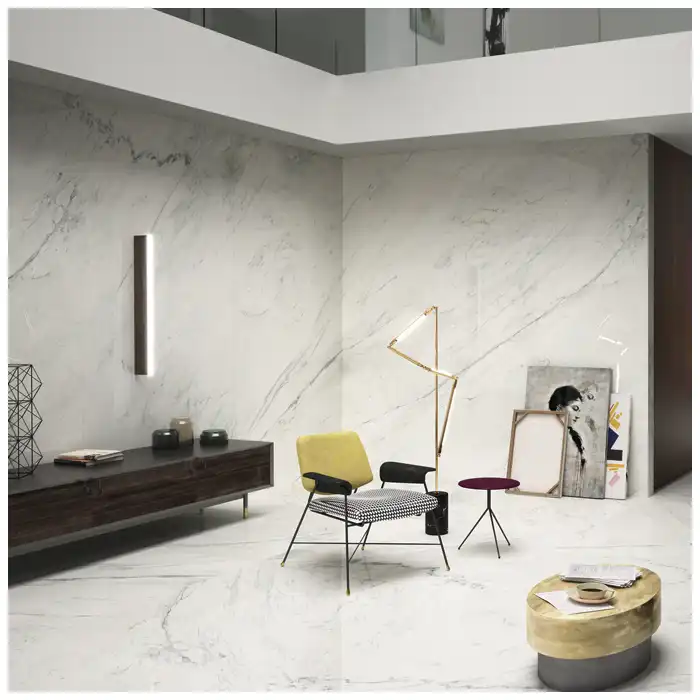
Für Ariston White marble, I study light as movement rather than a single photograph. I compare diffuse, directional, warm, cool, face-on, and grazing views before I choose the finish and the scale of the application. The veins tell you where the composition runs; the crystals tell you how the room will see it through the day.
Read Crystal Scale across the Complete Face in Ariston White Marble
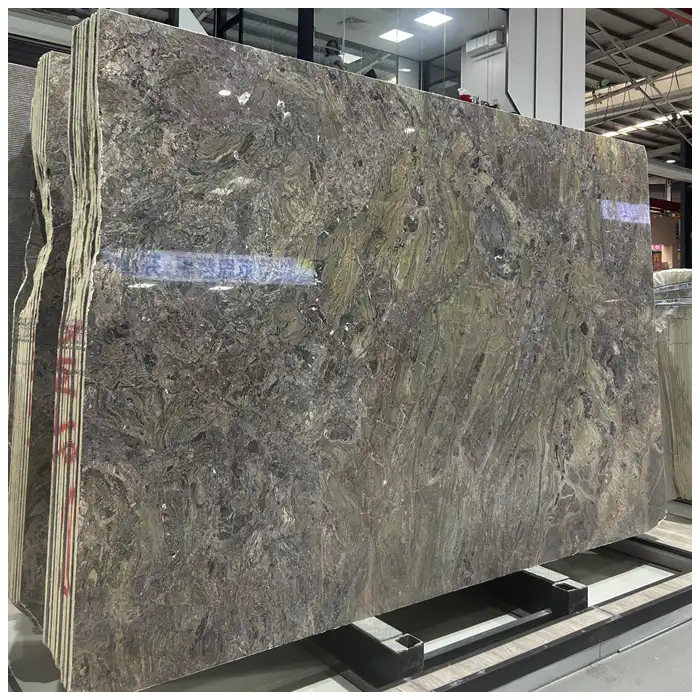
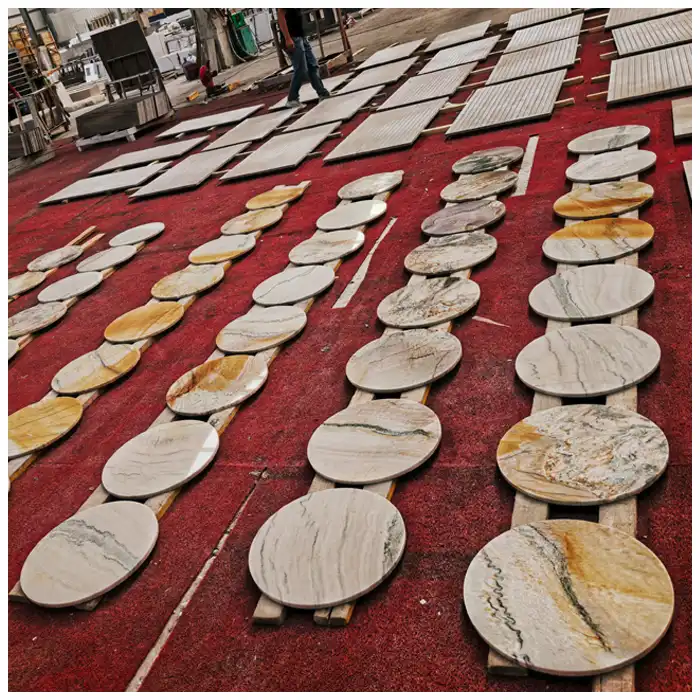
A full slab holds more than one white. Beside diffuse daylight I let my eye travel the crystalline field, noting grain size, the faint grey lines, and any healed fissures that sit quietly in the surface. Front light flattens all of it. The face looks calmer than it is, and that calm can fool an approval made from a single photograph. I keep two records for every project: a full-face study that carries the compositional decision, and a side-light view that tells the workshop how to hold the stone after cutting. A spare offcut preserves the visual weight of a warm passage I might otherwise lose in layout. The detail has to survive joints, openings, edges, and supports without turning into noise.
I place this reading within Luxury Natural Stone Slabs and Furniture: Complete Guide to Materials, Applications, Edges, Lighting, and Support, where full-face character, finish, fabrication, scale, and material value stay connected.
Compare Diffuse Light with Grazing Light
Ariston White marble reads differently under the two light regimes that most often decide an interior. Diffuse light keeps the face quiet and even; grazing light drags grain boundaries, lips, and resin fills into view. I lower my viewpoint toward a warm passage and map quiet against active, checking whether the warmth belongs to the stone or to the room around it. A wall elevation seen from across the room is not the same object as a slab studied at arm’s length, so I walk the face under side light before I commit to any crop. A small sample can hide the fact that grazing light exposes repairs that front-on approval missed.
In Ariston Weiße Marmorplatte, I look for the mineral depth and full-face movement that will still persuade after cutting and installation.
Color temperature changes what the eye calls white. A 3000K warm lamp pulls cream and gold passages forward and can make a cool slab read pink; 4000K and daylight pull that warmth back and provide a cooler comparison condition rather than a final reading of the undertone. I hold the current sample under the lamps the room will actually use, then again under daylight, and keep both readings in the approval file. A slab judged under one temperature has not been judged yet.
Separate Undertone from Reflected Room Color
Undertone is the single most misread quality in a white marble. A dining top under a warm pendant picks up the lamp’s glow and passes it off as stone warmth. I read the faint warm passage from edge to edge, then move the same sample into cooler light to see what actually belongs to the slab. I keep a movement map and finish samples together, oriented the same way, so a later piece can follow the quiet zone under diffuse light without flattening it. The second reading concerns sparkle under grazing light. Polish can tip into glare at the main approach, so I compare current polished and honed samples before I commit to either finish.
| Decision point | Evidence to inspect | Release condition |
|---|---|---|
| Full face | Crystal scale, pale lines, warm and cool passages | Selected range reads coherently at distance |
| Light direction | Diffuse, face-on, side, and grazing views | Depth appears without unacceptable glare |
| Oberfläche | Current polished and honed samples | Reflection, touch, and feature visibility suit the use |
| Fabrication | Crop, joints, edges, openings, repairs, supports | Bright passages remain composed after cutting |
| Companions | Faces compared under identical lighting | Future work keeps a similar light response |
The Hard-Won Lesson: A polished sample can approve sparkle and hide glare
A small polished piece catches side light beautifully on a sample table. On a broad wall opposite a window, the same reflection washes out the crystalline drawing from the main approach. The material still has depth, but the room cannot see it through the glare.
The Lesson: Approve polished stone from the actual viewing path, not only beneath a sample lamp.
Choose Polish or Hone for the Intended Movement
Polish reveals depth quickly; hone makes the surface quieter and more tactile. For Ariston White marble the choice is not aesthetic preference alone. It is a decision about how fast the crystals give themselves up to the eye. I study the quiet zone under diffuse light, then overlay the application crop to see whether hone suppresses too much crystalline contrast. At a polished edge in grazing light I stand back before tracing the sparkle, because glare at the main approach is the common failure. A dining table wants the light to move across the top; a bathroom wall can afford more restraint. I make the call only after both finishes sit in the actual room, under the actual lamps.
Hone also changes how much the grain shows water marks and fingerprints, not only how it reflects light. On a dining top, a honed face can hide light scratches better than polish on many stones, but the outcome depends on crystal scale, finish quality, cleaning habits, and a real-sample test, and honing can still mute the sparkle that makes the crystal feel alive under a pendant. On a wall that nobody touches, polish can be the lower-risk choice, yet only when a current sample confirms the reflection stays composed from the main approach. I let the maintenance routine and that sample check, not the showroom table, settle the finish.
Place the Brightest Passages away from Glare
The brightest passage in the slab often deserves protection, and it is rarely the area to aim straight at a window; the geometry of the room decides how much of that brightness the eye can accept. I compare the quiet and force around a honed sample beside pale timber, watching how the polished window reflection moves as I walk past the face. A joint cut through a long luminous passage interrupts the composition, so I place joints before nesting. The cutting release carries a scaled crop and joint overlay so fabrication does not reduce the slab to disconnected dimensions. Later interventions do not have to reinterpret the intent behind a honed, softened grain.
I study Ariston Weiße Marmorfliese under side light before deciding where its crystalline passages should meet an edge, joint, or support.
When I place a joint, I cut through the quieter zone rather than the brightest passage, so the composition does not end in a hard line of reflected light. I scale the crop before nesting, then walk the paper template under the actual lamps to confirm the bright areas stay composed at arm’s length and from the doorway. The drawing is the plan; the walk is the test.
Record each glare approval with the details that let someone reproduce it: the date, the room position, the window or lamp geometry, the viewing distance, the finish on the tested sample, and the photo IDs taken from the main approach. File that shot beside the slab ID and the approved finish, because a glare finding recorded without its viewing geometry cannot be re-checked once the stone is installed.
Carry Crystal Depth through Edges and Furniture
At close range the honed, softened grain is where edge work shows its quality. I inspect edges and repairs closely, because edge build-up misaligns the grain response and reads as a fault line under side light. Two companion faces standing together must share the same rhythm; otherwise a joint interrupts a long luminous passage and the finished object suffers. Before the crop is released I return to Luxury Natural Stone Slabs and Furniture: Complete Guide to Materials, Applications, Edges, Lighting, and Support and ask whether the detail still preserves the larger composition.
Keep Companion Slabs within the Same Light Response
Companion material needs the same light test as the hero slab. Two faces can match head-on and separate under side light because crystal scale or finish differs. Returning to a quiet crop framed for furniture, I follow the honed, softened grain across the whole face, then pair an edge mock-up with a support drawing before fabrication. Returns and later additions should continue the direction the joint established across a luminous passage. I reserve visible replacements only after comparing them beside the selected faces under identical lighting.
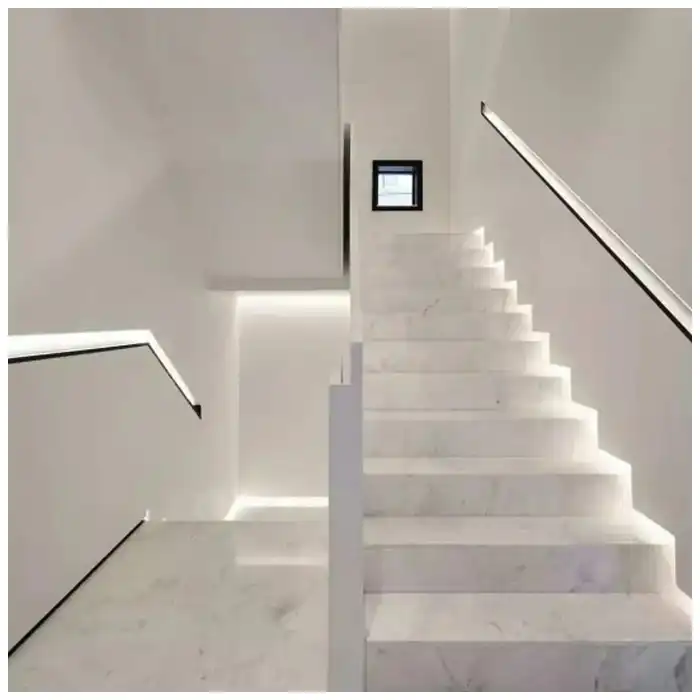
Companion faces also need to come from a close batch, because crystal scale and base tone shift between quarry blocks even under one trade name. I reserve the companion slabs by lot and photograph them beside the hero face under the same light before cutting. A return added from a different batch will announce itself as soon as the side light moves across it.
When Crystalline White Stone Feels Alive rather than Bright
Light must move across the face
A single front photograph compresses the changing relationship between grain reflection and fine mineral lines. If a face shows no change across three viewing angles, I treat that as a prompt to check the current finish, the lighting geometry, and a physical sample again before accepting the face as plain white; flatness under three lights alone is not proof of over-processing or mis-finishing.
Finish controls the pace of discovery
Polish reveals depth quickly while hone makes the surface quieter and more tactile. I choose polish when the room’s light is diffuse and the crystals need to catch it; I choose hone where glare risk, traffic and the cleaning regime make a mirror surface harder to live with, and I confirm that choice on a full-size sample in the room light.
Architecture gives the crystals scale
Wall distance, table height, edge detail, and joint rhythm decide whether sparkle becomes character or distraction. If the brightest passage sits at eye level opposite a window, the sparkle can read as glare; whether it does depends on the room geometry, the finish, the lighting and the actual sample.
Geology keeps the description honest
Mineral description should remain careful. Commercial Ariston supply is sold as a Greek-origin marble, and our product data describes a white dolomitic background crossed by calcite lines; precise mineral composition belongs to the current lot documentation rather than the trade name. Beauty does not turn a trade name into a laboratory result.
Color temperature changes perceived warmth, while spectral distribution and surrounding finishes also matter. A 3000K lamp, pale oak, and cream plaster can make a white slab read warmer; cool daylight and stainless steel can pull it the other way. Compare the complete palette before you name the undertone.
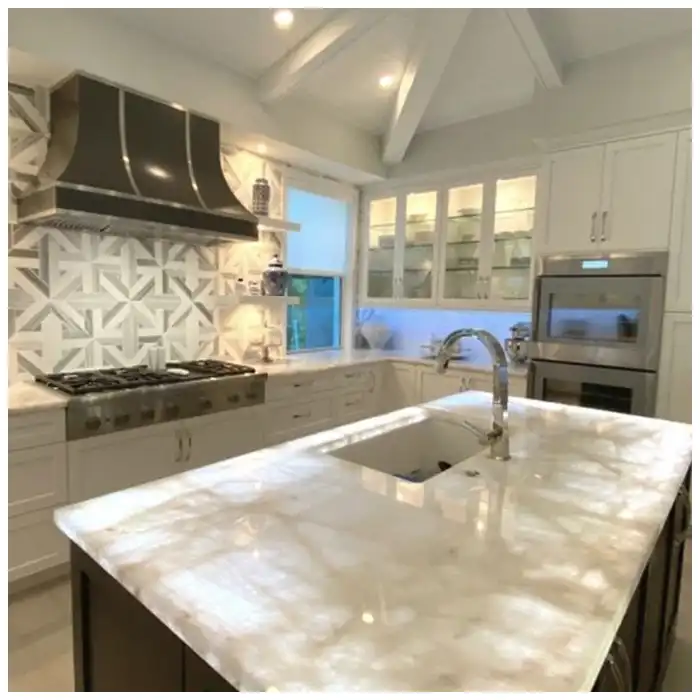
A dining table creates a moving ring of reflections beneath a pendant. Study the full top from standing and seated positions, then check the edge where crystal scale and any repair become close. Structural support remains a separate engineering and fabrication decision.
For wall panels, photograph the elevation from the principal approach and from one grazing angle. The first tests composition; the second exposes texture, lips, repairs, and reflection changes. Neither view should replace the other in the approval file.
I take one last look at the pale grey mineral line from a dining top under a warm pendant and compare current finish samples. The added angle tests whether the crop can carry its place in the complete object, and whether the warmth was ever in the stone at all.
Frequently Asked Questions
1. What makes Ariston White marble look crystalline?
Its visible mineral grains reflect light at changing angles. The exact appearance varies by slab, finish, crystal scale, and viewing conditions, so I always judge it under the room’s own light.
2. Does Ariston White marble always look pure white?
No natural slab should be promised as one absolute white. Current faces may carry grey, cream, or warm passages that need controlled comparison beside the surrounding materials.
3. Is polished or honed finish better?
Polish can deepen reflection and sparkle; hone softens both. Choose from actual samples under intended light and inspect repairs and cleaning needs before deciding.
4. Can this marble be used for furniture?
It can when the crop, thickness, edge, support, repairs, finish, and care suit the object. Pendant lighting and seated viewing deserve direct study before you commit.
5. What should happen if the installed surface produces strong glare?
Work in three steps. First, photograph the complete approach under known lighting, including the window or lamp position. Second, pause any further finish alteration or cleaning. Third, send the images together with slab IDs and approval views to your supplier for comparison before any remedial work.
Quick-Reference Checklist for Ariston White marble
- View full faces under diffuse light.
- Add side and grazing-light passes.
- Compare undertone beside the room’s materials.
- Test current polished and honed samples.
- Overlay crop, joints, edges, and supports.
- Reserve companions by light response.
Final Conclusion
Crystalline white stone belongs where full-face range, light direction, finish, crop, joints, edges, repairs, and companion slabs let depth remain visible without uncontrolled glare. The room must participate in selection. The approved Ariston White marble must stay connected to the records, physical references, and application decisions that made it acceptable. This stone has been waiting for millions of years, and MQ STONE would rather move the light once more than reduce that crystalline record to a flat white photograph.
References
- Marmor, Wikipedia.
- Standard Terminology Relating to Dimension Stone (ASTM C119), ASTM International.
- Standard Specification for Marble Dimension Stone (ASTM C503), ASTM International.
- Natural Stone Finishes Technical Guidance, Natural Stone Institute.
- Stone Selection and Use Guidance, Natural Stone Institute.
- Ariston Natural Marble, Sourcing Stone product data.
- Ariston Pure White Marble Worktops, In2stone.
- Search Essentials, Google Search Central.