Quick Summary: Arabescato Corchia Marble for Vein-Led White Marble Interiors
Arabescato Corchia-Marmor is an Italian white marble with a crystalline white-to-ivory background interrupted by strong grey, charcoal, and grey-brown brecciated movement. Its pattern is best retained across kitchens, floors, walls, stairs, and larger architectural pieces where adjoining cuts can be planned together. Slab approval should therefore establish the acceptable vein density, finish, usable area, and cutting direction before fabrication begins.
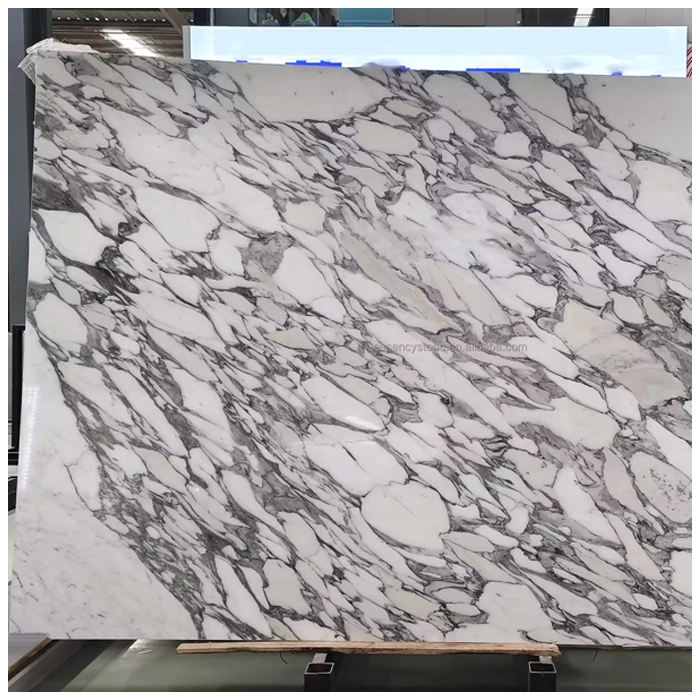
Italian Arabescato Corchia Marble with Bold Grey Breccia MovementArabescato Corchia has more visual structure than a soft, evenly veined white marble. Grey and charcoal lines break into broader brecciated fields, while ivory and white areas remain visible between the darker mineral movement. That variation affects cutting decisions. A kitchen island may benefit from one broad flowing section, while wall panels or stairs can require several compatible areas from the same slab group. Full-slab photographs are therefore more useful for layout approval than a small sample alone.
|
|
Slab reference for checking white background, darker breccia areas, usable cutting zones, and possible panel continuity. |
Closer view for judging vein density, ivory clasts, grey-brown movement, and the contrast expected after polishing. |
Why the Brecciated Pattern Matters When Specifying Arabescato Corchia Marble
| Pattern Scale | Broad grey movement may cross a large part of the slab, so the finished appearance changes substantially depending on where a countertop, wall panel, or tile is nested. |
| White-to-Grey Balance | Some slabs read brighter and whiter; others contain heavier grey or charcoal movement. One visible project zone should be selected from a compatible range. |
| Panel Continuity | Large walls, backsplashes, islands, and stair runs benefit from piece sequencing so major veins do not stop or change direction unintentionally at every joint. |
Product Overview: Arabescato White Marble with Grey and Charcoal Breccia Veins
Arabescato Corchia is a natural Italian white marble associated with the Tuscany and Carrara marble district. Its appearance combines crystalline white and ivory areas with irregular grey, grey-brown, and darker mineral movement, creating the fragmented brecciated character associated with Arabescato marble.
Polishing increases brightness and separates the darker veins more clearly from the white field. Honing reduces reflection and gives the same pattern a quieter reading. Because the material is natural, colour balance, vein scale, fissures, and mineral boundaries should be reviewed on the actual slab group used for the project.
Technical Specifications for Arabescato Corchia Marble Slabs and Cut-to-Size Stone
| Produktname | Arabescato Corchia-Marmor |
| Material | Natural Italian white marble |
| Related Names | Arabescato Marble, Arabescato Corchia Marble Slabs, Arabescato White Marble, Italian white marble, natural white marble |
| Visual Character | White to ivory crystalline field with grey, charcoal, and grey-brown brecciated movement |
| Slab Reference | 1800up×600upmm, 2400up×1200upmm, 2800up×1500upmm, plus custom dimensions according to available slabs |
| Current Thickness Reference | 10mm, 12mm, 18mm, 20mm, 30mm listed in the primary product summary; legacy page tables also contain other thickness references, so final availability should be confirmed before ordering |
| Main Finish | Poliert, geschliffen |
| Fabricated Forms | Slabs, tiles, countertops, vanity pieces, wall panels, stairs, columns, backsplashes, and project cut-to-size stone |
| MOQ | 300 SQM |
Polished slab approval should establish the acceptable contrast between the brighter field and darker mineral areas before individual pieces are assigned to kitchens, walls, floors, or stairs.
Slab Mapping, Vein Flow, and Cutout Placement for Arabescato Corchia Marble
| Full-Slab Mapping | Overlay the principal finished pieces onto slab photographs before cutting so broad veins and quieter white areas can be assigned deliberately. |
| Bookmatch | Where suitable companion slab faces are available, a mirrored layout can be reviewed for feature walls or large decorative panels. The match should be confirmed before fabrication. |
| Kitchen Cutouts | Locate sink and cooktop cutouts after the preferred pattern zones are selected so a major vein or clean white field is not removed unintentionally. |
| Seam Position | Position seams with the pattern in mind, especially on islands and long counters where a poorly placed joint can interrupt a dominant grey vein. |
| Floor Dry Layout | Sort cut pieces by background tone and vein intensity before installation when a large floor is supplied from several slab areas. |
The cutting map should be locked while the selected slab images and project drawings are viewed together, rather than treating fabrication and aesthetic approval as separate steps.
Arabescato Corchia Marble for Kitchen Islands, Countertops, and Backsplashes
Kitchen fabrication should coordinate the slab pattern with seam position, sink cutouts, cooktop cutouts, exposed edges, waterfall returns, and backsplash panels. A strong grey vein can be used as the visual centre of an island, while quieter white areas may suit narrower countertop sections or returns.
Because Arabescato Corchia is natural marble, daily-use expectations should also be realistic. Acidic foods and cleaners can etch the surface, while sealing helps manage staining but does not make the stone acid-proof. Cutting boards, trivets, prompt spill cleaning, and suitable stone-care products remain appropriate for kitchen use.
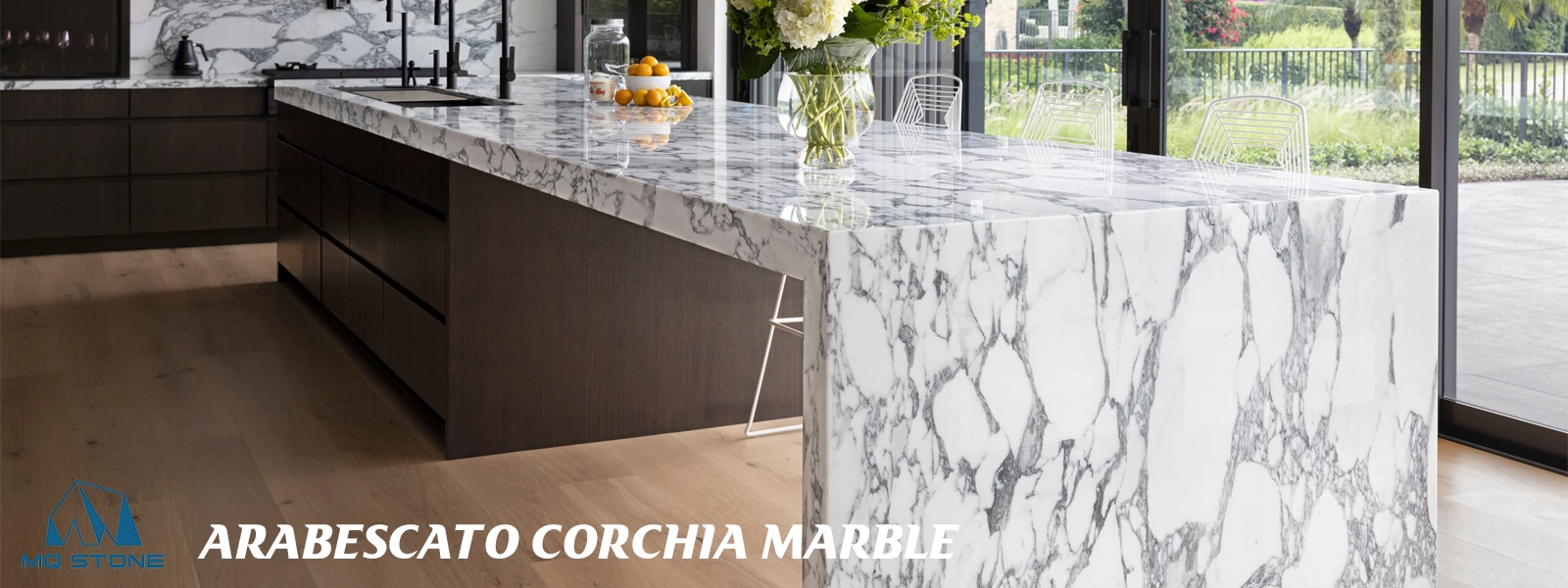
Kitchen reference showing how large grey movement becomes part of the countertop composition once slab selection and fabrication drawings are coordinated.
Arabescato White Marble for Floors, Stairs, Walls, and Connected Interior Areas
| Floor Fields | Group pieces by white-grey balance and vein density before fixing so darker brecciated areas do not collect unintentionally in one part of the room. |
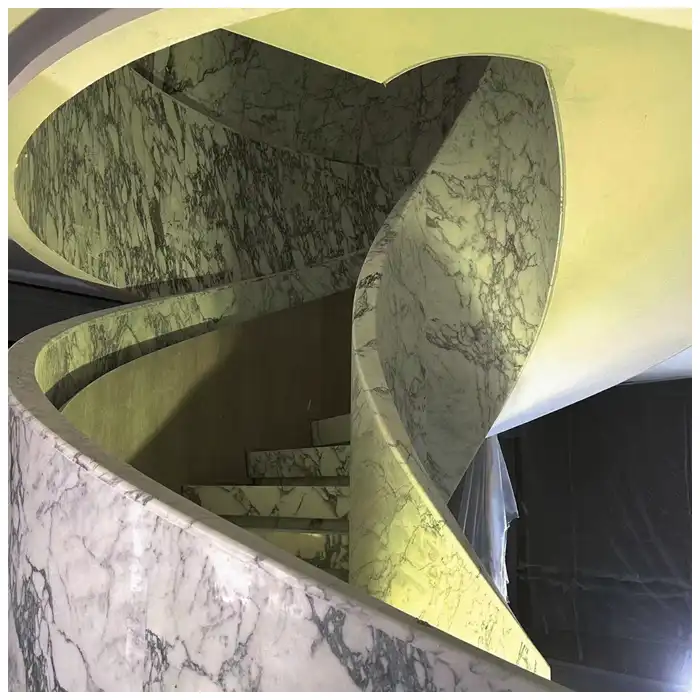
| Stair Runs | Coordinate tread and riser direction, nosing detail, skirting pieces, and numbering before production so the pattern remains coherent between levels. |
| Wall Panels | Use panel elevations to decide whether the main vein should continue, mirror, or change direction intentionally across joints. |
| Wet Interior Areas | Match the finish to project-specific slip requirements and treat substrate waterproofing independently from marble sealing. |
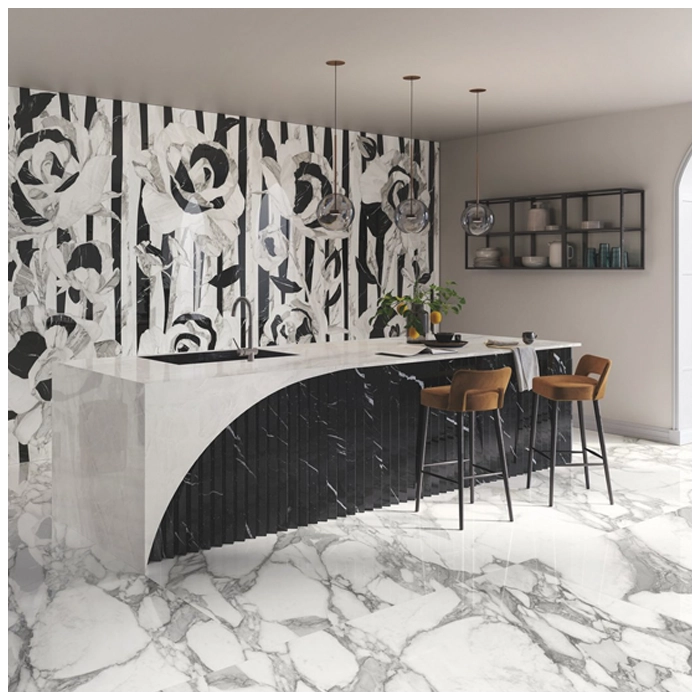
Flooring reference showing why tile grouping and installation sequence matter once the slab pattern is divided into multiple pieces.
Arabescato Corchia Marble Compared with Red, Black, Gold, and Dark Grey Marble
| Material | Visual Direction | Where the Difference Matters |
| Arabescato Corchia-Marmor | White and ivory field with strong grey, charcoal, and brecciated movement. | For buyers who want an expressive Italian white marble rather than a quiet uniform surface. |
| Arabescato Orobico Rosso Marble | Burgundy, rose, red, grey, cream, and white movement. | A warmer statement direction when red mineral fields should dominate the interior. |
| Schwarzer Aziza-Marmor | Deep black field with white and gold veining. | Creates a much darker graphic contrast for floors, counters, walls, and vanity surfaces. |
| Calacatta Oro Gold Marmor | White Italian marble with grey and warm golden veining. | Works where warm gold accents are preferred over the cooler grey breccia of Arabescato Corchia. |
| Bardiglio Dunkle Marmorplatten | A dark grey marble direction rather than a white marble field. | Useful when the design requires a deeper grey base and lower overall brightness. |
MQ STONE Slab Sorting, Fabrication QC, and Packing for Arabescato Corchia Marble
Material control should begin with slab allocation. Before fabrication, review the selected pieces for white-grey balance, vein direction, visible natural fissures or repairs, usable dimensions, surface finish, and the location of the principal finished components on each slab.
After cutting, inspect dimensions, edge work, polish or hone consistency, cutout geometry, visible-face direction, and piece codes against the approved drawings. Full slabs need supported bundle packing, while countertops, stairs, tiles, and wall panels require reinforced crates, separation between finished faces, edge protection, and installation-zone identification.
Order Execution Risks for Arabescato Corchia Marble Slabs and Fabricated Pieces
- Slabs with very different white-grey balance can look disconnected when mixed across one island, feature wall, or connected floor area.
- Sequenced panels can lose the intended vein flow if numbered pieces are split between crates or rearranged on site.
- Countertops with sink or cooktop cutouts need extra handling support around narrow stone bridges and internal corners.
- Long stair treads, backsplash strips, and narrow wall components require packing support matched to their geometry.
- Polished and honed pieces should be identified separately when both finishes are included in the same project shipment.
Care and Maintenance for Polished Arabescato White Marble
Use pH-neutral natural-stone cleaner, clean water, and non-abrasive tools. Avoid vinegar, citrus-based cleaners, aggressive descalers, and other acidic products because natural marble can etch. For countertops, clean spills promptly and use cutting boards and trivets. Sealing can assist with stain management, but the interval depends on finish, use, exposure, and the selected sealing system.
Common Specification Mistakes for Arabescato Corchia Marble
- Approving only a small white marble sample without defining the acceptable grey-vein density across full slabs.
- Releasing kitchen drawings before slab orientation, seam position, sink cutouts, and backsplash relationships are locked.
- Requesting a bookmatch without first confirming that suitable companion slab faces are available.
- Mixing polished and honed finish notes between drawings, schedules, and purchase documents.
- Ordering floor pieces without a dry-layout or tone-grouping plan for larger continuous areas.
- Using legacy thickness references from the old page without reconfirming the actual thickness required and currently available for the order.
FAQs About Arabescato Corchia Marble
What is Arabescato Corchia Marble?
Arabescato Corchia Marble is a natural Italian white marble from the Tuscany marble district with a white-to-ivory crystalline field and strong grey, charcoal, and grey-brown brecciated movement. It is fabricated for slabs, floors, walls, countertops, stairs, vanity pieces, columns, and custom stonework.
What slab sizes are listed for Arabescato Corchia Marble Slabs?
The existing MQ STONE page lists common slab references including 1800up×600upmm, 2400up×1200upmm, and 2800up×1500upmm, with custom dimensions depending on the selected material. Actual usable slab size should be confirmed before cutting.
Which thickness should be specified?
The current product summary lists 10mm, 12mm, 18mm, 20mm, and 30mm, while legacy tables on the old page contain additional references. The purchase order should therefore state the required thickness and confirm current availability rather than relying on all historic values.
Is polished or honed Arabescato Corchia Marble better for a project?
Polished marble gives stronger brightness and vein contrast, while honed marble reduces reflection and produces a softer surface. The choice should follow the application, lighting, maintenance expectations, and any project-specific slip requirement.
Can Arabescato Corchia Marble be used for kitchen countertops?
Yes. For kitchens, slab orientation, seams, sink and cooktop cutouts, edge profiles, backsplash pieces, support, sealing, and marble-specific care should be resolved before fabrication.
Should Arabescato Marble flooring be dry laid before installation?
Dry layout is useful for larger floors because the natural white background and grey breccia movement vary between pieces. Sorting allows the installer to control tone distribution and vein direction before fixing.
How should Arabescato Corchia wall panels or countertops be packed?
Finished pieces should use reinforced packing appropriate to their geometry, with separation between finished faces, protected edges, and piece codes that correspond to the fabrication drawing and installation schedule.
How should Arabescato Corchia Marble be cleaned?
Use pH-neutral natural-stone cleaner, clean water, and non-abrasive tools. Avoid acidic cleaners, vinegar, aggressive descalers, and harsh abrasives because natural marble can etch and lose polish.
What Buyers Should Confirm Before Ordering Arabescato Corchia Marble by the Slab
The important approval is not simply “Italian white marble.” Buyers should agree on the actual white-grey range, dominant breccia movement, usable slab dimensions, finish, thickness, and the pieces that must visually connect before cutting instructions are released.
Alternative Marble Palettes for the Same Interior Specification

Arabescato Orobico Rosso MarbleA burgundy, rose, grey, cream, and white Italian marble direction for projects that need much warmer and stronger colour than Arabescato Corchia. |

Schwarzer Aziza-MarmorDeep black marble crossed by white and gold veins for darker floors, wall panels, vanity tops, counters, and high-contrast interior schemes. |

Calacatta Oro Gold MarmorplattenItalian white marble with warm gold and grey veining for buyers who want a brighter white field with warmer decorative accents. |

Bardiglio Dunkle MarmorplattenA dark grey marble alternative for interiors that need greater visual weight and lower overall brightness than a white Arabescato surface. |

Turn Arabescato Corchia Marble Slab Photos into a Cutting Map Before FabricationFor quotation and slab allocation, send the finished countertop, wall, floor, stair, vanity, column, or cut-to-size schedule together with required thickness, polished or honed finish, acceptable white-grey range, drawings, cutouts, seams, panel direction, destination, and project timing. Where several pieces must connect visually, mark those relationships on the drawing so the selected Arabescato Corchia Marble slabs can be assigned before production. |
Information Needed for Slab Allocation
|