Quick Summary
Smaragdgrüne Granitplatte is a dark natural stone commercially known as Emerald Pearl Granite. Its charcoal-black background contains reflective blue-green feldspar crystals that become especially visible on a polished surface. Geologically classified as larvikite, Emerald Pearl is associated with the Larvik region of Norway and is supplied in large slab formats for countertops, wall panels, tiles and other architectural components. Principal size references include 2400mm up × 1200mm up and 2600mm up × 1400mm up, with 20mm and 30mm thicknesses commonly specified. Crystal distribution, slab dimensions and finish selection determine the appearance of the completed stonework.
Emerald Pearl Granite Slabs for Countertops, Wall Panels and Tiles
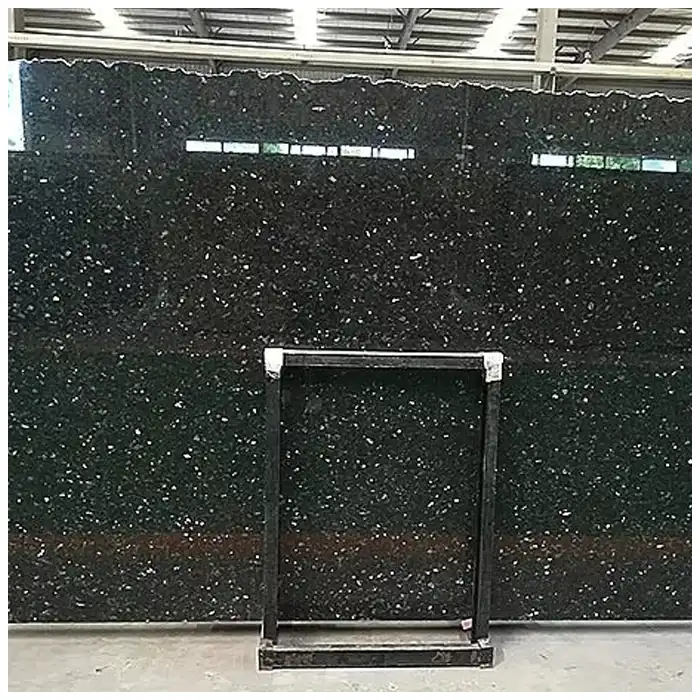
Emerald Pearl Granite is distinguished by the luminous mineral crystals distributed throughout its dark stone background. Depending on the light and viewing angle, these crystals display blue-green, deep emerald and occasionally silver-toned reflections. The surrounding material appears charcoal-black to very dark grey.
The stone is commercially grouped with granite because of its hard, crystalline character and established use in dimensional stone fabrication. Its more precise geological classification is larvikite, a feldspar-rich monzonitic rock associated with southern Norway.
The distinctive reflections originate within the feldspar crystals. They are a natural optical characteristic of the mineral structure rather than a metallic coating or a colour treatment applied after polishing.
Emerald Pearl has a relatively granular composition rather than the broad directional veins found in many decorative marbles and quartzites. The individual crystals vary in size, orientation and concentration, creating differences between slabs without forming a continuous linear pattern.
Large slab fabrication makes the material suitable for kitchen countertops, island tops, bathroom vanities and architectural wall panels. Smaller modules can be cut for flooring, stair components and other dimensional stone applications where the actual stone and finish meet the project specification.
The dark background remains an important part of the material’s appearance. Under diffuse lighting, the stone can appear nearly black, while directional illumination reveals a much stronger concentration of reflective blue-green crystals.
This variation in reflection is a defining feature of Emerald Pearl. The finished surface does not depend on matching a single prominent vein, but it does benefit from a consistent overall balance of dark background and visible crystal activity across adjoining pieces.
Emerald Pearl Green Granite Crystal Distribution and Slab Selection
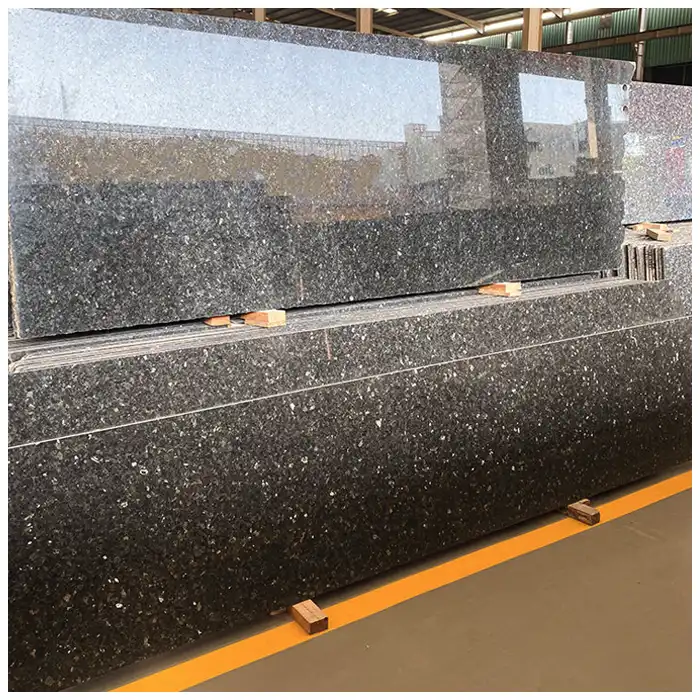
The visual quality of Emerald Pearl is closely associated with its reflective feldspar crystals. Their distribution creates the characteristic scattered flashes across the dark background, but the amount of visible reflection changes according to how each slab is illuminated.
Two slabs with similar background colours may appear different when photographed from separate angles. Crystals that seem subdued in one view can become noticeably brighter under a different light direction.
Feldspar Crystal Size and Orientation
The reflective crystals are not all positioned at the same angle. Individual mineral faces respond differently to light, producing the scattered shimmering effect associated with Emerald Pearl rather than a uniform metallic reflection.
Larger reflective areas may appear more prominent on some slabs, while others display finer, more evenly distributed flashes. These natural differences influence the character of a finished countertop or wall panel.
Dark Background and Crystal Concentration
Some material selections show a stronger contrast between the nearly black background and luminous crystals. Others have a more subdued appearance with fewer visibly bright areas under the same lighting conditions.
For a project containing multiple finished pieces, the overall density of the reflective crystals can be coordinated across the material selection. A noticeably brighter slab placed beside a quieter one may create a visual difference even when their base colours are similar.
Lighting and Finished Stone Appearance
Polished Emerald Pearl can display strong reflections under spotlights, natural daylight and other directional light sources. The viewing position also affects which crystal faces become visible.
Because of this optical behaviour, a single flat photograph cannot fully represent the material. Images taken from several angles help distinguish differences in actual crystal distribution from changes caused primarily by lighting.
Emerald Green Granite Slab Specifications
Emerald Pearl is supplied in natural stone slab and cut-to-size formats. The dimensions below are commercial size references; the usable area of each selected slab depends on its measured dimensions, edge condition and required fabrication layout.
| Produktname | Smaragdgrüne Granitplatte |
| Commercial Stone Name | Smaragd-Perl-Granit |
| Geological Classification | Larvikite (Monzonite) |
| Origin Reference | Larvik, Norway; confirm the actual supplied material |
| Farbe | Charcoal-black with reflective blue-green feldspar crystals |
| Primary Slab Size | 2400mm up × 1200mm up |
| Additional Slab Size | 2600mm up × 1400mm up |
| Common Thicknesses | 20mm and 30mm |
| Thicker Slab Options | 40mm and 50mm subject to material availability |
| Finish Options | Polished, honed, flamed, bush-hammered and selected textured treatments |
| Cut-to-Size Tile References | 305 × 305mm, 305 × 610mm, 300 × 600mm and 600 × 600mm; thickness to match the selected format |
| Finished Product Forms | Large slabs, countertop slabs, tiles, vanity tops, stairs and architectural panels |
| Primary Applications | Countertops, wall cladding, interior floors and suitable exterior stonework |
| MOQ Reference | 100 SQM; subject to order confirmation |
| Indicative Price | USD 42–50/SQM; final quotation depends on material and specification |
| Quantity Reference | 1600 SQM; allocation and current availability require confirmation |
20mm and 30mm Emerald Pearl Granite Slabs for Fabrication
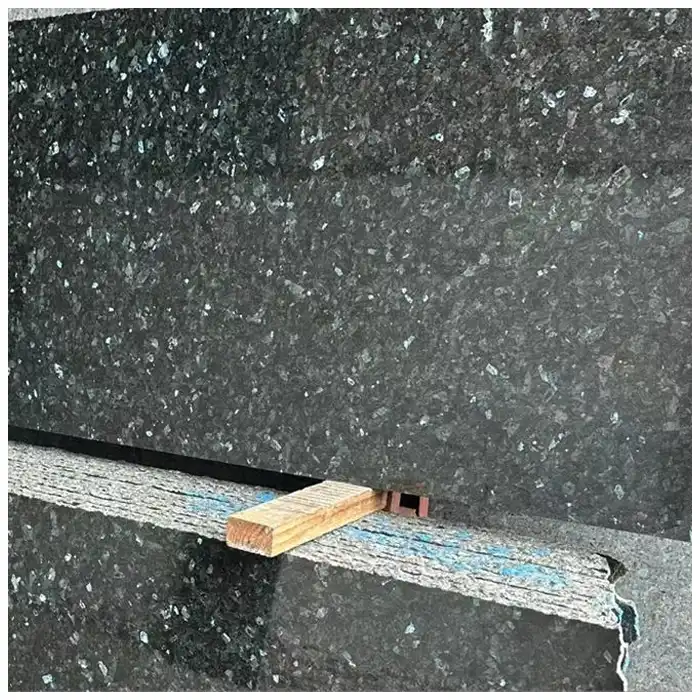
The 20mm and 30mm slab formats are commonly used for dimensional stone fabrication. The selected thickness affects the stone weight, edge treatment, handling method and supporting structure of the completed component.
A 20mm slab can be processed into suitable countertop sections, wall panels and other finished pieces when its dimensions and support arrangement meet the project requirements. Its relatively thinner profile requires attention around openings, narrow sections and exposed edges.
20mm Countertop Slab Fabrication
A 20mm countertop allows a comparatively restrained finished edge. A thicker visual edge can also be created through an appropriate fabricated detail rather than assuming the full countertop must be cut from a thicker solid slab.
The cutting layout must account for sink openings, appliance cutouts and the remaining stone around those openings. Corners and narrow connecting sections need suitable handling and support during fabrication and installation.
30mm Granite Countertop Slabs
A 30mm slab produces a more substantial exposed edge and changes the weight of the finished component. Larger countertops and island pieces still require an appropriate support design; thickness alone does not establish the permitted span or overhang.
The visual character remains determined by the selected stone. Greater thickness does not increase the amount of reflective crystal visible on the polished face, although the cut edge may reveal additional mineral detail.
Thicker Architectural Stone Components
The product range also lists 40mm and 50mm thickness options. These are separate material and fabrication choices whose availability depends on the selected blocks and production requirements.
The additional weight of thick natural stone affects lifting, transportation and installation. Structural connections and handling arrangements must be based on the actual finished component rather than its commercial thickness category alone.
Polished, Honed and Textured Emerald Green Granite Finishes
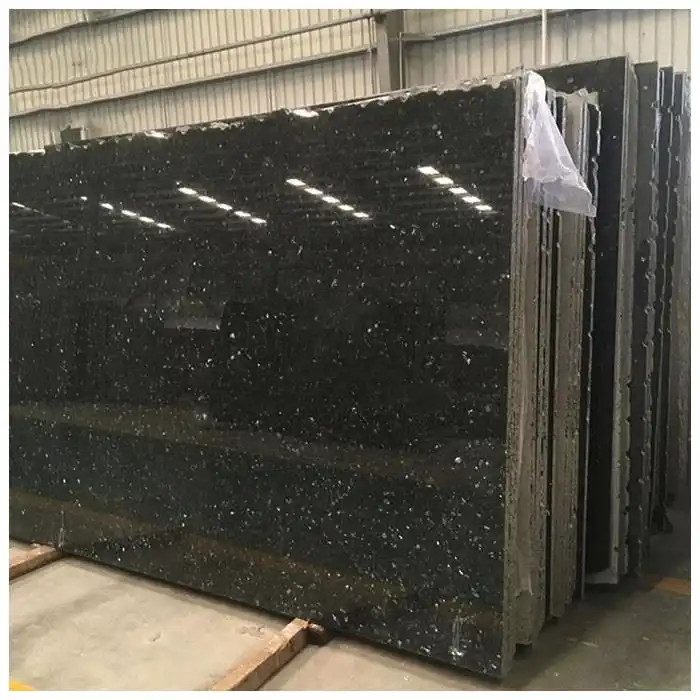
Surface finishing has a particularly noticeable effect on Emerald Pearl because much of its appearance depends on reflections from feldspar crystals. A polished face reveals these reflective areas more strongly than a lower-sheen or heavily textured surface.
Polished Emerald Pearl Granite
Polishing produces a smooth surface that emphasizes the blue-green crystal reflections. The dark matrix and brighter feldspar faces create a pronounced contrast under directional lighting.
Polished Emerald Pearl is a principal finish for countertops, vanity tops, decorative wall panels and other interior surfaces where the crystalline appearance is intended to remain visible.
Surface inspection should include gloss consistency and local polishing marks. Because the material contains reflective mineral faces, uneven finishing may be particularly apparent when the slab is viewed from an angle.
Honed Emerald Pearl Granite
A honed finish reduces surface reflection and produces a more subdued appearance. The natural crystals remain present within the stone, but their visible shimmer can be less pronounced than on a polished surface.
A honed sample may therefore appear darker or more uniform in certain lighting conditions. This difference is important where the intended architectural finish depends on maintaining the characteristic Emerald Pearl crystal effect.
Flamed and Bush-Hammered Finishes
Flamed and bush-hammered treatments introduce texture and may be considered for selected exterior or architectural surfaces. The processing method changes how the feldspar crystals are exposed and how light interacts with the stone.
A heavily textured Emerald Pearl surface will not reproduce the same appearance as a polished slab. The final colour and texture need to be established on the actual stone selection.
Where flooring requires a specified slip-resistance level, the finished surface must be assessed under the applicable test method. The finish name alone is not a substitute for performance evaluation.
Emerald Pearl Granite Physical Property Reference Data
The following figures are published ASTM reference measurements for Norwegian Emerald Pearl larvikite. They relate to tested natural stone specimens and do not represent a laboratory certificate for MQ STONE’s current slab allocation. The test conditions are included because compressive and flexural strength results can differ according to specimen orientation and moisture condition.
| Physical Property | Material Reference | Test Standard |
|---|---|---|
| Scheinbare Dichte | 169 lb/ft³ (approximately 2.71 g/cm³) | ASTM C97 |
| Water Absorption by Weight | 0.07% | ASTM C97 |
| Druckfestigkeit | 18,220 psi (approximately 125.6 MPa), dry, perpendicular loading | ASTM C170 |
| Biegefestigkeit | 1,460 psi (approximately 10.1 MPa), dry, perpendicular loading | ASTM C880 |
Reference conditions: density and absorption were measured on sawn stone specimens. The listed flexural measurement relates to a tested specimen thickness of approximately 1¼ inches. Results obtained with different standards, moisture conditions or specimen orientations are not directly interchangeable.
These figures describe a documented Norwegian Emerald Pearl material selection. They do not certify the identity or performance of every commercially named Emerald Pearl slab, the current 1600 SQM quantity reference, or a fabricated countertop or cladding assembly. Project-specific certification requires documentation for the actual supplied stone.
Emerald Pearl Granite Countertop Fabrication and Seam Planning
Emerald Pearl is used for kitchen countertops, island tops, worktops and bathroom vanities. Its dark granular pattern does not require the same directional vein alignment as strongly veined marble, but the overall concentration of reflective crystals still influences the appearance of adjoining sections.
Slab Yield and Cutting Layout
The cutting layout is determined by the actual usable dimensions of the selected slab. Edge trimming, saw kerf, sink openings and other fabrication requirements reduce the portion of the stone available for finished components.
For a large island, the required finished width and length determine whether a single-piece surface is practical. Where a seam is necessary, its location should be coordinated with the stone appearance and the supporting cabinetry.
Seam Appearance and Crystal Consistency
The absence of continuous veins can make Emerald Pearl more flexible in some cutting layouts. Nevertheless, a seam between slabs with markedly different crystal density can remain visually prominent even when the dark background colour is closely matched.
Consistent polishing across adjoining countertop pieces helps preserve the material’s reflective appearance. Different surface gloss levels can change how the blue-green crystals appear at the seam.
Sink Cutouts and Finished Edges
Sink and cooktop openings introduce internal corners and narrow stone sections. These details require suitable fabrication geometry and support during handling and installation.
The edge profile changes the appearance of the finished worktop. A polished eased edge displays the stone differently from a substantial laminated edge, particularly where reflective crystals are exposed along the vertical face.
Waterfall countertop ends require coordination between the top and vertical sections. The surface pattern does not depend on continuous marble-like veining, but the colour and crystal concentration of both pieces remain visible when viewed together.
Emerald Pearl Granite Tiles and Architectural Wall Cladding
Emerald Pearl can be cut into smaller tile formats for floors, wall cladding and stair components. The individual crystal pattern remains visible on the finished surface, although the larger reflective areas become distributed across separate pieces.
For wall panels, the fixing method must correspond to the finished dimensions, stone thickness, substrate and installation height. Larger natural stone panels require a suitable support arrangement, particularly where mechanical restraints or exterior cladding systems are involved.
Flooring places different demands on the surface. Pedestrian traffic, moisture exposure and the required slip resistance influence the choice between polished and textured finishes.
The natural material can also be considered for exterior architectural stonework where the selected finish, fixing details and environmental conditions are appropriate. Weather exposure, drainage and movement accommodation must be addressed within the installation design.
For stairs, tread geometry and finished nosing details are particularly important. The selected stone thickness and surface texture should match the intended use rather than being copied from a standard wall panel specification.
Emerald Pearl Granite Kitchen Countertop Application Reference
The following image illustrates Emerald Pearl granite in a kitchen countertop setting. The polished stone’s dark surface and blue-green crystal reflections are visible in combination with the surrounding interior finishes.
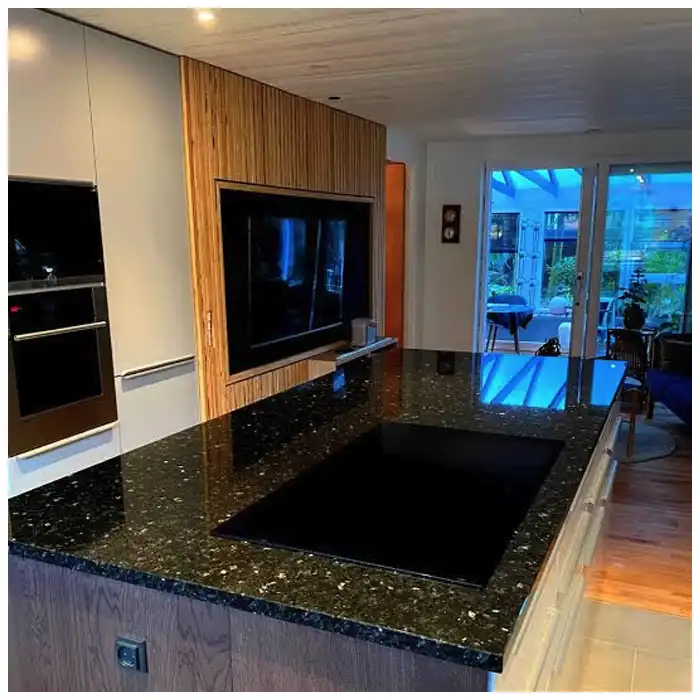
This image is an application reference rather than confirmation of a particular completed project or its construction details. The finished countertop thickness, cutting layout and supporting structure depend on the actual fabrication drawings.
Emerald Pearl Granite Compared with Four Alternative Granite Slabs
Emerald Pearl combines a nearly black background with small, reflective blue-green crystals. Other decorative granite collections create contrast through lighter backgrounds, stronger blue colour areas or broad mineral movement.
| Stone Selection | Visual Character | Design Difference |
|---|---|---|
| Smaragd-Perl-Granit | Dark background with blue-green reflective feldspar crystals | Granular crystal reflections rather than broad directional veins |
| Weiße Rose Granitplatten | Light-toned natural granite with contrasting mineral detail | A brighter stone selection with less dominant dark background |
| Sodalith Blauer Granit | Blue-dominant decorative stone with contrasting mineral areas | A stronger continuous blue colour presence rather than scattered blue-green crystal flashes |
| Blauer Amazonas-Granit | Blue and grey natural stone with expressive mineral movement | Broader colour variation compared with Emerald Pearl’s compact crystalline pattern |
| Titanium Gold Granit | Dark stone with flowing gold, silver and pale mineral formations | Large-scale veining and mineral movement rather than evenly scattered reflective crystals |
The four materials are separate commercial stone selections. Their geological identity, slab dimensions, available finishes and physical properties must be evaluated independently rather than assumed equivalent to Emerald Pearl.
Emerald Pearl Granite Slab Inspection and Export Packing
Emerald Pearl inspection involves more than checking the dark background colour. The distribution of reflective crystals, overall slab tone and polish quality affect how adjoining finished pieces appear under the same lighting.
Natural variation is expected between individual slabs. Visible cracks, edge defects and processing damage require separate evaluation from normal differences in feldspar orientation and crystal size.
Slab dimensions and finished thickness are checked against the order specification. For cut-to-size countertops and tiles, the finished measurements, edge condition and relevant processing details must correspond to the approved fabrication drawings.
Polished surfaces require protection from abrasion during packing and transportation. Suitable separation materials reduce direct contact between stone faces, while reinforced support and secure restraint help protect large slabs during export handling.
Finished countertop sections and architectural panels are packed according to their dimensions and handling requirements. Where several pieces belong to one installation layout, appropriate identification helps preserve their intended sequence after unpacking.
Cleaning and Maintaining Polished Emerald Pearl Granite
Polished Emerald Pearl is maintained with cleaning products compatible with natural stone and the selected finish. Loose grit should be removed before wiping or mopping to reduce scratching of the finished surface.
Its dark background may show dried water deposits, soap residues and fingerprints under certain lighting conditions. Regular cleaning with a suitable non-abrasive product helps maintain a clear polished appearance.
For kitchen countertops, spills should be cleaned promptly around sink openings, joints and frequently used work areas. The compatibility of any impregnating sealer should be established with the actual stone and finish.
A sealer does not prevent scratching, eliminate joint maintenance or protect surrounding adhesives and sealants from excessive heat. Hot cookware should be placed on suitable supports, particularly near joints and fabricated edges.
Textured outdoor finishes may require different cleaning equipment from polished interior slabs. Maintenance should reflect the actual surface treatment and exposure conditions.
FAQs About Emerald Green Granite Slabs
1. What is Emerald Green Granite Slab?
Emerald Green Granite Slab is a commercial name for Emerald Pearl, a dark natural stone with reflective blue-green feldspar crystals. It is commonly sold as granite and used for countertops, wall panels and cut-to-size tiles.
2. Is Emerald Pearl Granite geologically a true granite?
Emerald Pearl is commercially classified as granite, but its more precise geological classification is larvikite, a feldspar-rich monzonitic rock. The material is associated with the Larvik region of Norway.
3. Why does Emerald Pearl Granite have reflective green crystals?
The reflective appearance comes from feldspar crystals within the natural stone. Their optical response changes with the lighting and viewing angle, creating blue-green flashes against the dark background.
4. What slab sizes and thicknesses are available?
Principal size references include 2400mm up × 1200mm up and 2600mm up × 1400mm up. Common thicknesses are 20mm and 30mm, while 40mm and 50mm options require confirmation against the selected material.
5. Is polished Emerald Pearl different from honed Emerald Pearl?
Yes. Polishing makes the reflective feldspar crystals more prominent, while honing reduces the surface reflection. The natural mineral pattern remains present in both finishes.
6. Can Emerald Pearl Granite be fabricated into kitchen countertops?
Yes. Emerald Pearl is used for kitchen countertops, island tops and vanity tops. The fabrication specification must account for finished dimensions, stone thickness, openings, seams and the supporting structure.
7. Can Emerald Green Granite be used for flooring and exterior cladding?
Emerald Pearl can be considered for flooring and suitable exterior stonework. The selected finish, slip-resistance requirements, environmental exposure and fixing system determine the appropriate construction.
8. Are the listed Emerald Pearl test results certified for the supplied slabs?
No. The published ASTM figures are reference measurements for a documented Norwegian Emerald Pearl material selection. They are not current-batch laboratory certificates for MQ STONE’s supplied slabs or fabricated products.
9. What is the Emerald Pearl Granite slab price reference?
The indicative price is USD 42–50 per square metre, with a quantity reference of 1600 SQM. Final pricing depends on the selected slabs, thickness, finish and commercial terms. The quantity does not confirm current stock availability.
10. What information is required for an Emerald Pearl Granite quotation?
The required slab dimensions, thickness, finish, quantity and delivery destination establish the quotation scope. Countertops and cut-to-size architectural components also require the relevant fabrication drawings.
Emerald Pearl Granite Slab Specification Summary
Emerald Pearl’s distinctive appearance depends on the distribution and optical response of its feldspar crystals. For coordinated stonework, slab selection must account for the dark background, reflective crystal concentration and chosen finish. The finished dimensions determine the cutting arrangement and structural support, while polished and textured surfaces require different installation and maintenance specifications. The technical properties of the actual supplied stone remain separate from published material reference values.
Recommended Decorative Granite Slabs

Weiße Rose Granitplatten
Light-toned granite with softer mineral contrast for architectural stone surfaces.


Emerald Pearl Green Granite Slabs and Custom Stone Fabrication
MQ STONE supplies Emerald Pearl Granite in slab and cut-to-size formats for countertops, wall panels, tiles and architectural components. Material selection is based on the required crystal appearance, actual slab dimensions and surface finish. Countertop and panel fabrication can be specified through approved dimensions and drawings.
Request Emerald Pearl Granite Details
Send the required slab size, thickness, finish, quantity and delivery destination for an Emerald Pearl Granite quotation.