Quick Summary: Grand Antique Marble for Architectural Slabs and Custom Stone Furniture
Großer antiker Marmor is a French black-and-white brecciated natural stone used for hotel feature walls, kitchen and bathroom countertops, round dining tables and nesting coffee tables. Its angular black limestone fragments are separated by contrasting white calcite, producing a distinctive pattern across large slabs and smaller fabricated components. MQ STONE’s original catalogue references include slabs from 2400mm+ × 1400mm+ and 2000mm+ × 1000mm+, with 18mm, 20mm and 30mm thickness options. The finished design should be developed from actual slab photographs, especially where large white calcite sections intersect cutouts, edges or narrow furniture components.
Grand Antique Marble Slabs for Hotel Lobbies and Black-and-White Feature Walls
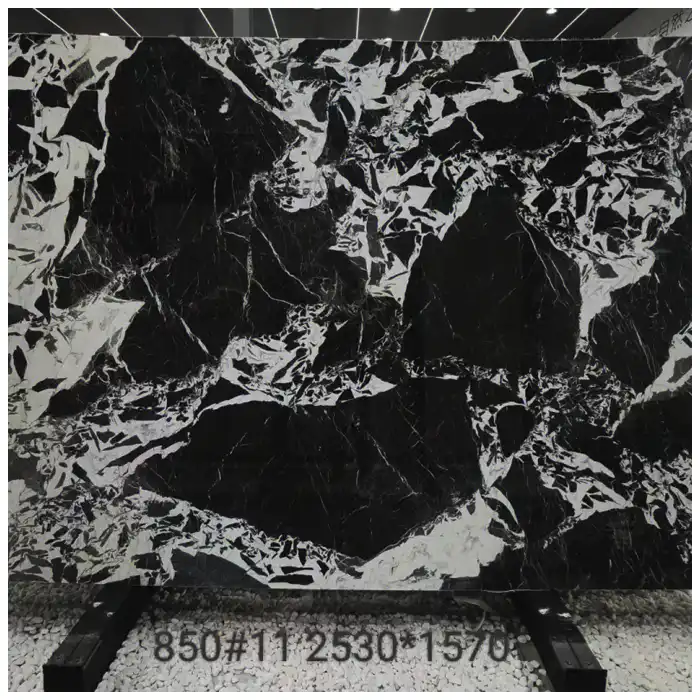
Grand Antique Marble has a very different appearance from black marble with fine linear veins. The stone contains angular black fragments surrounded by white calcite formations. On a large panel, these contrasting mineral areas form a bold composition that can be understood from across a room.
The material is associated with Grand Antique d’Aubert, a historic French decorative stone from the Pyrenees. Its brecciated structure means that the position of black and white areas changes substantially between slabs. This is particularly important for large reception walls where the stone occupies most of the visible elevation.
A hotel lobby can use Grand Antique as a wall behind the reception desk, as an elevator-lobby surround or as a contrasting panel between quieter finishes. Pale plaster, dark timber and brushed metal can frame the material without introducing competing stone patterns.
For private residences, the same marble can become a living-room feature wall or a central architectural panel. The design begins with the actual slab composition. A wide white formation may be positioned toward the centre of the wall, while smaller fragments can be distributed around openings and edges.
Noir Grand Antique Marble Collection for Interior Design and Stone Furniture
Grand Antique is also encountered under commercial names such as Noir Grand Antique, Noir Antique Black Marble and Grand Antique d’Aubert. These names refer to the distinctive black-and-white decorative stone family, although the provenance of individual commercial batches should still be checked.
Its appearance comes from the stone’s natural breccia structure rather than a regular set of veins. Some pieces contain extensive black areas with narrower white boundaries. Others have large white calcite sections surrounding smaller black fragments. These variations affect the design of a finished wall, countertop or furniture top.
Large-Pattern Selections
A slab with large contrasting sections is often appropriate for a broad architectural panel. The composition can remain legible from a distance, but large mineral boundaries need careful assessment when a drawing includes narrow components or openings.
Smaller Fragment Patterns
More closely spaced fragments can work well for dining tables, coffee tables and smaller decorative surfaces. The finished shape should be positioned on the actual slab photograph to assess which parts of the black-and-white composition will remain visible after cutting.

Grand Antique Marble Slab Sizes, Thickness and Custom Fabrication Specifications
The existing MQ STONE catalogue describes large slabs, cut-to-size tiles and architectural stone components. The specifications below separate those product forms. Exact slab dimensions, thickness combinations and available finishes should be confirmed using the selected material rather than assumed from catalogue references.
| Produktname | Grand Antique Marble / Noir Grand Antique Marble |
| Material | Natural black-and-white brecciated decorative marble |
| Associated Origin | Aubert, Ariège, French Pyrenees; actual supplied material provenance subject to confirmation |
| Visual Structure | Angular black limestone fragments with white calcite formations and natural breccia boundaries |
| Large Slab Reference 1 | 2400mm+ × 1400mm+ |
| Large Slab Reference 2 | 2000mm+ × 1000mm+ |
| Historical Tile References | 300×300mm, 300×600mm, 600×600mm and selected custom tile dimensions |
| Nominal Thickness | 18mm / 20mm / 30mm; other sections subject to material and processing approval |
| Oberflächenbehandlungen | Polished and honed; brushed and selected custom textures subject to sample approval |
| Slab Fabrication | Architectural wall panels, countertop blanks, vanity tops and decorative cladding |
| Furniture Fabrication | Round dining tables, nesting coffee tables, custom plinths and decorative table components |
| Architectural Applications | Hotel feature walls, residential interiors, approved flooring, kitchen countertops and bathroom surfaces |
Slab Size and Finished Furniture Dimensions
A marble slab large enough for a rectangular wall panel may not produce the preferred round table diameter from its most visually attractive area. Curved furniture components, sink openings and mitred edges affect cutting yield. Before fabrication, position the finished drawing over a photograph of the selected slab and inspect the mineral boundaries that intersect the proposed cut lines.

Large Grand Antique Marble Wall Panels for Reception Areas and Private Villas
Grand Antique Marble is particularly effective when the architectural surface is large enough to show its full breccia pattern. In a narrow wall strip, a white calcite area may dominate the entire piece. Across a broad panel, the relationship between the black fragments and white formations becomes clearer.
For hotel reception walls, the slab arrangement should follow the elevation rather than simply maximize cutting yield. Large white sections can be positioned to frame a central desk or feature opening. Where several panels meet, their patterns should be assessed together to avoid distracting changes at the joints.
Bookmatching may be considered where suitable consecutive slabs are available. However, the angular breccia pattern can produce a very strong mirrored arrangement, and not every wall benefits from perfect symmetry. Flow matching or deliberately composed individual panels may suit some interiors better.
The finished wall requires suitable substrate preparation, fixing and joint design. Actual panel thickness, size and material condition should be reviewed before selecting the installation method. For mechanically fixed large panels, anchorage and supporting construction must be assessed by the responsible project designer.
Selecting Polished or Honed Grand Antique Marble for Interior Applications
The surface finish changes how strongly the black fragments contrast with the white calcite. Polishing emphasizes the graphic pattern, while honing reduces reflections and can make the stone more restrained in an interior with extensive direct lighting.
| Oberfläche | Surface Appearance | Application Consideration |
| Poliert | Glossy black-and-white contrast with a strong reflective appearance. | Feature walls, decorative countertops and furniture tops where the finish suits the expected use. |
| Geschliffen | Smooth low-sheen surface with reduced reflections. | Residential walls, tables and selected floor applications; slip performance still requires verification. |
| Gebürstet | Subtle surface texture with uneven light reflection. | Decorative cladding and custom stone elements after processing and cleaning suitability are reviewed. |
| Special Texture | Project-specific mechanically processed appearance. | Approve the actual finished stone sample, especially where black and white sections respond differently to processing. |
Black-and-White Marble Selection for Kitchen Islands and Furniture Components
Grand Antique has an unusually high-contrast composition. On a kitchen island, the direction of the black fragments and white calcite formations can influence the position of seams, cutouts and waterfall edges. A large white area may be visually appealing on the finished top, but its natural boundaries require inspection before cutting.
When a design includes a sink or hob, the remaining stone around the opening should be assessed according to the selected slab and the intended support arrangement. Narrow sections and inside corners may be vulnerable to breakage during processing and installation.
For custom furniture, the same considerations apply to table legs, cylindrical bases, plinths and edge returns. A visually solid stone element may be constructed from multiple cut pieces rather than one uninterrupted block, depending on weight, material yield and the design.
A Grand Antique piece should be judged by its finished geometry, not only by the beauty of the raw slab. The cutting drawing should show the most visible surfaces, the intended relationship between adjoining pieces and any joints that will remain exposed.

Grand Antique Marble Physical Properties and Geological Structure
Grand Antique d’Aubert is a brecciated carbonate stone. Geological references describe dark limestone fragments within a white calcite matrix. That structure explains its black-and-white pattern and also means that natural mineral boundaries should be considered when planning narrow cutouts or carved furniture components.
Published technical values for Grand Antique vary between suppliers. The figures below retain their original source attribution rather than combining them into a single laboratory report.
| Material Property | Published Reference | Source and Interpretation |
| Dichte | 2690 kg/m³ | Lithos Design Grand Antique material reference; useful for preliminary stone weight assessment. |
| Wasserabsorption | 0.24% | Lithos Design reference; does not establish resistance to acidic liquids or all staining conditions. |
| Biegefestigkeit | 14–17 MPa | StoneContact commercial stone-library range; not verified for the selected MQ STONE slabs. |
| Druckfestigkeit | 98.4 MPa | StoneContact listed reference value; not a finished furniture or panel load rating. |
Relevant project testing may include EN 1936 for density and porosity, EN 13755 for water absorption, EN 12372 for flexural strength and EN 1926 for compressive strength. The published figures above are not presented as proof that one identified MQ STONE batch has passed tests under those methods.
Technical qualification: the figures originate from separate public references and do not constitute a combined test certificate. Natural breccia composition, stone selection and any treatment can influence actual results. Project-specific material documentation and engineering review take precedence.

Grand Antique Marble Countertops for Kitchen Islands and Bathroom Vanities
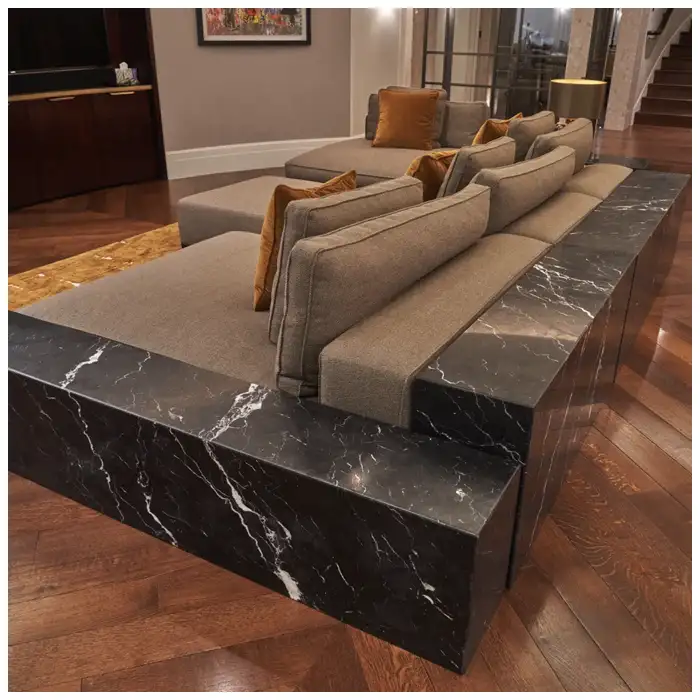
The Grand Antique countertop image illustrates the material as a horizontal architectural surface. Here, the black-and-white composition is viewed at close range, with the finished edges, sink openings and adjacent cabinetry forming part of the design.
Kitchen Island Countertops
For a kitchen island, the cutting layout should identify the most visible white formations and the relationship between the top and any waterfall end panels. Sink and appliance cutouts must be positioned with the stone’s natural structure in mind.
Countertop Edge Fabrication
Straight, eased or mitred profiles can be considered according to the finished design. The selected edge should account for stone condition, support, handling and the appearance of contrasting mineral sections along the exposed side.
Bathroom Vanity Tops
Grand Antique may be used around a basin or across a vanity cabinet where the stone is suitably supported. Faucet openings, narrow rim sections and the connection to wall cladding require approval before cutting.
Daily Use and Surface Care
As a carbonate stone, Grand Antique can be etched by acidic liquids. Its polished finish may also show scratches, water marks and dull areas. Kitchen use requires realistic maintenance expectations rather than claims of scratch-proof or acid-proof performance.
Grand Antique Marble Round Dining Tables for Luxury Residential Interiors
A round Grand Antique Marble dining table transforms the stone’s irregular breccia composition into a circular design. The curved perimeter cuts across black fragments and white calcite formations, making the final appearance different from that of the original rectangular slab.
The proposed table diameter should be positioned on a full-slab photograph before cutting. An attractive central white area may work well on a round tabletop, while other selections may benefit from distributing the contrasting mineral sections around the perimeter.
The base design is equally important. A central pedestal can keep the perimeter visually open, while multiple supports may be appropriate for other table proportions. The designer must consider finished stone weight, centre of gravity, support connections and stability during use.
A rounded or softly eased edge can reduce uncomfortable sharp contact. Any thick-looking edge built from joined stone sections should be detailed to prevent unsupported components or visible joints that conflict with the intended appearance.
In dining spaces, the stone should be used with suitable placemats, coasters and protective care. Wine, citrus and other acidic foods can etch carbonate marble. A sealer may reduce certain absorption-related stains but will not prevent chemical etching.

Grand Antique Marble Nesting Coffee Tables for Villas and Hotel Lounges
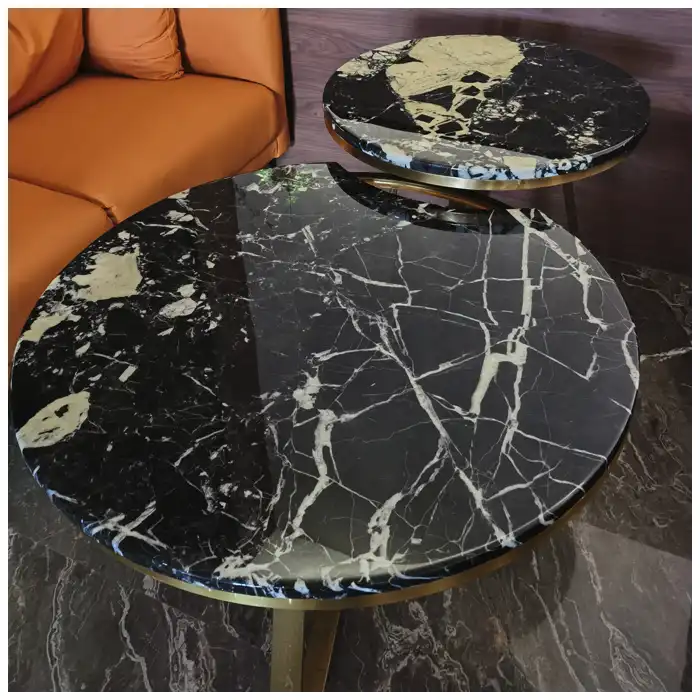
Nesting coffee tables introduce Grand Antique Marble on a smaller scale. Rather than displaying the entire slab composition, each tabletop presents a selected portion of the black-and-white pattern. This can be effective in living rooms, hotel suites and reception lounges where the furniture is viewed from several directions.
Coordinating the Tabletop Patterns
Two or more tables can be cut from compatible areas of the selected material. Exact vein matching is not necessary, but the balance of black and white should be considered so the individual tops form a recognizable set.
Selecting the Edge Profile
Round and curved table edges require careful finishing, particularly where large calcite boundaries intersect the perimeter. Eased edges and approved radii help limit sharp contact and reduce handling risks.
Nesting Clearance and Table Stability
The height difference between nested pieces should allow them to overlap or sit together without unwanted contact. Finished base dimensions, tabletop overhang and floor contact must also be checked to keep each table stable.
Hotel and Residential Furniture Use
The finished construction should account for cleaning, moving and everyday contact. Decorative stone tables may require protective pads, suitable base connections and separate packing for delicate components.
Grand Antique Marble for Hotel Flooring and Bathroom Wall Cladding
Grand Antique can also be specified in cut-to-size forms for selected interior floors and bathroom walls. These applications use the stone differently from a feature slab or furniture top. Tile dimensions, finish and installation methods must be matched to the project requirements.
On a floor, strong black-and-white fragments can create a highly graphic surface. Smaller tiles may break the pattern into distinct sections, while larger formats retain more of the natural breccia composition. A dry layout can help distribute concentrated white areas before installation.
For bathrooms, the stone may be used on vanity walls and selected vertical cladding areas. Wet installations require suitable waterproofing behind the stone, compatible setting materials and appropriate joint detailing. A sealer is not a substitute for a waterproof membrane.
Floor suitability depends on the actual surface’s slip resistance and abrasion characteristics. A polished decorative slab should not automatically be used for a wet floor or high-traffic hotel entrance. Where the project requires such use, test the selected stone and finish against the applicable performance criteria.
Grand Antique Marble Compared with Other Black Marble Collections
The main difference between Grand Antique and other black marble selections is the structure of its pattern. It is formed by contrasting fragments and calcite rather than relying primarily on fine linear veins or gold-coloured mineral markings.
| Stone Selection | Pattern Character | Design Direction |
| Großer antiker Marmor | Angular black fragments separated by prominent white calcite formations. | Feature walls, sculptural furniture and stone surfaces requiring a bold geometric composition. |
| Silver Portoro Marble | Dark natural stone with lighter silver-toned contrasting movement, depending on selection. | An alternative dark palette for decorative walls and custom stone surfaces. |
| Black and Gold Marble Tile | Black background with warm gold-toned mineral patterning. | Decorative floor and wall tiles requiring warmer accents rather than pure black-and-white contrast. |
| Marmorfliese Nero Marquina | Dark marble with predominantly linear or branching white veins. | Black-and-white tile layouts where a less fragmented pattern is preferred. |
| Schwarzer Portoro-Marmor | Black stone with contrasting golden and other mineral markings. | Reception areas, countertops and decorative details with a black-and-gold colour direction. |
Selecting Grand Antique Slabs for Different Architectural and Furniture Applications
| Anmeldung | Product Form | Critical Design Decision |
| Hotel Feature Wall | Large coordinated slabs or cut-to-size panels | Breccia pattern placement, visible joints and wall fixing arrangement |
| Kücheninsel | Custom countertop and waterfall panels | Cutout position, stone boundaries, edge construction and maintenance |
| Round Dining Table | Circular marble top with an approved supporting base | Diameter, tabletop pattern, total weight and stability |
| Nesting Coffee Tables | Coordinated curved or shaped tabletops and bases | Nesting clearance, edge treatment, pattern grouping and base connections |
| Bathroom Vanity | Cut-to-size countertop and wall panels | Basin opening, moisture management, support and surface care |
Fabrication Inspection and Export Packing for Grand Antique Marble
The selected slabs should be photographed in full before the cutting layout is finalized. Large black fragments and calcite boundaries must be considered where the drawing includes openings, curved tabletops or narrow decorative components.
Finished stone should be checked against the approved dimensions, thickness, surface treatment and edge profiles. Visible natural discontinuities, repairs and reinforcement should be assessed according to the intended use. A decorative tabletop and a large wall panel may require different acceptance criteria even when fabricated from the same material.
For dining and coffee tables, inspection should include the tabletop perimeter, flatness, base connection, stability and the appearance of any joined stone components. Where furniture is shipped in separate pieces, the assembly method must be clear from the approved drawings.
Packing should protect polished faces, stone corners and curved edges with suitable separation and rigid support. Large slabs and finished furniture components require different handling arrangements. Crates should identify the contents and any component positions needed for final assembly or installation.
Common Specification Mistakes with Grand Antique Marble
- Treating Grand Antique as ordinary white-veined black marble: its angular breccia pattern needs different slab selection and layout planning.
- Approving a wall from a small sample: individual black fragments and white formations may occupy large portions of the finished elevation.
- Ignoring mineral boundaries during cutting: openings, narrow strips and table edges should be evaluated against the actual stone structure.
- Assuming all Grand Antique slabs can be bookmatched: suitable consecutive pieces must be available and approved.
- Specifying an unsupported marble tabletop: large stone furniture requires suitable base connections, support and stability assessment.
- Using marble as an acid-resistant kitchen surface: Grand Antique contains carbonate minerals and can be etched by acidic liquids.
- Transferring decorative slab finishes directly to wet flooring: the actual installed finish must satisfy the applicable slip and wear requirements.
Cleaning and Maintaining Grand Antique Marble Countertops and Furniture
Clean Grand Antique Marble using a soft cloth and a pH-neutral product suitable for natural carbonate stone. Avoid vinegar, acidic descalers, citrus-based cleaners and abrasive powders. Remove food and drink spills promptly, particularly on dining tables and kitchen countertops. Use coasters, placemats and appropriate protection beneath hot objects. An impregnating treatment may help manage some absorption-related staining, but it does not prevent acid etching or make the stone scratch-proof. Furniture surfaces should also be protected from impact at thin edges, while wall installations require periodic inspection of exposed joints and supporting details.
FAQs About Grand Antique Marble
What is Grand Antique Marble?
Grand Antique Marble is a French black-and-white brecciated decorative stone, also known as Noir Grand Antique or Grand Antique d’Aubert. Its distinctive pattern consists of dark limestone fragments surrounded by white calcite, making it suitable for architectural feature panels and custom stone furniture.
How is Grand Antique Marble different from Nero Marquina Marble?
Grand Antique has angular black-and-white breccia formations, while Nero Marquina generally has a dark background crossed by more linear or branching white veins. The difference is especially visible across large slabs and tabletops.
What slab sizes and thicknesses are listed for Grand Antique Marble?
The original MQ STONE listing references slabs from 2400mm+ × 1400mm+ and 2000mm+ × 1000mm+, with nominal thicknesses of 18mm, 20mm and 30mm. Actual usable dimensions depend on the selected material and fabrication drawings.
Can Grand Antique Marble Slabs be used for bookmatched feature walls?
Bookmatching may be possible when suitable consecutive slabs are available. The mirrored pattern, panel orientation and joint positions should be approved from full-slab photographs before fabrication.
Is Grand Antique Marble suitable for kitchen countertops?
Grand Antique can be fabricated into kitchen countertops with suitable support, cutout details and edge processing. As a carbonate stone, it is sensitive to acidic liquids and requires appropriate daily maintenance.
Can Grand Antique Marble be made into round dining tables?
Yes. Round Grand Antique Marble dining tables can be developed from selected slabs, with the tabletop diameter and pattern arrangement determined before cutting. The base must be designed for the finished stone weight and required stability.
What should be considered for Grand Antique Marble nesting coffee tables?
Nesting coffee tables require coordinated tabletop patterns, suitable edge profiles, correct height differences and stable base connections. Their finished dimensions should allow the tables to sit together without unwanted contact.
Can Grand Antique Marble be used for bathroom walls and flooring?
Grand Antique can be considered for bathroom wall cladding and selected interior floors when the stone, thickness, finish and installation system meet the project requirements. Wet flooring requires appropriate slip-resistance verification and bathroom walls need suitable waterproofing behind the stone.
What physical properties are reported for Grand Antique Marble?
Lithos Design lists a density of 2690 kg/m³ and water absorption of 0.24% for Grand Antique. A separate StoneContact reference lists flexural strength of 14–17 MPa and compressive strength of 98.4 MPa. These are published reference values from different sources, not verified test results for the current MQ STONE slabs.
How should Grand Antique Marble tables and countertops be cleaned?
Use a pH-neutral natural stone cleaner and a soft cloth. Avoid acidic or abrasive products, wipe spills promptly and use coasters or placemats on tables. Sealing may reduce some staining risks but does not prevent acid etching or scratching.
Recommended Black Marble Slabs and Decorative Stone Collections

Silberne Portoro-Marmor-Platten
Dark decorative marble slabs for interior feature walls, custom countertops and coordinated stone panels.

Black and Gold Marble Tile
Black marble tiles with warm golden mineral movement for hotel interiors and decorative floors.

Marmorfliese Nero Marquina
Black-and-white marble tiles with linear veining for residential floors and bathroom walls.

Schwarzer Portoro-Marmor
Dark Portoro marble for kitchen islands, statement walls and custom residential interiors.

Grand Antique Marble for Custom Architectural and Furniture Specifications
Grand Antique Marble can be developed into large feature wall panels, kitchen and vanity countertops, round dining tables and nesting coffee tables. Each product form requires a different cutting layout and support arrangement. Select the actual stone pattern first, then coordinate the finished dimensions, visible edges and installation or furniture construction. For projects combining slabs and furniture, the selected material can be reviewed as one design collection while allowing for natural variation between pieces.
Grand Antique Marble Project Enquiry
Send the intended application, finished dimensions, surface finish and relevant drawings for Grand Antique slab selection and custom fabrication review.