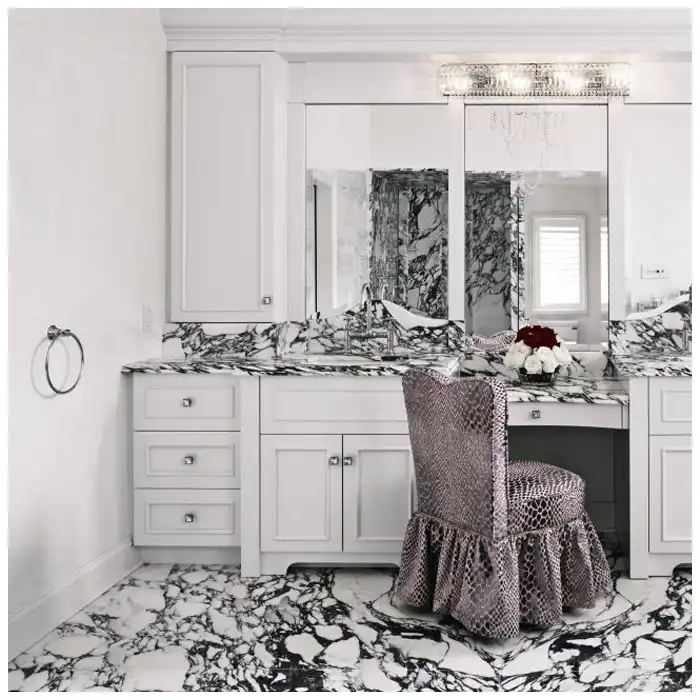
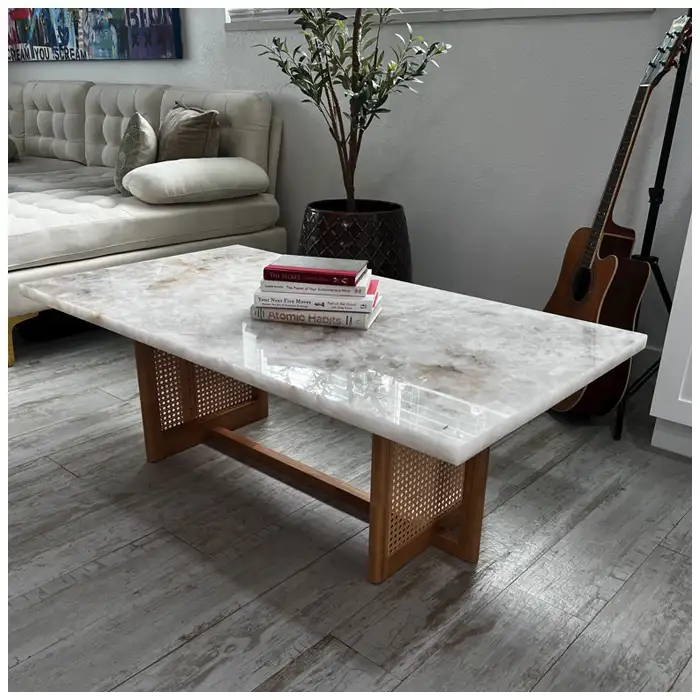
Quick Summary: Noir Grand Antique Marble Slabs for Feature Walls and Custom Tables
Noir Grand Antique Marble Slabs are natural black-and-white breccia stone with sharply contrasting white calcite formations and dark limestone fragments. Associated with the historic Grand Antique stone from France, the material is used for decorative feature walls, luxury countertops, marble tiles and custom furniture. Existing slab references include 2400mm+ × 1200mm+ and 2000mm+ × 800mm+, with thickness references of 16mm, 18mm, 20mm and 30mm. Polished slabs reveal the dramatic mineral contrast, while slab orientation, pattern selection and the intended fabrication details determine the final architectural appearance.

Noir Grand Antique Marble Slabs for Black and White Feature Walls
Grand Antique Marble is immediately recognizable by its large, angular white formations against a nearly black stone background. The contrast is fundamentally different from the narrow, linear veining of many other black marbles. On a full slab, the white calcite can form connected masses, fractured lines and irregular geometric shapes that occupy substantial areas of the surface.
This character makes Noir Grand Antique particularly relevant for feature walls where the stone is expected to establish the architectural identity of a room. A single slab can form a decorative panel, while carefully coordinated slabs may be used across larger hotel reception walls, villa living rooms and private residential entrances.
The polished finish strengthens the perceived separation between black and white areas. Under controlled lighting, the natural pattern reads as a composition of bold mineral shapes rather than a repeated decorative print.
For architectural projects, the first decision is the slab layout. The position of large white formations, the direction of the main breaks and the location of panel joints should be reviewed together before cutting begins.
How to Select Grand Antique Black Marble by Breccia Pattern and White Calcite Distribution
Large White Formations for Statement Walls
Slabs with broad white calcite areas can create strong focal points. These are worth considering for a reception backdrop or a feature wall viewed from a distance, where the pattern needs to remain legible across a large architectural surface.
Balanced Black and White for Furniture
For smaller tabletops, a cutting containing both dark breccia and white calcite generally expresses the material more clearly than a section taken entirely from one colour zone. The intended tabletop outline should be overlaid on the actual slab image before fabrication.
Natural Fractures, Filling and Surface Features
Grand Antique is a brecciated carbonate stone. Natural boundaries between different mineral components form part of its geological structure, and some slabs may contain filled areas or features requiring closer assessment. Their location matters when cutting narrow strips, exposed edges, sink openings or other vulnerable shapes.
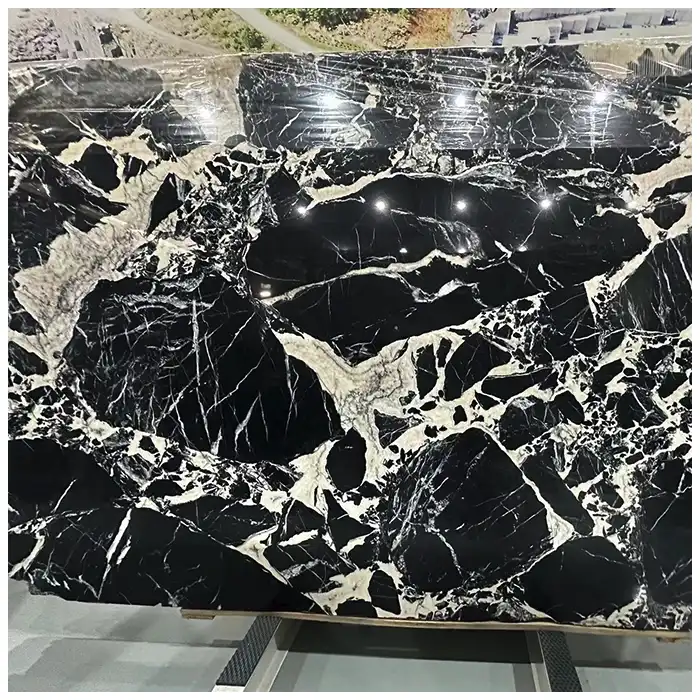
Noir Grand Antique Marble Slab Sizes, Thickness and Surface Specifications
The original MQ STONE listing includes several slab-size references and four nominal thickness options. Because natural block dimensions and cutting yields vary, these figures should be treated as supply references rather than guaranteed finished dimensions for every available slab. Larger historical sizes require confirmation against the current inventory.
| نام محصول | Noir Grand Antique Marble Slabs |
| Commercial Stone Names | Grand Antique Marble, Noir Grand Antique, Grand Antique Black Marble, Grand Antique d’Aubert |
| نوع سنگ | Natural black-and-white carbonate breccia, commercially classified as decorative marble |
| Historical Material Origin | Aubert, French Pyrenees; origin and identification of the supplied batch to be confirmed |
| رنگ | Deep black and high-contrast white, with natural variation in the calcite and breccia formations |
| Primary Slab Size References | 2400mm and above × 1200mm and above; 2000mm and above × 800mm and above |
| Additional Historical Size References | 2900×1800mm, 1900×1300mm, 3100×1600mm and 2600×1000mm; current availability not guaranteed |
| Thickness References | 16mm, 18mm, 20mm and 30mm; confirm the thickness of the selected slabs |
| پایان سطح | Polished primary reference; alternative finishes subject to material and sample approval |
| Product Forms | Full slabs, cut-to-size marble tiles, feature-wall panels, countertops, vanity tops, table tops and decorative architectural pieces |
| Fabrication | Slab allocation, cutting, edge profiling, polishing, opening preparation and custom shapes according to approved drawings |
| Main Applications | Luxury interior feature walls, reception counters, decorative panels, custom tables, selected kitchen countertops and bathroom vanities |
Confirm Usable Slab Dimensions Before Approving the Cutting Layout
A nominal raw slab size is not the same as the usable rectangle available for a finished wall panel or tabletop. Edge trimming, natural features, repairs and the selected white-pattern position may reduce the cutting area. The actual slab photograph and measured dimensions should be reviewed before finalizing large uninterrupted pieces.

Why Polished Grand Antique Marble Shows Such Strong Black and White Contrast
The characteristic Grand Antique appearance comes from dark limestone fragments surrounded by white calcite-rich material. The mineral contrast is inherent to the stone rather than a printed or applied surface pattern.
Polishing can make the black areas appear deeper while increasing the visual clarity of the white formations. Because these components may differ in mineral structure, the finished slab should be examined for a consistent polish and an acceptable transition across the natural breccia boundaries.
For feature walls, polished surfaces reflect architectural lighting and can make large white shapes more prominent. For furniture, the same finish emphasizes the mineral pattern on a horizontal surface viewed at close range.
A honed alternative may be discussed where a lower-sheen appearance is required, but the resulting colour balance and surface quality should be approved on processed material. An unfinished slab image is not sufficient to establish how the completed surface will look.
Bookmatched Grand Antique Marble for Hotel Lobbies and Villa Feature Walls
Grand Antique is well suited to a feature-wall design in which the black and white pattern is treated as the principal decorative element. Some projects may call for mirrored panels, while others benefit from a more irregular arrangement that retains the stone’s natural fragmentation.
A true bookmatched layout requires suitable consecutively produced slabs with corresponding faces. The appearance cannot be promised solely from the commercial stone name. Before confirmation, the available slabs should be photographed in sequence and assessed in the intended mirrored arrangement.
Where matching slabs are unavailable, a coordinated composition can still be developed by selecting panels with compatible black-to-white proportions. The key is to position the largest formations deliberately rather than allowing major colour changes to fall unpredictably across the central wall.
Elevation drawings should define the finished panel dimensions, visible joints, openings, corners and the position of nearby cabinetry or architectural lighting. Support and fixing must be designed for the actual wall construction and finished stone sizes.

Grand Antique Marble Kitchen Countertops: Pattern Selection, Cutouts and Maintenance
Grand Antique Marble kitchen countertops are primarily a design-led specification. The stone’s bold black and white composition can make an island or worktop the main visual feature of a kitchen, particularly alongside plain timber, white or charcoal cabinetry.
When planning a kitchen island, the cutting outline should be assessed against the selected slab photograph. A prominent white calcite formation can become the centre of the design, but its position must be balanced with sink openings, hob cutouts and the areas that remain visible after cabinetry installation.
Openings and narrow sections require fabrication review. The position of natural breccia boundaries, the remaining stone width around cutouts and the support provided by the cabinets can affect the suitability of the proposed piece.
This material is carbonate-based and sensitive to acidic substances. Lemon juice, vinegar and some household cleaners may etch the finish. Oils and coloured liquids can also require prompt removal, depending on the stone and any applied treatment.
Buyers specifying Grand Antique marble for everyday food-preparation surfaces should accept the maintenance implications before ordering. Where resistance to acidic kitchen exposure is a primary requirement, a different worktop material may be more appropriate. The stone is best selected with a clear understanding of its decorative value and care needs.

Grand Antique Marble Tables: Choosing Slabs for Round, Oval and Dining Tabletops
A Grand Antique marble table is most successful when the cutting position has been selected specifically for the furniture shape. A round tabletop isolates one part of the stone’s irregular pattern, while an oval or elongated dining table displays a larger section of the black-and-white composition.
For a round coffee table, the relationship between the white formations and the circular perimeter affects the entire appearance. Cutting a large white area through the edge can create a very different result from positioning it near the centre.
Dining tables require additional attention to slab length, useful cutting width and support. The visible edge can be eased, rounded, bevelled or developed as an approved built-up design, subject to the selected stone thickness and machining feasibility.
The base must adequately support the finished marble top. Large spans, cantilevered sections and unusually shaped tabletops need a suitable furniture support design. A decorative slab thickness should not be treated as proof of structural capacity.
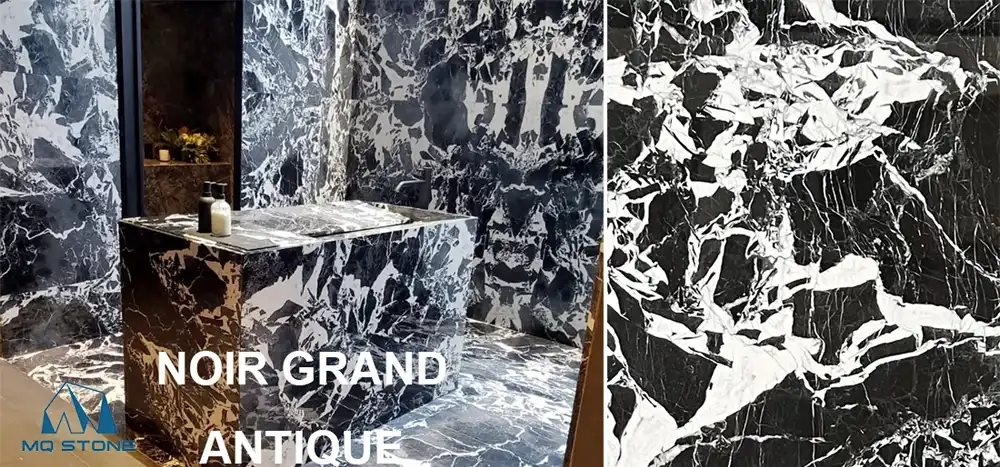
Grand Antique Marble Countertops and Decorative Panels in Luxury Interiors
The countertop application image supplied for this product illustrates how Grand Antique’s white calcite formations can remain visually dominant on finished stone surfaces. For residential and hospitality projects, the material is particularly relevant where an individual element is intended to contrast with quieter surrounding finishes.
Reception Desks and Bar Fronts
Large decorative faces can carry the material’s bold pattern into a hotel reception or private club interior. Edge junctions, counter overhangs and the transition from horizontal to vertical surfaces should be resolved in the fabrication drawing.
Bathroom Vanity Tops
Grand Antique can be considered for a statement vanity, subject to basin cutout design, support and marble-care expectations. Personal-care products and acidic cleaners require attention because the polished carbonate surface can be etched.
Marble Tiles and Accent Panels
Cut-to-size Grand Antique marble tiles can be arranged as decorative wall panels or selected floor accents. Smaller formats change the apparent scale of the breccia pattern, so the tile layout should be reviewed before breaking down larger slabs.
Fireplace and Architectural Features
The black-and-white stone can form a decorative fireplace surround or display feature. Proximity to heat sources requires compliance with appliance clearances, suitable backing and the project installation specification.
Grand Antique Marble Compared with Other Luxury Marble Slabs
The four related MQ STONE products below offer different colour and pattern directions. The selection should reflect how strongly the material needs to contrast with the surrounding architecture, as well as its intended product form and installation conditions.
| جنس سنگ مرمر | Colour and Pattern | Design Selection |
| Noir Grand Antique Marble | Deep black breccia with large, angular white calcite formations. | Statement feature walls, custom tables, selected countertops and dramatic monochrome interior compositions. |
| Calacatta Oro Gold Marble | White marble with grey and warm golden veining. | Bright luxury interiors, decorative walls and surfaces that coordinate with warm metal finishes. |
| سنگ مرمر Giallo Siena | Warm golden-yellow and ochre tones with contrasting natural movement. | Classical interiors, warm hotel reception areas and projects requiring a more saturated gold stone palette. |
| Shangri-La Jade Green Marble | Green tones with white and dark directional mineral movement. | Green-led feature walls and interiors seeking a more directional stone pattern. |
| مرمر سیاه عزیزه | Dark natural marble appearance with its own batch-dependent contrasting veining. | Alternative dark-marble surfaces when the bold black-and-white breccia character of Grand Antique is not required. |
Grand Antique Marble Technical Properties and Project Verification
Grand Antique is a commercially named marble formed from a brecciated carbonate stone. The black limestone fragments and white calcite matrix explain its visual character, but they do not establish one universal set of mechanical values for all slabs supplied under the name. Numerical performance data should come from documentation for the actual material being purchased.
| Technical Property | Relevant Verification | Procurement Relevance |
| Density and Open Porosity | Material-specific results using an applicable method such as EN 1936. | Relevant to material characterization, weight estimates and handling considerations. |
| جذب آب | Representative material testing, such as EN 13755 where specified. | Informs moisture and staining risk assessment, but does not establish complete stain resistance. |
| استحکام خمشی | Actual material results under an applicable bending-strength test such as EN 12372. | Relevant when evaluating large panels, furniture spans and vulnerable cutouts with the support design. |
| Surface and Finish Quality | Approved slab or processed sample, surface inspection and agreed acceptance criteria. | Important across the black limestone and white calcite transitions on polished surfaces. |
| Abrasion and Slip Performance | Project-accepted tests for the actual finished surface where flooring is proposed. | Needed for pedestrian-use areas; decorative wall approval does not establish floor suitability. |
Technical qualification: no batch-specific density, absorption, compressive-strength or flexural-strength values have been confirmed for the currently offered MQ STONE material. Figures from another black marble or an unrelated Grand Antique quarry selection should not be represented as certificates for this product.
Factory Inspection and Export Packing for Grand Antique Marble Slabs
A full-slab inspection should compare the selected material with the approved photographs and purchase specification. Key checks include measured dimensions, thickness, usable cutting area, polish quality and the location of visible natural features or repairs.
Because the black-and-white pattern changes significantly across individual slabs, material identification is particularly important. Each approved slab should retain its reference through cutting and packing so the intended pieces can be associated with their wall elevations or furniture drawings.
Finished countertops and tables require additional inspection of edge profiles, surface finish, cutouts and the areas surrounding openings. Where a wall package uses coordinated slab arrangements, the completed pieces should be checked as a set before shipment.
Full slabs require appropriate rigid support and separation during transport. Cut-to-size panels and furniture components need protection at polished faces, exposed corners and vulnerable edges. Export crates should be identified according to the actual stone sizes and project allocation rather than relying on a universal packing quantity.
Avoid These Mistakes When Ordering Noir Grand Antique Marble Slabs
- Approving a small sample instead of a full slab: a hand sample cannot represent the distribution and scale of the white calcite formations across an entire panel.
- Assuming bookmatching is always available: true mirrored compositions require suitable consecutive slabs and advance layout approval.
- Planning cutting from nominal dimensions: the usable stone area may be smaller once trimming, natural features and pattern positioning are considered.
- Ignoring breccia boundaries: narrow table edges, sink openings and unsupported cutouts require review of the actual stone and finished geometry.
- Specifying marble like granite: carbonate-based Grand Antique is vulnerable to acid etching and should not be marketed as a maintenance-free kitchen surface.
- Ordering without a material sequence: a large feature-wall or furniture package can lose its intended pattern arrangement if slabs and finished pieces are not identified consistently.
Cleaning and Maintaining Polished Grand Antique Marble
Use a soft cloth, clean water and a pH-neutral cleaner suitable for natural marble. Avoid acidic descalers, vinegar, lemon-based cleaners and abrasive powders. Acidic liquids may etch the calcite-rich surface, including polished white areas, while oils and coloured liquids should be removed promptly. For kitchen islands and dining tables, use cutting boards, coasters and trivets rather than relying on the polished stone to resist every form of contact or heat exposure. Sealing requirements depend on the actual stone, surface treatment and use conditions. The finish should be inspected periodically, particularly around heavily used worktop edges and furniture surfaces.
FAQs About Noir Grand Antique Marble Slabs
What is Noir Grand Antique Marble?
Noir Grand Antique Marble is a natural decorative black-and-white breccia stone containing dark limestone fragments and contrasting white calcite. It is commercially known as Grand Antique Marble and is associated with the historic stone from Aubert in the French Pyrenees.
What makes Grand Antique Marble different from other black marbles?
Grand Antique is distinguished by broad, irregular white calcite formations rather than predominantly fine or linear white veining. This gives full slabs a bold geometric appearance suitable for prominent decorative applications.
What slab sizes are available for Noir Grand Antique Marble?
The original listing includes 2400mm+ × 1200mm+ and 2000mm+ × 800mm+ references. Additional historical dimensions include approximately 2900×1800mm and 3100×1600mm, among others. Current sizes and usable dimensions must be checked against the selected stock.
What thicknesses are offered for Grand Antique Marble Slabs?
The existing product references include 16mm, 18mm, 20mm and 30mm. Availability depends on the selected slabs and current stock. Finished thickness should also be suitable for the planned fabrication and support conditions.
Can Grand Antique Marble Slabs be bookmatched for feature walls?
Bookmatching may be possible when suitable consecutive slabs are available. The pattern relationship should be reviewed using actual slab photographs and an approved mirrored layout before cutting. Not every slab selection can form a true bookmatched pair.
Are Grand Antique Marble kitchen countertops practical for everyday use?
They can be used in kitchens where the buyer accepts natural marble maintenance. Grand Antique contains carbonate minerals that may etch from acidic substances, and the surface should not be treated as scratch-proof or stain-proof. Fabrication around sinks and cooktops also requires suitable support and cutout detailing.
Can Noir Grand Antique Marble be fabricated into dining and coffee tables?
Yes. Selected slabs can be processed into round, oval and rectangular table components. The final dimensions, cutting position, edge profile and base support must be approved as part of the finished furniture design.
Is Grand Antique Marble suitable for hotel lobby flooring?
It may be considered for selected interior flooring, subject to material-specific wear and slip-performance testing, expected pedestrian traffic and the approved installation system. Decorative wall suitability does not automatically establish suitability for heavily used floors.
What finish is commonly used on Grand Antique Marble?
Polished is the principal finish in the existing MQ STONE listing because it emphasizes the stone’s black-and-white contrast. Alternative finishes may be reviewed against available material and an approved sample.
What information is needed to order Grand Antique Marble Slabs?
Confirm the required slab quantity, thickness, preferred appearance and intended application. For feature walls, provide panel elevations and any proposed matching arrangement. For countertops or tables, include the cutting dimensions, openings, edge profiles and relevant support drawings.
Recommended Luxury Marble Slabs for Feature Walls and Custom Interiors

Calacatta Oro Gold Marble Slabs
White marble with warm gold and grey veining for bright statement walls, vanity tops and refined interior surfaces.

صفحات مرمر Giallo Siena
Golden-yellow marble for warm hotel interiors, decorative walls and architectural stone features.

Shangri-La Jade Green Marble Slabs
Natural green marble with contrasting directional mineral patterns for feature walls and custom interior stonework.

مرمر سیاه عزیزه
A dark decorative marble alternative for polished interior stone surfaces and monochrome design schemes.

Noir Grand Antique Marble Slabs for Feature Walls and Custom Table ProjectsThe defining choice with Grand Antique is how its black-and-white pattern will appear in the finished piece. Feature walls need an approved slab sequence and joint arrangement; dining tables and countertops need cutting positions selected around their finished outlines. Confirm the available slabs before committing to either fabrication route. |
Grand Antique Slab and Fabrication Options
|