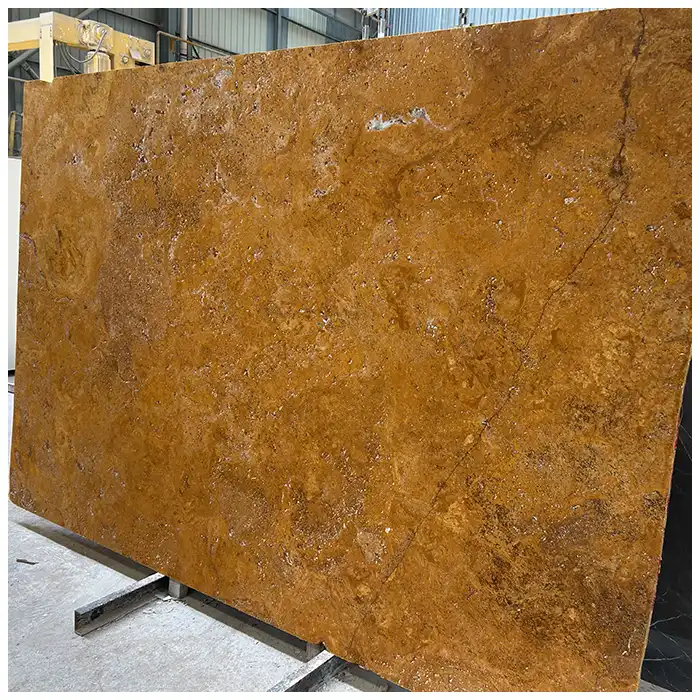
Leathered Quartzite Slabs: Where Texture Helps and Where It Does Not
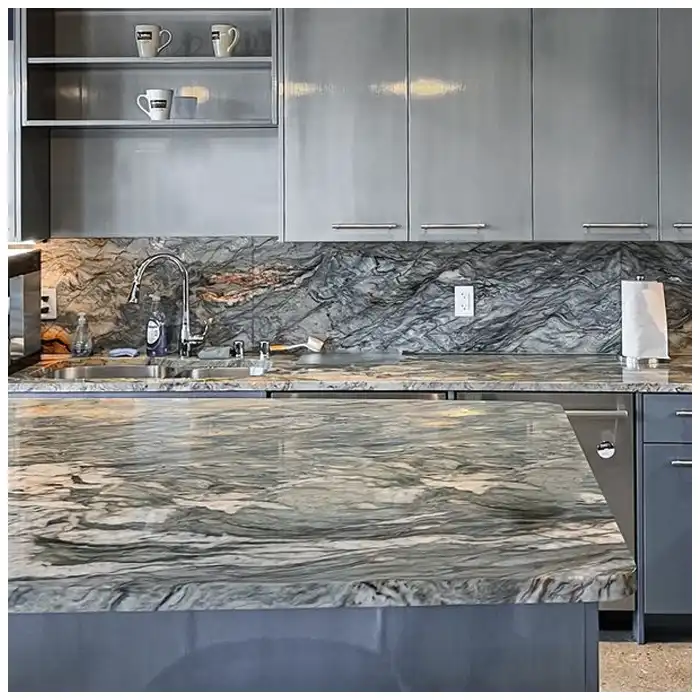
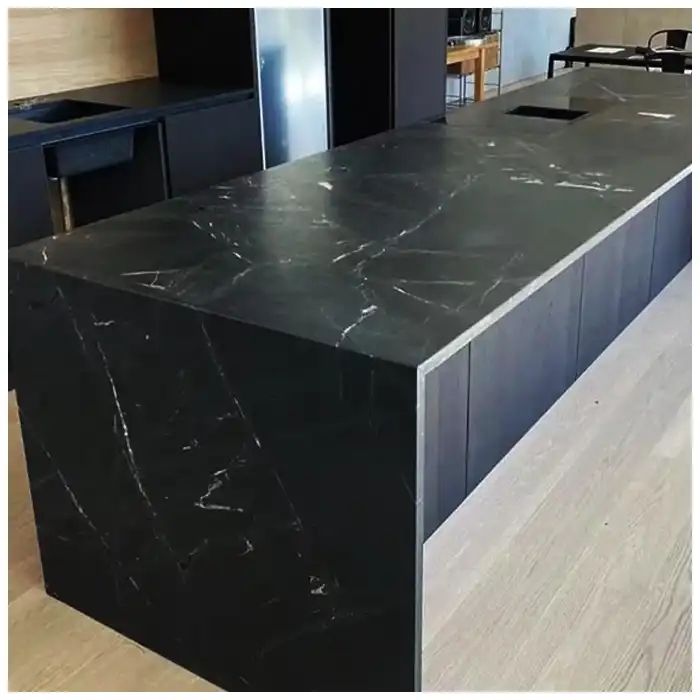
Negresco changes when the light drops low across its face. The charcoal field stays quiet, but pale quartz ridges catch thin silver lines and the surface stops reading as one flat color. I noticed the change first with my fingertips, then with my eyes. That is the useful way to approach leathered quartzite slabs: as finished mineral surfaces, not polished slabs with the shine removed.
Before I approve the finish, I need four things on the bench: a marked full-slab photograph, samples from genuinely different mineral zones, one full-thickness corner, and the cleaning products planned for the room. If one of those is missing, the word “leathered” tells me too little.
Why Leathered Quartzite Slabs Do Not Have Uniform Relief
Quartzite began as quartz-rich sandstone and was recrystallized by heat and pressure. Its quartz grains interlock, but the stone may also carry mica, iron-bearing minerals, amphiboles, resin-filled fissures, and other local changes. A leathering process meets each of those zones differently.

The English overview of metamorphism gives the geological background. It does not predict the finished relief of a commercial slab. For that, I need the actual face, the fabricator’s process, and samples cut from known positions.
A Negresco leathered quartzite can move from dense charcoal to narrow white crystalline bands within a short distance. The darker field may accept a deeper tactile finish while the quartz line stays firmer and smoother. Under side light, one rises like a ridge and the other recedes.
The hand finds transitions that a front photograph misses
I run my fingertips across, not along, the main mineral movement. That direction reveals abrupt steps, rough repairs, or isolated pockets more quickly. A controlled leathered quartzite texture can vary without feeling careless; the transitions still need to make sense where people touch the stone.
The broader Luxury Natural Stone Slabs for Walls, Furniture, and Light helps decide where the material belongs. My concern here is narrower: does the chosen surface remain coherent when the cut piece crosses several mineral characters?
Choose Leathered Quartzite Slabs by Sample Location
A courier-sized offcut from a calm corner is convenient and often misleading. I mark a pale crystalline field, a dark ground, a strong vein, and any repaired or resin-treated area that will enter the finished pieces. Each sample keeps its slab number, orientation, and source box on the full-face image.
The companion Exotic Quartzite Finish Selection: Polished, Honed, Leathered, and Brushed Surfaces under Gallery Lighting helps choose the finish family. Once leathering is selected, leathered quartzite slabs need a second decision: how much local relief can vary before the wall, table, or counter begins to look inconsistently processed?
An Amazonite green quartzite slab may combine blue-green fields, pale quartz and warmer mineral inclusions. I would not ask one machine setting to erase those differences. I would ask for a transition that still feels deliberate across the planned crop.
| Sample position | What I inspect | Why it matters | Reason to pause |
|---|---|---|---|
| Calm field | Baseline depth, sheen and hand feel | Provides the process reference | Finish already feels harsh or catches fibers |
| Strong quartz band | Height change and broken reflection | Shows how harder minerals respond | Ridge becomes sharp or visually detached |
| Mixed mineral zone | Transition across two or more bands | Represents the real cut piece | Texture changes abruptly within a touch area |
| Filled fissure | Resin sheen, recess and edge of repair | Treatment may react differently | Repair flashes or becomes a dirt pocket |
| Full-thickness edge | Face-to-profile continuity and corner comfort | Furniture is touched at the perimeter | Profile looks unrelated to the face |
| Production piece | Match to retained samples under the same light | Separates process drift from geology | Difference cannot be located on the slab map |
A useful record is physical and visual
I keep the approved pieces instead of relying on photographs alone. The file still matters: it shows the slab, source position, finish date, face direction, edge profile and light used during review. The retained sample gives that file a surface I can touch again.
A second leathered quartzite texture sample should cross the hardest visible transition, not repeat the easiest field. If both samples feel virtually identical, I check whether they truly came from different mineral zones.
The Sample Must Cross the Change in Mineral Character
Run one trial across a pale quartz-rich field and a darker mineral band. The pale area may stay restrained while the dark band opens into deeper relief. That is useful information, not an automatic rejection. I place the proposed table or wall crop over the sample locations and decide whether the transition will sit beneath a hand, beside a joint, or high on a panel. The same variation can be welcome in one position and distracting in another.
Approve the transition that enters the finished piece, not two isolated samples that avoid it.
Let the Edge Confirm the Finishing Standard
A flat face is the easiest part to process and the least complete approval for furniture. The edge turns through the slab thickness, meets different mineral bands, and may pass through a laminated build-up or local repair. I want the real profile at full scale.
Le quartzite edge finish can match the face, contrast with it, or use a quieter hone. A polished bevel sometimes frames a dark leathered surface with a clear line. On another slab it looks like an unrelated glossy strip. There is no useful answer without the corner in hand.
With a Patagonia quartzite slab, a bright crystalline zone can become unexpectedly transparent along a polished bevel. I check whether that flash supports the design or pulls attention away from the main face.
I judge the perimeter from the position of the user
At a dining table, my forearm meets the edge for more than a few seconds. At a coffee table, knees and fingertips find the corners. A console is approached from above and often sits close to a wall. Those are different reasons to choose a radius, bevel, eased line, or contrasting finish.
Le Luxury Stone Table Tops: Color, Edge, Light, and Base Details Before Production ties the perimeter to the base and proportion. Here I use it to check whether the quartzite edge finish remains comfortable and visually connected to the textured face.
Where the Surface Belongs on Furniture and Walls
A dining top asks for comfort, repeatable cleaning and an edge that does not collect crumbs. A feature wall can accept stronger relief because it is viewed more than touched, although joints and high-level cleaning still matter. A counter adds water, products, cutouts and task lighting.
I do not assume that leathered quartzite slabs hide fingerprints or stains better than polished material. A dark textured field may disguise one dry mark and make dried residue more obvious. The only honest answer comes from the selected stone, finish and normal room light.
Bookmatched panels need one further check. Matching veins do not guarantee matching highlights. If the brush direction or process changes across the center joint, the pair can flash as two panels even when the mineral lines meet accurately.
Read Leathered Quartzite Slabs in Grazing Light
Overhead warehouse lighting compresses texture. A low source travels across the relief and turns small height changes into highlights and shadows. I use both. The overhead view tells me how the slab reads generally; the grazing view shows what a wall washer, pendant or low window may reveal.
The article How Lighting Changes Colorful Marble, Quartzite, and Onyx Slabs provides the wider color method. For leathered quartzite slabs, I add a slow side-to-side video at the intended orientation. A still image freezes the one moment when every raised band happens to look controlled.
Reflections are broken rather than removed. Pale crystals still catch light. Resin may hold a different sheen. A deep charcoal area may look velvety from the front and almost metallic from the side. I want those changes understood before the lighting plan is fixed.
Test Cleaning on the Surface You Will Supply
Texture changes the path of a cloth and the places where residue can remain. I test the intended cleaner, water, a soft cloth and the normal wiping direction. Once dry, I look across the sample under side light for lint, film, darkened pockets or a change in sheen.
Textured quartzite care cannot be copied from a generic polished-stone sheet. The supplier, fabricator and treatment manufacturer need to agree on products for the actual material and use. If a sealer or other treatment is proposed, it belongs on half of a representative sample so the visual difference remains available for comparison.
I also leave the treated sample long enough to reach the condition stated by its manufacturer. Judging it while wet confuses temporary darkening with the final appearance. My handover note records what was applied, where, and how the trial was cleaned.
Texture is not a maintenance exemption
Deep relief can hold crumbs on a table and dust on a wall. Shallow relief may clean easily but deliver less tactile character. Textured quartzite care starts with that tradeoff, then gives the operator a method that has already been tried on the retained finish.
The permanent comparison Natural Quartzite vs Marble-Look Sintered Stone: The Definitive Comparison for Premium Interiors explains why the natural depth remains different from a printed manufactured surface. Care protects that depth; it does not promise that a natural textured face will behave like a flat sheet.
Release Leathered Quartzite Slabs without Erasing Natural Variation
I approve a first production piece beside the retained sample. The record names the slab, sampled zones, process reference where available, orientation, edge, treatment and inspection light. If another slab carries a materially different mineral field, I do not hide that fact under the first approval.
Leathered quartzite slabs can vary for two separate reasons: geology and finishing. The slab map helps explain the first. The retained samples and first-piece record help detect the second. Without both, every inconsistency can be blamed on “natural variation,” which is not serious quality control.
I place adjacent panels or paired furniture pieces together under side light before release. The center joint, outer edges and main touch zones receive most of my attention. A small process difference is far easier to see when two related pieces stand side by side.
When the delivered texture does not match
First, photograph the complete piece, slab code, approved sample, edge and disputed zone under the same light direction. Second, stop sealing, installation and further finishing so the original condition remains available. Third, send the supplier the slab map, sample record, first-piece inspection and packing images for comparison.
Cleaning, a controlled refinish, reassignment, replacement or acceptance may follow. I do not choose among them until the team knows whether the difference comes from residue, the mineral field, the finishing process or the viewing light.
Frequently Asked Questions
1. What are leathered quartzite slabs?
They are quartzite slabs finished with a textured process that reduces continuous reflection and reveals differences in mineral relief. The exact surface varies with stone composition, resin treatment, abrasives, equipment, and process settings.
2. Is leathered quartzite suitable for a dining table?
It can be, when the approved texture feels comfortable, the edge works with hands and serving pieces, the base supports the top, and cleaning tests suit the intended use. Test the selected slab, not a generic sample.
3. Does leathered quartzite show stains less than polished quartzite?
Do not assume that. Color, texture depth, treatment, sealing, spill, cleaning method, and light affect visibility. Use a controlled test on the actual finish and follow accepted care guidance.
4. Should the edge of leathered quartzite also be leathered?
It may be leathered, polished, honed, or deliberately contrasted. Approve a full-scale edge because profile, texture continuity, reflection, comfort, and fabrication access change the result.
5. What should I do if delivered texture differs from the sample?
First, document the full piece, slab code, sample, edge, light, and disputed area. Second, stop sealing, installation, and refinish work. Third, compare the process record, slab map, first-piece inspection, and packing evidence through the supplier.
Quick-Reference Checklist for Leathered Quartzite
- Choose sample zones across every representative mineral field and treated feature.
- Mark each sample location and orientation on the full-slab photograph.
- Produce the intended edge profile on the same approved texture sample.
- View the sample in the planned vertical or horizontal orientation under grazing light.
- Test agreed spills, cleaning products, cloths, and treatment on the actual finish.
- Retain a signed sample and inspect the first production piece before continuing.
Final Conclusion
Leathered quartzite slabs deserve approval as complete geological surfaces, not as finish names. Sample every mineral zone, include the edge, observe grazing light, test real care, and retain the physical standard through production.
MQ STONE keeps the approved piece in hand through production, because texture cannot be controlled from photographs alone.

References
- Dimension Stone Design Manual, Natural Stone Institute.
- Natural Stone Institute Technical Bulletin: Natural Stone Finishes, Natural Stone Institute.
- ASTM C616 Standard Specification for Quartz-Based Dimension Stone, ASTM International.
- ASTM C97 Standard Test Methods for Absorption and Bulk Specific Gravity of Dimension Stone, ASTM International.
- ASTM C880 Standard Test Method for Flexural Strength of Dimension Stone, ASTM International.
- Manual for Stone Furniture and Interior Applications, Stone Federation Great Britain.
- Quartzite, Wikipedia, Wikimedia Foundation.