
Quick Summary: Bianco Lasa Marble Slabs and Tiles for Architectural Interiors
Marbre Bianco Lasa is a natural Italian white marble from the Val Venosta region of South Tyrol, selected for large interior wall panels, villa kitchen countertops, marble floor tiles and bathroom vanities. Its fine crystalline white background and restrained grey markings suit interiors requiring a relatively consistent stone appearance across adjoining surfaces. MQ STONE’s original catalogue includes slab references from 2400mm+ × 1400mm+ and 2000mm+ × 1000mm+, with 16mm, 18mm, 20mm and 30mm thickness options. Slab grading, final cutting dimensions and surface finish should be reviewed together before fabrication.

Bianco Lasa Marble Slabs for Villa Kitchens and Hotel Wall Cladding
Bianco Lasa is quarried in the Italian Alps, in the Val Venosta area of South Tyrol. It differs from the better-known Carrara marbles in both geographical origin and its characteristic appearance. The stone commonly has a fine crystalline structure, a bright white background and relatively delicate mineral markings.
For architectural interiors, this restrained pattern has practical design value. A broad wall can be finished in pale natural stone without requiring the prominent grey veins associated with certain Calacatta varieties. A kitchen island can also retain a predominantly white appearance while preserving the variation expected from natural marble.
In hotels, Bianco Lasa is suitable for consideration in reception walls, elevator surrounds, bathroom vanities and selected floor areas. Large polished panels can emphasize the crystalline white background, while a honed finish may better suit rooms with strong directional lighting.
The most important initial decision is the intended degree of visual uniformity. Some selections are exceptionally quiet, while others contain grey or blue-grey lines. The finished room should be planned around an approved range of natural variation, rather than an expectation that every slab will be identical.
Lasa White Marble Slab Selection for Coordinated Interior Projects
For a project using white marble in several rooms, selecting the right slab group is more important than selecting an individual attractive piece. The goal is to establish a consistent visual character across surfaces that may be installed at different stages.
White Background Grading
Bianco Lasa selections can differ in overall brightness, fine crystalline texture and the concentration of visible markings. A predominantly white wall may call for a quieter group, while a countertop can accommodate selected pieces with more visible grey movement. The choice should be intentional.
Slab Orientation and Wall Layout
Although many Bianco Lasa slabs have restrained patterns, the direction of any grey markings still influences the finished composition. For a full-height wall, slab photographs should be reviewed in the orientation proposed for installation before the final cutting lines are approved.
Multiple-Room Material Selection
Where one project includes kitchen counters, bathroom vanities and wall cladding, the stone can be allocated by visibility and fabrication requirement. Principal wall surfaces may need a particularly consistent background, while smaller countertop sections can be matched to the relevant cabinets and fixtures. Confirm the selected faces and available dimensions before producing a combined cutting schedule.
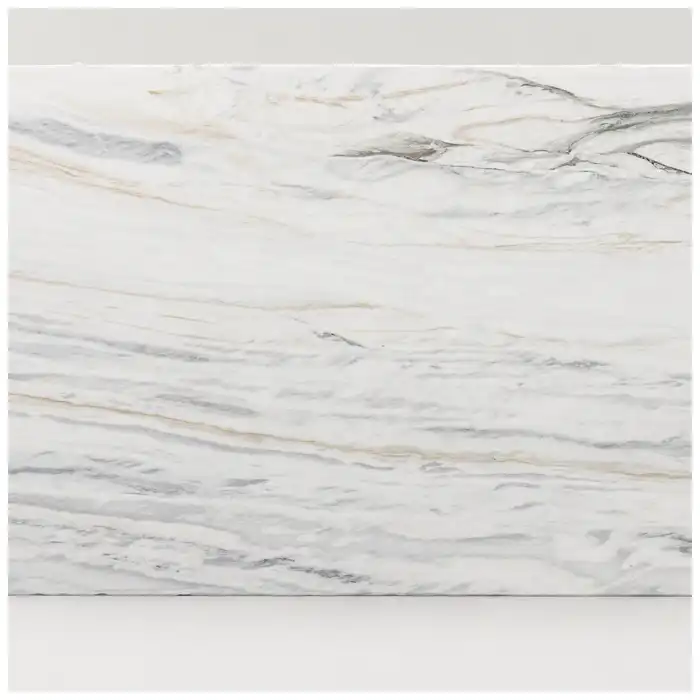
Bianco Lasa Marble Slab Sizes, Tile Dimensions and Product Specifications
MQ STONE’s original Bianco Lasa listing includes full slabs, modular tiles and several thickness references. The principal options are summarized below. Catalogue sizes describe possible product formats and should not be interpreted as confirmation that every size and thickness is available from the same selected slab group.
| Nom du produit | Bianco Lasa Marble / Marble Bianco Lasa |
| Matériau | Natural Italian White Calcite Marble |
| Origine | Val Venosta, South Tyrol, Italy; exact quarry and batch to be confirmed |
| Couleur | White to soft ivory with delicate grey or blue-grey natural markings |
| Large Slab Reference 1 | 2400mm+ × 1400mm+ |
| Large Slab Reference 2 | 2000mm+ × 1000mm+ |
| Tile Size References | 300×300mm, 300×600mm, 600×600mm and 600×1200mm; other sizes subject to cutting approval |
| Other Tile References | 305×305mm and 610×610mm imperial-related formats; exact finished dimensions require confirmation |
| Main Thickness References | 16mm / 18mm / 20mm / 30mm |
| Other Historical Thicknesses | 10mm / 25mm / 40mm and other custom sections subject to material and fabrication approval |
| Finitions de surface | Polished and honed; grooved, brushed and selected textures subject to sample approval |
| Traitement des bords | Straight-cut, eased, mitred and selected custom profiles according to drawings |
| Product Forms | Full slabs, wall cladding panels, floor tiles, kitchen countertops, bathroom vanity tops and custom architectural pieces |
| Principal Applications | Villa kitchens, hotel interiors, bathrooms, selected interior flooring and architectural wall cladding |
Confirm Finished Dimensions Before Cutting
Nominal slab size is not the same as usable fabrication size. Trimming, natural fissures, edge defects and the position of openings can reduce the available cutting area. Metric formats such as 300×600mm and imperial-related formats such as 305×610mm must also be distinguished in the installation drawings.
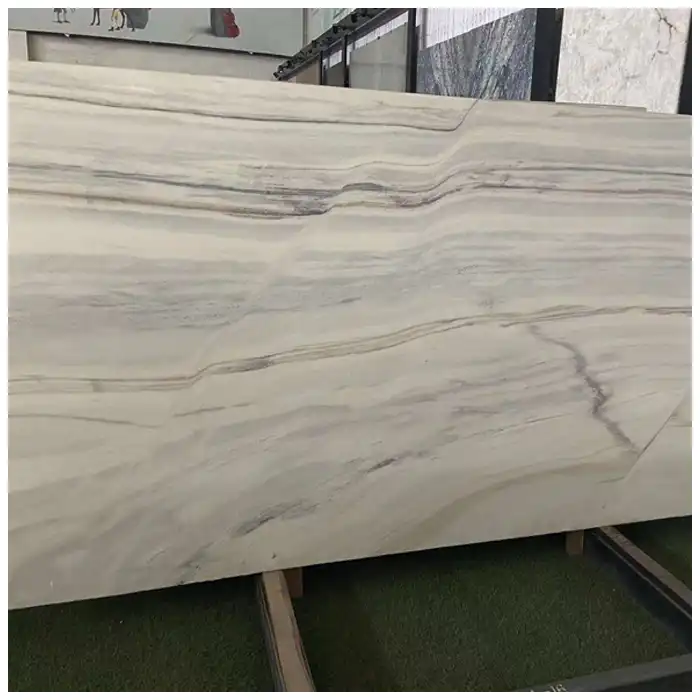
Bianco Lasa Marble Floor Tiles for Hotel Lobbies and Residential Interiors
Bianco Lasa Marble Tile can be considered for interior floors where a white stone surface is required without strongly contrasting mineral movement. The relatively quiet pattern makes it useful in rooms with complex furniture layouts or large areas of adjoining wall cladding.
Tile dimensions influence the overall appearance. A 600×600mm module produces a regular grid suitable for many entrance halls and living areas. A 300×600mm format introduces a more directional joint pattern, which may work better in corridors or narrower rooms. Large-format pieces can reduce the number of joints but require tighter control of substrate flatness and handling.
For a hotel floor, the approved stone selection should include representative tiles from the intended production group. Even when the natural pattern is subtle, small changes in background brightness may become visible across a broad surface.
The finish must also respond to the way the floor will be used. Polished marble may be appropriate for selected dry interior areas where its performance is acceptable, but wet entrances and regularly washed floors need a surface that meets the required slip-resistance criteria.
The installation drawing should establish tile orientation, movement joints, perimeter cuts and transitions to other materials. These decisions are particularly important when the same marble continues into adjoining rooms or stairs.
Surface Finish Selection for Bianco Lasa Floors, Walls and Countertops
The surface finish influences both the appearance and the maintenance requirements of Bianco Lasa. Polishing makes the crystalline white structure more reflective. Honing produces a softer, lower-sheen result. Other mechanical finishes should be assessed on the actual material before they are included in the final specification.
| Finition | Visual Result | Application Decision |
| Poli | Reflective white face emphasizing the crystalline structure and fine markings. | Feature walls, kitchen and vanity countertops, and selected dry interior floors. |
| Honoré | Smooth matte or low-sheen white surface with reduced glare. | Bathroom walls, residential floors and broad interior panels; verify floor traction separately. |
| Grooved | Linear decorative channels machined into the stone. | Selected interior wall features; groove depth, cleaning and panel strength need review. |
| Brushed or Textured | Lower, less uniform reflection with a mechanically worked texture. | Application-specific surfaces after sample approval and appropriate performance testing. |
Bianco Lasa White Marble Wall Panels for Bathrooms and Hotel Suites
Large Bianco Lasa wall panels can establish a continuous light background in hotel bathrooms, private villa suites and architectural corridors. Because the natural markings are usually restrained, the finished result depends heavily on panel alignment, lighting and the quality of the visible joints.
On a bathroom vanity wall, the main panels should be planned around the mirror, taps and cabinetry. Large uninterrupted pieces may reduce the number of joints, but the selected slab size must accommodate the required openings and edge trimming.
A polished surface can reflect decorative lighting and nearby fixtures. Where light falls across the wall at a shallow angle, a honed finish may help reduce glare. This choice should be reviewed with the final lighting design rather than made from a small sample in isolation.
For shower wall applications, the stone is only one part of the assembly. Waterproofing, fixing materials, sealants and movement joints require appropriate detailing. A penetrating sealer cannot replace the waterproof membrane behind the marble.
When individual wall panels are large or mechanically fixed, their size, thickness and support arrangement must be assessed by the project designer. Finished panel weight and fixing capacity should be calculated from verified product information rather than a generic slab description.
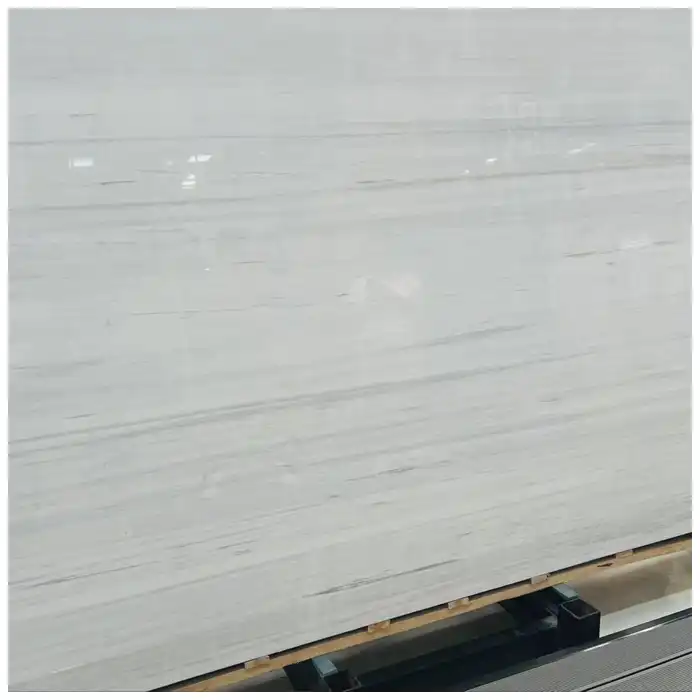

Bianco Lasa Marble Kitchen Countertops for Private Villas
The MQ STONE villa kitchen image illustrates Bianco Lasa used as a pale natural marble countertop. Its subtle crystalline markings allow the countertop to work with cabinetry, lighting and other interior finishes without introducing a dominant vein pattern.
Kitchen Island Slab Layout
The island top should be positioned within the usable area of an approved slab. Sink openings, hob positions and exposed edges must be coordinated before cutting. The aim is to retain a consistent white appearance while avoiding unsuitable stone sections around narrow openings.
Waterfall End Panels
Where the countertop continues down a cabinet end, the top and vertical panel should be selected together. Mitred joints require accurate cutting and a suitable supporting structure. The decorative stone connection should not be treated as the sole load-bearing element.
Cabinet and Stone Coordination
Cabinet levels, support rails, appliance clearances and sink fixing arrangements should be reviewed before installing the marble. The chosen countertop thickness must be compatible with the cabinet design and any required reinforcement.
Marble Countertop Maintenance
Bianco Lasa is a calcite marble and can be etched by acidic liquids. Its surface should be protected from citrus, vinegar, abrasive cleaning tools and direct cutting. A sealer may reduce some staining risks but will not prevent chemical etching.
Bianco Lasa Marble Physical and Mechanical Properties
The figures below are representative published test results for the Lasa Bianco natural marble material. They provide a useful technical reference for preliminary selection but are not a batch-specific test certificate for MQ STONE’s current slabs. Actual project acceptance should use documentation identifying the selected stone and relevant test conditions.
| Material Property | Reference Value | Test Method and Interpretation |
| Calcium Carbonate Content | Approximately 98% | EN 12407 reference; confirms the carbonate character of the named marble selection. |
| Densité apparente | 2710 kg/m³ | EN 1936; useful as a preliminary reference for panel self-weight calculations. |
| Open Porosity | 0.30% | EN 1936; a parent-stone porosity reference, not a waterproofing classification. |
| Absorption de l'eau | 0.10% | EN 13755; does not establish resistance to acid etching or every staining condition. |
| Résistance à la compression | 79 MPa | EN 1926; typical compression-strength reference, not a certified countertop load capacity. |
| Résistance à la flexion | 15.1 MPa | EN 12372; relevant to stone characterization, with component design requiring additional assessment. |
| Abrasion Test Result | 21.5mm groove length | EN 14157; representative test outcome, not a universal traffic classification. |
| Slip Resistance | Dry SRV 82 / Wet SRV 79 | EN 14231, sandblasted specimen only. These values do not apply automatically to polished or honed tiles. |
Technical qualification: the values are representative Lasa Bianco material data. They do not certify the specific MQ STONE production batch, any resin or mesh reinforcement, or a finished installation. Where performance determines acceptance, request testing for the actual selected marble and finish.
Cut-to-Size Fabrication for Bianco Lasa Marble Countertops and Wall Panels
The fabrication route should follow the intended finished product. Full wall panels are planned primarily around dimensions, joint locations and the selected slab faces. Countertops additionally require cutouts, exposed edge details and coordinated support. Modular tiles depend on consistent finished sizes and a practical cutting yield.
For custom countertops, sink and appliance openings should be reviewed against natural fissures and the available stone sections. Inside corners and narrow strips may need particular attention during machining, lifting and installation. The drawings must identify the final edge treatment and any unsupported spans.
For large wall panels, cutting layouts should account for trims, fixtures and adjoining finishes. Stone faces should be identified before fabrication so the intended orientation is retained during packing and installation. Any reinforcement or resin treatment present on the selected slabs must be considered when choosing adhesives or anchors.
For stair components, the drawing should specify tread and riser dimensions, edge profiles and the required slip-resistant treatment. A slab thickness that suits wall cladding may not be suitable for a particular stair or countertop construction without further engineering review.
Bianco Lasa Marble Compared with Four Other MQ STONE Marble Collections
Bianco Lasa, Calacatta Oro, White Carrara, Calacatta Classico and Grand Antique can all be used in architectural interiors, but they serve different visual and fabrication goals. The following comparison helps identify which stone is better aligned with the intended surface. Appearance refers to typical commercial selections; actual slabs should be reviewed before a final decision.
| Comparison | Marbre Bianco Lasa | Calacatta Oro Gold | White Carrara | Calacatta Classico | Grand Antique |
|---|---|---|---|---|---|
| Origine | Val Venosta, South Tyrol, Italy | Italian Calacatta marble selection | Carrara, Tuscany, Italy | Italian Apuan marble district | French Pyrenees, Aubert |
| Typical Appearance | Luminous white crystalline background with fine grey markings | White background with grey and warm golden veins | White-to-grey ground with more distributed smoky grey movement | White-to-ivory background with expressive grey veins | Strong black-and-white angular breccia pattern |
| Product Forms | Slabs, floor tiles, wall panels, countertops and vanity tops | Decorative slabs, wall panels and countertops | Slabs, tiles, stair components and countertops | Slabs, floor tiles, bookmatched panels and countertops | Slabs, feature panels, countertops and custom stone furniture |
| Ideal Design Direction | Bright, relatively uniform white architectural surfaces | Warm-toned feature walls and statement kitchen islands | Coordinated classic white-grey flooring and bathrooms | White interiors with prominent vein-led compositions | High-contrast feature walls and sculptural interiors |
| Wall Installation | Prioritize background consistency and precise joints | Coordinate strong gold veins across adjacent panels | Group compatible grey-white stone selections | Plan bookmatching or directional vein layouts where available | Position large contrasting fragments deliberately |
| Custom Fabrication | Coordinated cabinet tops, vanity openings and pale stone panels | Waterfall vein alignment and decorative countertop edges | Repeated tile modules, stairs and standard countertop shapes | Cut-to-size panels and vein-led countertop arrangements | Full-slab pattern placement, curved tables and detailed edges |
| Key Selection Check | Consistent whiteness, actual dimensions and suitable floor finish | Golden-vein intensity and slab sequence | Background shade, tile grading and joint layout | Actual pattern and available consecutive slabs | Breccia boundaries, cutout positions and panel support |
Comparison note: these are design and fabrication distinctions, not test-based performance rankings. All five are natural carbonate stone selections, and their suitability for floors, wet areas or kitchen countertops depends on the actual material, finish and installation specification.
Bianco Lasa Marble Inspection and Export Packing
Inspection should begin with the approved slab group and its acceptable white-background variation. Full slab photographs help identify any grey markings, natural fissures or repaired areas that could influence fabrication. Finished pieces should then be checked against the drawings for dimensions, thickness, edge quality and surface condition.
For polished wall panels, surface reflection can reveal inconsistencies that are less apparent during cutting. Adjacent panels should be reviewed in the intended sequence before packing. Floor tiles should be grouped by their approved visual range and kept separate by finished size and surface finish.
Kitchen countertops require additional checks around sink cutouts, appliance openings and exposed edges. Any reinforcement or resin treatment affecting the chosen pieces should be recorded where relevant to installation.
Export packing should protect slab faces, polished edges and finished corners. Cut-to-size panels need suitable rigid support and identification corresponding to their installation positions. Separate crates may be appropriate for large wall pieces, modular tiles and custom countertops because their handling requirements differ.
Cleaning and Maintaining Bianco Lasa Marble Interiors
Clean Bianco Lasa Marble with a soft cloth or suitable floor-cleaning equipment and a pH-neutral product intended for carbonate stone. Remove grit regularly from floors to reduce surface abrasion. On kitchen countertops, promptly wipe away wine, citrus juice, vinegar and other acidic liquids. Avoid abrasive powders, harsh descalers and aggressive pads. Use cutting boards and appropriate protection under hot cookware. An impregnating sealer may reduce some absorption-related staining but cannot prevent chemical etching or make marble scratch-proof. In bathrooms, maintain grout, sealant and waterproofing details according to the installation specification.
FAQs About Bianco Lasa Marble
Where does Bianco Lasa Marble come from?
Bianco Lasa Marble comes from the Val Venosta region of South Tyrol in northern Italy. It is a natural calcite marble associated with the Lasa stone district, rather than the Carrara marble district of Tuscany.
What are the main uses of Bianco Lasa Marble slabs?
Bianco Lasa Marble slabs are used for interior wall panels, hotel and residential cladding, kitchen countertops, bathroom vanity tops and custom architectural stone components. The selected dimensions, finish and supporting construction must suit the application.
What slab sizes are listed for Bianco Lasa Marble?
MQ STONE’s original product references include slabs from 2400mm+ × 1400mm+ and 2000mm+ × 1000mm+. Actual usable dimensions depend on the selected slabs, edge trimming and the intended cutting layout.
Which thicknesses are available for Bianco Lasa Marble slabs and tiles?
The main original thickness references are 16mm, 18mm, 20mm and 30mm. Other nominal sections may be considered, but the final size and thickness combination must be confirmed before fabrication.
Can Bianco Lasa Marble Tile be used for hotel flooring?
Bianco Lasa Marble Tile can be considered for hotel interior floors when the selected stone, thickness, finish, slip resistance, wear performance and supporting installation meet the project’s requirements. Wet entrances and regularly washed areas need particular attention.
Is Bianco Lasa Marble suitable for kitchen countertops?
Bianco Lasa can be fabricated into kitchen countertops and waterfall island panels with suitable support and cutting details. As a natural calcite marble, it is vulnerable to acid etching and requires appropriate surface care.
How does Bianco Lasa differ from White Carrara Marble?
Bianco Lasa generally has a more uniform white crystalline background and restrained markings, while White Carrara commonly shows a greyer background with more distributed smoky veins. They are also associated with different Italian quarry districts. Actual slab selections should be compared.
What physical properties are reported for Lasa White Marble?
A representative Lasa Bianco material dataset reports apparent density of 2710 kg/m³, open porosity of 0.30%, water absorption of 0.10%, compressive strength of 79 MPa and flexural strength of 15.1 MPa. These values are material references, not verified batch test results for MQ STONE’s current slabs.
Is polished Bianco Lasa Marble suitable for wet bathroom floors?
A polished Bianco Lasa slab should not automatically be specified for a wet bathroom floor. The actual finished tile requires suitable slip-resistance assessment, and the installation must include appropriate waterproofing, falls and drainage.
What information is needed for a Bianco Lasa Marble quotation?
Provide the intended application, slab or finished tile dimensions, thickness, surface finish, preferred white background selection and delivery destination. For kitchen countertops and wall panels, include drawings showing openings, edges and panel arrangements.
Recommended Top 4 Popular Natural Marble Slab Collections

Dalles de marbre Calacatta Oro Gold
Italian white marble with warm golden veins for kitchen islands, decorative walls and bespoke interior panels.

Plaque de marbre blanc de Carrare
Italian white-grey marble for coordinated interior floor tiles, bathroom walls and cut-to-size worktops.

Marbre Calacatta Classico
White Italian marble with more pronounced grey veins for feature walls and custom countertop designs.

Grand Marbre Antique
French black-and-white brecciated stone for feature walls, countertops and sculptural furniture.

Italian White Marble Bianco Lasa for Villa Kitchen and Interior Cladding Specifications
For a Bianco Lasa interior, begin with the approved white marble selection and the architectural drawings. Kitchen countertops require coordinated cabinet supports, openings and edge details. Wall cladding depends on panel dimensions, joint positions and secure fixing. Interior floor tiles need a consistent setting-out module and an appropriate surface finish. These decisions determine how the selected slabs can be allocated and fabricated into finished components.
Bianco Lasa Marble Project Enquiry
Share your slab or tile dimensions, thickness, finish, intended application and drawings for a review of suitable Bianco Lasa material and cutting arrangements.
