Backlit Onyx Wall Panels for Hotel Lobbies: Light-Box Depth, Slab Selection, and Bookmatching
I first saw a pale onyx slab become luminous at a fabricator’s yard after the afternoon sun slipped behind the loading bay. The edge caught the light before the field did, and honey-coloured mineral clouds seemed to rise from inside the stone. This stone has been waiting for millions of years… and a careless light box can make it look like frosted plastic in ten minutes.
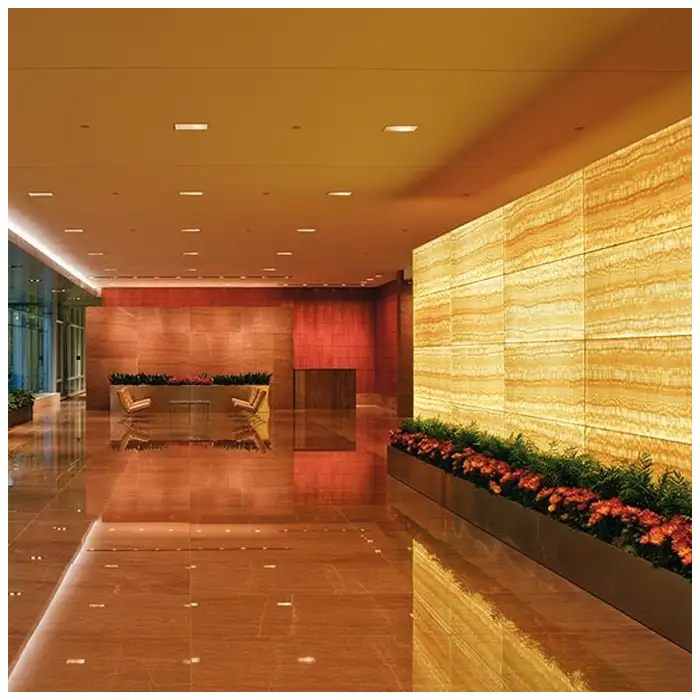
Backlit onyx wall panels are having a renewed place in hospitality interiors because a lobby now often needs one material moment that feels intimate rather than loud. The veins will tell you where the wall wants to breathe. Our job is to listen before we cut a perfect bookmatch into an unusable set of rectangles.
Choose the onyx under light, not only under warehouse lamps
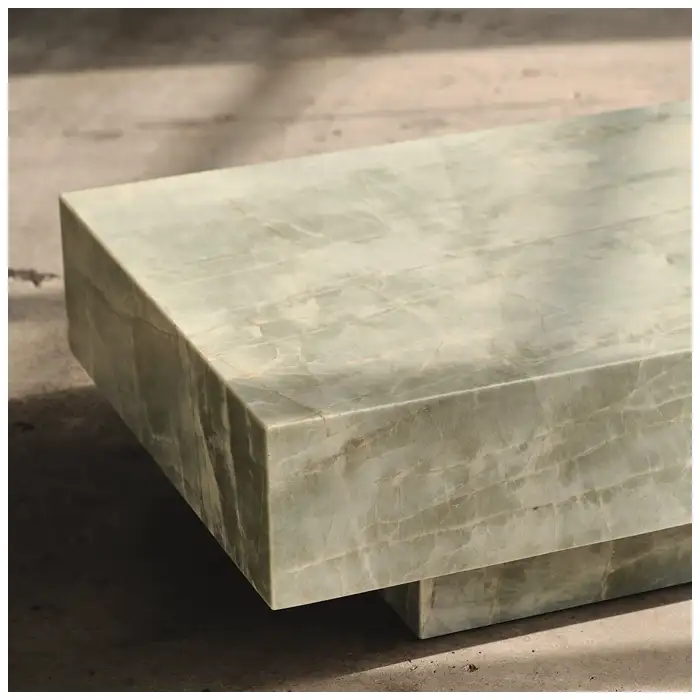
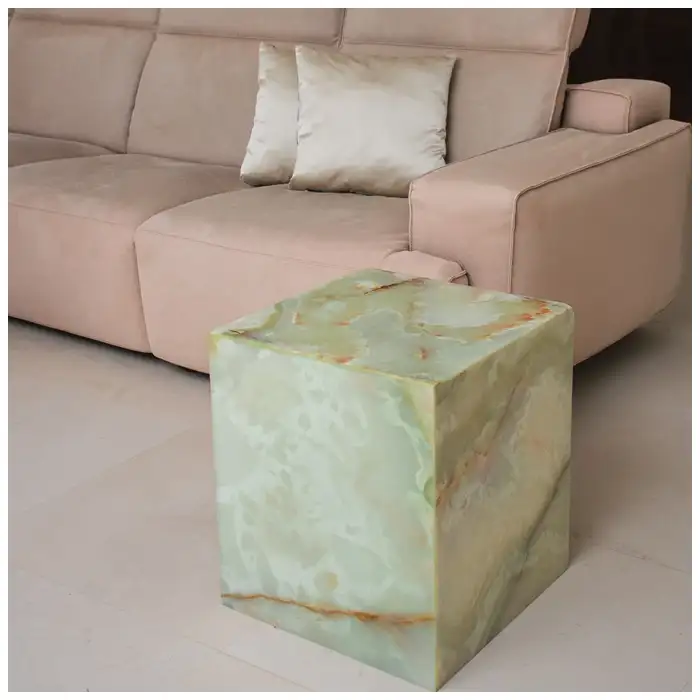
Onyx is largely calcite, formed as mineral-rich water deposits layer after layer. Iron oxides lend honey or rust, while other impurities create milk, green, or smoky shadows. That geology creates the glow. It also means opacity can vary within a single slab. I test several zones rather than placing one lamp behind one flattering corner.
वेनिला गोमेद स्लैब can carry a soft cream field that rewards restrained lighting, while नीला गोमेद often asks for careful diffusion so its darker mineral passages retain depth. True luxury is something you never get tired of looking at, not something that shouts at every guest entering the lobby.
| Light-box variable | Test before fabrication | Visual risk |
|---|---|---|
| Stone-to-light distance | Test the actual panel thickness and cavity | Individual LED points read through the stone. |
| Diffuser | View at guest eye level and oblique angles | The wall becomes flat and loses mineral depth. |
| Bookmatch axis | Mark the central joint on full slabs | A dramatic symmetry breaks at the most visible line. |
| Service access | Agree removable panel or rear access route | A failed driver requires disturbing finished stone. |
The Hard-Won Lesson: More light erased the stone
A boutique hotel asked for a brighter feature wall after a daytime test. The installer doubled the LED output without changing the cavity or diffuser. At night, the pale zones blew out and the bookmatched brown veins became two dark scars. We rebuilt the light box with deeper spacing and lower, even output. The original slab was not wrong. The light was impatient.
The Lesson: Tune diffusion and cavity depth before increasing output; brightness cannot replace a controlled glow.
Backlit onyx wall panels need a bookmatch with a purpose
A bookmatch is more than symmetry. I look for a central movement that feels inevitable, then I decide whether the wall needs a calm spine or a dramatic opening. The veins will tell you when a slab should be mirrored and when it should be allowed to run freely. This stone has been waiting for millions of years… there is no reason to force it into a pattern that fights its own geology.
Snow White Onyx may reward a quieter joint line and soft lighting, while a more active material can carry a bolder composition. The correct decision comes from full slabs, a realistic light test, and the actual wall proportions.
Let the wall become quiet before it becomes bright
When I stand in front of a good onyx assembly with the lights off, I first look for depth in the stone itself: the cloudy calcite field, the fine darker trails, the small areas where transparency is already suggested. Then, when the light comes on, those features should grow slowly. If the whole panel becomes one flat white rectangle, the system has defeated the material. This is not decoration. This is geology.
A hotel lobby asks for a different response at noon and at midnight. Daylight may reveal a deep, matte mineral surface; evening light can reveal inner colour without blinding the seating area. We often test dimming ranges rather than one fixed output. The wall should hold a conversation with the room, not win an argument against it. True luxury is something you never get tired of looking at.
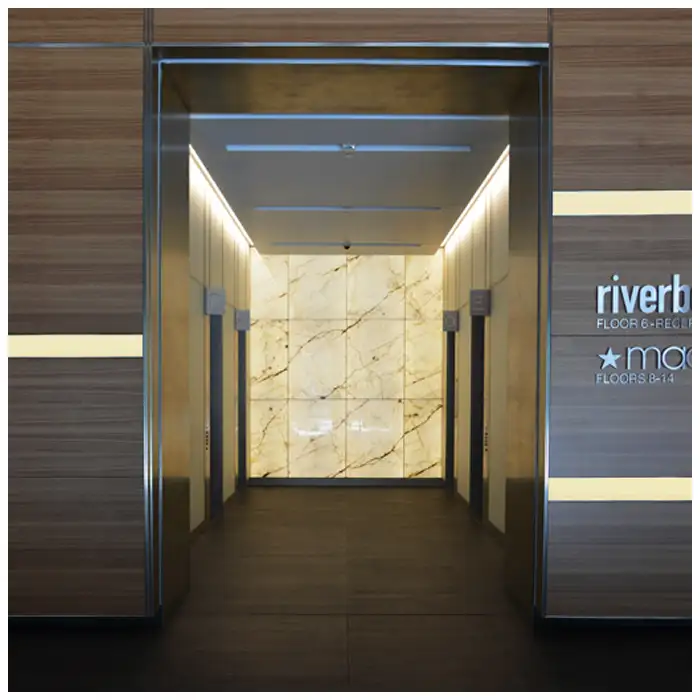
Fabrication details deserve the same care. A very thin edge may glow more readily, but it also asks more from the support. The substrate must be flat, the fixing system must allow the panel to be placed without point stress, and the joint must have a reason. The veins will tell you where a joint can disappear; the installer needs drawings that respect that answer.
Study the slab as a sequence of light, not a flat photograph
When I select an onyx slab for a lobby wall, I walk around it before I ever put light behind it. Some fields have a slow, fog-like translucency. Others contain sharp mineral borders that become graphic under illumination. I mark the areas that can carry the centre of a composition and the areas that may be better at an edge or behind a fixed furnishing. The stone is not a printed panel. It has a front, a back, a grain, and zones of different density.
A bookmatch can be almost ceremonial when the two halves meet around a quiet mineral river. It can also become too loud when two dense patches collide in the middle. The veins will tell you which is which. I take the full slab image, fold it visually along the possible axis, and then compare it to the actual wall width. This stone has been waiting for millions of years… it deserves more than a mirrored image dropped into a random rectangle.
The veins will tell you… whether the centre needs to open, settle, or remain deliberately asymmetrical. I do not silence that answer for the convenience of a generic panel module.
Edge lighting needs restraint. A narrow illuminated return can make a stone look thinner and more floating, but it can also reveal a poor lamination or a joint that should have been concealed. Test the return at a distance and close up. Luxury interiors are experienced from both positions: the first impression across a lobby and the close inspection by someone standing beside the reception desk.
Plan darkness as carefully as brightness
Not every area of a hotel needs a glowing wall. Onyx becomes more convincing when some mineral passages remain quiet. I prefer a dimming scene that allows the lobby to settle later in the evening, with the panel becoming a warm reference point rather than the room’s only source of drama. True luxury is something you never get tired of looking at because it leaves room for the rest of the architecture.
Colour temperature changes the material’s emotional register. A warmer source can make honey tones feel deep and intimate; a neutral source can preserve cooler white or blue mineral notes. There is no universal prescription. We test the same slab with the furniture, metal, and nearby wall material. A blue onyx panel beside warm walnut may ask for a different light than the same slab beside smoked stainless steel.
Build an access plan before the stone becomes a wall
Every backlit installation eventually needs a driver, connection, or diffuser checked. If the only route is through the face of the stone, the wall has been designed as a photograph rather than a building element. I want a concealed rear route, a removable adjacent panel, or an agreed service zone that does not break the bookmatch. The wall may be rare, but maintenance is ordinary.
Record the selected slabs, their orientation, the lighting test, and the component layout. That file becomes the best protection when a future repair is needed. The veins will tell you where the original centre line was; the record tells the next team how not to disturb it.
The veins will tell you… why the original composition mattered. A clear record gives that quiet material logic a future beyond the first installation team.
Understanding luminous stone in today’s luxury interiors
Why authentic depth matters
Manufactured marble-look surfaces can reproduce an image, but they do not reproduce calcite layers transmitting light at different depths. Natural Quartzite vs Marble-Look Sintered Stone: The Definitive Comparison for Premium Interiors puts that distinction in a wider material conversation. True luxury is something you never get tired of looking at because it changes with the room.
What to do when the installed light is uneven
First, photograph the wall with the system on and off. Second, stop any irreversible panel fixing around the affected area. Third, compare the images with the approved slab and light-box test, then bring the supplier and lighting team back to the same reference. A translucent wall has nowhere to hide an uneven source.
Frequently asked questions
1. Are backlit onyx wall panels suitable for hotel lobbies?
They are suitable where the project can protect the material, plan maintenance access, and test the exact slabs with the intended light system before fabrication.
2. How deep should an onyx light box be?
There is no universal depth because slab opacity, thickness, LED spacing, and diffuser type work together. Test a full-size sample assembly rather than relying on a drawing alone.
3. Why does onyx look different when backlit?
Calcite-rich zones transmit light differently from denser mineral passages. The variation is part of the material’s identity and should guide slab selection.
4. Can bookmatched onyx be repaired with a replacement panel?
Only with difficulty. A replacement should come from the same selected material and be evaluated beside the installed pair under the same illumination.
5. What should I do first if an onyx wall has visible LED spots?
Document the condition, pause the local installation, and review the approved test with the lighting and stone teams before changing output or fixing panels permanently.
Final Conclusion
I would never choose onyx from a thumbnail and then ask a lighting contractor to make magic happen. Test the real slab, control the source, protect the bookmatch, and leave a way to service the wall. The veins will tell you when the light is right, and MQ STONE would rather preserve that quiet geological depth than make it merely brighter.

References
Dimension Stone Design Manual, Natural Stone Institute.
Natural Stone Care and Maintenance, Natural Stone Institute.
Marble Dimension Stone, ASTM International.
Architectural Lighting, Illuminating Engineering Society.
Natural Stone in Architecture, Stone Federation Great Britain.
Hotel Design, Hospitality Design.
Natural Quartzite vs Marble-Look Sintered Stone, MQ STONE.