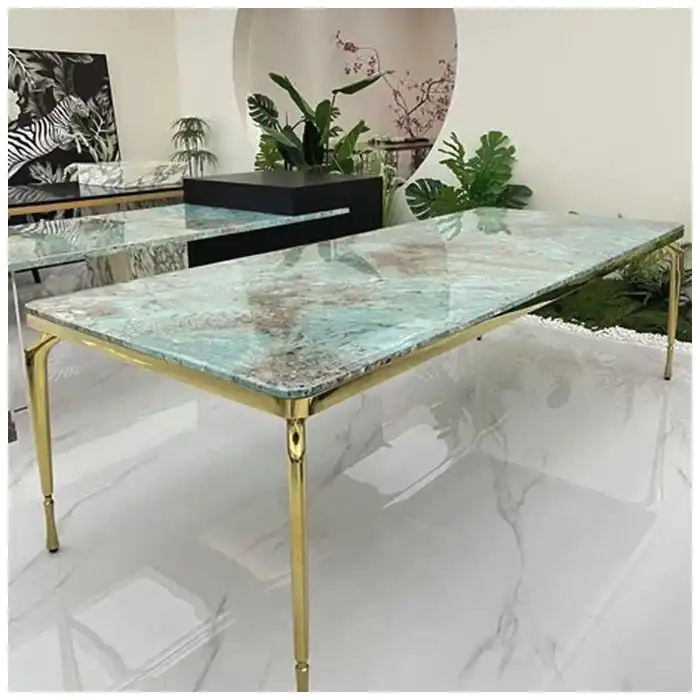
Quick Summary: Dedalus Quartzite Slabs for Feature Walls and Custom Interiors
डेडालस क्वार्टजाइट is a green exotic natural stone commercially specified for architectural wall panels, reception desks, kitchen islands, vanity tops and custom interior features. Wide flowing mineral bands in olive, forest green, cream, grey and black give the material a directional composition that is especially visible on full slabs. MQ STONE lists slab references from 2400mm+ × 1400mm+ and 2000mm+ × 1000mm+, with 16mm, 18mm, 20mm and 30mm thickness options. Slab identity, available dimensions, finish and suitability for the intended installation must be confirmed from the actual selected material.

Dedalus Quartzite Slabs for Hotel Reception Desks and Statement Walls
Dedalus is selected for the way its wide mineral bands move across a full stone face. The pattern may combine deep forest green, lighter olive and jade tones, soft cream passages, grey sections and dark branching structures. These contrasts can become the main architectural feature of a reception area or private living room.
On a hotel reception wall, one large slab may carry a long diagonal mineral movement. Several coordinated panels can extend that movement across the wider elevation, provided their actual colours and veins are reviewed together before cutting.
The material can also be incorporated into a reception desk, where the visible front face and horizontal top are seen from different directions. The stone should be selected with the desk’s finished proportions in mind. A broad green band positioned centrally on a full slab may become partly hidden once the desk outline is cut.
For villas and designer-led interiors, Dedalus works alongside dark wood, brushed metal, pale plaster and quieter stone finishes. Its pattern is strong enough to define one architectural zone without repeating the same material across every wall and floor.
Dedalus Green Stone Collection for Architectural Feature Surfaces
The strongest part of the Dedalus pattern is often its irregular flow. Darker green areas may be crossed by broad grey or cream bands, while narrow black mineral features define the edges of contrasting sections. The movement is less regular than the parallel grain found in wood-vein marble.
Selecting a Focal Slab
For a single wall or decorative desk front, begin with the complete slab photograph. A strong central mineral passage can define the composition, while calmer areas can be positioned near edges, fixtures or adjoining materials.
Coordinating Multiple Stone Panels
The selected slabs should be reviewed together rather than ordered solely by material name. Differences in green intensity, dark mineral concentration and the direction of the bands become particularly apparent across a large wall.
Working with Natural Discontinuities
Bold mineral boundaries can coincide with veins, fissures or areas requiring treatment. Their condition matters when the design includes narrow strips, sink openings or long mitred edges. The cutting plan should distinguish visual features from structural characteristics before machining.

Dedalus Quartzite Slab Dimensions and Cut-to-Size Product Specifications
MQ STONE’s original catalogue includes large slabs, smaller slabs, modular tiles and custom countertop references. The principal sizes are summarized below. The figures describe previously listed formats rather than a guarantee that every dimension and thickness is available in one stone selection.
| प्रोडक्ट का नाम | Dedalus Quartzite / Dedalus Green Quartzite Slab |
| Commercial Stone Category | Exotic Green Quartzite; final geological classification requires batch verification |
| Other Trade Names | Dedalus Green Marble / Dedalus Marble Slab; names do not establish identical stone identity |
| रंग | Olive green, forest green, jade, cream, grey and black mineral movement |
| Large Slab Reference 1 | 2400mm+ × 1400mm+ |
| Large Slab Reference 2 | 2000mm+ × 1000mm+ |
| Other Slab References | 1800mm+ × 600mm+ and larger selections where available; usable dimensions to be confirmed |
| Thickness References | 16mm / 18mm / 20mm / 30mm nominal thicknesses |
| Modular Tile References | 305 × 305mm, 400 × 400mm, 457 × 457mm and 600 × 600mm; cutting feasibility to be checked |
| सतही समापन | Polished, honed, brushed and leathered; selected finish subject to sample approval |
| Custom Fabrication | Reception desk panels, wall cladding, kitchen islands, vanity tops, tables and architectural components |
| Pattern Arrangement | Individual slab composition, flow matching or bookmatching where suitable stone sequences exist |
| Main Applications | Hotel reception desks, interior feature walls, residential countertops, bathroom vanities and custom stone furniture |
Large Slab Size and Finished Panel Yield
A catalogue slab dimension does not represent its full usable cutting area. Edge trimming, natural discontinuities, the chosen grain direction and architectural openings can reduce the size of finished panels. Confirm the actual usable slab measurements before committing to a single-piece wall, island top or reception counter front.

Custom Dedalus Quartzite Wall Panels for Hotels and Private Residences
A Dedalus wall is best planned from the full stone composition. Its bands are broad enough to change direction across an individual slab, so the placement of panel joints can significantly alter the final appearance.
A vertical composition can emphasize room height when the main movement runs upward. Horizontal placement may draw the eye across a wide reception or living-room wall. The decision should be made from actual slab images rather than a generic illustration of the stone.
Where consecutive slabs have compatible patterns, bookmatching or flow matching can be considered. Neither arrangement should be promised before the relevant stone faces have been selected and photographed. A mirrored layout may amplify a dark mineral area that was less noticeable in an individual slab.
For large interior cladding, the final panel size, stone condition, wall construction and fixing method must be coordinated by the project team. Decorative panels should not be treated as interchangeable with structurally engineered facade cladding.
Polished, Honed and Leathered Finishes for Dedalus Architectural Projects
Surface finishing changes how the green mineral bands interact with light. The finish also affects cleaning, tactile feel and, for floor applications, the need to verify traction. Finish selection should use a representative piece from the chosen slab group.
| सतह खत्म | Finished Appearance | Architectural Application |
| पॉलिश | Reflective stone face with stronger contrast between green, cream and dark mineral bands. | Reception desk fronts, feature walls and selected countertop designs where the finish meets functional requirements. |
| सम्मानित | Smooth lower-sheen surface with softer reflections and a more restrained mineral pattern. | Interior wall cladding, vanity surfaces and furniture applications. |
| Leathered | A subtly textured face that changes reflection across the natural mineral structure. | Custom counters, decorative panels and selected furniture where cleaning and surface suitability are approved. |
| ब्रश | Mechanically worked texture with reduced uniform reflection. | Architectural cladding and specific surface designs; confirm sample appearance and processing feasibility. |
Polished Dedalus Slabs for Kitchen Islands and Custom Countertops
A kitchen island uses Dedalus at a different scale from a wall. The stone is viewed from above and around its edges, often under pendant lighting. The cutting orientation should preserve the main mineral movement while avoiding unsuitable positions for sink and appliance openings.
A long diagonal vein may work well across an island top. If the design includes waterfall ends, the corresponding edge and vertical panel should be reviewed together. The finished connection depends on the selected stone, cutting plan and the support arrangement beneath the countertop.
Material classification is particularly important for kitchen use. Some stones sold under the Dedalus name are classified as marble rather than true quartzite. These materials can differ in acid sensitivity, scratching and processing behaviour. The selected batch should be identified and tested before countertop performance is represented to the client.
A kitchen countertop also needs appropriate treatment around cutouts, seams and exposed edges. Stone hardness alone does not establish the strength of narrow strips or unsupported spans. Fabrication details must follow the actual selected material and approved drawings.

Dedalus Quartzite or Dedalus Marble? Material Identification for Project Specifications
Dedalus is a commercial stone name used for green materials with dramatic mineral movement. Stone suppliers do not always classify products sold under this name in the same way. Certain catalogues identify Dedalus as quartzite, while others list Dedalus Marble. Origin information also differs between commercial listings.
This distinction matters because marble and quartzite do not necessarily respond to fabrication, abrasion and chemicals in the same manner. A product photograph or trade name alone cannot establish the stone’s mineral composition.
For specifications involving countertops, wet floors, heavily used surfaces or exterior exposure, the actual selected material should be supported by suitable identification and test documentation. Published figures from unrelated suppliers must not be combined into a single performance certificate.
| Verification Item | Relevant Method | Project Purpose |
| Stone Identity | Petrographic or mineralogical examination, where necessary | Establish whether the selected material is correctly identified as quartzite, marble or another rock type. |
| Density and Open Porosity | EN 1936 | Material characterization and preliminary load assessment. |
| जल अवशोषण | EN 13755 | Assessment of the selected stone’s absorption characteristics. |
| आनमनी सार्मथ्य | EN 12372 | Relevant information for panel and component design. |
| सम्पीडक क्षमता | EN 1926 | Supporting stone-property evaluation where required by the specification. |
| Surface Suitability | Application-specific chemical, abrasion and slip testing | Assess suitability for kitchens, commercial floors or wet-area installations. |
Technical qualification: these are applicable evaluation methods, not claims that the current MQ STONE material has been tested or certified. Laboratory results should identify the actual selected stone and test conditions. Performance data for a differently sourced product bearing the Dedalus name should not be substituted.

Dedalus Green Stone for Bathroom Vanities and Sculptural Furniture
Dedalus can be used as a decorative material for custom vanity tops, reception furniture and stone tables when the selected slab and finished component are suitable for the intended function.
A bathroom vanity exposes the stone to water, cosmetics, cleaning products and plumbing openings. The basin cutout must leave sufficient material for the planned support, while the selected surface should be assessed for moisture and chemical sensitivity.
For a stone table, the outline changes how the full-slab pattern is perceived. A circular or oval top may reveal contrasting mineral bands around its perimeter. A rectangular top can retain a longer uninterrupted direction. The final shape should be placed over the actual slab photograph before cutting.
Furniture weight, edge thickness, base contact and transport dimensions also require review. Stone with dramatic natural veins should not be assumed suitable for long unsupported overhangs simply because it is marketed as quartzite.

Dedalus Quartzite Reception Desk Project: Slab Pattern and Furniture Geometry
The MQ STONE Dedalus Green Quartzite desk image illustrates the use of this strongly patterned stone on a custom furniture element. Unlike a conventional wall, a desk presents several visible faces at once. Its front panel, return sides, top edge and base must work as one composition.
Front-Face Slab Composition
The main front panel is usually the strongest viewing surface. A wide mineral band may run through its centre or toward one end. Its placement should be approved according to the final desk width and the visitor’s approach direction.
Corners and Return Panels
When the desk has stone-clad returns, adjacent surfaces need coordinated colour and edge details. A mitred corner may preserve a clean outline, but the joint and underlying support require an appropriate fabrication method.
Countertop and Work Surface
The upper surface must be designed for its actual function. Reception equipment, writing areas and customer contact may introduce loads or cleaning conditions different from those affecting the decorative front panel.
Installation and Site Access
Large stone furniture should be coordinated with the delivery route, floor loading, supporting frame and on-site assembly sequence. Where separate panels are used, their identification should match the approved fabrication drawing.
Choosing Dedalus Stone for Different Interior Applications
Not every project benefits from the same panel size or finish. A feature wall is judged mainly by full-slab composition and secure fixing, while a worktop must meet additional requirements relating to use, support and maintenance.
| आवेदन | Product Format | Main Specification Decision |
| Hotel Feature Wall | Full slabs or coordinated cut-to-size panels. | Slab sequence, vein movement, visible joints and wall fixing system. |
| Reception Desk | Custom front panels, side returns and worktop. | Panel layout, edge joining, furniture support and user-contact surfaces. |
| Residential Kitchen Island | Custom countertop and waterfall panels. | Verified stone classification, chemical sensitivity, cutouts and support. |
| Bathroom Vanity | Cut-to-size vanity top and wall surround. | Basin opening, moisture exposure, compatible fittings and cleaning requirements. |
| Interior Flooring | Modular or custom-cut tiles where approved. | Abrasion resistance, actual slip performance, thickness and substrate suitability. |
Fabrication Planning for Large Dedalus Wall Panels and Stone Furniture
A cutting drawing should be overlaid on the selected slab image before production. This allows the design team to compare the proposed panel boundaries with the stone’s principal green bands and darker mineral features.
Where the pattern crosses a mitred edge, the return piece should be taken from a suitable slab area and dry-fitted before final approval. A visually continuous joint depends on accurate cutting, compatible colour and the available mineral pattern.
Cutouts, fixing holes and narrow edges deserve particular attention. Veins and natural discontinuities may affect where an opening can safely be positioned. The workshop should not move a critical opening without coordinating the design and intended installation.
For large wall panels or heavy furniture, the responsible designer should establish the support and installation system using the actual material and finished geometry. Panel thickness alone cannot determine safe span, anchorage or handling capacity.
Inspection and Export Packing for Dedalus Quartzite Slabs
Inspection should compare the actual slabs with the approved full-face photographs, including the main green colour range, vein distribution and any natural or repaired features. Selected pieces should retain identifiable slab numbers through cutting and packing.
The finished product should be checked for dimensions, thickness, surface condition, edge quality and the details shown on the approved drawing. Bookmatched or flow-matched panels should be laid out in sequence so the composition can be examined before dispatch.
Where resin, mesh reinforcement or other treatment is present, its location and condition should be recorded when relevant to fabrication or installation. Such treatments do not remove the need to assess the stone’s natural structure.
Export packing should protect polished surfaces, corners, finished edges and any narrow sections around openings. Stone furniture components and large wall panels need rigid support appropriate to their dimensions and weight. Crates should identify the intended installation position and correspond to the project packing schedule.
Common Specification Mistakes with Dedalus Green Stone
- Assuming every Dedalus product has the same geology: the name is used for stones classified differently by commercial suppliers. Verify the selected material.
- Approving only a close-up photograph: a detail image cannot establish the full mineral composition of a feature wall.
- Assuming a bookmatch exists: a mirrored layout requires suitable consecutive stone faces.
- Ignoring the cutting direction: a strong diagonal green band can lose its visual effect when the finished panel is rotated or trimmed.
- Using unverified countertop performance claims: chemical resistance, wear and maintenance must relate to the actual stone type and surface treatment.
- Omitting furniture and panel support details: large stone surfaces require suitable framing, connections, handling and installation arrangements.
Care and Maintenance for Dedalus Slabs and Finished Interiors
Use a cleaner suitable for the verified stone composition and finished surface. Avoid abrasive pads and test any unfamiliar maintenance product on an inconspicuous or spare piece. Do not assume that a stone marketed as Dedalus Quartzite is unaffected by acidic cleaners, especially where the selected batch has not been confirmed as quartzite. Remove spills promptly, protect polished furniture from impact and excessive heat, and maintain joints and supports according to the installation design. Any sealing treatment should be approved for the actual material, resin treatment and finish.
FAQs About Dedalus Quartzite
What is Dedalus Quartzite used for?
Dedalus Quartzite is commercially supplied for architectural feature walls, reception desks, kitchen islands, bathroom vanities and custom stone furniture. The selected material and installation must be checked for the actual application.
Is Dedalus Quartzite the same as Dedalus Green Marble?
Not necessarily. Dedalus is a commercial name used for materials listed as quartzite by some suppliers and marble by others. The exact geology and source should be confirmed for the selected batch rather than assuming all similarly named products are identical.
What slab sizes are available for Dedalus Quartzite?
The original MQ STONE listing references slabs from 2400mm+ × 1400mm+ and 2000mm+ × 1000mm+, with other formats available for review. Actual usable dimensions depend on the selected slabs and cutting requirements.
What thicknesses are listed for Dedalus Green Quartzite Slabs?
The main catalogue references are 16mm, 18mm, 20mm and 30mm. The available dimensions and thickness combinations should be confirmed before approving custom fabrication.
Can Dedalus Quartzite Slabs be bookmatched?
Bookmatching can be considered if suitable consecutive slabs are available. The mirrored composition, panel orientation, vein continuity and joint positions should be approved using photographs of the actual stone.
Can Dedalus be used for kitchen countertops and waterfall islands?
Dedalus can be considered for kitchen countertops and waterfall island designs after confirming the stone’s identity, surface performance and structural suitability. Cutouts, mitred edges, support and maintenance requirements must follow the selected material.
Which finish is suitable for a Dedalus reception desk?
Polished, honed, brushed and leathered finishes may be reviewed. A polished surface emphasizes the mineral contrast, while lower-sheen treatments change reflection. The final choice depends on the desk’s design and expected use.
Can Dedalus Green Stone be used for bathroom walls and floors?
Interior bathroom wall cladding can be considered with suitable waterproofing and fixing. Floor applications require verification of the selected stone, thickness, abrasion performance, slip resistance and installation system.
What technical data should be checked before specifying Dedalus Quartzite?
Confirm the selected stone’s identity and obtain relevant batch documentation where required. Density, water absorption, flexural strength and other application-specific properties should be assessed using appropriate testing methods rather than data for a different Dedalus product.
What information is needed for a Dedalus Quartzite project enquiry?
Provide the intended application, required slab or finished dimensions, thickness, surface finish, preferred mineral pattern and delivery destination. For reception desks and wall panels, include drawings and the proposed panel arrangement.
Recommended Exotic Quartzite and Architectural Stone Collections

Crystal Tiffany Quartzite
Green and crystalline quartzite surfaces for architectural feature walls and custom interior stone designs.

बियांको क्रिस्टालो क्वार्टजाइट
Light crystalline quartzite for backlit feature concepts, countertops and designer-led interior projects.

अटलांटिक लावा पत्थर
Grey-blue natural stone with a more restrained palette for interior cladding and custom work surfaces.
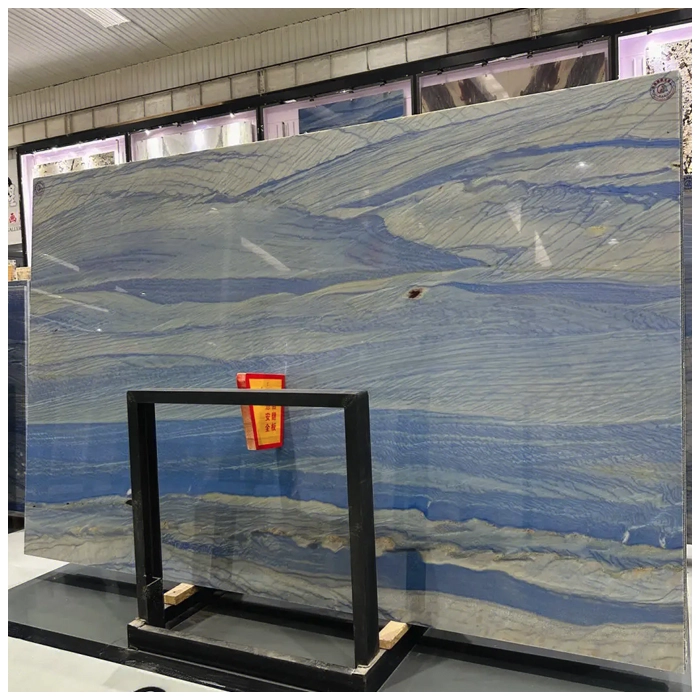
Blue Macaubas Quartzite
Brazilian blue quartzite for statement kitchen islands, feature walls and custom architectural panels.

Dedalus Green Quartzite for Custom Stone Walls and Reception Furniture
Choose the Dedalus slab composition according to the finished architectural feature. A reception desk needs an approved front-panel layout, edge details and furniture support. A feature wall requires coordinated stone faces, suitable panel joints and a secure fixing system. Kitchen and bathroom surfaces also need material-specific performance assessment. Provide drawings and the intended installation conditions so the actual stone selection can be matched to the work.
Dedalus Stone Project Enquiry
Share your required slab dimensions, finish, panel layout and application details for a review of suitable Dedalus material.