Arabescato Corchia Reception Desk: Front Panels, Countertop Edges, and Joint Lines
I first notice a stone reception desk from the other side of the lobby. Then I walk close enough to see the edge, the seams, the way the grey movement changes under a pendant light, and the place where a hand rests while signing in. Those two views do not ask the same thing from the stone. A panel that looks powerful from six metres away can feel busy at the counter. A quiet top can make the front look flat if the two were not allocated together.
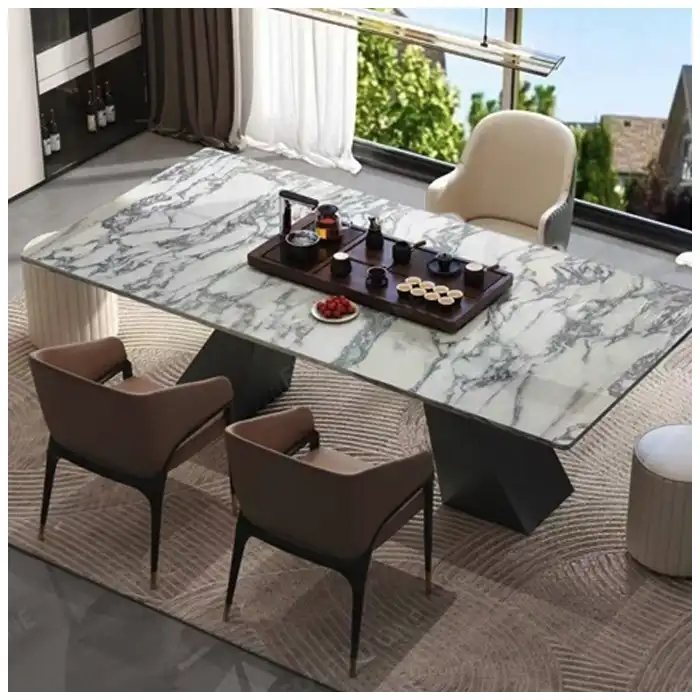
An Arabescato Corchia reception desk is not a countertop with some panels added below it. It is a freestanding architectural object. The front, end return, top, transaction ledge, plinth, and sometimes a backlit logo wall all meet within a short distance. The veins will tell you where the marble carries depth, but the design team has to decide where a seam ends, where the counter edge catches light, and where the visitor’s first glance should rest.
True luxury is something you never get tired of looking at. A lobby desk does not need every inch of marble to shout. It needs one clear gesture and enough quiet material around it for the room, the staff, and the guests to breathe.
Begin with the first approach view
Start with the elevation a guest sees from the entrance. The height of the desk, the distance of the approach, ceiling light, floor reflection, and any sign behind the desk determine how much movement the front can carry. I place the front panels on the full-slab image before I place the top. The front usually has the largest uninterrupted field and therefore deserves the first allocation decision.
A centred bookmatch can work beautifully when the desk itself has a clear central axis. It can look forced when the reception opening, transaction ledge, or side return is offset. Do not use symmetry as an automatic sign of luxury. The desk geometry needs to earn it. Sometimes a single sweeping field with one controlled seam is more convincing than two mirrored panels fighting the actual function of the counter.
Look at the desk from the guest seating area as well as from the entrance. A powerful grey branch may line up with a chair back, a column, or a light fitting. It may also disappear behind a floral arrangement or a sign. The first view is not a rendering exercise. It is the real path a visitor takes while entering the room.
Arabescato Corchia reception desk panels need a full-slab plan
Use full-slab photography with the intended front elevation, top, end panels, and cut-outs drawn over it. Mark the visible front face and the exact location of every finished edge. A fabricator needs to know which part of the grey movement faces the lobby and which part turns toward staff. A generic material swatch cannot answer that question.
Consider the countertop and front together. A line that descends through the front may become a strong horizontal mark on the top if both pieces come from adjacent parts of the slab. That continuity can be beautiful when it is deliberate. It can be distracting when a grey line lands under the terminal, the transaction opening, or the most visible counter corner.
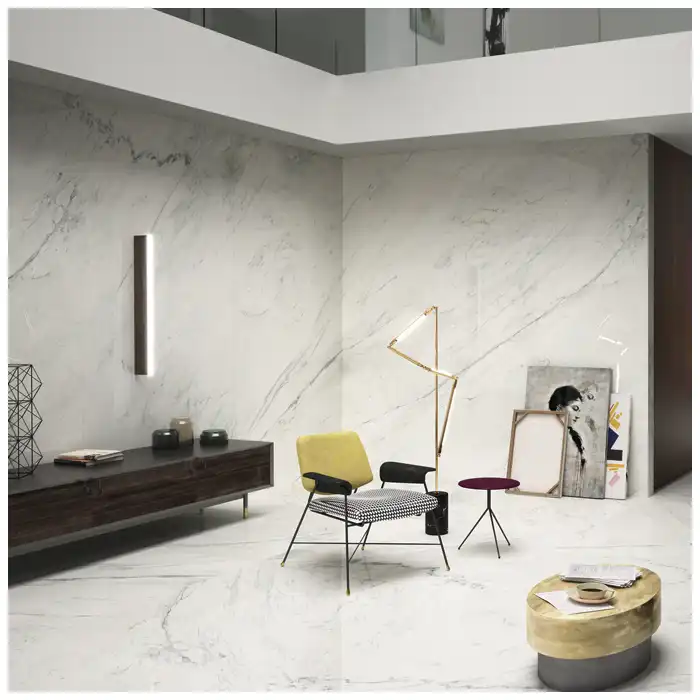
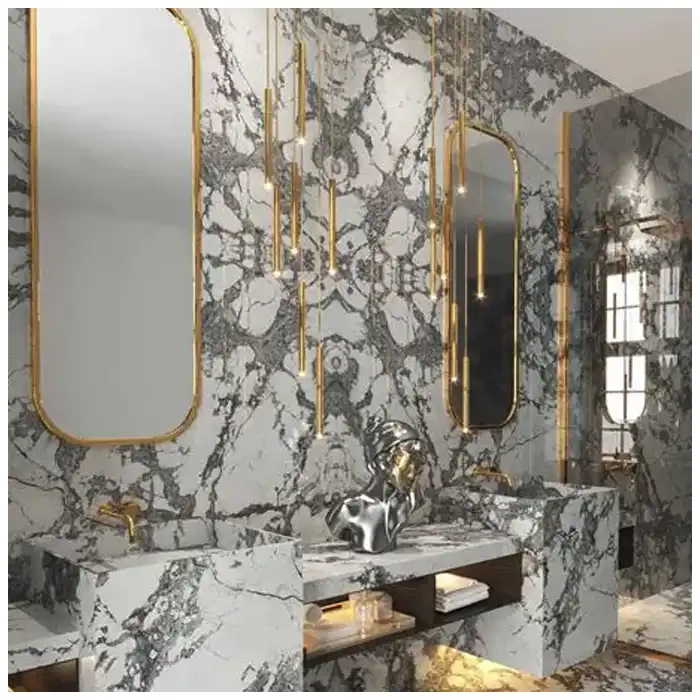
This stone has been waiting for millions of years, and its movement comes from mineral variation and pressure within the original marble. The pattern has real depth rather than a printed repeat. That is the reason to give it a real allocation drawing. If the material is cut into convenient rectangles without a whole-object view, the geology becomes visual noise.
Give the top its own role
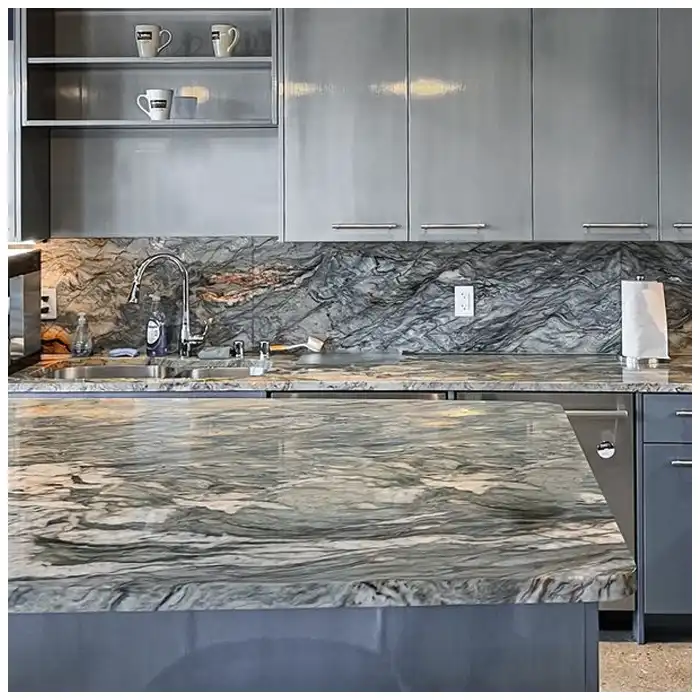
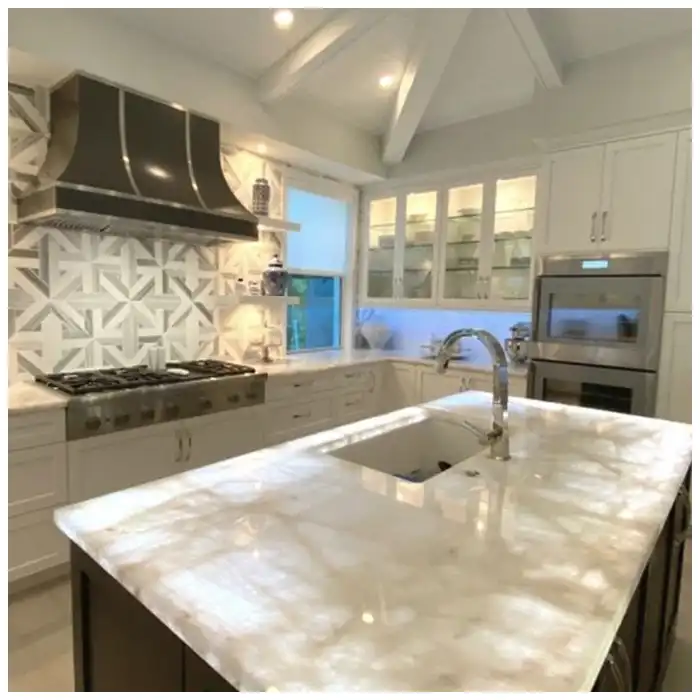
A countertop is touched, wiped, and seen from above. The front is read as an elevation. They do not need identical movement. I often prefer a calmer working top above a front with more character, especially where staff use screens, documents, or keys. The top can still belong to the same slab family without asking every grey line to continue across the edge.
Read the side return before the front is final
The end of a reception desk can be the first thing a guest sees when approaching from a corridor. A side return with an abrupt cut line can undermine a well-composed front. Place that return on the slab early, then decide whether the movement wraps, stops at a seam, or gives way to a quieter field. A narrow leftover is rarely the right answer for a lobby edge.
Put seams where the architecture gives them a reason
Stone seams are not automatically defects. They are part of the fabrication reality and can be placed with care. A vertical seam may align with a panel break, a join in the millwork, a shadow line, or the edge of a transaction opening. A horizontal seam can work where a ledge changes level. The weak approach is hiding a seam wherever material happens to end, then hoping the lobby lighting will ignore it.
Countertop joint lines need equal discipline. A seam through the most-used registration point or beside a sink cut-out may draw attention every day. A seam at a natural visual break can fade into the desk’s construction. The project should draw the joint on the elevation and plan, then review it with the selected slab image and edge profile.
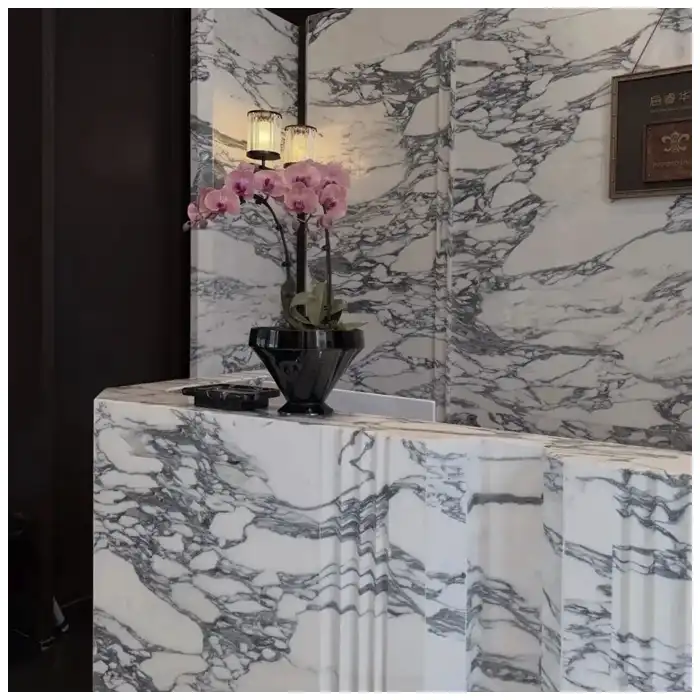
For an Arabescato Corchia reception desk, a seam can either interrupt a grey branch or use it as a quiet place to stop. Neither answer is universal. The point is to decide before cutting, with the full face, top, and return visible together. A seam chosen after panels are already separated is rarely a design decision.
Edges change the scale of the object
A polished counter edge catches the light more strongly than the front panel below it. A slim eased edge can make the top appear to float. A heavier profile can give a desk more weight but may make the marble seem darker at the perimeter. I touch the edge sample, stand back, and look from the seated guest position before I choose. A profile has both a visual and a practical consequence.
An Arabescato Corchia reception desk needs that edge test because a guest reads the counter at hand level long after the front panel has set the first impression.
Look closely at the slab area allocated to the edge. A natural feature or resin-filled line that is quiet on the horizontal top may become prominent after profiling. That does not mean the stone is unsuitable. It means the edge zone needs its own review. The fabricator should not discover its most visible line after the rest of the desk is already polished.
Later in the process, Arabescato Corchia Marble Countertops can be evaluated for the selected top thickness and edge direction. The link between the counter and the front is visual, but the working requirements are different enough to deserve their own checked drawing.
Use lighting to test the real stone
Side light can open the pale field of Arabescato Corchia and make the grey movement appear deeper. Direct downlight can sharpen a polished edge. Warm indirect light can soften the entire desk. I want to see the chosen panels under a light condition close to the lobby scheme, especially when the design uses a pale front against a dark floor or a bright logo wall.
Do not mistake a bright photograph for a resolved lighting condition. A desk can look luminous in a studio and flat in a lobby where the front is shaded by its own countertop. Build a small standing mock-up of the key front panel, edge, and light angle if the material is important to the room. The point is to understand the result before the full object is installed.
An Arabescato Corchia reception desk may need its strongest movement moved away from a light reflection or polished metal detail. That is not a loss. The stone should still be read clearly when guests approach, not fight for attention with every reflective surface around it.
Coordinate stone, millwork, and service openings
A reception desk often contains cable openings, a transaction ledge, a staff return, drawers, screens, and a concealed support frame. The marble allocation has to acknowledge those interruptions. Do not lay a key grey branch across a planned access cover or a service slot. The top drawing should show every opening before the slab map is approved.
For an Arabescato Corchia reception desk, those practical interruptions deserve places that look intentional from the public side.
The stone may sit on a millwork carcass or a metal frame. Those support decisions do not need to dominate the material story, but they set the limits for thickness, span, and joint location. If the top needs a support line, make it coincide with a practical seam or architectural break. The veins will tell you where a visual break can be least intrusive; the support system tells you where it must happen.
Number the panels by installed sequence and protect the face direction through fabrication. A front panel that is rotated or swapped with a side return can make the desk look immediately wrong even when every piece fits. Keep the full-slab layout, cut list, and dry assembly photographs together until the first installation passes review.
What the allocation table needs to settle
| Desk condition | What the slab plan must show | What can go wrong |
|---|---|---|
| Arrival view | Main front field and first visible panel | The desk feels fragmented from the lobby entrance |
| Piano di lavoro | Working field, edge zone, and service openings | A strong line lands under a terminal or finished edge |
| Joint line | Elevation and plan location against millwork breaks | A seam crosses the most visible or most-used point |
| Side return | Wrap, stop, or quiet allocation from the same slab family | A leftover panel interrupts the front composition |
| Lobby lighting | Side light, downlight, and counter shadow | The marble reads flat or overly busy after installation |
The Hard-Won Lesson: A bookmatch can fail when the desk is not truly symmetrical
The failure pattern is easy to recognise. A bookmatched front is selected before the transaction opening, end return, and staff side are fixed. Once those practical features arrive, the centre line moves or a panel must be trimmed heavily on one side. The marble did not fail. The desk geometry changed after the material gesture had already been chosen.
The Lesson: Fix the working geometry first, then decide whether the stone wants a centred bookmatch or an asymmetrical field.
Reading Arabescato Corchia reception desk as a lobby object
Furniture scale and lobby scale are not the same
A small console can carry a strong grey line because it is read from close range. A long reception front has to hold a room. Compare the difference with Arabescato Corchia Console Table: Slim Profiles, Edge Weight, and Wall-Side Support before extending a furniture allocation directly into a commercial front.
The permanent material question remains relevant
The parent Luxury Natural Stone Slabs and Furniture: Complete Guide to Materials, Applications, Edges, Lighting, and Support helps teams place this desk within a broader material decision. Real marble changes with light, finish, and edge because the depth belongs to the stone rather than a repeated surface graphic.
When the front panels do not read as planned
Photograph the desk from the entrance and at the counter, stop the next installation sequence, and compare the panel marks with the approved full-slab plan and dry assembly. Contact the supplier with those records before moving a panel or cutting a new seam. A quick visual patch can make the desk less coherent from both views.
Questions project teams ask before release
1. Should an Arabescato Corchia reception desk use a bookmatched front?
Only when the finished desk has a genuine centre and the openings, side returns, and transaction ledges support the composition. A bookmatch should be a response to the architecture, not a decorative decision made before the working geometry is fixed.
An Arabescato Corchia reception desk can be more persuasive with a single directional field when the operational layout does not support a true centre.
2. Where should seams go on a marble reception counter?
Place them at a panel break, transaction opening, support line, or another architectural reason. Avoid leaving a seam through the most visible arrival view or a heavily used work zone. Review the seam on both elevation and plan with the slab allocation.
3. Should the countertop match the front-panel veins exactly?
It should belong to the same overall material composition, but it does not have to repeat the front. A calmer working top can support a more expressive front panel. The full slab layout should make that relationship intentional.
4. Why does the marble look different at the counter edge?
The edge catches light at a different angle, and the profile exposes a new part of the stone. A grey vein, fill, or natural feature that is quiet on the horizontal top may become more visible once the edge is polished or shaped.
5. What should happen if a reception panel is installed in the wrong direction?
Photograph the panel and the approach view, stop further installation of the affected sequence, and compare the piece mark with the approved slab plan and dry assembly. Contact the supplier with the records before rotating, recutting, or hiding the change behind a sign or repair.
Quick-Reference Checklist for Arabescato Corchia reception desk
- Allocate front, countertop, end returns, and visible edges on the full slab.
- Review the first arrival view before choosing a bookmatch or main seam.
- Draw service openings, transaction ledges, and support lines before cutting.
- Inspect the finished countertop edge under the intended lobby light.
- Dry-assemble key front panels and returns before packing.
- Keep panel marks and orientation visible until the first completed desk is approved.
Final Conclusion
An Arabescato Corchia reception desk should make the arrival feel considered before a guest reads a single word of signage. I would settle the front, edge, seam, and light on one full-slab layout, then let the marble do what printed surfaces cannot. At MQ STONE, that quiet confidence is the standard I look for in a lobby object.
References
- Marmo, Wikipedia.
- Natural Stone Institute Dimension Stone Design Manual, Natural Stone Institute.
- ASTM C503 Standard Specification for Marble Dimension Stone, ASTM International.
- Stone and Architecture: Material Selection Guidance, Stone Federation Great Britain.
- Interior Stone Care and Protection, Natural Stone Institute.
- Search Essentials, Google Search Central.