The global architecture and procurement landscape of 2026 has witnessed a profound shift toward direct-from-source material strategies. As supply chain volatility persists, architects and developers are increasingly bypassing traditional middlemen to partner directly with an integrated Marmo della Cina facility. This move is not merely about cost reduction; it is about absolute control over material quality, batch consistency, and the precise execution of custom design specifications. When evaluating a supplier, the focus must move beyond surface-level aesthetics to the underlying industrial capabilities and project management rigor that differentiate a commodity vendor from a world-class manufacturing partner.
For procurement professionals, the decision to source in the East is often driven by the vast variety of available textures, from the subtle veining of Orient White to the high-contrast drama of China White Beauty marble slabs. However, the primary challenge remains “Slab Anxiety”—the fear that the bulk delivery will deviate from the initial master sample. Overcoming this requires a deep dive into the manufacturer’s infrastructure and a rigid adherence to technical verification protocols.

Assessing Factory Infrastructure: The Backbone of Quality Control
The technical capability of a manufacturing site is the only reliable predictor of project success. A high-tier marble factory in China must utilize advanced Italian or top-grade domestic machinery to ensure that large-scale orders maintain a high degree of uniformity. The infrastructure audit should prioritize three specific areas: block processing, precision fabrication, and surface finishing.
Modern gang saws are essential for high-volume slab production. Multi-blade saws ensure that every slab within a block is cut to a precise thickness, typically within a ±0.5mm tolerance. This level of calibration is crucial for commercial flooring installations where uneven edges (lippage) can cause tripping hazards and rejection by site inspectors. Furthermore, for intricate lobby patterns, the use of 5-Axis CNC waterjet machines allows for zero-gap precision in medallions and custom geometric layouts, effectively turning raw stone into high-precision architectural components.
Consistency across thousands of square meters is achieved through automated polishing lines. These lines utilize multiple abrasive heads that apply uniform pressure across the entire slab surface, ensuring a consistent gloss meter reading of 90+. For designers, understanding these technical nuances is a prerequisite for success, as detailed in our guide to specifying Chinese marble slabs, which serves as a blueprint for technical compliance.
The Crucial Role of Dry-Lay Inspection in Mega Projects
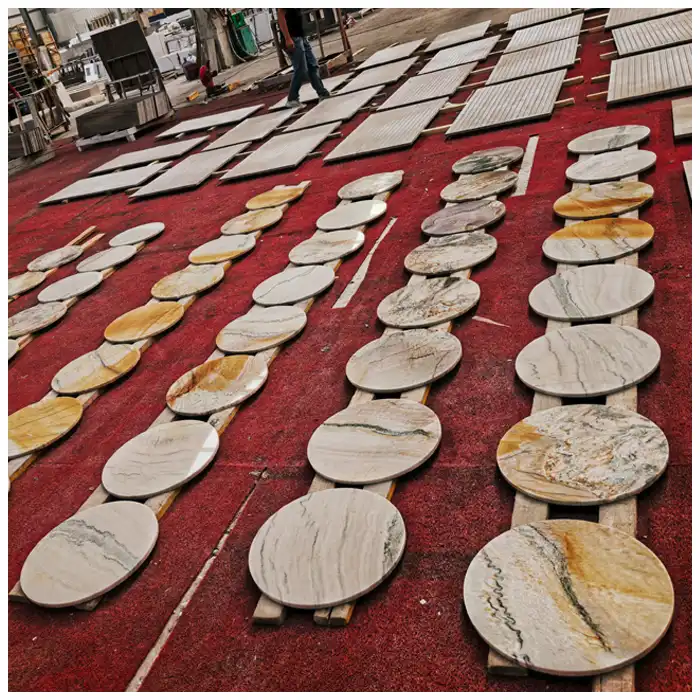
In the world of wholesale white marble slabs, visual continuity is the ultimate goal. For mega-projects—such as luxury hotel atriums or corporate headquarters—relying on the manufacturer’s automated sorting is insufficient. A mandatory “Dry-Lay” inspection is the industry’s most powerful risk-mitigation tool. This process involves laying out the finished tiles or slabs on the factory floor in a mock-up that replicates the final site installation.
During a dry-lay, quality control teams can manually adjust the sequence of tiles to create a natural transition of veining and color. Any pieces that show excessive mineral spots or “jumping” vein patterns are rejected and replaced. This level of commercial stone project management ensures that the final result on-site is a seamless, architectural masterpiece rather than a fragmented mosaic of mismatched stones. For B2B buyers, the dry-lay report—complete with high-resolution photography and numbered orientation maps—is the final gatekeeper before the cargo is loaded for export.
Understanding Material Parameters: A Scientific Benchmark
To maintain high EEAT (Experience, Expertise, Authoritativeness, and Trustworthiness) standards, one must compare natural stone varieties against established ASTM benchmarks. Below is a comparative analysis of common varieties available through a China Marble manufacturer compared to international industry standards.
| Technical Property | Oriental White (China) | Panda White (China) | ASTM C503 Standard |
| Density (g/cm³) | 2.72 | 2.68 | Minimum 2.59 |
| Water Absorption (%) | 0.12% | 0.16% | Maximum 0.20% |
| Compressive Strength (MPa) | 115 | 108 | Minimum 52 |
| Flexural Strength (MPa) | 14.2 | 12.8 | Minimum 7 |
| Mohs Hardness | 3.5 | 3.0 | N/D |
As indicated, premium Chinese varieties often exceed international requirements for density and compressive strength, making them highly suitable for high-traffic commercial environments. However, the low water absorption rate is particularly critical for white marbles, as it significantly reduces the risk of moisture-induced yellowing or staining over the product’s lifecycle.

Negotiating Wholesale Pricing: MOQ and Lead Time Considerations
Negotiating with a factory is vastly different from purchasing from a local distributor. B2B buyers must navigate the intersection of Minimum Order Quantities (MOQ), quarry extraction cycles, and global logistics. The price-per-square-meter is a dynamic variable that shifts based on the “selectivity” of the block. A project requiring “Grade A” slabs—those with the most pristine background and balanced veining—will command a premium, whereas “Commercial Grade” batches offer significant savings for back-of-house or high-volume flooring areas.
Managing lead times is equally critical. In the 2026 logistics era, a typical order for custom cut-to-size marble tiles involves a 15–20 day fabrication window followed by 30–45 days of ocean transit. Strategic buyers often place orders 4 months ahead of the installation date to account for potential quarry delays or port congestion. Understanding the pricing structure—FOB (Free On Board) vs. CIF (Cost, Insurance, and Freight)—is essential for calculating the true landed cost of the material.
Securing the Cargo: Advanced Fumigated Wood Crating
The journey across the ocean is the final hurdle in the supply chain. Standard palletizing is insufficient for premium stone. Export-ready Marmo della Cina must be secured in heat-treated, fumigated wood crates that comply with ISPM-15 international standards. These crates are engineered to withstand the mechanical shocks of container loading and the shifting forces of high-seas transit.
Internal crate protection is just as important as the wood itself. Slabs should be separated by thin foam sheets to prevent surface scratching, and bundles must be braced with heavy-duty plastic or steel strapping. For white marbles, moisture-proof wrapping is mandatory to prevent condensation during the temperature swings of a long sea voyage, which can lead to oxidation and unsightly surface spots.
Common Pitfalls and Strategic Recommendations
One of the most frequent mistakes in B2B sourcing is “Master Sample Over-Reliance.” Natural stone is an organic product; the quarry face moves, and patterns change. Buyers should demand current block photos rather than relying on a sample from a year ago. Furthermore, neglecting the “Sub-Floor Reality” often leads to project delays. No matter how perfect the marble is, if the sub-floor is not perfectly level, the stone will crack under load.
Expert Advice for 2026 Sourcing:
-
Block Selection: Always “lock” the block numbers during the procurement phase to ensure all material for a specific zone comes from the same geological strata.
-
Edge Engineering: Specify “Mitered” edges for counters to maintain vein continuity—this is a hallmark of high-end manufacturing.
-
Third-Party QC: For multi-container orders, hire an independent third-party inspector to verify the dry-lay results before the crates are sealed.
By adopting a technical, manufacturer-direct approach, procurement teams can transform their supply chain from a point of risk into a competitive advantage. The ability to source premium Marmo della Cina—verified by scientific parameters and secured by rigorous inspection—ensures that commercial projects achieve their aesthetic vision while meeting the most demanding performance and safety standards of the modern era.

FAQ
1. How do I verify a China Marble factory’s capacity for a 20,000sqm project?
Verifying capacity involves auditing three primary metrics: quarry block access, fabrication machinery, and specialized labor force. For a 20,000sqm commercial project, the China Marble manufacturer should ideally have a minimum of 5-8 gang saws running 24/7 and a monthly output capacity exceeding 30,000sqm. B2B buyers should request a current production schedule and a list of completed mega-projects with similar volume. An on-site or third-party audit of the slab yard is essential to confirm that sufficient raw material is already “blocked” for the specific project requirements.
2. What is the average lead time for custom cut-to-size marble tiles?
The average lead time for fabrication is typically 15 to 25 days, depending on the complexity of the 5-axis CNC waterjet patterns or specific edge profiles. Tuttavia, the total “Project Lead Time” must include material selection (7 days), dry-lay inspection/approval (5 days), and international ocean transit (30-45 days). For 2026 commercial projects, it is standard industry practice to place the deposit 4 months prior to the required site delivery date to mitigate potential quarry extraction delays or global port congestion.
3. How does China white marble compare to Italian Carrara in physical tests?
Premium Chinese white marbles, such as Oriental White, often exhibit higher density (approx. 2.72 g/cm³) and lower water absorption (approx. 0.12%) compared to average Italian Carrara (approx. 2.70 g/cm³ and 0.20% absorption). In compressive strength tests, many Chinese varieties exceed 110 MPa, making them technically superior for high-traffic flooring. While Italian marble carries historical brand prestige, 2026 material science data shows that high-grade Marmo della Cina is equally durable and often more stain-resistant than its European counterparts.
4. What are the primary export regulations for shipping stone to the USA or EU?
The most critical regulation is the ISPM-15 standard, which requires all solid wood packaging (crates and pallets) to be heat-treated or fumigated to prevent the spread of pests. Furthermore, shipments must include a detailed Packing List, Commercial Invoice, and Certificate of Origin for customs clearance. For the USA, buyers should verify the current Harmonized Tariff Schedule (HTS) codes for natural marble to account for potential duties or trade-related taxes, ensuring a smooth transition through the about process of legal compliance.
5. Why is a dry-lay inspection mandatory for large commercial marble orders?
Natural stone is an organic product that varies by block and even within a single block. A dry-lay is the only way to ensure color harmony and vein matching across a large architectural area. By laying out the finished tiles in the factory, the quality control team can eliminate “rogue” pieces that contain undesirable mineral spots or abrupt color shifts. This prevents expensive on-site rejections and ensures that the final installation meets the contact specifications provided by the architect for visual continuity.
References
-
“ASTM C503/C503M-22: Standard Specification for Marble Dimension Stone.” ASTM International, West Conshohocken.
-
“ISPM 15: Regulation of Wood Packaging Material in International Trade.” International Plant Protection Convention (IPPC), FAO.
-
“Natural Stone Design Manual (v2026).” Natural Stone Institute, Oberlin.
-
“The Global Stone Trade: Market Trends and Manufacturer Capacity Analysis.” Journal of Construction Economics, Oxford University Press.
-
“Biophilic Design and the Psychology of Natural Materials in Commercial Spaces.” Journal of Environmental Psychology, Elsevier.
-
“Stone Selection for High-Traffic Commercial Environments: DCOF and Durability Standards.” Tile Council of North America (TCNA).
-
“LEED v4.1: Material Ingredients and Sustainable Sourcing in Building Design.” U.S. Green Building Council (USGBC).
-
“Technical Assessment of Chinese White Marble vs. European Classics.” International Journal of Geophysics and Mineralogy, Springer.
Expert Insights: Strategic Procurement & Asset Valuation in the China Marble Market
Industry Perspective (Why & What): Direct sourcing of Marmo della Cina has evolved from a cost-saving measure into a sophisticated asset management strategy for 2026. The value for B2B buyers lies in vertical integration—controlling the process from raw quarry block selection to high-precision custom cut-to-size marble tiles. This ensures that mega-projects maintain visual continuity, directly influencing the long-term resale value and architectural authority of premium commercial properties.
Actionable Procurement & Risk Mitigation Protocols
- Infrastructure Verification (Standard Option)
To secure high-end hospitality finishes, procurement teams must verify that the marble factory in China utilizes automated polishing and 5-axis waterjet technology. This is the only reliable method to guarantee a ±0.5mm thickness tolerance and gloss levels above 90, which are essential for seamless large-scale floor installations and intricate lobby medallions. - Safety & Export Compliance (Critical Consideration)
Regulatory adherence is non-negotiable for international transit. All wholesale marble slabs must be secured in ISPM-15 compliant, heat-treated wood crates to bypass North American and European customs delays. Furthermore, for public safety, commercial architects must mandate honed or leathered finishes to meet modern DCOF slip-resistance codes, effectively mitigating long-term litigation risks in high-traffic zones.