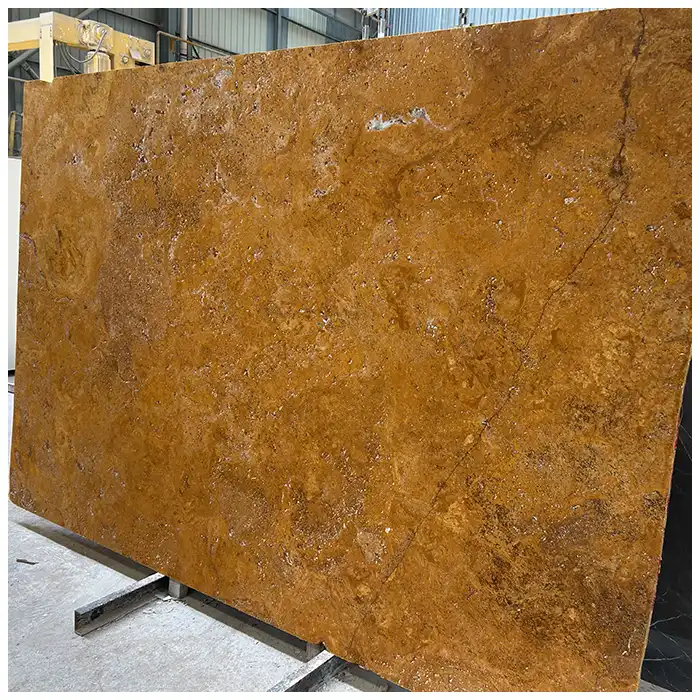
Oval Stone Dining Table: Carry the Vein through the Long Axis
A long gray vein enters one rounded end and bends toward the far side before leaving the opposite curve. The oval turns that line into movement, not a border. I begin an oval stone dining table by preserving that long-axis journey while checking what the curved ends do to seats and support.
Maximum dimensions cannot describe the shape. I need the finished digital outline, corner transitions and base positions over the actual slab.
Define Oval Stone Dining Table Geometry before Slab Selection
An ellipse, racetrack oval and freeform oval can share length and width while producing different ends. The exact file controls nesting, edge path, seating and support.

The mathematical ellipse has a specific continuous curve, but many furniture ovals use straight sections or modified radii. Name the actual shape rather than assuming.
I print or project the outline at reliable scale and mark centerlines. A loose sketch cannot authorize an irreplaceable slab cut.
Orient the Stone Table Long Axis
Veins running with the long axis can lengthen the object. Crossing movement can create a strong center or divide side seats. Diagonal movement often makes the curved ends more active.
I place the principal doorway, side views and end views around the overlay. The best composition is the one that remains coherent through all of them.
A dense vein should not land at a curved tip by accident. The fabricator also checks repairs, fissures and machining allowance around the complete edge.
Keep End Seating Honest
Rounded ends suggest an extra chair, but the curve can reduce usable place-setting width and bring the diner closer to the base. Draw the actual plate, chair and knee envelope.
End diners need reach and leg space without forcing side chairs outward. A large top can still have poor end seating when support occupies the centerline.
I test the place settings at full scale. Seat count remains provisional until chairs move without collision.
Choose One Center Base or Two Supports
A center base can preserve the long silhouette but may require a substantial hidden frame. Twin bases shorten unsupported spans and can create better side clearance, yet they may conflict with end knees.
Draw the base at floor, knee and underside levels. A taper or flare changes occupied space with height.
The responsible technical team designs bearing, connections, stability and floor contact for the actual material and outline. I do not transfer a base rule from a rectangular table.
Read Curved Ends through the Edge
At the long sides, a vein may run nearly parallel to the edge. As the oval turns, that relationship changes quickly. The end can reveal a cross-section that the face does not advertise.
A Calacatta White marble dining table can carry bold movement into the curve, where gold and gray lines become a continuous band. Inspect the full edge sample.
Il Stone Table Edge Detail supports the profile decision. The oval adds changing grain direction around every end.
Compare Marble and Quartzite Expectations
Marble’s calcite body offers soft depth and visible patina; quartzite often brings quartz-rich crystalline resistance. Actual identification, repairs and slab condition matter more than the sales name.
Il Quartzite vs Marble Dining Table comparison owns daily use. This oval decision assumes the material has already been selected honestly.
A long quiet slab can make the outline feel serene. Strong crossing movement can turn it into sculpture. Neither should be sold as a universal luxury formula.
Place the Base under the Visual Center
The geometric center and visual center can differ. A dark mineral field near one end may make the top feel weighted even when dimensions are symmetrical.
I compare base position against both centers, then leave structural decisions to the responsible technical team. Moving support for appearance requires a new review.

True luxury is something you never get tired of looking at. Small asymmetry can feel alive when it is deliberate and stable.
Check Pendant and Daylight along the Axis
A row of pendants can reinforce the long axis or break it into segments. One centered fixture may leave the ends quieter. Test the selected stone under the intended distribution.
Polished crystal can create several bright points as viewers move. Honed marble may read as one softer field, making the curve more visible than the reflection.
A Statuario White marble dining table can make cool gray movement appear crisp under neutral light and warmer beneath a 3000K source.
Prototype Chair Movement around Curved Ends
Chairs near the transition between side and end seats may angle toward each other. Draw and physically test their pull-out paths.
The room needs circulation beyond the chair-back position. An oval placed too close to a wall loses the reason for its softened ends.
I walk the route with every chair occupied in the drawing. Furniture must work after the photograph is taken.
Control the Revised Outline
Changing length, width or end radius creates a new edge and slab composition. Update cut map, support, seating and pendant alignment together.
Keep the superseded outline visible in the record. The fabricator should never decide which oval is current by comparing email attachment times.
The final release carries one numbered file, slab overlay and physical edge approval.
Dry Assemble before Site Delivery
Place the finished top on its actual base, verify centerline, level, connections, frame visibility and chair clearance. Photograph side and end views.
A top can look elegant alone and awkward once base spacing divides the long axis. The complete assembly is the design object.
If end seating or support differs from approval, stop use and correct the record before the table enters its finished room.
| Oval decision | Side-view question | End-view question | Evidence |
|---|---|---|---|
| Outline | Does the long side feel calm? | Is the end too blunt or narrow? | Finished digital shape |
| Vein direction | Does movement extend the axis? | How does it exit the curve? | Numbered slab overlay |
| Base span | Are side knees clear? | Can end diners sit naturally? | Full-scale plan and prototype |
| Bordo | Does the long band read evenly? | Do cross-veins open at the tip? | Complete curved sample |
| Lighting | Does reflection fragment the top? | Are ends left dark? | Project-light mock-up |
The maximum size worked but the end seat did not
The outline met the requested length and width, yet the twin bases sat too close to the curved ends. Side seating passed; an end diner’s knees met the base before the chair reached its intended position. The drawing had dimensions but no human envelope.
The Lesson: Approve oval seating with actual chairs and base zones at full scale, not with maximum dimensions alone.
What the Oval Must Prove before Cutting
The outline is real
Use the final digital geometry, machining allowance and centerlines. Every change reopens slab, edge and base review.
The seats are usable
Test side, transition and end chairs with place settings, knees, feet and circulation. A nominal seat is not enough.
The assembly is balanced
Photograph side and end elevations under the intended light. Stop if support, level or composition differs from approval.
Check Oval Stone Dining Table Transition Seats
The most difficult chairs often sit where the straight long side begins to curve. Their place-setting width, pull-out path and view toward the base differ from both side and end positions.
An oval stone dining table should label these transition seats separately in the plan. Calling them ordinary side seats hides the geometry that can make elbows or chair backs collide.
Use the True Perimeter Length for Edge Review
Maximum length and width do not tell the fabricator how much curved edge will be produced or where the vein crosses it. The digital outline supplies the full path and machining reference.
I number the end arcs and long sides, then compare finish and easing around the complete perimeter. Any repaired point is tied back to the slab map.
Coordinate Oval Stone Dining Table Base Spacing
Twin bases can divide the long axis elegantly when their spacing follows the top and chairs. Too wide, they interfere with end seats; too narrow, they may make the ends feel visually unsupported.
Il oval stone dining table prototype shows the visible spacing while the responsible technical team verifies hidden framing, bearing, stability and connections. One drawing should not pretend to replace the other.
Inspect End Curves under Grazing Light
Polished curved ends catch moving reflections. A small profile inconsistency can appear as a ripple when the viewer walks around the table. I use a straight reflected source and hand inspection on the complete curve.
Honed material reduces the mirror line but can show sanding or resin differences. The finish sample must include a curved section rather than only a straight offcut.
Control Oval Stone Dining Table Vein Exit Points
Where a vein leaves the end can change visual balance. I test the outline at several slab positions, preserving enough allowance for fabrication and any local feature rejection.
An oval stone dining table does not need mirrored ends. It needs a deliberate relationship between long movement, curved exits and the room’s principal approaches.
Plan Movement through the Room
Soft ends often improve circulation, but pulled-back end chairs can still occupy the main route. Draw occupied, standing and service conditions around the final shape.
Rugs, pendant centerlines and nearby consoles also influence placement. The table should not be rotated or shifted on site without checking the approved circulation and stone orientation.
Release the Oval Stone Dining Table after Full Assembly
Photograph both long sides, both ends, the overhead face, underside supports and every seating group. Confirm level, centerline, edge continuity and base clearance.
Il oval stone dining table passes inspection when the mineral journey remains coherent along the axis and diners can use the curves without negotiating around the base.
Compare Racetrack and Continuous Curves
A racetrack shape keeps straight long sides and joins them with semicircular ends. A continuous oval changes curvature all the way around. Chairs, edge machining and vein exits respond differently to each.
Place both outlines over the same slab when the design is still open. One may preserve the long mineral field more clearly, while the other softens the relationship with circulation. The selected geometry should be named in the drawing.
Check Seam and Slab-Size Limits Early
If the finished outline exceeds the usable slab or fabrication limits, the design needs a seam, another material selection or a revised size. Do not hide that decision until production.
A seam across an oval interrupts both the long-axis movement and curved edge. Map its position, support, joint appearance and slab relationship with the responsible fabricator before approval.
Use End Lighting to Read Mineral Depth
Light entering from the long side can flatten the curved ends. A fixture or daylight source near one end may reveal crystals and veins that disappear from the opposite view.
I inspect both directions under the intended room conditions. Natural stone does not need identical brightness at each end, but the asymmetry should be understood before the table is placed permanently.
Record the approved pendant or daylight direction on the orientation drawing. If the table moves to another room later, repeat the end-view and circulation check. The same slab can feel longer, darker or more visually weighted when the light enters from a different side.
Keep both end photographs and the final centerline so future room and lighting changes can be compared without relying on memory or camera auto-correction.
Frequently Asked Questions
1. Is an oval stone dining table the same as an elliptical table?
Not always. Furniture ovals may be true ellipses, racetrack forms or custom curves. Use the final digital outline because edge path, seating and support change with geometry.
2. Should veins run along the long axis?
They may run along, across or diagonally. Overlay the exact shape on the actual slab and judge side, end and doorway views before choosing.
3. Can one pedestal support a long oval stone table?
It may when the actual top, material, hidden frame, connections, stability and floor condition receive project-specific technical design and testing.
4. How many people fit at an oval table?
Use actual chair widths, place settings, curved-end space, base zones and room circulation. Nominal length alone cannot establish a comfortable seat count.
5. What should happen if end seating conflicts with the base?
Stop fabrication or use, photograph and mark the conflict, then revise the chair plan, base position or outline with the responsible designer and technical team.
Oval Stone Dining Table Approval Checklist
- Issue the final digital oval, not maximum dimensions.
- Overlay the complete curve on the numbered slab.
- Draw side, transition and end place settings.
- Map base zones at floor, knee and underside height.
- Inspect the changing curved edge.
- Prototype chair movement and room circulation.
- Photograph side and end elevations before handover.
Final Conclusion
An oval stone dining table needs a real outline, not maximum dimensions. Carry the vein through the long axis, protect end seating and prototype the complete base relationship.
MQ STONE follows the curve until mineral movement, chairs and structure agree from both ends of the room.

References
- Dimension Stone Design Manual, Natural Stone Institute.
- Natural Stone Care and Cleaning Guidance, Natural Stone Institute.
- ASTM C97 Standard Test Methods for Absorption and Bulk Specific Gravity of Dimension Stone, ASTM International.
- ASTM C170 Standard Test Method for Compressive Strength of Dimension Stone, ASTM International.
- ASTM C880 Standard Test Method for Flexural Strength of Dimension Stone, ASTM International.
- ANSI/BIFMA X5.5 Desk and Table Products, Business and Institutional Furniture Manufacturers Association.