Travertine Console Table: Decide How the Surface Should Age
Run a hand across vein-cut travertine and the layers may move in pale bands like a shoreline seen from above. On a honed face, small pores interrupt the light just enough to keep the surface quiet. That is an appropriate starting point for a long travertine console table against a plaster wall, but the slab still had several questions to answer.
The answer is not simply “choose the warmest beige.” Decide how the layers run, which pores remain open, what the hand should feel at the edge, how the narrow top is supported, and how close the piece sits to the wall. A console is restrained furniture. Every unresolved detail becomes visible.
Let the Travertine Console Table Follow the Stone’s Layers
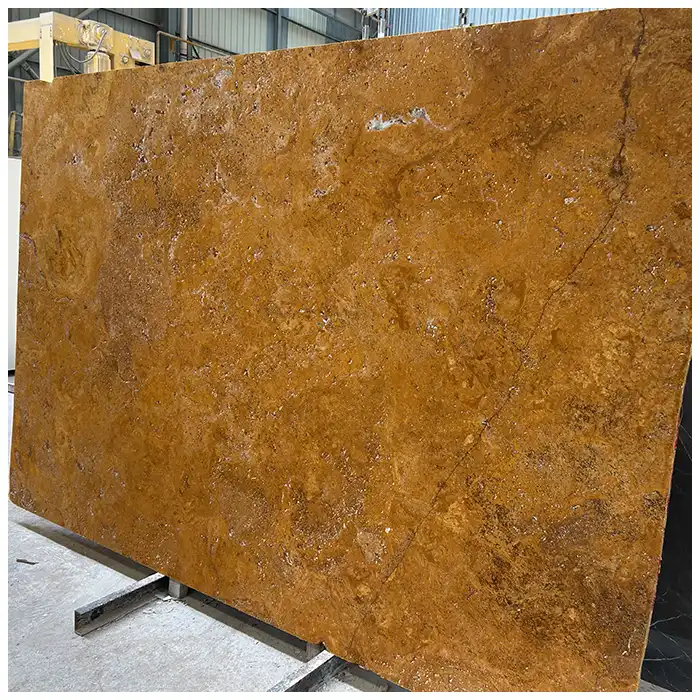
Travertine forms through mineral precipitation, often around springs, and its layered growth can leave bands, cavities, and changes in density. Vein cutting reveals linear bedding. Cross cutting opens softer cloud-like fields. The same block can therefore produce two very different furniture languages.

A long console often benefits from directional calm. Vein-cut bands can extend its horizontal proportion, while cross-cut movement can make a compact piece feel more monolithic. I compare the slab with the elevation, not with a small color sample.
Luxury Natural Stone Slabs for Walls, Furniture, and Light covers the broader relationship between luxury slabs and custom furniture. This decision is narrower: travertine’s pores, layers, touch, and aging behavior must become part of the console rather than defects disguised by photography.
A Roman Travertine slab can carry long cream and beige strata with subtle interruptions. The veins will tell you where the piece wants to lengthen, but the cut map must still protect usable edges and base connections.
Filled vs Unfilled Travertine Is a Use Decision
Filled vs unfilled travertine changes touch, cleaning, edge behavior, and the honesty of the surface. Filled pores create a more continuous plane. Unfilled cavities make geology immediately visible but can collect dust or catch objects in high-contact areas.
I do not treat one option as more authentic. A reception console that guests touch daily may need a smoother top while the vertical base keeps controlled open texture. A private gallery piece may accept more tactile variation. The designer, fabricator, and maintenance team should see the same sample.
Filler color matters. A pale fill can quiet small cavities, while a dark or mismatched fill turns each pore into a dot. Resinous and cementitious systems can age differently from the stone. I ask for an actual production sample and repair limit.
The face and edge may need different treatment
A broad honed face can use one filling approach, while a rounded edge exposes cavities at changing depths. The fabricator may need local repair so the edge remains comfortable and stable. That work should be visible in the sample rather than discovered after shaping.
Travertine furniture finish includes sheen, filler, brushing, edge touch, and cleaning response. A finish name alone is too vague for custom furniture.
| Furniture detail | Option to sample | What it changes | Approval question |
|---|---|---|---|
| Cut direction | Vein-cut and cross-cut faces from current lot | Horizontal rhythm, clouding, visual length | Does movement support the console proportion? |
| Pore treatment | Filled, selectively filled, or controlled unfilled areas | Touch, cleaning, shadow, repair visibility | Which surfaces can remain open in actual use? |
| Finitura | Honed, brushed, or another tested finish | Color softness, tactile drag, reflected light | Does the finish suit hands and maintenance? |
| Bordo | Straight, softened, radius, built-up, or carved return | Perceived thickness and exposed cavities | Can repairs remain quiet around the full perimeter? |
| Base contact | Plinth, legs, slab ends, concealed frame | Span, shadow line, stability, assembly | Does structure support the approved stone geometry? |
| Wall relationship | Clearance, skirting, outlet, fixing and floor level | Final alignment and service access | Can the piece sit correctly in the real room? |
Give the Edge Enough Quiet Weight
A travertine console table usually reads from its front edge before the top. A thin edge can feel light but may expose more fragile pore conditions. A thicker straight edge gives architectural weight. A soft radius catches diffuse light and invites touch.
I prefer edges that do not imitate another material. Travertine can carry a substantial profile without becoming loud because its bands remain gentle. A built-up edge may work, but its return pieces, vein direction, joint, and filler must be mapped.
The published Sculptural Stone Edges for Islands, Tables, and Reception Counters explores expressive profiles. For a console, restraint is usually stronger. The edge should complete the proportion, not compete with objects placed above it.
The Clean Edge Opened after Shaping
Suppose a console sample shows a smooth filled face and a crisp square edge. Production uses a deeper slab area where several cavities sit just below the surface. When the edge is eased, those pores open along the front line and require visible local filling. The stone remains usable, but the approved sample did not represent the edge condition. The team changes the cut position and prepares a full-thickness edge sample from the selected face before continuing.
Approve the edge through the full stone thickness, not from a face sample that never exposes the underlying pores.
Support the Long Narrow Top as Furniture, Not Cladding
Travertine console support depends on finished length, depth, thickness, stone condition, edge profile, base spacing, overhang, connection method, expected loads, wall relationship, transport, and floor level. A qualified fabricator or engineer sets the final system.
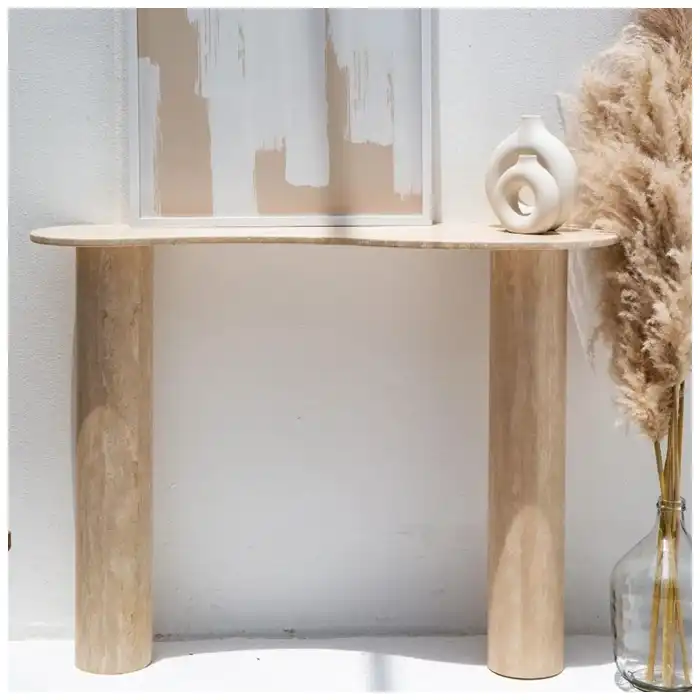
I judge travertine console support from the actual span rather than the apparent lightness of the top. Two decorative legs placed far inward may leave vulnerable ends. A full plinth can support well but make floor irregularity obvious. A concealed frame changes the shadow line and assembly route.
I place the base footprint on the slab map before cutting. Cavities, repaired areas, or directional weakness near a connection need technical review. The stone is not asked to forgive a base chosen after fabrication.
A Silver Travertine slab may introduce stronger gray and brown bands that make base alignment more visible. If the top and legs come from related faces, map how those lines meet at the corners.
Check the wall, skirting, outlets, and floor
A console rarely lives in empty space. Skirting can push the base forward. An outlet may sit behind a solid plinth. A wall can bow. The floor can fall across the length. I want a site dimension and elevation showing those conditions before the final base is approved.
I ask the responsible professional to determine whether wall restraint is appropriate and how the fixing meets the substrate. We never assume a heavy stone console can lean safely against decorative wall finishes without a defined detail.
Use Light to Reveal Texture without Making It Dirty
I use raking light to expose every pore and filler difference before approval. It can make vein-cut travertine wonderfully legible, or make a poorly cleaned surface look dusty. Broad warm light softens the bands and brings cream forward. Cooler light separates gray mineral lines.
Travertine console table lighting should be tested with the wall color, artwork, mirror, and objects likely to sit on the top. A spotlight directly above a vase may create a harsh reflection and leave the front edge dead.
Il How Lighting Changes Colorful Marble, Quartzite, and Onyx Slabs explains the larger light-and-finish relationship. Travertine adds micro-shadow. Its pores and layers respond more through texture than through deep translucency.
Plan Handling before the Console Becomes One Heavy Object
I ask whether the travertine console table travels assembled or as separate top and base components. Door widths, turns, lifts, floor protection, lifting points, temporary frames, assembly access, and final leveling can determine the practical choice.
A Light Grey Travertine console may look visually soft, but corners and long edges still require serious protection. Foam, timber, straps, and supports must avoid rubbing the finish or loading an exposed pore.
Travertine console table approval includes the underside because installers work there. Mark connections, frame pockets, fixing access, orientation, center of mass where required, and surfaces that must never receive a lifting clamp.
Accept Patina, but Define Neglect
Travertine can become more beautiful as the finish softens and the hand-polished areas develop a quiet variation. That is patina. Dirt packed into open pores, acidic etching, oil staining, unstable filler, and chipped edges are maintenance or damage questions, not romantic aging.
Travertine furniture finish should come with a cleaning test and care record. Use pH-appropriate products recommended for the stone and filler. Sealers may help manage absorption when specified, but they do not make calcite-rich stone immune to acids.
Il Natural Quartzite Or Marble-Look Sintered Stone for Premium Interiors offers a useful contrast with manufactured surfaces. Sintered decoration can repeat a controlled image and offer different maintenance behavior. Travertine offers real pores, layered growth, and gradual wear. The project should choose that reality knowingly.
Escalation when a pore, fill, or edge changes unexpectedly
First, photograph the full console, close condition, lighting, edge, underside, and product used during cleaning. Second, do not continue filling, grinding, or installing until the change is reviewed. Third, contact the supplier with the original slab photos, finish sample, edge approval, fabrication record, and site condition for comparison.
Approve the Travertine Console Table as One Quiet Object
I walk from the room entrance toward the finished piece. The bands should lead rather than fight. The edge should feel calm under the fingers. The base should meet the top without a nervous joint. Light should reveal enough texture to make the stone real.
Travertine console table design is successful when the pores look intentional, the support feels inevitable, and the surface can age without losing its order. This stone has been waiting for millions of years; the furniture should not rush it into a shape the material cannot carry.
Frequently Asked Questions
1. Is a travertine console table practical for daily use?
It can be, when the pore treatment, finish, edge, support, cleaning plan, and expected use are agreed. A high-touch hospitality piece may need a smoother filled top, while controlled open texture can remain on vertical faces or lower-contact areas.
2. Should travertine furniture be filled or unfilled?
Neither answer fits every surface. Filling creates a more continuous, easier-to-wipe plane. Controlled unfilled pores reveal more geology but collect dust and complicate contact areas. Sample the actual stone and assign treatments by face and use.
3. What edge works best on a travertine console?
A straight substantial edge, soft radius, or carefully built profile can all work. The choice depends on slab thickness, pores through the edge, proportion, touch, repair visibility, and fabrication. Approve a full-thickness sample from the selected material.
4. Does a long travertine console need hidden support?
The answer depends on length, depth, thickness, overhang, base spacing, stone condition, connection, load, transport, and floor conditions. A qualified fabricator or engineer should set the support system from the actual drawings and material.
5. What should I do if filler or an edge changes after installation?
First, photograph the complete piece, close issue, light, underside, and cleaning products. Second, stop further filling, grinding, or installation. Third, compare the condition with the slab record, finish sample, edge approval, and fabrication file before choosing corrective work.
Quick-Reference Checklist for Travertine Consoles
- Compare vein-cut and cross-cut faces from the current stone selection.
- Assign filled, selectively filled, and open-pore treatments by surface use.
- Approve finish, filler color, sheen, and cleaning on one production sample.
- Test the full-thickness edge for exposed pores and repair visibility.
- Coordinate base spacing, connections, overhang, and wall restraint before cutting.
- Measure skirting, outlets, wall variation, floor level, and handling access.
- Record care expectations that distinguish patina from staining or damage.
Final Conclusion
A travertine console table should make its geology useful. Choose the cut direction, assign the pores, test the finish and edge, support the long top, measure the wall, and plan how the piece will move into place.
True luxury is something you never get tired of looking at, and MQ STONE would rather let travertine age honestly than polish away every trace of the stone it is.

References
- Dimension Stone Design Manual, Natural Stone Institute.
- ASTM C1527 Standard Specification for Travertino Dimension Stone, ASTM International.
- ASTM C97 Standard Test Methods for Absorption and Bulk Specific Gravity of Dimension Stone, ASTM International.
- ASTM C880 Standard Test Method for Flexural Strength of Dimension Stone, ASTM International.
- Natural Stone Care and Cleaning Guidance, Natural Stone Institute.
- Natural Stone Flooring: Industry Standards and Best Practice, Stone Federation Great Britain.
- Architectural Lighting Design Guidance, Illuminating Engineering Society.