Invisible White Marble: What Its Fine Grey Movement Looks Like at Full Scale
From across a room, an Invisible White marble slab reads as almost nothing: a pale, even field with the faintest hint of direction. Step closer and the surface opens. A hairline grey trace splits and rejoins, a cloudy patch gathers around a scatter of crystal grains, and somewhere a single darker line crosses the whole face before it thins out. The stone asks for time, not attention.
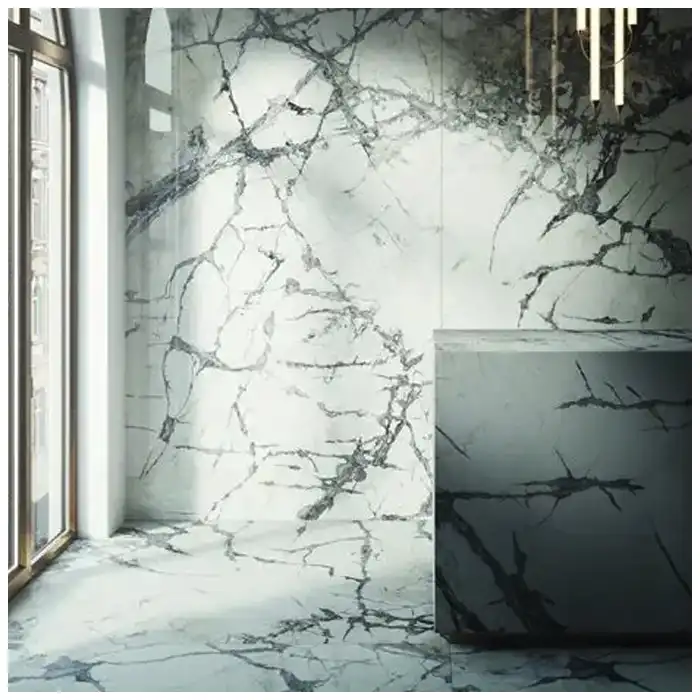
I trained my eye on stone faces long before I sold them, and I read a white field the way I read any full slab, ground first, then the lines that cross it. Our product page and current supply sheets describe this material as a dolomitic marble from Turkey, so I treat the whiteness as carbonate and keep any statement about how the grey lines formed tied to that specific supply instead of to marble in general. A quiet face is not an empty one.
This stone has been waiting for millions of years, and its quieter record is no less geological than a dramatic breccia. The restraint is the subject.
I start every Invisible White marble selection at full scale, not with a chip. I want the balance between the quiet ground and the few lines that carry the composition, and I want it settled before anyone talks about panel yield.
Read the White Field before the Grey Lines in Invisible White Marble
I set the slab upright beside diffuse daylight and look at the white field first, before any vein. What I am checking is whether the ground is even, because a white ground is rarely one colour. It carries a temperature. Some faces lean cool, almost blue-grey in shadow; others warm toward cream as the sun drops. That temperature is the first thing a room will register, and it decides whether the slab sits beside warm oak or cool grey paint.
The sample chip fails here in a predictable way. A four-inch square of fine white marble shows almost nothing, so the stone looks blank, and anyone judging only from the chip may question whether it will read as laminate at a few metres. The full slab tells the opposite story. Crystals, healed fissures, and faint mineral bands change the tempo of light across the face, and the chosen crop has to keep that alive at wall, table, or fireplace scale.
I lower my sightline toward the pale crystalline cloud and walk the length of the slab under side light. What I am looking for is depth, not drama: whether the grey sits on the surface or seems to live inside the stone. Part of that depth is physical: on a carbonate marble like this one, polish lets light travel a little way below the surface, so a shallow vein can appear to float while resin fills and repaired cracks tend to stay flatter. How much reads depends on the lot, the finish, and the repair method, so I confirm it on the current sample rather than assume it.
This reading sits inside our broader Luxury Natural Stone Slabs and Furniture: Complete Guide to Materials, Applications, Edges, Lighting, and Support, where full-face character, finish, fabrication, and authentic material value stay connected.
See Fine Movement from the Final Viewing Distance
My second reading concerns the fine grey marble veins and how far they travel before they disappear. I map the quiet passages against the active ones, then I step back to the exact distance the finished surface will be seen from. A kitchen island might be checked from roughly a metre, while a feature wall behind seating could be judged from four or five metres back. I treat those as scenario examples to test on the real elevation, not as records of one project, because each room changes the viewing distance, so I confirm the real points before fixing the crop. The same face can look busy up close and almost still from the doorway.
Whether cool light flattens pale mineral clouds depends on the spectral distribution of the lamp, the finish, the exposure, and the adjacent materials, so I try to see the face under the light the room will use. Under a north-facing window, fine grey movement can all but vanish on some faces; under a warm pendant it can come forward on others. If the room is cool-lit, I compare crops under that exact lamp before asking for more contrast, since the quieter passages may lose themselves anyway.
For Invisible White marble, I look for the mineral depth and full-face movement that survive cutting and installation, and I check that against the 見えない白い大理石 slab in our gallery before the crop is fixed.
Compare Crystalline Depth under Moving Light
Under a warm dining pendant, I stand back before I trace any line. Moving light is the honest test for these white marble slabs, because a fixed front photograph compresses everything. It hides the way a pale cloud brightens as you cross the room and a grey line deepens when the light rakes across it. I read the soft diagonal movement twice, once lit from above and once from the side.
The crop loses authority if warm light pulls cream from one slab and leaves its neighbour grey. That shift is normal for stone; it only becomes a fault when nobody caught it before cutting. I keep current finish samples beside the face while I read, so the approved polish or hone is the same finish the client will live with.
| Decision point | Evidence to inspect | Release condition |
|---|---|---|
| Background | Cool, warm, and neutral full-face comparison | White field agrees with room palette |
| Movement | Fine lines, clouds, and stronger passages | Visual scale suits wall or furniture |
| 終了 | Polish and hone under diffuse and side light | Subtle contrast remains readable |
| Fabrication | Crop, joints, openings, edges, repairs, supports | Quiet composition survives cutting |
| Continuity | Companion faces and mapped offcuts | Future work stays within tone and movement |
The Hard-Won Lesson: Quiet stone can lose its only line at a joint
A wall composition may depend on one long grey passage crossing a broad white field. If the panel joint cuts that line and the next slab starts its own line in another direction, the surface fragments even though every panel stays pale. The effect is easy to see in a dry-lay: the drawings look fine until the slabs stand side by side and the single through-line becomes three orphaned marks.
The Lesson: Draw the quiet composition before optimizing panel yield.
Choose Finish without Erasing Subtle Contrast
I walk past the face watching the single darker passage, because finish decisions turn on that one mark. Polish deepens it: light passes a little way into the carbonate and the grey seems to sit inside the stone. Hone scatters the light at the surface, so the same passage reads flatter and, on a quiet slab, can almost disappear.
The test for a luxury white marble is simple. I lay polished and honed samples on the same face under grazing light and compare how much of the fine contrast survives. If the room wants a matte, low-glare surface, I accept the hone but I choose a crop with slightly stronger movement, so the character has room to lose some contrast without going blank.
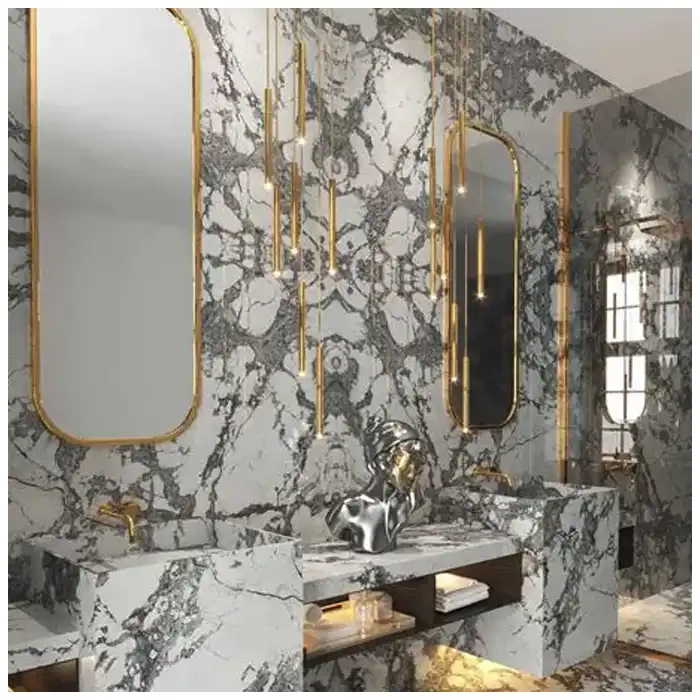
With Invisible White marble, walk past both polished and honed samples and watch how the grey changes as the finish changes.
Place Joints, Openings, and Edges in Quiet Zones
Before I think about nesting, I mark the quiet zones and the active ones, then I put every interruption in a quiet zone. Joints belong where the face is calm, not across the one line that organizes the composition. An opening does the most damage when it consumes the visual rest area, the patch of plain white that lets the eye breathe between passages.
A mitred edge can interrupt restraint by showing the same fine line twice at a corner. When the stone is this quiet, I usually suggest an eased solid edge, or I select companion strips that continue the face instead of mirroring it. The fabricator should inspect natural and repaired features before cutting, because a repair that reads fine flat can catch the light once it is polished on an edge.
When a project needs a white face with more drawing, I study Calacatta Cremo marble under the same side light before deciding where its stronger passages should meet an edge or joint.
Use Furniture Scale to Find the Right Crop
Furniture crops for luxury white marble need slightly more visual information than wall panels, because the viewer sits close. A tabletop is read from two feet, so a totally blank crop begins to resemble a manufactured surface. A calm centre with one line near the edge reads composed at that distance; it gives the eye a place to land without shouting.
I examine the honed reduction in contrast and inspect the edges and repairs closely before I release a crop for a table or a vanity. Then I return to the Luxury Natural Stone Slabs and Furniture: Complete Guide to Materials, Applications, Edges, Lighting, and Support and ask whether the detail still preserves the larger composition the client chose the stone for.
Reserve Companion Faces by Tone and Movement
Companion slabs have to be photographed together, because white marble slabs reveal their undertone differences most strongly side by side, especially under warm light. Two faces that matched under the warehouse’s cool lamps can drift apart in a home once the evening light hits them. I reserve visible replacements from the same accepted family and record their orientation and intended use.
From another angle I revisit any repair that shows in side light, because a repair is the one feature that can change character after installation. I coordinate support before drilling, so a screw line never lands on the only grey passage in the crop.
Why Restraint Becomes More Visible at Architectural Scale
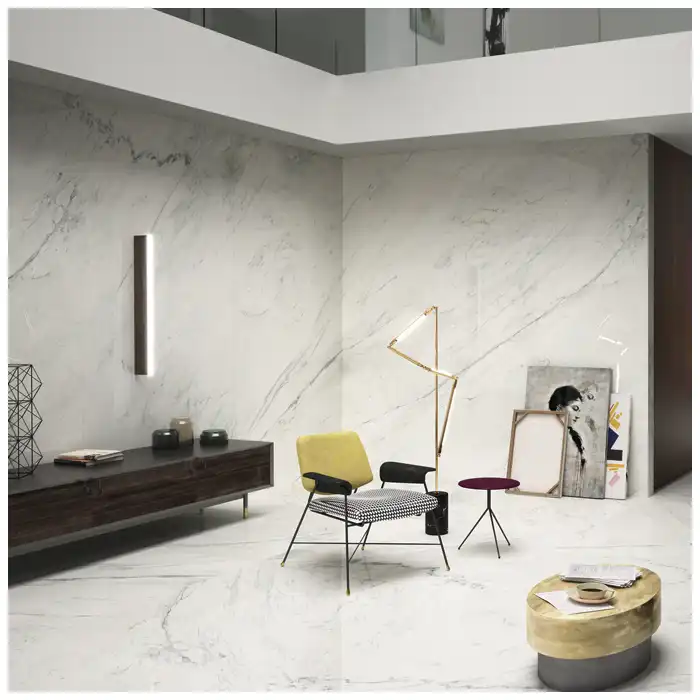
Restraint in stone is not the absence of movement; it is movement with room around it. That is why a slab that looks plain in a warehouse can read as richly textured on a double-height wall.
A broad field gives small movement authority
Fine grey marble veins carry weight only when the surrounding white leaves them space. What makes this work is a ground that is genuinely even. If one strong passage already dominates the face, the field stops reading as calm and becomes background, and the small marks lose their authority.
Light reveals mineral depth slowly
Changing reflection separates the crystalline clouds that a fixed front photograph compresses. I trust a slab only after a moving-light review, lit from above and from the side, under both the room’s lamp temperature and daylight. A slab judged only from one front photo is not yet approved.
Precision protects calm
Joints, openings, edges, repairs, and companions all have to respect the few marks that organize the face. The layout has to place every interruption in a quiet zone. If the only through-line lands on a joint, the layout goes back to the drawing.
Restraint is not blankness
Quiet does not mean featureless, and a crop that reads as manufactured up close is the wrong crop. Judge by distance: what reads calm across a room must still show the fine grey line up close, or the stone has been cropped to the point of erasure.
Commercial naming does not replace supply data. Carbonate stones vary in their mineral balance, and what holds for marble in general does not automatically hold for one lot, so I keep the description aligned with the current technical sheets and tie the aesthetic reading to the actual slab.
Frequently Asked Questions
1. What does Invisible White marble look like?
It generally presents a pale white field with fine grey movement and subtle crystalline variation, with the grey ranging from hairlines to a few stronger passages. Every current slab still needs direct review, because the balance between quiet ground and active line changes block to block.
2. Is Invisible White marble suitable for a feature wall?
Yes, when the full faces, panel scale, joints, openings, finish, support, repairs, and companion slabs form one controlled composition. The main risk is scale: a face that reads calm in a warehouse can look busy across a large wall, so review the full elevation and a panel at eye level before fixing the sequence.
3. Can it work for a stone table?
It can. Choose a crop with enough movement to reward close viewing, and coordinate the thickness, edge, support, repairs, finish, and daily care. A tabletop is read from close range, so a slightly stronger crop usually serves it better than a blank one.
4. Should this material be polished or honed?
Polish deepens the grey and lets a little light below the surface, so veins read as if they sit inside the stone. Hone scatters light at the surface and can reduce fine contrast. Compare current samples under the room’s intended light before deciding; on a very quiet slab, polish usually keeps more character.
5. What should happen if installed panels look warmer than approved?
Photograph the whole field under known light first, and stop any further surface treatment. Then send the photos together with the original full-face approval records to the supplier for comparison, and check the lamp temperature, adjacent finishes, slab IDs, and finish against what was approved before anyone cuts or seals anything.
Quick-Reference Checklist for Invisible White marble
- View each complete face from room distance.
- Compare undertone beside the room palette.
- Walk past polish and hone under side light.
- Map fine lines and quiet zones.
- Overlay joints, openings, edges, and supports.
- Reserve companions by tone and movement.
Final Conclusion
Quiet white marble depends on the relationship between a broad field, fine movement, crystalline depth, finish, crop, joints, edges, light, and companion material. Restraint takes as much composition as drama. The approved Invisible White marble has to stay connected to the records, physical references, and application decisions that made it acceptable.
True luxury is something you never get tired of looking at, and MQ STONE leaves enough white space around the mineral drawing for the eye to keep returning.
References
- 大理石, Wikipedia.
- 見えない白い大理石, MQ STONE product data for the current Turkish supply.
- MQ STONE current supply technical data and lot records for the lot under review (internal batch documentation, available on request).
- Luxury Natural Stone Slabs and Furniture: Complete Guide to Materials, Applications, Edges, Lighting, and Support, MQ STONE.