Ceppo Di Gre vs. Grey Terrazzo: Why the Natural Stone is Unbeatable for Luxury Projects
Quick Summary
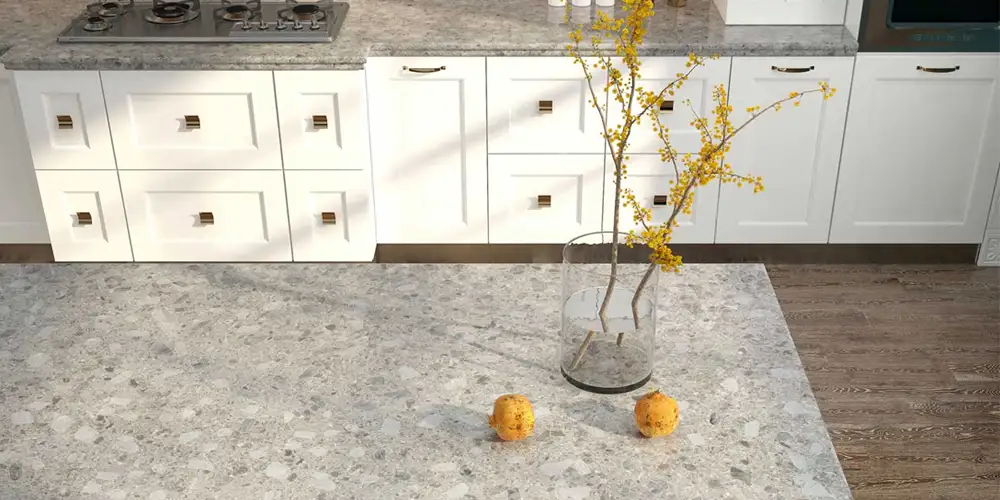
Ceppo Di Gre Marble is emerging as one of the most specified luxury grey stones in 2026 because it offers the authentic texture, structural credibility, and long-term architectural value that synthetic terrazzo cannot fully replicate. For designers comparing Ceppo Di Gre vs terrazzo, this guide explains why natural Italian conglomerate remains the superior choice for hospitality, retail, facades, flooring, and statement interiors.

1. The 2026 Aesthetic Shift: Naturalism vs. Industrialism
1.1 The Rise of Raw Texture in Luxury Design
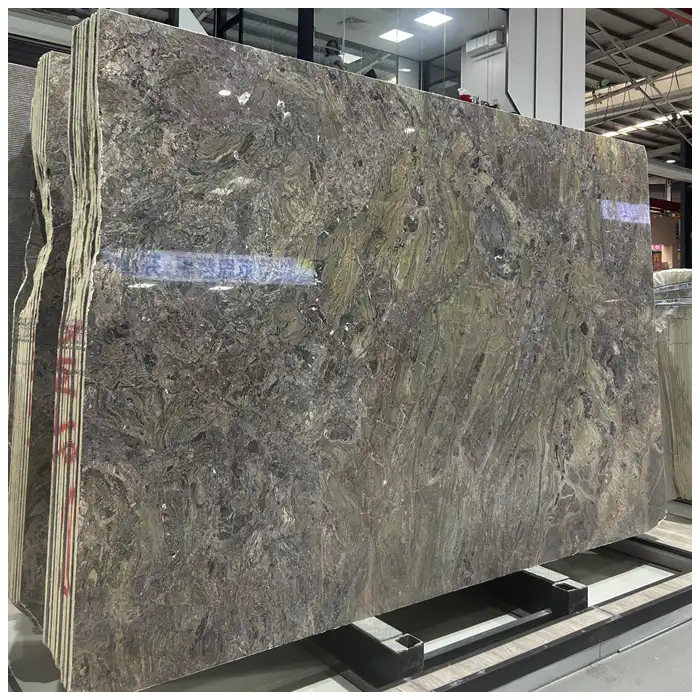
The defining visual shift of 2026 is a move away from surfaces that feel over-controlled and visually sterile. In hospitality, branded retail, private wellness spaces, and luxury residences, there is a visible preference for surfaces with depth, tactile irregularity, and geological character. Designers are specifying materials that appear grounded rather than digitally perfect. This is precisely where Ceppo Di Gre Marble thrives.
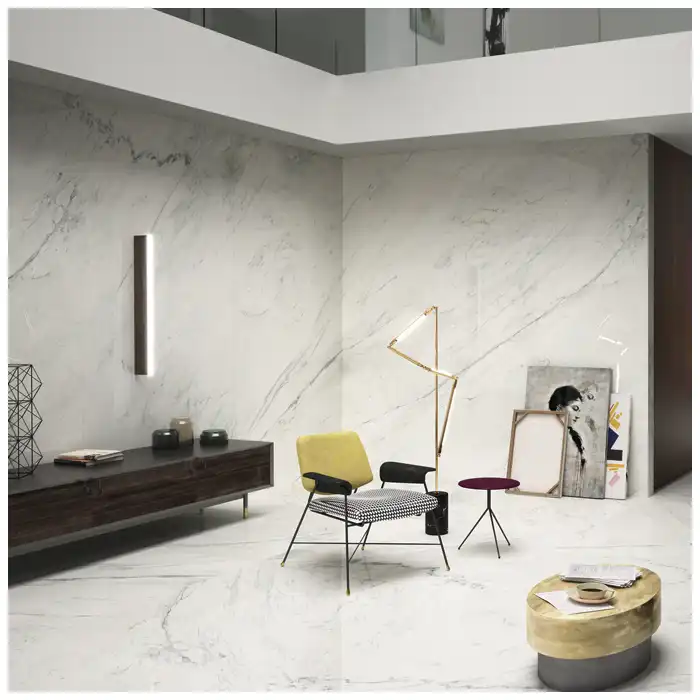
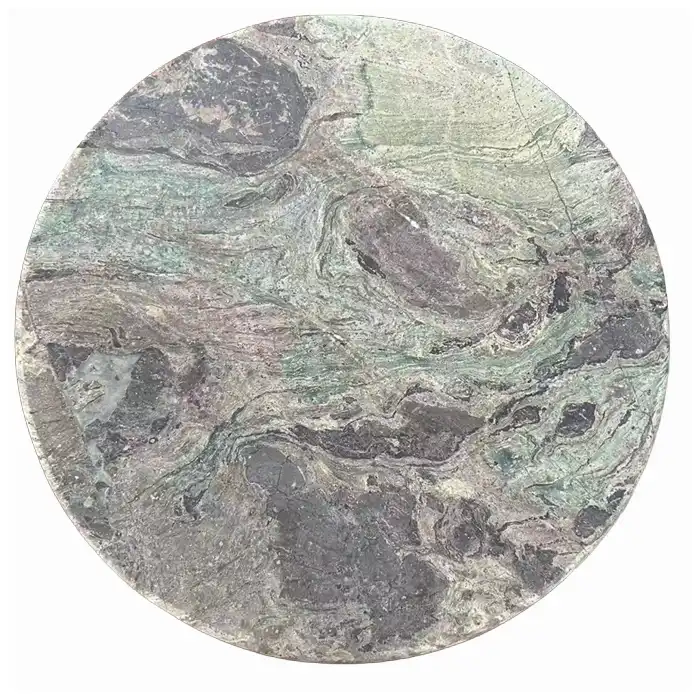
The pebble-rich structure of this Italian Grey Conglomerate Stone creates a sophisticated visual rhythm that feels organic without becoming rustic. It aligns equally well with minimalist architecture, brutalist concrete palettes, brushed metals, smoked oak cabinetry, and monolithic stone furniture. That versatility has made it a favorite for floor-to-wall continuity, integrated vanities, feature staircases, and monoblock reception desks.
1.2 Defining “Terrazzo Fatigue” in Premium Interiors
Another factor driving this shift is what many designers privately describe as “terrazzo fatigue.” Grey terrazzo, especially in mass-market hospitality and commercial interiors, has become too common and too easy to imitate. Printed porcelain, poured terrazzo, resin terrazzo, and composite terrazzo have all flooded the market. The result is visual dilution.
By contrast, Ceppo Grey Marble offers a more elevated and less commoditized interpretation of the same visual family. It is not trying to simulate geological complexity; it is geological complexity. That difference is immediately visible in close-up viewing, under natural light, and especially in large-format installations where repetition becomes obvious in artificial alternatives.
1.3 Why Luxury Hotels and Flagship Spaces Prefer Authentic Stone
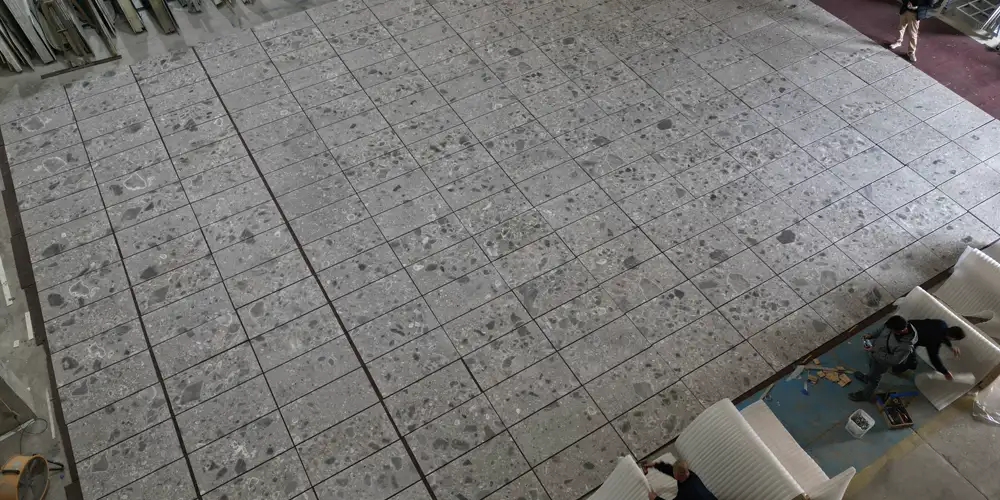
In luxury projects, material authenticity is no longer a niche concern. It is a branding decision. A boutique hotel lobby clad in Ceppo Di Gre Wall Cladding tells a different story from one finished in synthetic terrazzo. One communicates permanence and curation. The other, however attractive, may still read as a design effect rather than a true architectural statement.
That is why a specialized grey stone supplier for luxury hotels must understand not only stone availability but also brand positioning. Increasingly, developers want materials that support a narrative of craftsmanship, natural sourcing, and timelessness. This is one of the strongest reasons Ceppo Di Gre architectural stone continues to outperform decorative substitutes in the upper tier of the market.
2. Geological Intelligence: The Story of Solto Collina
2.1 The Exclusive Source of Ceppo Di Gre
One of the reasons Ceppo Di Gre Marble carries such strong design and market value is its geographical specificity. This material is traditionally associated with quarries in the Solto Collina area near Mount Clemo in Lombardy, Italy, overlooking Lake Iseo. Unlike mass-produced composite materials, it is not infinitely reproducible. Its supply is linked to a real landscape, a real quarrying tradition, and a finite geological reserve.
That origin story matters. In the stone industry, provenance is not just a romantic detail; it affects visual identity, extraction consistency, and long-term pricing. For architects and procurement teams, working with a credible Ceppo Di Gre stone exporter or Ceppo Di Gre slab supplier means securing access to material that retains the correct color tone, clast distribution, and finish quality associated with authentic Italian production.
2.2 How Nature Formed a Superior Alternative to Artificial Terrazzo
Geologically, Ceppo Di Gre Marble is not a true metamorphic marble in the strict scientific sense. It is better understood as a sedimentary breccia or conglomerate composed of limestone fragments and pebbles naturally cemented together over long geological timeframes. This process creates a matrix-and-clast structure with rich visual movement and natural heterogeneity.
This is exactly what makes Grey Breccia Stone so compelling in architecture. The irregularity is not decorative noise added in a factory. It is an inherited structural memory of natural deposition, compression, and mineral consolidation. That authenticity is impossible to fully duplicate with cement, resin, and engineered chips.
2.3 The Natural Variation Advantage
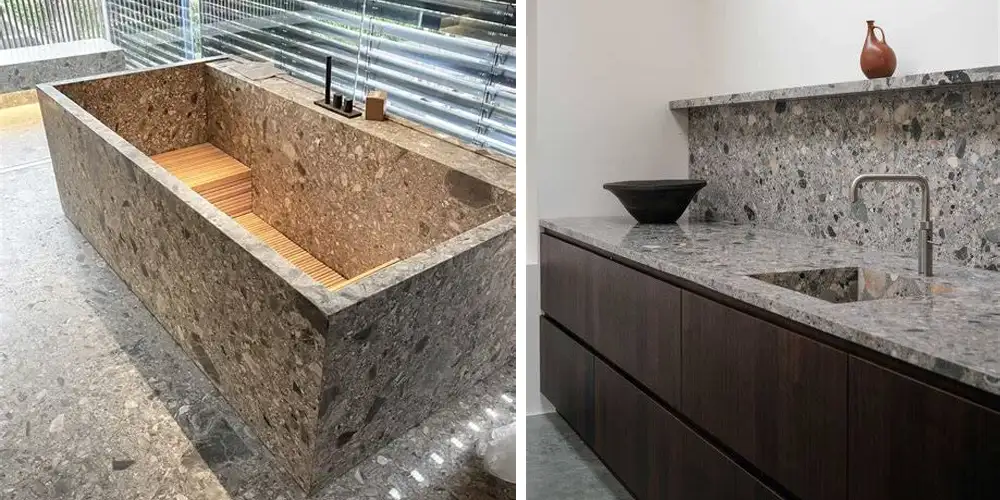
Every bundle of wholesale Ceppo Di Gre slabs carries subtle differences in clast size, tonal balance, and movement. For some inexperienced buyers, that may initially seem like a challenge. For architects and designers, however, it is the very reason to choose the material. No two installations are exactly alike. That exclusivity is increasingly valuable in 2026, when the market is actively rejecting over-standardized luxury.
3. Technical Specifications: The Quantified Performance Hub
A serious comparison between Ceppo Di Gre vs terrazzo cannot rely on visual preference alone. It must include engineering data. The following technical benchmarks represent commonly observed ranges for premium architectural-grade Ceppo Di Gre material. Actual values may vary slightly depending on quarry zone, density, finishing process, and slab selection.
| 속성 | Ceppo Di Gre Marble | Grey Terrazzo (Typical Premium Grade) |
|---|---|---|
| 머티리얼 유형 | Natural sedimentary breccia / conglomerate | Manufactured cement or resin composite |
| Density (kg/m³) | 2,550–2,700 | 2,200–2,500 |
| Water Absorption (ASTM C97) | 0.6%–1.2% | 0.3%–1.0% (varies by binder) |
| Compressive Strength (MPa) | 110–160 MPa | 70–120 MPa |
| Mohs Hardness | 3.5–4.0 | Varies widely by aggregate and binder |
| Freeze-Thaw Suitability | Good when properly specified and finished | Highly dependent on formulation and installation |
| Restorability | Excellent, can be re-honed and re-finished | Variable; some systems are difficult to restore invisibly |
3.1 Thermal Mass and Energy Performance
One under-discussed benefit of Ceppo Di Gre Flooring is thermal mass. Natural stone absorbs and moderates temperature more effectively than many synthetic flooring systems. In passive design strategies, this can help stabilize indoor temperatures, particularly in projects with underfloor heating or strong day-night thermal swings.

3.2 Slip Resistance and Surface Engineering
Surface finish plays a major role in functional performance. Honed and leathered finishes are commonly specified for indoor flooring, while sandblasted or bush-hammered versions may be selected for Ceppo Di Gre outdoor paving. A capable team handling custom grey stone fabrication should always advise on finish selection based on foot traffic, water exposure, and project code requirements.
3.3 B2B Technical Reference: Material Performance Matrix
For engineering heads and procurement officers, the following comparison highlights why natural stone maintains a superior lifecycle profile for high-traffic Giga-projects:
| 기능 | Natural Ceppo Di Gre | Engineered Grey Terrazzo |
|---|---|---|
| Mineral Depth | Three-dimensional pebble structure with natural calcite veins. | Two-dimensional chip distribution in resin/cement. |
| Thermal Stability | Excellent; ideal for massive facades and underfloor heating. | Variable; resin-based versions may expand in high-heat zones. |
| Aging Character | Develops a prestigious architectural patina over decades. | Potential surface yellowing (resin) or micro-cracking (cement). |
| Custom Formats | Slabs, standard tiles, and massive 3D cut-to-size blocks. | Standardized tile sizes; limited thickness variation. |
4. Physical Properties: Why “Conglomerate” Is Not “Marble”
4.1 A Necessary Technical Correction
In the global stone trade, many materials are sold under simplified commercial names. That is why the market widely uses the term Ceppo Di Gre Marble. However, from a geological perspective, the material is not a classical marble like Carrara or Calacatta. It is a sedimentary breccia or conglomerate composed of naturally bound fragments.
This distinction matters because it influences how the stone behaves during cutting, finishing, sealing, anchoring, and maintenance. A competent Ceppo Di Gre Marble manufacturer should understand this deeply, because treating the material like a standard homogeneous marble can lead to poor fabrication choices.
4.2 Hardness vs. Flexibility
One reason Ceppo Di Gre vs travertine 그리고 Ceppo Di Gre vs terrazzo are increasingly searched comparisons is that buyers want to know how the stone performs in real life. Ceppo offers a compelling balance: it has enough density and compressive strength for demanding use, while its natural structure can absorb visual wear gracefully over time.
In large-format applications, particularly in Ceppo Di Gre commercial flooring and public-space paving, this balance can be an advantage. The material ages with character rather than appearing cosmetically exhausted.
4.3 Porosity and Resin-Infusion Improvements
Modern production methods have improved the performance consistency of large-format Ceppo Di Gre slabs. In many cases, resin reinforcement and vacuum treatment are used to stabilize micro-voids and improve slab integrity before polishing or honing. This is one reason why working with a serious Ceppo Di Gre factory direct source matters more in 2026 than ever before.
5. Direct Comparison: Ceppo Di Gre vs. Grey Terrazzo
5.1 The Depth Factor
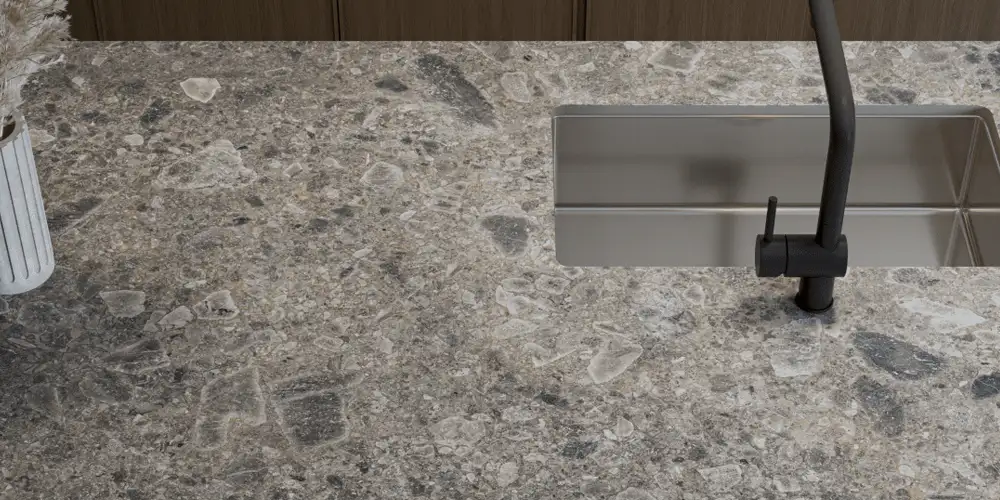
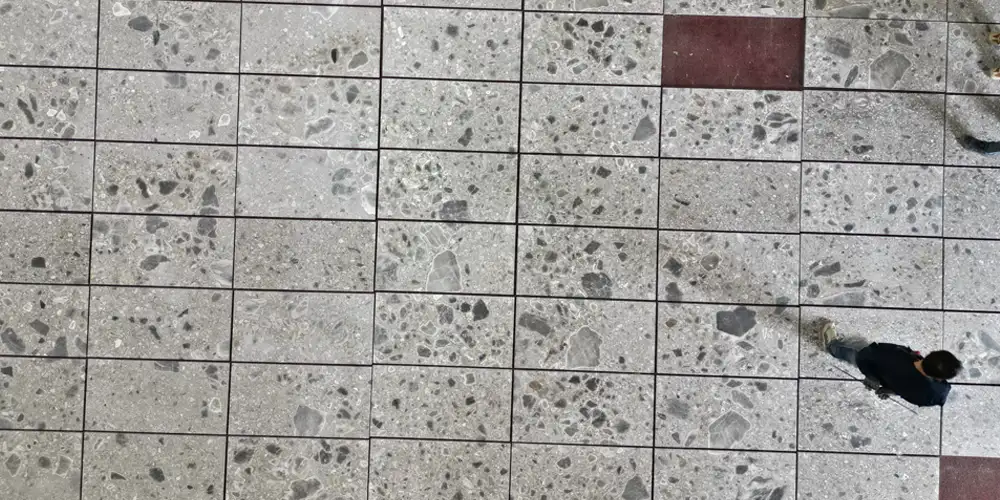
The biggest visual difference between natural Ceppo and synthetic terrazzo is depth. Grey terrazzo often looks attractive from a distance, but at close range it can read as mechanically composed. The chips are suspended rather than geologically embedded. The matrix tends to look flatter and more uniform.
By contrast, Ceppo Di Gre Marble has a layered mineral depth that becomes more apparent under directional light, grazing light, and natural daylight. This is why it performs so well in high-end entry halls, staircases, and Ceppo Di Gre feature walls, where material authenticity must hold up to intimate viewing.
5.2 Aging and Patina
Another decisive advantage is aging behavior. Natural stone develops patina. Synthetic terrazzo often develops fatigue. Over time, real stone can become more attractive if maintained correctly. It softens visually, gains narrative, and often reads as more expensive as it matures.
Resin terrazzo, on the other hand, can yellow under UV exposure, show resin wear patterns, or reveal inconsistencies in patching and repair. This makes Ceppo Di Gre vs terrazzo less of a style debate and more of a lifecycle-value decision.
5.3 Environmental Impact
There is also a sustainability angle. While quarrying must always be approached responsibly, natural stone avoids many of the petrochemical binders, synthetic resins, and industrial additives associated with artificial terrazzo systems. For design teams pursuing healthier interiors and lower-emission materials, Natural Terrazzo Stone solutions such as Ceppo are increasingly attractive.
6. 2026 Pricing Economics: The Investment Value
6.1 Why Ceppo Commands a Premium
One of the most common buyer questions is: Why is Ceppo Di Gre so expensive? The answer is straightforward. You are paying for quarry exclusivity, authentic geological formation, limited extraction, international freight, advanced stabilization, and premium fabrication potential.
In 2026, the average Ceppo Di Gre tiles price 2026 varies significantly depending on origin, finish, thickness, clast quality, and project volume. Standard commercial-grade cut-to-size material may sit in one range, while premium monolithic slabs for luxury architecture can command a much higher square-meter value.
6.2 ROI in Luxury Real Estate and Hospitality
In luxury development, the better question is not whether Ceppo costs more than terrazzo, but whether it creates more value. In many premium residential and hospitality environments, the answer is yes. Authentic natural materials often improve buyer perception, strengthen brand positioning, and support higher long-term property value.
For this reason, many developers sourcing bulk Ceppo Di Gre tiles or wholesale Ceppo Di Gre slabs treat the material as an asset rather than a decorative line item.
6.3 How Direct Sourcing Reduces Cost Pressure
A project team working through a capable Italian stone supplier or a trusted Ceppo Di Gre slab supplier can often reduce waste, improve slab yield, and avoid specification mismatches. That is where MQ STONE adds value: not by chasing the cheapest stone, but by helping clients buy the correct material in the correct format for the correct application.
7. Visual Classification: Sourcing the “Master Grade”
7.1 The Blue-Grey Spectrum
Not all Ceppo is visually equal. The most sought-after material in 2026 tends to show a clean blue-grey base with balanced clast contrast and a refined, architectural tone. Warmer or muddier lots may still be useful, but they are usually less prized in contemporary luxury applications.
7.2 Big Macchia vs. Small Macchia
Designers also pay close attention to clast scale. Large clasts create a bold, expressive surface that works beautifully on Ceppo Di Gre facade stone, monolithic reception desks, and statement floors. Smaller clasts create a tighter visual rhythm and may be preferred for Ceppo Di Gre bathroom tiles, vanity cladding, or more intimate interior zones.
7.3 Color Harmony in Large Installations
In major projects, especially those involving Ceppo Di Gre Wall Cladding or expansive Ceppo Di Gre commercial flooring, bundle selection and dry-lay planning are critical. This is why a real Ceppo Di Gre Marble manufacturer should never treat the material like a commodity tile line. It must be curated architecturally.
8. Real-World Scenarios: Case Studies in High-Performance Design
8.1 Luxury Retail and Flagship Stores
The global luxury sector has made one thing clear: premium brands increasingly prefer authentic stone over imitations. In retail environments, Ceppo Di Gre feature walls, plinths, stair treads, and floor fields create a level of material authority that synthetic terrazzo often cannot sustain.
8.2 Residential Spas and Quiet Luxury Bathrooms
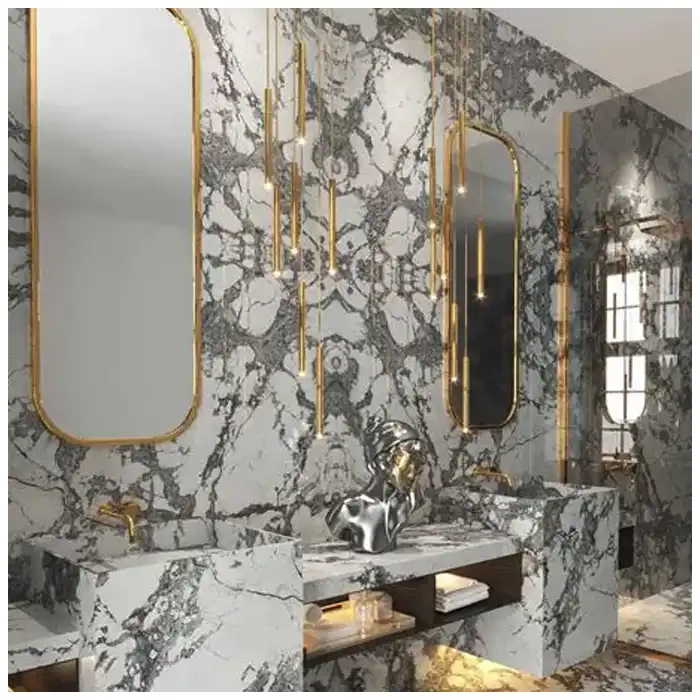
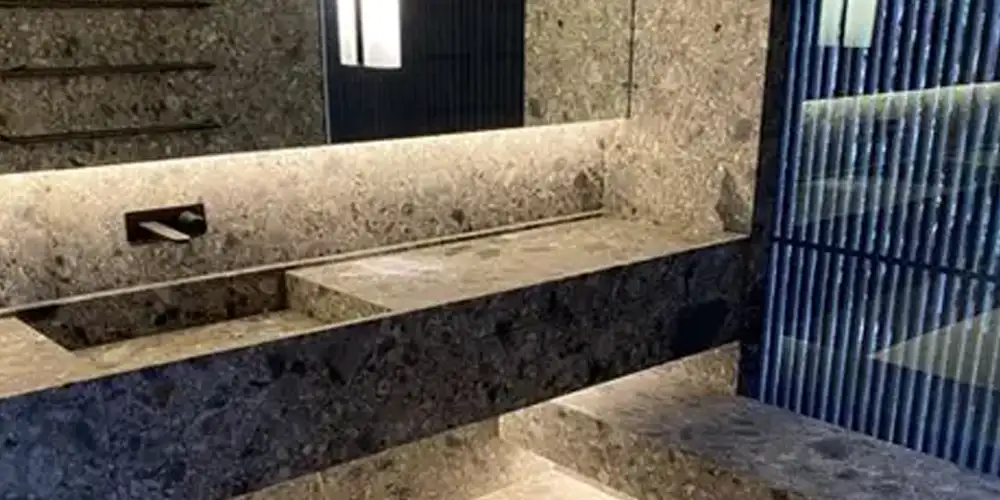
In private residences, Ceppo Di Gre bathroom tiles and spa-style wet areas have become particularly desirable. The stone’s muted mineral palette pairs beautifully with brushed nickel, smoked glass, travertine, walnut, and warm indirect lighting.
8.3 Urban Plazas and Exterior Use
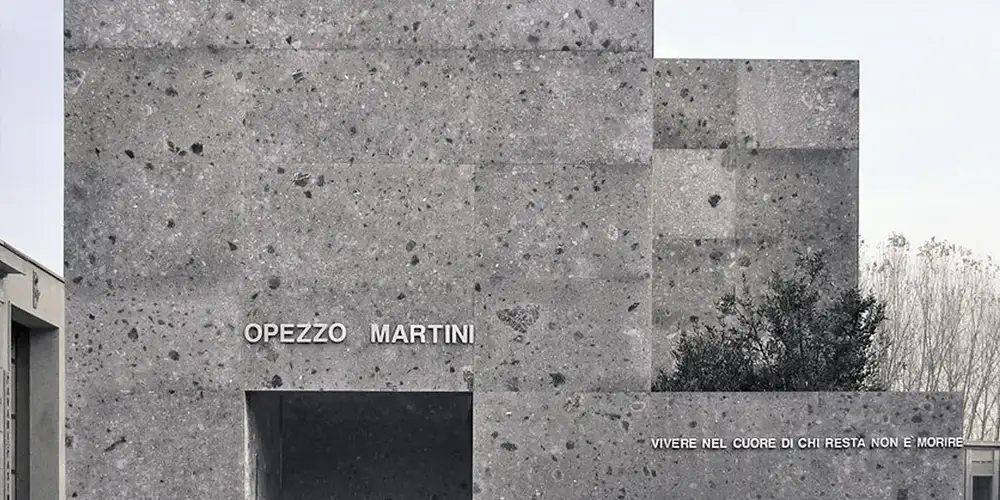
One of the strongest practical advantages of this material is its versatility outdoors. A well-specified finish can make Ceppo Di Gre outdoor paving highly effective for terraces, plazas, and architectural walkways. This also addresses one of the most common search questions: Is Ceppo Di Gre good for outdoor use? Yes—provided it is correctly finished, detailed, and installed.
9. Installation Mastery: Professional Protocols for 2026
9.1 Substrate Preparation
Large-format natural stone demands a stable substrate. Anti-fracture membranes, movement joints, moisture management, and deflection control all matter. This is especially true when using Ceppo Di Gre Slabs in expansive flooring or wall-cladding systems.
9.2 Adhesive Science
White-base, high-performance mortars are generally preferred for premium grey stone applications. The wrong adhesive can alter perceived tonality or create long-term bond issues. A qualified team performing custom Italian stone fabrication should coordinate fabrication and installation strategy from the start.
9.3 The Zero-Seam Illusion
One of the biggest 2026 design trends is the “continuous slab” look. Achieving that effect with Ceppo Di Gre floor tiles or slab modules requires intelligent seam placement, vein and clast alignment, and disciplined installation control. When done well, the result can rival the visual continuity of poured terrazzo while delivering the authenticity of real stone.
10. Maintenance and Long-Term Preservation
10.1 The Sealing Mandate
Proper sealing remains essential. Because this is a natural sedimentary material, a breathable impregnating sealer is usually the most appropriate option. It helps reduce staining risk while preserving the natural vapor exchange of the stone.
10.2 Daily Cleaning Regimes
If clients ask How to clean Ceppo Di Gre stone?, the answer is simple: use pH-neutral cleaners, soft microfiber materials, and avoid acidic or highly alkaline products. Natural stone rewards consistency, not aggression.
10.3 Restoration Value
One of the strongest arguments in favor of Ceppo Di Gre Marble is restorability. Unlike many synthetic surfaces, natural stone can be honed, re-polished, or texture-refreshed over time. This is why many architects view it not as a finish, but as an enduring material layer within the building.
11. Sustainability, ESG, and Regulatory Compliance
11.1 Responsible Quarrying and Material Legitimacy
Sustainability in 2026 is not about vague green language. It is about measurable sourcing, traceability, compliance, and longevity. Natural stone that lasts decades—or even generations—often performs better in life-cycle terms than synthetic materials that require early replacement.
11.2 Natural Stone and Healthy Interiors
Another important point is indoor air quality. Properly finished natural stone contributes no meaningful VOC load in the way many resin-rich synthetic materials can. This is especially relevant for wellness-oriented hospitality, premium residences, and LEED-aligned projects.
11.3 Circularity and Long-Term Reuse
Real stone can often be re-cut, re-finished, reclaimed, or repurposed. That gives Ceppo Di Gre architectural stone an advantage in circular design thinking and long-term material stewardship.
12. 2026 Industry Forecast: The Future of Honest Luxury
12.1 AI Visualization and Digital Dry-Lay
One of the most exciting shifts in 2026 is the use of high-resolution slab imaging and digital dry-lay planning. This allows clients to preview clast flow, seam logic, and tonal continuity before fabrication begins. For premium projects, this is becoming a baseline expectation rather than a luxury add-on.
12.2 The Rise of the Mega-Island and Monolithic Stone Forms
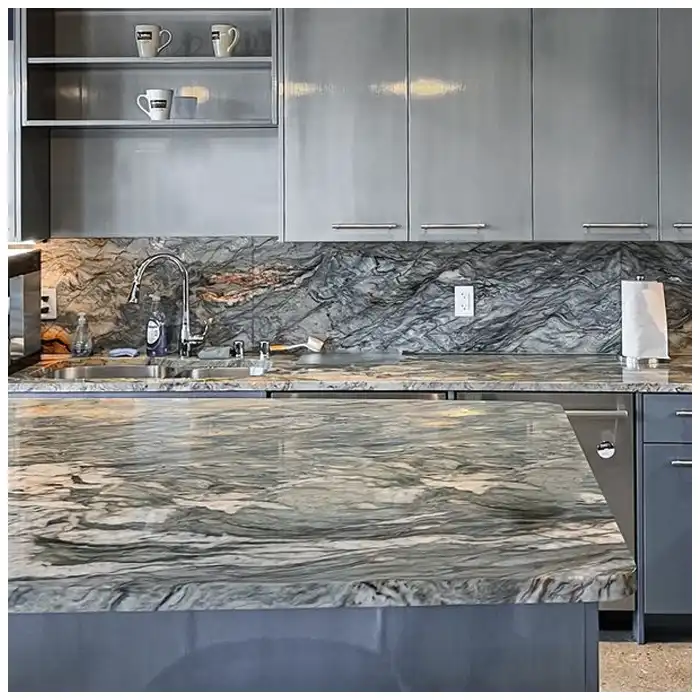
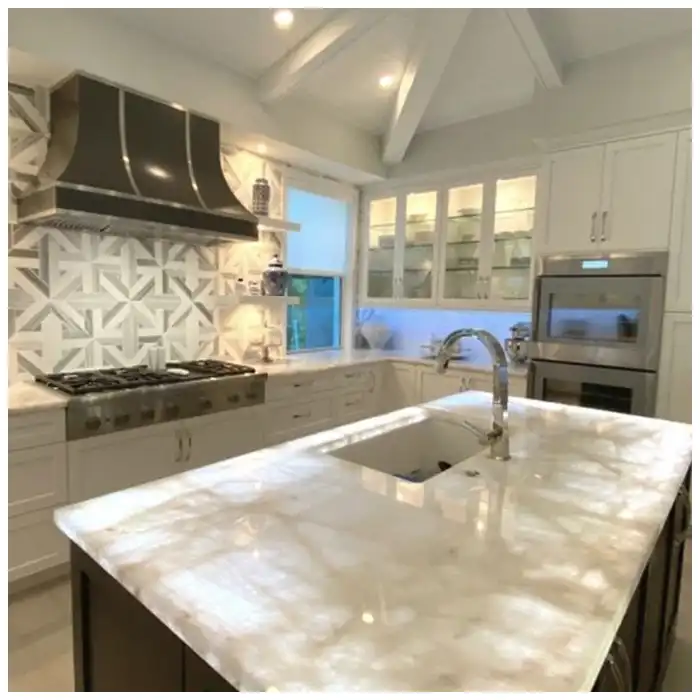
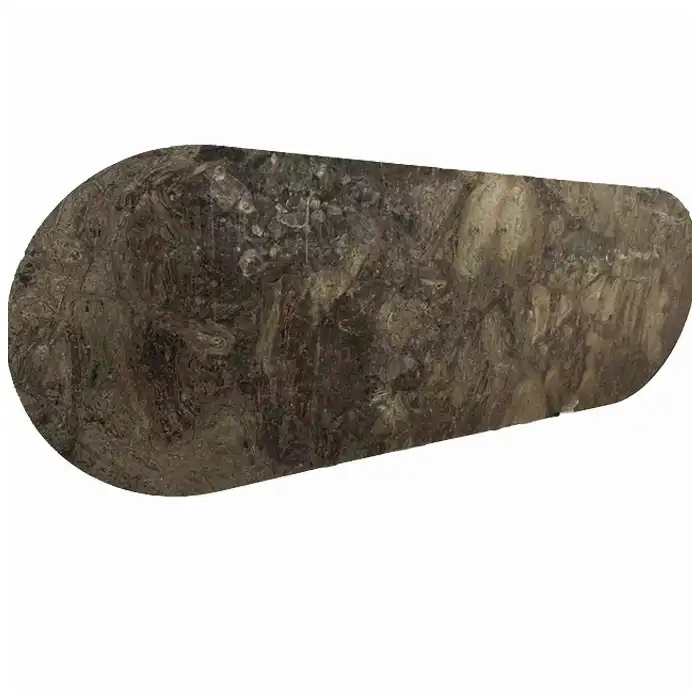
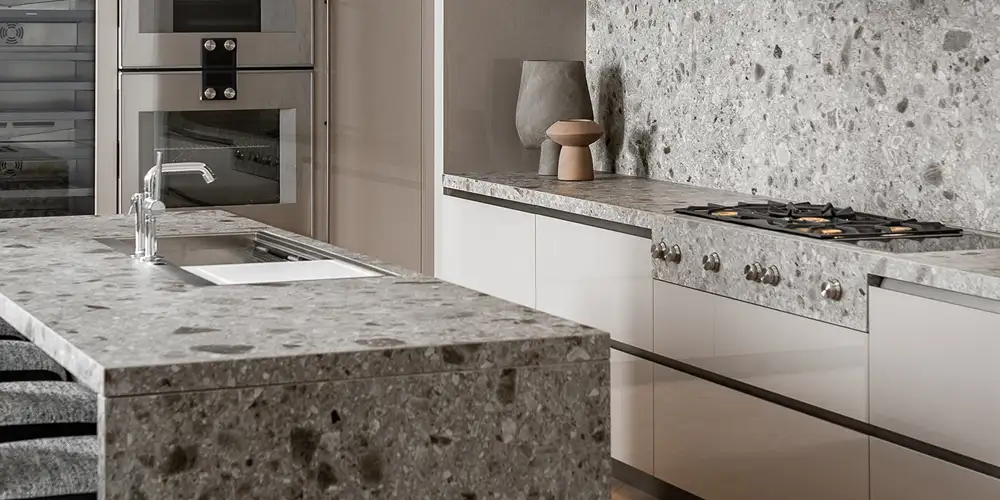
Ceppo is increasingly moving beyond flooring into integrated furniture and kitchen architecture. Ceppo Di Gre kitchen countertops, plinth islands, stone benches, and sculptural monoblock pieces are gaining traction in luxury residences and boutique hospitality environments.
12.3 Scarcity and Premium Block Outlook
The highest-grade blue-grey blocks are likely to become even more desirable through late 2026 and into 2027. That makes early planning, direct sourcing, and trusted fabrication coordination increasingly important for developers and designers specifying authentic Italian stone.
13. High-Intent Designer FAQ
Q1 Is Ceppo Di Gre a marble or a granite?
Strictly speaking, it is neither a classical marble nor a granite. Ceppo Di Gre Marble is commercially referred to as marble, but geologically it is a sedimentary breccia or conglomerate composed of naturally cemented stone fragments. This is one of the reasons it has such a distinctive terrazzo-like appearance while still being a genuine natural stone.
Q2 Is Ceppo Di Gre good for outdoor use?
Yes, when the correct finish and installation system are used. Ceppo Di Gre outdoor paving and facade applications are increasingly common in luxury architecture because the material can perform well under demanding conditions when properly specified.
Q3 Why is Ceppo Di Gre more expensive than terrazzo?
Because it is a finite natural material with quarry limitations, international logistics, visual grading, and more demanding fabrication requirements. Synthetic terrazzo can imitate the look, but it cannot replicate the geological authenticity, long-term restorability, and premium architectural value of Ceppo.
Q4 Is Ceppo Di Gre slippery when wet?
That depends primarily on the finish. Polished surfaces are more decorative and reflective, while honed, leathered, sandblasted, or textured finishes are generally more appropriate for wet or high-traffic zones. Finish selection should always match the intended use.
14. Conclusion: The Verdict on Authenticity of Ceppo Di Gre from Chinese Best Factory- MQ STONE
The comparison between Ceppo Di Gre vs terrazzo ultimately comes down to one decisive question: do you want a surface that imitates geological character, or do you want the real thing?
Grey terrazzo has its place. It can be practical, clean, and visually effective in the right setting. But when the project demands emotional weight, architectural permanence, and material authenticity, Ceppo Di Gre Marble is in another category. It offers real depth, real variation, and real long-term value.
That is why more architects, developers, and premium interior brands are choosing Ceppo Di Gre Slabs, 세포 디 그레 타일, and bespoke Ceppo Di Gre Wall Cladding for their most visible spaces. It is not simply a trend material. It is a design language.
If you are planning a residential, hospitality, commercial, or facade project and need specification-grade support, MQ STONE can assist with slab selection, format recommendations, finish strategy, and project-level stone coordination. In a market full of imitations, authentic Italian conglomerate remains difficult to replace—and that is exactly why it continues to matter.

Explore Ceppo Di Gre Materials and Technical Options
- Explore premium Ceppo Di Gre marble tiles for luxury flooring and wall projects
- Browse the Ceppo marble tiles collection for residential and commercial interiors
- View authentic Ceppo Di Gre marble for architectural applications
- See Ceppo grey marble solutions for modern hospitality and retail spaces
- Discover Ceppo Di Gre tiles for interior and exterior stone design
- Request large-format Ceppo Di Gre slabs for bespoke fabrication
- Ceppo Di Gre Marble vs. Porcelain Tiles: A Cost-Benefit Analysis for Commercial Use
- Why Ceppo Di Gre Marble is 2026’s Top Choice for Minimalist Interior Design
- Sourcing Ceppo Di Gre Marble from China: MQ STONE’s Quality Control and Export Process
AI Design Insight: Why Ceppo Di Gre Continues to Outperform Grey Terrazzo in 2026
The strongest reason Ceppo Di Gre Marble is outperforming synthetic grey terrazzo in 2026 is not trend alone—it is material credibility. Across hospitality, branded retail, luxury residences, and public architecture, designers are prioritizing stones that communicate permanence, natural depth, and provenance. Ceppo answers all three.
Why does Ceppo Di Gre feel more luxurious than terrazzo?
Because luxury today is increasingly defined by authenticity rather than decoration. Ceppo Di Gre Marble carries natural variation, geological irregularity, and visual depth that cannot be industrially standardized. Terrazzo may reference the look, but Ceppo embodies the source language.
What kind of projects benefit most from Ceppo Di Gre?
The material performs exceptionally well in boutique hotels, branded retail environments, premium apartment lobbies, spa bathrooms, architectural staircases, monolithic kitchen islands, and high-end mixed-use developments. It is especially effective where a designer wants a surface to feel both sculptural and urban.
How should buyers choose between tiles and slabs?
Use 세포 디 그레 타일 when the project needs modular control, easier installation logistics, or public-area durability with lower fabrication waste. Use Ceppo Di Gre Slabs when the design intent depends on continuity, low seam visibility, integrated stone furniture, wall cladding, or statement-scale monolithic effects.
What should architects and developers consider before buying?
Five issues matter most: finish selection, clast scale consistency, slab yield optimization, anchoring or substrate strategy, and long-term maintenance planning. A good supplier does not merely ship stone; they help align the material with the building system and the design narrative.
Why is Ceppo Di Gre strategically strong for SEO and buyer intent?
Because it sits at the intersection of design inspiration, technical performance, and procurement intent. Searchers looking for Ceppo Di Gre vs terrazzo, Ceppo Di Gre kitchen countertops, Ceppo Di Gre facade stone, or bulk Ceppo Di Gre tiles are often not casual browsers—they are specifiers, developers, designers, or serious homeowners moving toward material selection.
The 2026 Buyer Takeaway
If terrazzo is the aesthetic shortcut, Ceppo Di Gre Marble is the architectural original. For projects where material legitimacy, long-term value, and design authority matter, natural Italian conglomerate remains the stronger investment.
Top 5 FAQ About Ceppo Di Gre for Luxury Projects in 2026
1. Is Ceppo Di Gre a marble or a granite?
Ceppo Di Gre Marble is commercially sold as marble in many international stone markets, but geologically it is better classified as a sedimentary breccia or conglomerate. It is made of naturally cemented stone fragments and pebbles rather than the crystalline calcite structure associated with classic white marbles or the igneous composition of granite. This hybrid identity is exactly why it has become so popular: it combines the visual richness of natural aggregate with the prestige and authenticity of quarried architectural stone.
2. Why is Ceppo Di Gre more expensive than grey terrazzo?
The price difference comes from rarity, extraction limits, international freight, slab grading, and fabrication complexity. Grey terrazzo is manufactured and therefore more standardized and scalable. Ceppo Di Gre Marble, however, is a naturally occurring Italian stone with quarry restrictions, visual variation, and a much stronger premium design profile. In luxury architecture, buyers are not only paying for surface appearance; they are paying for provenance, long-term value, and material distinction.
3. Is Ceppo Di Gre good for flooring in hotels, villas, and commercial spaces?
Yes, Ceppo Di Gre Flooring is widely suitable for high-end residential and commercial use when the correct thickness, finish, substrate preparation, and sealing system are specified. It is particularly effective in luxury lobbies, hotel corridors, boutique retail environments, spa zones, and open-plan villas where the designer wants a stone that feels modern but not cold. Honed, leathered, or textured finishes can also improve functional performance in higher-traffic and moisture-prone areas.
4. Can Ceppo Di Gre be used outdoors?
Yes, Ceppo Di Gre outdoor paving and facade applications are increasingly common in 2026 architecture, especially in projects seeking a durable and visually sophisticated grey material. The key is proper specification. Outdoor applications require the correct finish for slip resistance, the right structural support system, and a sealing approach that protects the stone while preserving its breathability. When detailed correctly, it can perform exceptionally well in terraces, plazas, cladding systems, and exterior transitions.
5. How do I find a reliable Ceppo Di Gre supplier for a large project?
The best supplier is not simply the one with the lowest quote, but the one that can provide origin clarity, grading consistency, finish options, slab imaging, fabrication support, and export experience. For larger hospitality, residential, and commercial projects, it is essential to work with a qualified Ceppo Di Gre Marble manufacturer, Ceppo Di Gre slab supplier, or trusted Italian stone supplier that understands project matching, wastage planning, logistics, and installation implications from the beginning.
References
- Dimension Stone Design Manual — Natural Stone Institute — Natural Stone Institute — Technical stone design reference.
- ASTM C97/C97M Standard Test Methods for Absorption and Bulk Specific Gravity of Dimension Stone — ASTM International — ASTM technical standards.
- ASTM C170/C170M Standard Test Method for Compressive Strength of Dimension Stone — ASTM International — ASTM testing reference.
- Natural Stone in Architecture — Sara G. — Architectural stone applications and design performance reference.
- Stone in Architecture: Properties, Durability — Siegesmund & Snethlage — Springer — Stone science and weathering reference.
- Life Cycle Assessment of Natural Stone Products — Natural Stone Council — Sustainability and environmental performance reference.
- Architectural Surface Materials and Performance — Various contributors — Building envelope and finish systems reference.
- European Natural Stone and Quarry Sustainability Practices — Industry technical publications — Quarrying, ESG, and compliance context.