Luxury Natural Stone Slabs for Walls, Furniture, and Light
A rough-sawn stone face can look nearly closed after rain, then open into pale quartz, charcoal fragments, and a narrow amber seam as the surface dries. Touch adds another clue: the change between mineral zones may be felt before it becomes obvious in a photograph.
That first reading matters because a reception wall, table, or console will crop the geological composition. The design has to follow the actual face rather than a generic material name.
What Makes Luxury Natural Stone Slabs Different
Price alone does not create distinction. I look for geological character that remains coherent at architectural scale: mineral depth, changing crystal size, unusual inclusions, controlled fissure patterns, translucency, color relationships, and movement that can be composed across a wall or object. Rarity matters, but usable design potential matters more.

The How to Choose Statement Slabs for Countertops, Walls, and Furniture process begins with the entire face. A small sample can confirm polish and approximate color. It cannot reveal whether one dark mineral island dominates a dining table or whether two faces can form a balanced wall.
Natural stone is not a printed repeat. Marble records recrystallized carbonate minerals and impurities moved by heat, pressure, and fluids. Quartzite grows from quartz-rich sandstone transformed until grains interlock. Onyx used in interiors is commonly a banded calcite material deposited from mineral-rich water, which is why thin sections can glow. The geology is not decoration behind the story. It creates the visual behavior.
How Luxury Natural Stone Slabs Differ by Mineral Body
Marble: movement shaped by metamorphism
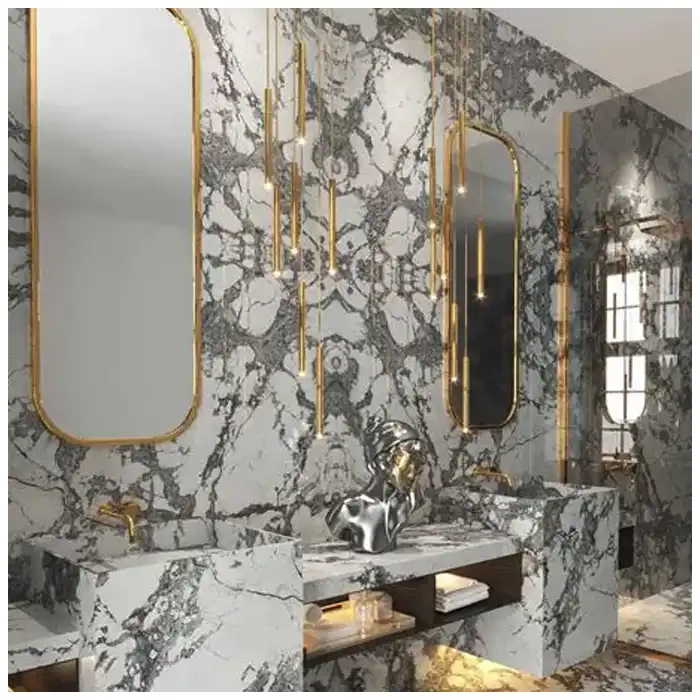
Marble can range from a nearly quiet crystalline field to sweeping, high-contrast movement. Veins may carry calcite, graphite, iron-bearing minerals, or other impurities that darken, warm, or color the face. Under grazing light, a honed field feels soft while a polished field catches reflections along every stronger line.
I reserve expressive marble for places where the eye can step back: lobbies, wall panels, large tables, portals, and carefully composed islands. Smaller objects can work, but the cut must preserve the material’s sentence. A large vein reduced to one disconnected corner looks accidental.
Quartzite: crystalline strength with visual depth
True quartzite often reveals a granular, glass-like depth that manufactured print cannot reproduce. Pale quartz crystals can scatter light into the face, while mica or iron-bearing zones draw silver, gold, green, or smoky movement. On some material, an angled flashlight makes the edge glow several millimeters deep.
The Cristallo Tiffany Quartzite example shows why exotic quartzite slabs need transmitted-light tests as well as front light. Crystalline zones may appear calm under ceiling lamps and become luminous near a window or concealed light source.
I group exotic quartzite slabs by architectural use, mineral depth, and viewing distance.
Onyx: architecture drawn with transmitted light
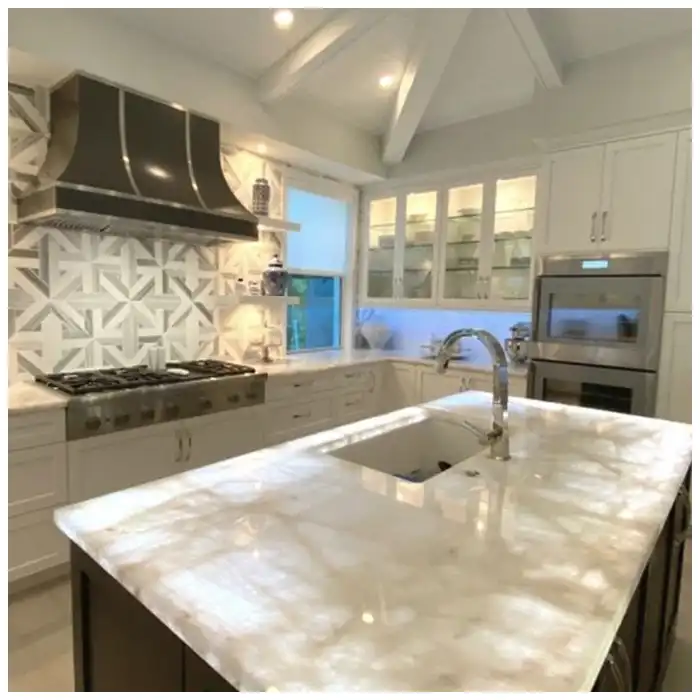
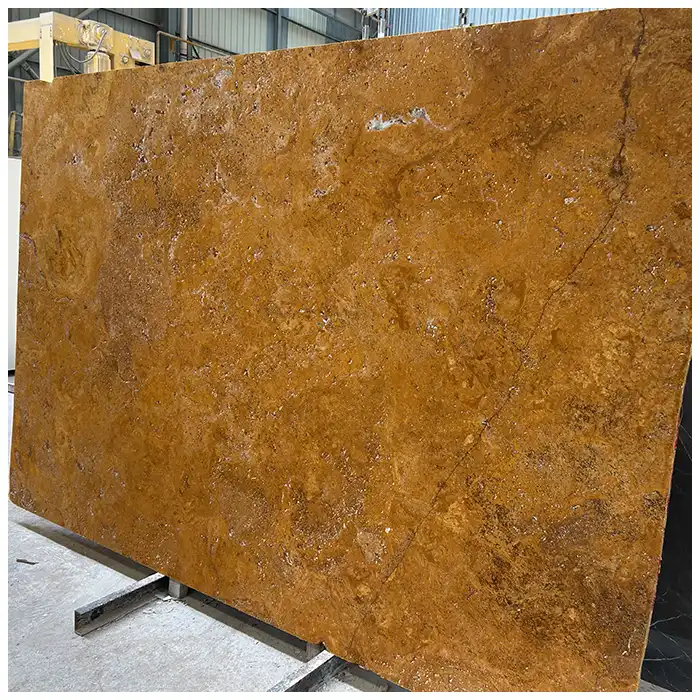
Onyx is less about surface reflection and more about light moving through banded calcite. Honey, orange, white, green, and rose layers can appear opaque from one direction and open like watercolor when backlit. Then, the backlight turns on. Thin veins that seemed secondary become the structure of the image.
I use 오렌지 오닉스 석판 only after testing the actual face with the proposed lamp distance, diffuser, cavity depth, and support pattern. A bright LED point can produce hotspots. A support rail can cast a dark stripe through an otherwise fluid composition.
Travertine: rhythm through pores and bedding
Travertine carries sedimentary bands and voids left by mineral deposition around springs. Vein-cut faces emphasize long linear movement. Cross-cut faces reveal clouded, circular structures. Filled and honed material can feel calm and architectural; unfilled texture can hold shadow like a low-relief drawing.
I like travertine where the room needs rhythm without one dominant image: long walls, monolithic consoles, plinths, and broad floor fields. The pores and bedding still require a finish, filling, maintenance, and edge plan suited to use.
Natural Stone and Manufactured Marble-Look Surfaces
Manufactured surfaces can offer repeatability, thin formats, controlled patterns, and predictable replacement. Those are real advantages in the right project. Natural material offers something different: mineral depth, non-repeating movement, tactile variation, and a relationship between face, edge, and light that comes from the material rather than an image layer.
The published comparison Natural Quartzite Or Marble-Look Sintered Stone for Premium Interiors is useful when performance priorities compete with authenticity. I do not pretend every room demands natural stone. I ask whether repetition or irreplaceable character carries more value in that specific space.
Lasting material value rewards close attention. A printed movement may be visually controlled, but the edge and cutout often reveal its construction. A natural quartzite edge continues as crystals and veins through thickness. That continuity can matter on a sculptural table or island where the object is seen from every side.
| Material family | Visual behavior | Design control to test |
|---|---|---|
| Exotic marble | Recrystallized field with mineral-driven veins and clouds | Full-face composition, joint location, finish, acid sensitivity |
| Natural quartzite | Interlocking quartz depth with crystalline or mica-rich movement | Mineral identification, fissures, edge, cutout, angled light |
| 오닉스 | Banded calcite that changes dramatically under transmitted light | Backlight mock-up, diffuser, support shadows, thickness |
| 석회화 | Layered deposition with directional pores and soft tonal rhythm | Cut direction, fill, finish, edge chipping, cleaning |
| Marble-look sintered surface | Controlled graphic with repeatable color and format | Pattern repeat, printed edge, thin-panel support, repair path |
Luxury Natural Stone Slabs in Walls, Islands, and Furniture
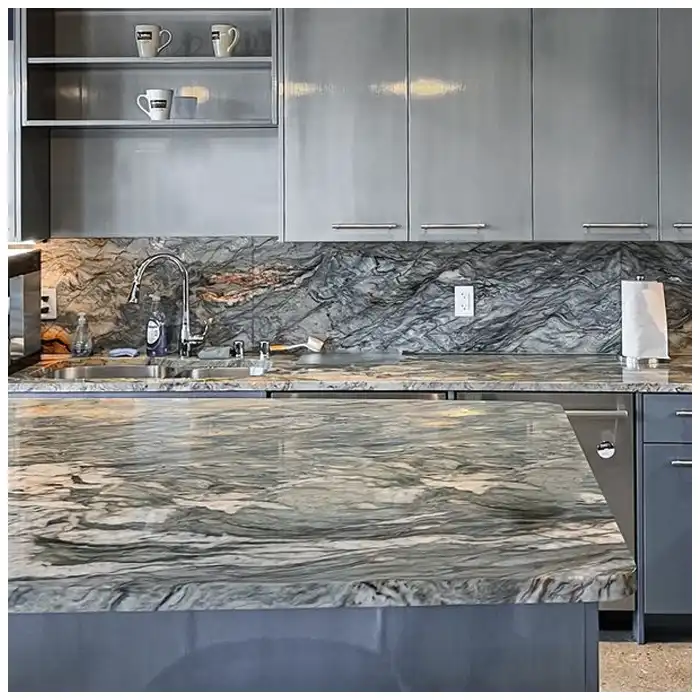
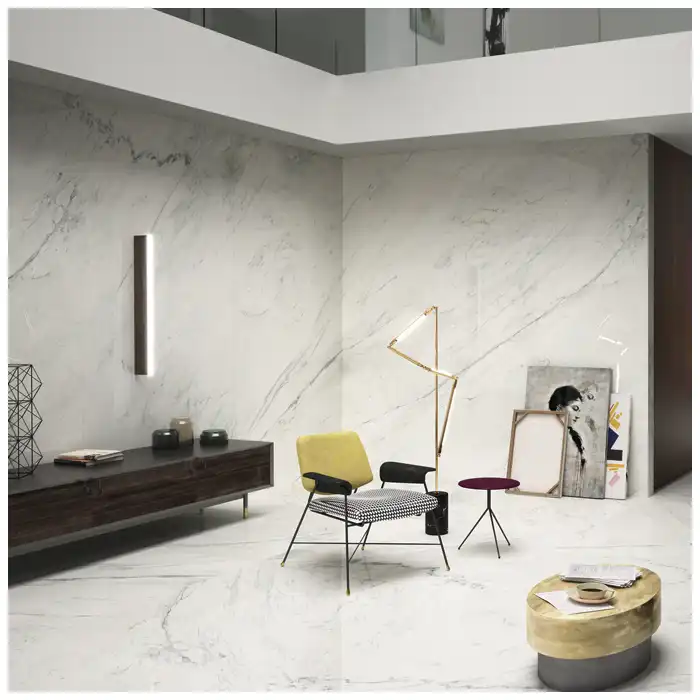
A feature wall gives the full face room to speak. I start with viewing distance, focal axis, openings, joints, reflected light, and nearby materials. The strongest face does not automatically belong in the center. Sometimes a quieter central field lets two moving outer panels pull the room together.
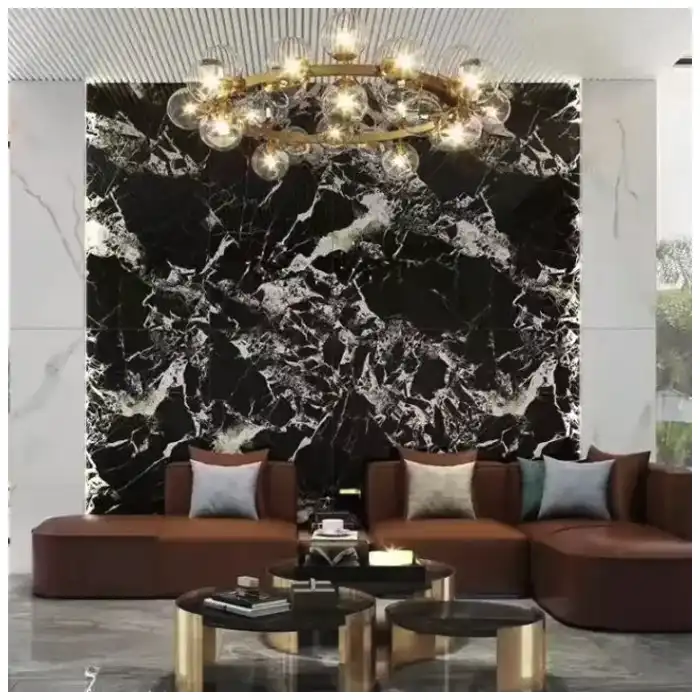
을 위한 bookmatched stone walls, I inspect whether adjacent faces are true sequential cuts and whether the movement balances after trimming. The Bookmatched Stone Walls: What To Confirm Before Fabrication record fixes orientation, seam width, finished dimensions, opening locations, and support before fabrication.
Islands expose edge and corner decisions. A mitred build-up can create visual thickness, but the vein must turn with intention. A solid edge shows the actual material body. I compare front, end, and seating views before choosing which face receives the strongest movement.
Stone furniture changes the scale again. A dining top is seen close, touched daily, and read from above and from the edge. The 럭셔리 대리석 스톤 테이블 form works only when the base, support, thickness, span, edge, and handling route respect the material.
Edges and Support for Luxury Natural Stone Slabs
I never choose a table base from a rendering alone. The fabricator needs finished top dimensions, thickness, estimated weight, support footprint, fixing method, unsupported span, overhang, edge profile, and intended movement. Natural stone is strong in compression and less forgiving in bending, especially around fissures, cutouts, or narrow sections.
Custom stone furniture requires a support plan shaped to the actual face. A dark mineral band or natural fissure can influence where I place the base or reinforcement. I do not publish one universal cantilever rule because material, thickness, reinforcement, edge, use, and engineering responsibility differ.
The Stone Table Supplier Guide for Marble Dining Tables, Coffee Tables, and Custom Bases helps turn an admired face into a buildable object. I ask how the top will be lifted, turned, carried through doors, protected on site, and separated from the base for future service.
Feel the edge. A small eased edge preserves a quiet line. A bullnose catches light continuously and can make the top feel softer. A carved or fluted edge creates shadows, but it also changes minimum thickness and cleaning. The mineral movement gives the direction whether the edge should disappear or become part of the object.
Design the Base Around the Actual Face
Suppose a long quartzite dining top may reach approval before the base drawing reaches the fabricator. One polished face contains a natural structural transition close to the planned unsupported end. Moving the base inward for appearance increases the vulnerable span. Adjusting the support footprint before fabrication can preserve the visual balance without asking the stone to perform outside the engineered design.
Never freeze a stone-furniture base before mapping the actual face, weight, span, and support line.
Lighting and Full-Face Review for Luxury Natural Stone Slabs
I view a slab in diffuse front light, side light, and the direction expected in the room. Side light reveals texture, resin, waviness, and finish differences. Backlight reveals translucent mineral zones. Warm light can soften a grey field; cool light can sharpen blue or green minerals. Camera processing may hide all three changes.
The guide How to Judge A Luxury Stone Slab from Photos and Videos asks for straight full-face images, dimensions, labels, close mineral details, side light, and unhurried video. I prefer a slow pass across the face to a dramatic reel with changing exposure.
This stone has been waiting for millions of years… and five seconds of filtered video is not enough to understand it. I place a scale and neutral reference near the face. For backlit work, I photograph front light, transmitted light, and the support mock-up separately.
Value and Selection Records for Luxury Natural Stone Slabs
Value comes from more than rarity. I consider block availability, slab size, usable yield, sequential faces, color coherence, repair demand, translucency, finish response, fabrication risk, and the design opportunity each face offers. A costly slab can be poor value if the room cuts away its defining movement.
The selection record contains full-face images, slab dimensions, thickness, finish, geological observations, accepted natural features, intended application, cut map, joint and edge concept, lighting test, support drawing, fabrication notes, and approval date. I also identify which decisions remain open. Beauty should not make the file vague.
How to Inquire about Luxury Natural Stone Slabs
I ask for project type, application, finished dimensions, quantity, viewing distance, light direction, desired color family, movement preference, edge idea, support concept, destination, schedule, and whether the client wants sequential or bookmatched faces. For furniture, I add base drawings, door and lift restrictions, assembly plan, and expected daily use.
Photographs of the room help, but I do not ask the stone to imitate a rendering exactly. The better conversation is about visual weight, rhythm, contrast, warmth, and how the material meets the surrounding architecture. Lasting material value rewards close attention, not a surface that copies one fashionable image.
Where the Luxury Natural Stone Slabs Decision Must End
Why natural depth survives changing taste
Mineral structure changes with viewing angle, daylight, touch, and distance. That complexity gives a room something new to reveal over time. Manufactured consistency can be useful, but it cannot reproduce geological continuity through every edge and cut.
How to choose between drama and restraint
I study the architecture first. A room with strong geometry may need a quieter stone. A calm volume can hold a more expressive face. The goal is not maximum movement; it is a lasting relationship between material and space.
What to do when a site issue appears
First, photograph the entire face or object and the close issue under the installed light. Second, stop cutting, fixing, or loading the affected piece. Third, send the supplier the images with full-face approval, cut map, lighting test, support drawing, fabrication record, and packing evidence for comparison.
Frequently Asked Questions
1. How do I choose luxury natural stone slabs from photographs?
Request straight full-face images with labels and dimensions, close mineral details, side-light views, and slow video with stable exposure. For translucent material, add front-light and backlight tests. Then place the proposed cut map on the actual face.
2. Is natural quartzite always better than marble-look sintered stone?
No. Quartzite offers real crystalline depth and non-repeating structure, while sintered surfaces can offer controlled pattern, thin format, and repeatability. Choose according to the room’s value priorities, fabrication plan, maintenance, and replacement expectations.
3. Can onyx be used for a backlit feature wall?
Yes, when the actual face is tested with the planned cavity, diffuser, lamp spacing, support pattern, thickness, joint design, ventilation, and service access. A small illuminated sample cannot reveal full-wall hotspots or support shadows.
4. What must be checked before making a natural stone table?
Confirm the actual face, finished size, thickness, weight, fissures, edge, support footprint, span, overhang, reinforcement, fixing, handling route, base assembly, and daily use. Structural decisions need project-specific fabrication or engineering input.
5. What should I do first if the installed slab looks different from the approval?
Photograph the complete surface and close difference under the installed light, stop further cutting or fixing, and send the supplier the images with full-face approval, cut map, lighting test, fabrication record, support drawing, and packing evidence.
Quick-Reference Checklist for Premium Slab Selection
- View the complete face in diffuse, side, and project-direction light.
- Map every joint, cutout, edge, and visible return on the actual image.
- Test translucent zones with the proposed diffuser and support pattern.
- Match table-base footprint and span to the actual face and finished weight.
- Record accepted fissures, repairs, mineral changes, and finish behavior.
- Plan lifting, access, assembly, and future service before fabrication.
- Approve the final composition at the viewing distance of the finished room.
Final Conclusion
Luxury natural 규암 stone slabs deserve more than a color name and one polished photograph. Read the geology, full face, edge, light, cut map, joint, support, and handling path together. The result may be a wall, island, console, or table, but the material should remain legible after fabrication.
Mineral movement gives a face its place in the room. At MQ STONE, I would rather follow that patient depth than force a surface the architecture will outgrow.

References
- Dimension Stone Design Manual, Natural Stone Institute.
- C616 Standard Specification for Quartz-Based Dimension Stone, ASTM International.
- C503 Standard Specification for Marble Dimension Stone, ASTM International.
- C97 Standard Test Methods for Absorption and Bulk Specific Gravity of Dimension Stone, ASTM International.
- C880 Standard Test Method for Flexural Strength of Dimension Stone, ASTM International.
- Natural Stone: Types and Geological Formation, Geological Society resources.
- Architecture and Interior Material Coverage, Dezeen.
- Search Essentials and Helpful Content Guidance, Google Search Central.