Quartzite Bookmatch vs Flow Match: Let the Slab Set the Wall Rhythm
Two consecutive quartzite slabs rest face to face on the rack. When the crane opens them like a book, a dark mineral branch divides into two equal arms. Closed in sequence, the same branch travels sideways, loosening as it crosses the next face. I step back because both arrangements are beautiful for different reasons.
That pause is the heart of quartzite bookmatch vs flow match. Bookmatching asks the cut faces to mirror around a joint. Flow-matching keeps the natural sequence moving in one direction. One creates a center. The other creates a journey. Neither can be chosen responsibly before the entire wall and the actual slabs are seen together.
My answer is to let the architecture decide what kind of order it needs, then let the stone decide whether it can carry that order. A narrow lobby wall may benefit from a strong mirrored center. A long corridor or reception backdrop may feel calmer when mineral movement continues without folding back on itself.
How Quartzite Bookmatch vs Flow Match Begins in the Block
Quartzite begins as quartz-rich sandstone transformed by heat and pressure. Quartz grains recrystallize into an interlocking structure, while accessory minerals create dark, gold, green, blue, or rust-colored passages. The general geological background appears in the English reference on quartzite. The wall composition, however, belongs to the selected block and sawing sequence.
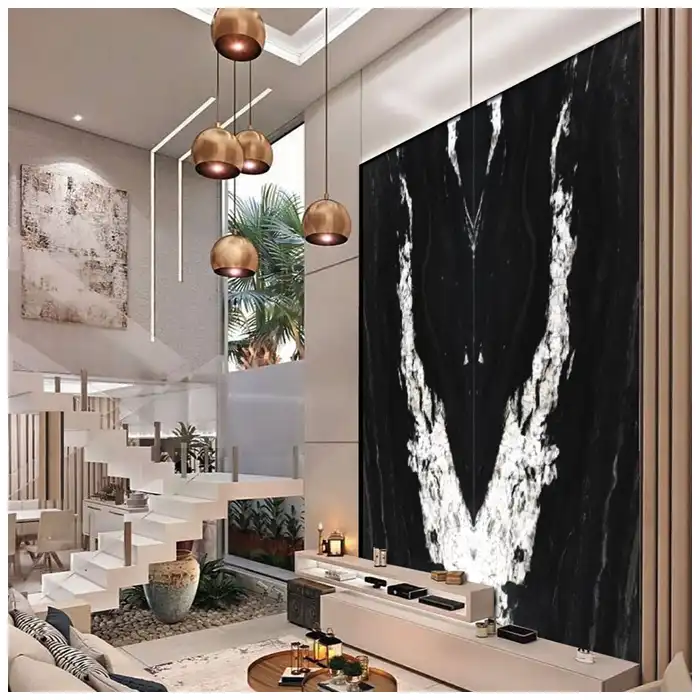
Bookmatching opens consecutive faces
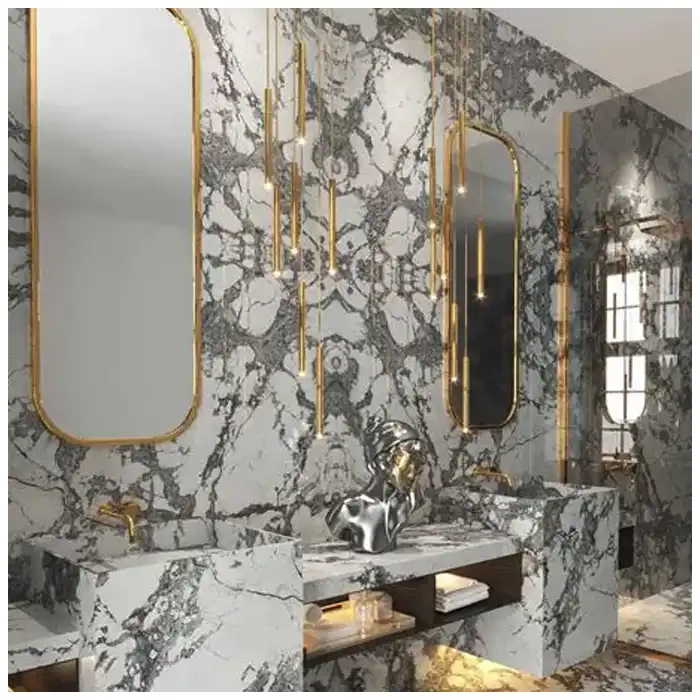
When adjoining slab faces are opened around their shared cut plane, veins and mineral structures can reflect across the joint. A black line may split like ink pressed between pages. A translucent quartz pocket may become a pale pair of wings. The joint becomes the visual axis.
At this stage, quartzite bookmatch vs flow match is still reversible. I photograph the pair opened, closed in sequence, and rotated only where the physical faces permit it. Those records show whether symmetry reveals the mineral structure or merely duplicates one dark area until it overwhelms the white field.
That symmetry can be exact in one area and loose in another because a natural block has depth. Mineral structures change as the saw moves through it. The first pair may mirror closely; later pairs may drift. I photograph every proposed pair rather than assuming the first opening represents the whole order.
Flow-matching protects sequence
Flow-matching keeps consecutive slabs oriented so movement continues from one face toward the next. It does not guarantee a vein will meet perfectly at every joint. Thickness lost to sawing, trimming, panel width, and changing mineral planes can shift the line.
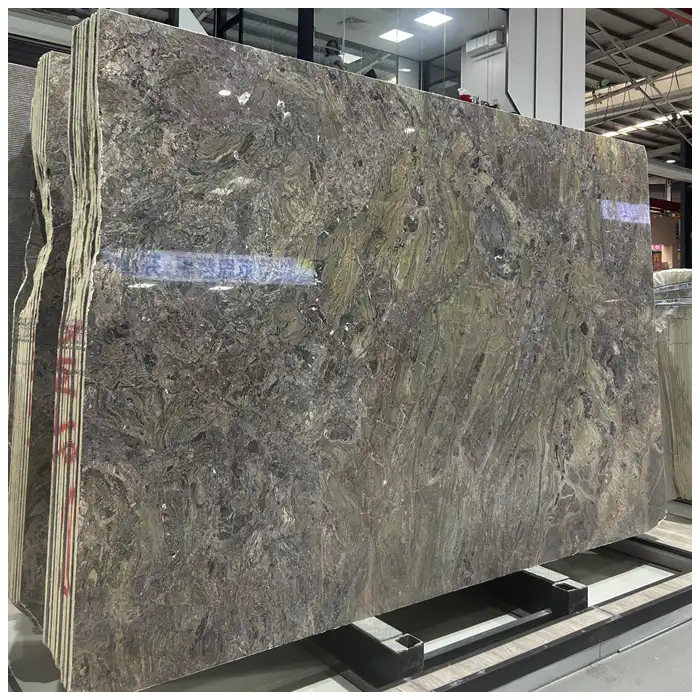
The value lies in direction rather than perfect continuity. On an Avocado quartzite slab, green fields and darker mineral channels may move across several panels like vegetation seen through mist. A mirrored center might make that movement feel formal. A flowing layout may preserve its quieter, more expansive character.
| Design question | Bookmatch response | Flow-match response | Approval evidence |
|---|---|---|---|
| Visual anchor | Strong centerline or repeated axes | Directional movement across the wall | Scaled elevation with slab images |
| Best wall shape | Centered, balanced, or paired composition | Long or asymmetrical composition | Room view and centerline record |
| Joint behavior | Joint is the mirror axis | Joint should not reverse movement | Numbered digital assembly |
| Opening risk | Door or screen can destroy symmetry | Opening can interrupt the visual path | Cutout overlay and return details |
| Slab yield | Pairs may restrict panel extraction | Sequence may restrict substitutions | Cut map with usable areas |
The Wall Has to Deserve the Symmetry
A centered wall can carry a bookmatch
A fireplace wall, reception backdrop, elevator lobby, or private dining room may have a clear centerline. If the architecture already organizes itself around that axis, a bookmatched pair can reinforce it. The strongest mineral event should meet the room’s center, not a random panel joint.
Furniture and sightlines can change quartzite bookmatch vs flow match after the wall elevation looks settled. A reception desk may hide the lower center, while pendant lights interrupt the upper field. I place those objects on the approval view so the chosen mineral axis remains visible from the occupied approach.
A Pink Patagonia quartzite pair can combine pale crystalline windows with black structure and rose-colored mineral areas. Opened symmetrically, it can resemble two geological maps touching at their borders. The composition needs breathing room. Too many shelves, screens, or signs can turn the wall into fragments.
A long wall often prefers flow
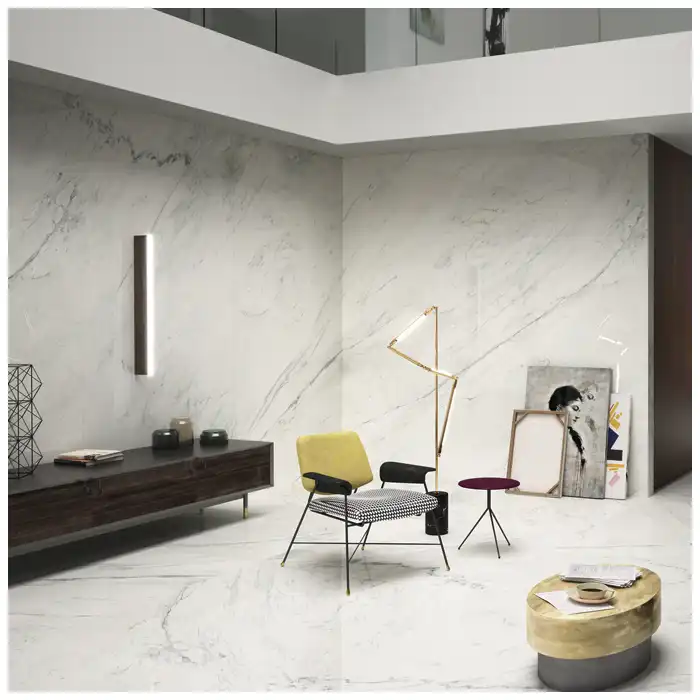
Flow-matching can work better when the viewer moves along the wall. The eye follows the mineral direction instead of returning repeatedly to mirrored centers. It also allows asymmetry, which can feel more faithful to a stone whose beauty comes from gradual change.
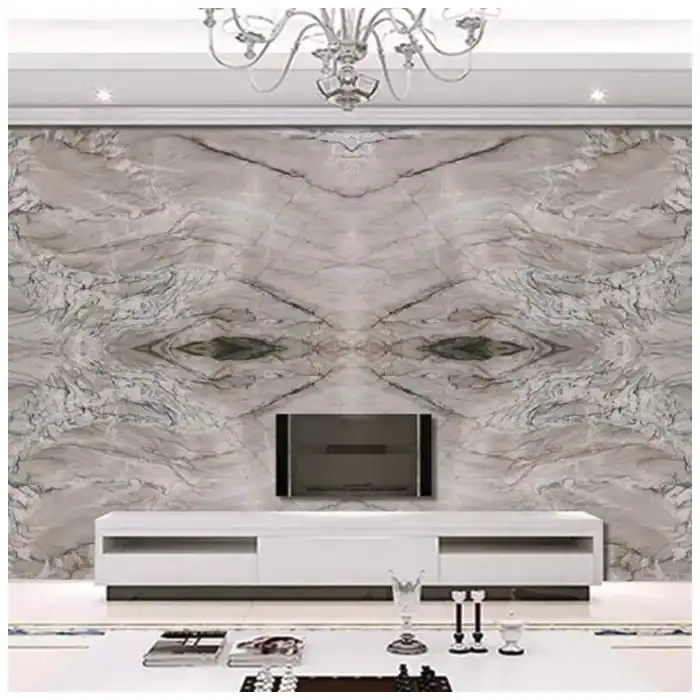
I still establish a start point. The first panel seen from the main approach should not contain only the weakest edge of the composition. The sequence then carries stronger and quieter areas in a deliberate rhythm.
Multiple pairs can become repetitive
Four or six bookmatched slabs can create repeated butterfly forms. Sometimes that order suits the room. Sometimes it feels imposed, especially when each pair has a different mineral scale. I compare a complete multi-pair elevation against a continuous layout before approving either.
True luxury is something you never get tired of looking at. Repetition can be powerful, but it should not make a rare natural material feel like printed wallpaper.
Cuts, Joints, and Returns Change the Original Idea
The active parent, Exotic Quartzite Slabs: Mineral Depth, Full-Face Selection, Finishes, Light, and Fabrication, explains why unusual slabs need full-face approval. This page takes the next step by placing those faces on one wall and exposing what fabrication removes.
Saw kerf and trimming create loss
A mirrored line may not meet exactly because material disappears between consecutive faces and again during edge trimming. Joint width adds another gap. The digital elevation should represent the expected finished seam rather than pushing slab images together with no loss.
Edge finishing also alters quartzite bookmatch vs flow match. A small bevel can widen the dark line at a mirror joint. A mitred return may remove another strip of the composition. The cut map should use finished panel dimensions and actual edge treatment, not raw slab rectangles placed against one another.
Openings take the most valuable areas first
Doors, screens, outlets, sconces, control panels, and ventilation grilles can land on the strongest mineral event. The solution is not always moving the opening. Sometimes the slab pair needs to shift, the panel grid needs to change, or another pair belongs on that wall.
I place every opening on the elevation with its finished frame and tolerance. A rough rectangle is not enough when a metal surround covers another 30 mm of stone around the cut.
Returns reveal depth and construction
A side return may use the adjacent slab area, a separate strip, or a mitred construction. The veins will tell you whether a hard folded corner makes sense. Some mineral passages turn beautifully around a return. Others break into unrelated marks.
Support, anchoring, substrate, joints, and handling must follow the project engineer, system provider, fabricator, and applicable requirements. Layout approval is not structural approval. Large quartzite panels can be heavy and brittle around cutouts even when the stone itself is strong.
Approve the Wall at Four Scales
1. Read the block sequence
Record consecutive slab numbers and face orientation. Keep photographs consistent. If slabs are flipped digitally, state it. The fabrication team needs to know which physical face corresponds to the approved image.
I add one physical-orientation sketch to every quartzite bookmatch vs flow match approval. It identifies front, back, top, slab number, neighboring face, and opening direction. That simple sketch prevents a beautifully rendered digital wall from becoming impossible when the workshop discovers that the approved face is on the wrong side of the sequence.
2. Read each complete slab
Inspect fissures, repairs, resin, mesh, translucent zones, mineral concentration, and usable boundaries. A perfect visual match that places a narrow cut through a complex repaired area may not be the right extraction.
3. Read the assembled elevation
Create bookmatch and flow-match options at scale. Include joints, openings, returns, floor, ceiling, nearby furniture, and viewing direction. Compare them from the main approach and from the closest occupied position.
4. Read the installation sequence
Number panels and define a setting order. The dry assembly should match the approved elevation. Packaging and site labels must preserve that order. One swapped pair can reverse the composition even when every panel fits.
The Hard-Won Lesson: The centerline belongs to the room, not the slab
A beautiful mirrored pair is centered on its slab joint, but the installed wall centers on a fireplace opening 120 mm away. The mineral axis and architectural axis now compete. Every panel is correctly cut, and the bookmatch itself is accurate. The composition still feels displaced because the approval ignored the finished room center.
The Lesson: Establish the architectural centerline before choosing which mineral event will meet it.
Choose the Layout That Still Works after the First Cut
Symmetry is not automatically more refined
A bookmatch can focus a room, but flow can preserve more natural depth. I choose between them by wall shape, approach, openings, slab anatomy, and the amount of visual order already present in the interior. Manufactured surfaces can repeat a controlled image; natural quartzite earns attention through variation and mineral depth.
The decision on quartzite bookmatch vs flow match should remain understandable when the backlight is off and furniture moves. I look for a composition that holds its structure in ordinary daylight, evening light, and the quieter periods when no dramatic lighting effect is active. The stone should not depend on one staged photograph.
Fabrication evidence protects the visual decision
The published Bookmatched Stone Walls before Fabrication article carries the layout into joint, support, cutout, finish, and installation checks. Use it after the composition is chosen, not instead of selecting the right composition.
Escalate before panels leave the dry assembly
If the dry assembly differs from the approved elevation, photograph the whole wall and every label. Do not trim, swap, or pack the disputed panels. Compare the physical sequence with slab IDs, digital orientation, cut map, and opening schedule, then let the designer, fabricator, and supplier agree on the correction.
After approval, quartzite bookmatch vs flow match still depends on installation order. Crates should group panels by elevation and preserve sequence. The site drawing must show the same left-to-right view as the dry assembly. A reversed reading direction can turn an approved flow into a visual collision without changing a single panel size.
I keep the approved elevation available during installation and photograph each completed row before protection covers it. That gives the architect a chance to catch a sequence error while panels can still be discussed. It also leaves the owner a record of slab identities and joints for future access, repair, or adjacent interior changes.
Archive the final light condition too. Raking light can make a small joint shift far more visible than the diffuse warehouse inspection ever did.
I keep that orientation set with my approved elevation.
Quick-Reference Checklist for Quartzite Wall Layout
- Record consecutive slab numbers and physical face orientation.
- Establish the room centerline and main viewing approach.
- Compare bookmatch and flow-match elevations with real joints.
- Overlay openings, frames, returns, and finished panel boundaries.
- Map fissures, repairs, translucent zones, and usable yield.
- Approve a numbered dry assembly before packing the panels.
Frequently Asked Questions
1. Is bookmatching possible with every quartzite?
Consecutive slabs can often be opened as pairs, but the visual result depends on block structure, sawing sequence, slab thickness, usable faces, repairs, and mineral movement. Some stones produce strong symmetry. Others look more natural in sequence. Review the actual pair before specifying the effect.
2. What is flow-matching?
Flow-matching arranges slab faces so the general mineral movement continues across the wall rather than reflecting around a center joint. Exact vein connection is not guaranteed because sawing and trimming remove material. The goal is coherent direction.
3. Which layout wastes less material?
Neither always wins. Bookmatched pairs may restrict where panels can be extracted. Flow-matching may require preserving sequence and rejecting substitutions. Openings, panel sizes, defects, repairs, and edge allowances often have more effect on yield than the layout name alone.
4. How is quartzite bookmatch vs flow match approved?
Create both scaled elevations from current full-slab photographs. Include finished joints, openings, returns, room centerlines, and panel numbers. Review usable areas and fabrication constraints, then approve a numbered dry assembly that matches the chosen elevation.
5. What should happen if two panels do not align at dry assembly?
Photograph the complete composition and labels. Stop trimming or packing. Check slab order, face orientation, cut map, joint width, and digital approval. The designer, supplier, and fabricator can then decide whether resequencing, recutting, or accepting natural drift is appropriate.
Final Conclusion
규암 bookmatch vs flow match is not a contest between a dramatic wall and a quiet wall. It is a decision about where the room needs an axis, where the stone wants to move, and what survives joints, openings, trimming, and support. Compare both arrangements with current slab faces, then approve the numbered assembly. At MQ STONE, I trust the composition that lets the geology remain itself after the architecture asks it to become a wall.
References
- Dimension Stone Design Manual, Natural Stone Institute.
- Natural Stone Institute Technical Guidance for Interior Stone Walls.
- ASTM C616 Standard Specification for Quartz-Based Dimension Stone, ASTM International.
- ASTM C880 Standard Test Method for Flexural Strength of Dimension Stone, ASTM International.
- ASTM C1354 Standard Test Method for Strength of Individual Stone Anchorages, ASTM International.
- Code of Practice for the Design and Installation of Natural Stone Cladding and Lining, Stone Federation Great Britain.
- Architectural Stone Fabrication and Installation Guidance, Natural Stone Institute.
- Search Essentials and Helpful Content Guidance, Google Search Central.