Quick Summary: Calacatta Classico Marble Slabs and Tiles for Interior Projects
Calacatta Classico Marble is a natural Italian white marble used for hotel flooring, bookmatched feature walls, kitchen countertops and bathroom interiors. Its white-to-ivory background carries flowing grey mineral veins, sometimes accompanied by warmer beige or gold-toned details. MQ STONE’s catalogue references full slabs from 2400mm+ × 1400mm+ and 2000mm+ × 1000mm+, with nominal thicknesses of 16mm, 18mm, 20mm and 30mm. Modular floor tiles and custom wall panels can be cut according to architectural requirements. The final slab selection, cutting orientation, finish and installation conditions determine how the material should be specified.

Calacatta Classico Italian Marble for Hotel Interiors and Architectural Wall Cladding
Calacatta Classico is part of the Italian Calacatta marble family associated with the Apuan Alps and Carrara stone district. It has a predominantly white background with irregular grey veining and, in some selections, warmer beige or gold-toned mineral movement.
The stone is used where natural marble needs to form a visible part of the architecture. Hotel reception walls, residential entrance halls and living-room feature panels are common design applications. A large slab retains the broader vein composition, allowing the marble to be viewed as one architectural surface rather than a series of separate tiles.
Calacatta Classico White Marble can be paired with darker cabinetry, timber, bronze-coloured metalwork or pale interior finishes. A light marble wall can bring contrast into a room with dark furniture, while the natural veins provide visual structure in an otherwise restrained interior.
The material should not be selected solely from a small sample. Some Calacatta Classico slabs contain relatively broad grey veins, whereas others have more open white areas. The visible result depends on which portions of the slab remain after cutting and how adjacent pieces are arranged.
For a coordinated interior, the designer should establish whether the marble will act as the main feature or as a quieter background material. This decision influences slab selection, panel dimensions and the position of major veins.
Calacatta Classico Marble Slab Selection for Bookmatched Walls and Large Panels
Large Calacatta Classico Marble Slabs allow the natural vein pattern to become part of an architectural elevation. When a wall contains several panels, the relationship between the slabs matters as much as the appearance of each individual piece.
Choosing the Principal Wall Panels
The largest uninterrupted pieces should be allocated first. A hotel reception backdrop may require one or more central panels with a clear vein arrangement. Smaller surrounding pieces can then be selected to maintain a compatible white background and grey-vein distribution.
Bookmatching and Vein Alignment
Bookmatching is possible when suitable consecutive slab faces are available. The mirrored pattern should be assessed from photographs of those actual pieces. A similar background colour does not mean two unrelated slabs will produce a convincing symmetrical composition.
Planning Panel Joints and Openings
The approved wall elevation should show the position of panel joints, doorways, sockets, decorative lighting and other openings. A major grey vein can be interrupted by an opening or lost behind a fixture if the cutting arrangement is not coordinated with the architectural drawing.

Calacatta Classico Marble Slab Sizes and Cut-to-Size Tile Specifications
The original MQ STONE product catalogue lists full slabs, modular tiles and multiple thickness options. The following specifications organize those references into a usable format for architectural drawings and material enquiries. Dimensions are catalogue references; the actual finished size depends on the selected slab and fabrication requirements.
| Product Name | Calacatta Classico Marble / Calacatta Classico Italian Marble |
| Material | Natural Italian White Marble |
| Associated Origin | Italy, Apuan Alps / Carrara marble district; exact quarry and batch to be confirmed |
| Background Colour | White to warm ivory white |
| Natural Veining | Flowing grey veins with occasional beige and warm gold-toned mineral accents |
| Large Slab Reference 1 | 2400mm+ × 1400mm+ |
| Large Slab Reference 2 | 2000mm+ × 1000mm+ |
| Common Tile Formats | 300×300mm, 300×600mm, 300×900mm, 600×600mm and 1200×600mm |
| Imperial Tile References | 12″×12″, 24″×24″ and 36″×36″; finished metric dimensions require confirmation |
| Nominal Thickness | 16mm / 18mm / 20mm / 30mm |
| Surface Finishes | Polished, honed and grooved; other decorative finishes subject to processing approval |
| Edge Processing | Straight-cut, eased, mitred and selected custom profiles according to approved drawings |
| Product Forms | Full slabs, floor tiles, wall panels, countertops, vanity tops, stairs and cut-to-size components |
| Primary Applications | Hotel interiors, residential flooring, kitchen islands, bathroom cladding and architectural feature walls |
Nominal Slab Dimensions vs Finished Cutting Sizes
A 2400mm+ slab does not automatically produce an uninterrupted finished panel of the same length. Trimming, natural fissures, usable vein areas and cutout positions can reduce the final dimensions. Likewise, 300×600mm and 305×610mm tile formats are different products and should not be mixed in the same setting-out schedule without dimensional adjustment.

Calacatta Classico Marble Countertops for Kitchen Islands and Villa Residences
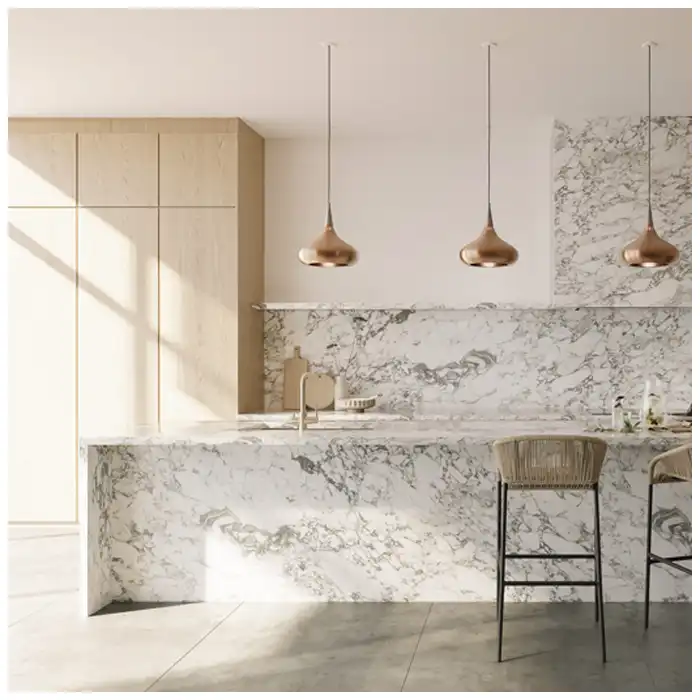
Calacatta Classico Marble Countertops can form a strong connection between kitchen cabinetry, splashbacks and surrounding architectural finishes. The stone’s predominantly white background makes it suitable for both pale and dark cabinet combinations, while the grey veins establish a natural pattern across the worktop.
For a kitchen island, the main slab should be selected according to the finished countertop dimensions. A large grey vein may be positioned across the centre or directed toward one edge, depending on the overall design. Where the island includes a waterfall panel, the top and vertical return should be considered together.
Waterfall Edge and Mitred Joint Planning
A mitred waterfall detail can make the countertop appear thicker while allowing the marble to continue down the side of the island. The vein alignment depends on cutting position and material availability. The underlying cabinetry or support structure must carry the load rather than relying on the decorative mitre alone.
Sink and Hob Openings
Cutouts reduce the stone remaining around fixtures. Narrow strips in front of a sink or behind a hob need particular attention, especially when natural veins or fissures intersect the cutting line. Corner geometry, reinforcement where appropriate and countertop support should be reviewed before machining.
Calacatta Classico is a carbonate marble, not engineered quartz. It may develop etching from citrus, vinegar and acidic cleaners, while sharp contact and abrasive grit can affect the polish. Kitchen owners should understand these characteristics before choosing a marble countertop.
Calacatta Classico Marble Floor Tiles for Hotel Lobbies and Residential Spaces
Calacatta Classico Marble Floor Tile formats can introduce a consistent white stone finish into hotel corridors, residential entrance halls and selected interior living areas. Compared with full-slab wall cladding, flooring places greater emphasis on modular dimensions, traffic conditions and the distribution of veins between adjoining tiles.
A 600×600mm tile can create a regular grid in an open floor plan. Rectangular formats such as 300×600mm can establish direction along a corridor or respond to the proportions of a narrower room. The selected tile size should minimize awkward perimeter strips around columns, doorways and built-in furniture.
For a large floor, the architect may choose a random natural pattern or a more controlled arrangement. Random laying still requires an approved range of white backgrounds and grey-vein intensity. Without this selection, a few heavily veined tiles may stand out unexpectedly within a predominantly light floor.
Floor performance cannot be determined from the stone name alone. Abrasion behaviour, slip resistance, surface finish, stone thickness and the supporting construction must suit the intended level of use. Particular care is needed at entrances, regularly washed floors and wet transition zones.
Where stair treads and floor tiles use the same material, the specification should address tread dimensions, nosing profiles, slip-resistant details and the alignment of visible joints. A polished floor sample is not sufficient evidence that the same finish is suitable for every stair or wet area.
Polished, Honed and Grooved Finishes for Calacatta Classico Interior Surfaces
Surface finish affects the appearance of Calacatta Classico and how the finished stone behaves in daily use. A polished surface increases reflections and emphasizes grey veins. Honed marble reduces glare, while grooved processing introduces a deliberate linear relief for selected decorative features.
| Finish | Appearance | Application Considerations |
| Polished | Glossy white surface with clearly defined grey veins and reflected light. | Feature walls, countertops and selected dry interior floors; assess glare, wear and slip requirements. |
| Honed | Smooth matte or low-sheen surface with a quieter vein contrast. | Bathrooms, interior wall panels and selected flooring; wet traction still requires testing. |
| Grooved | Regular linear channels cut into the stone face. | Decorative wall cladding and selected architectural details; groove depth and cleaning access require approval. |
| Custom Texture | Project-specific mechanically processed stone surface. | Confirm processing feasibility, sample appearance and the intended performance before production. |
Calacatta Classico White Marble for Bathroom Walls and Vanity Tops
Calacatta Classico can be used across bathroom walls, vanity surrounds and selected floor areas when the specified finish and installation system meet the required conditions. The combination of a light background and grey veins works with white sanitaryware, timber vanity units and dark metal fittings.
Large wall panels can reduce the number of visible joints behind a vanity or around a mirror. Their layout needs to account for tap outlets, electrical fixtures, niches and cabinet positions. A broad vein may look attractive on a complete slab but become visually disconnected if it is interrupted by multiple openings.
Vanity Countertop Fabrication
The selected marble should be cut according to the basin type and cabinet support. Undermount basins, vessel basins and integrated stone components require different openings and edge details. Narrow sections beside fixtures should be reviewed against natural veins before fabrication.
Shower Walls and Moisture Management
Where used on shower walls, the marble must be installed over an appropriate waterproofing system with compatible fixing materials and joints. A surface sealer does not replace waterproofing. Moisture-sensitive stone selections and any resin or mesh reinforcement should be considered when choosing installation products.
For shower floors and other areas regularly exposed to water, the actual tile finish must satisfy the project’s slip-resistance requirements. Polished wall panels should not automatically be used for wet flooring.

Calacatta Classico Marble Physical and Mechanical Reference Data
The following figures are published reference values for Calacatta Classico Marble in the StoneContact natural stone library. They describe the named stone selection and are not laboratory measurements from the current MQ STONE stock. Natural marble properties can vary between quarry areas, blocks and individual production batches.
| Material Property | Published Reference | Project Interpretation |
| Density | 2710 kg/m³ | Parent-stone density reference for preliminary material and weight assessment. |
| Water Absorption | 0.12%–0.15% | Published material range; it does not establish stain resistance, acid resistance or waterproofing performance. |
| Flexural Strength | 18.3 MPa | Stone bending-strength reference, not a certified load capacity for a specific slab or installed panel. |
| Compressive Strength | 139–150 MPa | Stone compression reference; performance of finished surfaces also depends on support and installation conditions. |
Relevant European natural stone test methods include EN 1936 for density and open porosity, EN 13755 for water absorption, EN 12372 for flexural strength and EN 1926 for compressive strength. These standards provide possible methods for verifying the selected material; the values above have not been independently confirmed as one MQ STONE batch report using these methods.
Technical qualification: these are published Calacatta Classico Marble material references, not finished-product certification. Slip resistance, abrasion performance, anchorage capacity and resistance to chemical exposure must be assessed separately where required by the project specification.
Using Calacatta Classico Across Multiple Interior Application Areas
A project may use the same white marble on walls, floors and countertops, but each location requires a different fabrication and installation decision. Matching the visual material does not mean the same thickness or surface treatment is suitable everywhere.
| Application | Preferred Product Form | Specification Priority |
| Hotel Reception Wall | Large slabs or coordinated wall panels. | Slab sequence, visible joints, panel weight and wall fixing arrangement. |
| Hotel Lobby Flooring | Modular or custom-cut floor tiles. | Floor module, surface wear, slip resistance and supporting substrate. |
| Villa Kitchen Island | Custom countertop and waterfall components. | Cutouts, vein alignment, edge construction and maintenance. |
| Bathroom Vanity | Vanity top with coordinated wall panels. | Basin openings, moisture management and compatible installation materials. |
| Residential Staircase | Custom treads, risers and landing pieces. | Finished geometry, tread edges, slip resistance and structural support. |
Cut-to-Size Marble Fabrication for Coordinated Flooring and Wall Projects
For architectural projects using Calacatta Classico Marble in several areas, fabrication planning should follow the approved room schedules and finished drawings. Floor tiles, wall panels and countertop pieces require different cutting strategies, even when they are selected from visually compatible stone.
Large feature panels should be allocated first when uninterrupted vein patterns are important. The cutting layout can then identify which remaining stone areas are suitable for smaller components, provided their dimensions, colour and structural condition meet the corresponding specifications.
For flooring, finished tile sizes must remain consistent throughout the setting-out grid. Where a project includes adjoining rooms, any change in the tile module should be reflected in the drawings and clearly identified before cutting.
Architectural stone pieces with curved edges, plumbing openings or mitred returns need separate fabrication details. Natural veins and fissures should be assessed where they intersect narrow sections. The workshop should use the approved drawing and selected slab face rather than adjusting visible cutting positions without coordination.
Calacatta Classico Compared with Other Decorative Marble Collections
Calacatta Classico is suitable where a coordinated Italian white marble appearance is required across several architectural surfaces. The following related stones create different colour and vein compositions; they should be compared using actual slab photographs rather than treated as interchangeable materials.
| Stone Collection | Visual Direction | Project Consideration |
| Calacatta Classico Marble | White-to-ivory Italian marble with flowing grey and occasional warm veins. | Coordinated interior walls, floor tiles, countertops and bathroom surfaces. |
| Calacatta Extra Marble | Italian white marble often selected for stronger or more concentrated vein compositions. | Feature-focused walls and kitchen islands where the selected slab pattern is central to the design. |
| Grigio Fantasy Marble | Light grey-white natural stone with broader smoky mineral movement. | Neutral flooring and wall designs with a more clouded grey composition. |
| Grand Antique Marble | Black-and-white brecciated stone with angular contrasting fragments. | Architectural focal points and decorative furniture requiring a strong monochrome pattern. |
| Rosa Aurora Marble | Portuguese rose-pink and ivory marble with natural grey and warmer mineral features. | Bathrooms and residential interiors needing a softer pink colour direction. |
Slab Inspection and Export Packing for Calacatta Classico Marble Projects
Material inspection should begin with full photographs of the selected slabs. These establish the approved white background, grey-vein distribution and any significant natural features. A small sample remains useful for confirming finish and colour, but does not replace full-slab selection for large architectural panels.
After fabrication, finished pieces should be checked for dimensions, thickness, edge condition and surface finish against the approved drawings. Visible natural discontinuities and repaired areas should be evaluated according to the intended application. Where reinforcement is present, its condition should be reviewed before packing.
Wall panels intended to form a coordinated elevation should be identified in their approved sequence. Floor tiles can be grouped by finish, size and compatible colour range, while countertop components require identification of openings, returns and visible edge orientations.
Export packing should provide suitable protection for polished surfaces, corners and finished edges. Full slabs require stable transport support, while cut-to-size tiles and shaped components need crates appropriate to their dimensions and weight. Packing identification should correspond to the finished material schedule and installation references.
Common Specification Mistakes with Calacatta Classico Marble
- Assuming every Calacatta Classico slab has the same pattern: actual grey-vein intensity and white background distribution can vary between selected blocks.
- Approving large wall panels from a small sample: bookmatching and full-height cladding depend on the actual slab faces and cutting arrangement.
- Confusing nominal and finished dimensions: metric and imperial tile modules must be coordinated with the setting-out drawings.
- Ignoring natural features near openings: sink cutouts, narrow countertop strips and mitred edges require careful stone assessment.
- Assuming polished marble is suitable for every floor: wet traction and abrasion performance must be checked for the intended environment.
- Using the marble surface as waterproofing: bathroom walls and floors require a properly designed installation system behind and around the stone.
- Expecting acid-proof countertop performance: natural Calacatta marble is sensitive to acidic liquids, and sealing cannot prevent chemical etching.
Cleaning and Maintaining Calacatta Classico Marble Floors and Countertops
Clean Calacatta Classico Marble with a soft cloth or suitable floor-cleaning equipment and a pH-neutral product intended for natural carbonate stone. Remove grit from floors regularly to reduce surface abrasion. On countertops, wipe spills promptly, especially vinegar, citrus juice, wine and other acidic liquids that can etch the polished surface. Avoid abrasive powders, harsh descalers and aggressive cleaning pads. Use cutting boards, coasters and suitable protection beneath hot objects. An impregnating treatment may reduce some absorption-related staining risks, but it does not make marble scratch-proof or prevent acid etching. In bathrooms, maintain grout joints, sealants and the waterproofing assembly according to the installation specification.
FAQs About Calacatta Classico Marble
What is Calacatta Classico Marble?
Calacatta Classico Marble is a natural Italian white marble associated with the Carrara and Apuan Alps stone district. It has a white-to-ivory background with flowing grey and occasional warm-toned veins and is used for interior slabs, tiles, countertops and wall panels.
What is the difference between Calacatta Classico and Calacatta Extra Marble?
Both belong to the Italian Calacatta marble family. Calacatta Classico is often selected for coordinated white marble surfaces, while Calacatta Extra may be chosen for a more prominent feature-slab composition. Actual slab photographs are needed because natural patterns overlap between commercial selections.
What slab sizes and thicknesses are listed for Calacatta Classico Marble?
The original MQ STONE catalogue references slabs from 2400mm+ × 1400mm+ and 2000mm+ × 1000mm+, with nominal thicknesses of 16mm, 18mm, 20mm and 30mm. Actual dimensions and combinations must be confirmed from the selected material.
Can Calacatta Classico Marble Floor Tiles be used in hotels?
Calacatta Classico Marble Floor Tiles can be considered for hotel interiors where the selected stone, finish, thickness, slip resistance and supporting installation meet the project requirements. Traffic conditions and maintenance should be included in the specification.
Which finish is better for Calacatta Classico floors and walls?
Polished marble emphasizes the natural veins and reflected light, while honed marble produces a lower-sheen appearance. The appropriate finish depends on the application. Wet floors require actual slip-performance verification regardless of the finish name.
Is Calacatta Classico Marble suitable for kitchen countertops?
Yes. Calacatta Classico can be fabricated into kitchen countertops and waterfall islands with suitable support, cutout details and edge processing. As a natural carbonate marble, it requires care against acidic liquids, scratches and staining.
Can Calacatta Classico Marble Slabs be bookmatched?
Bookmatching may be possible when suitable consecutive slabs are available. The mirrored composition, vein continuity and finished panel arrangement should be approved using photographs of the actual stone faces before cutting.
Can Calacatta Classico Marble be used for bathroom walls and vanity tops?
Yes. The marble can be used for bathroom wall cladding and vanity tops when the selected stone, fabrication details and installation system are suitable. Shower walls need appropriate waterproofing, and wet flooring requires separate slip-resistance verification.
What physical properties are reported for Calacatta Classico Marble?
One published Calacatta Classico Marble reference reports density of 2710 kg/m³, water absorption of 0.12%–0.15%, flexural strength of 18.3 MPa and compressive strength of 139–150 MPa. These are published stone-reference values, not verified laboratory results for MQ STONE’s current slabs.
How should Calacatta Classico Marble be cleaned?
Clean Calacatta Classico Marble with a pH-neutral natural stone cleaner and a soft cloth. Avoid acidic or abrasive products, remove spills promptly and use suitable protection on kitchen countertops. Sealing may help reduce some staining risks but does not prevent acid etching or scratching.
Recommended Marble Slabs for Architectural Interiors

Grand Antique Marble
French black-and-white brecciated marble for architectural walls, countertops and custom stone furniture.

Grigio Fantasy Marble
Light grey-white natural stone with smoky movement for floors, bathrooms and large decorative panels.

Calacatta Extra Marble
Italian white marble with expressive grey veins for feature walls and custom kitchen islands.

Rosa Aurora Marble
Portuguese pink and ivory marble for residential flooring, bathroom walls and decorative interiors.

Calacatta Classico Marble for Custom Interior Flooring and Countertop Specifications
Calacatta Classico Marble can connect large architectural wall panels, modular flooring and custom stone countertops within one interior design. The final material choice should follow the finished surface: full slabs for coordinated wall compositions, modular tiles for setting-out control and selected countertop pieces for fabrication around sinks, appliances and edge details. Review the architectural drawings, finish requirements and actual slab photographs together before approving cutting.
Calacatta Classico Project Enquiry
Share your required slab or tile dimensions, thickness, finish, installation area and relevant drawings for material selection and fabrication review.