Quick Summary
Caledonia Brown Granite Slabs are natural Canadian granite slabs with a closely distributed mixture of grey, brown, charcoal and black mineral grains. Their granular pattern makes them suitable for countertop fabrication, flooring, wall cladding, vanity tops and coordinated architectural stonework. The principal slab size references are 2400mm up × 1200mm up and 2600mm up × 1400mm up, with 20mm and 30mm thicknesses commonly specified. Polished, honed and textured finishes can be selected according to the application. Buyers should confirm the exact Caledonia material origin, slab dimensions, colour grouping and cutting requirements before placing an order, particularly where multiple finished pieces must be produced from matching material.
Caledonia Brown Granite Slabs for Countertops and Architectural Panels
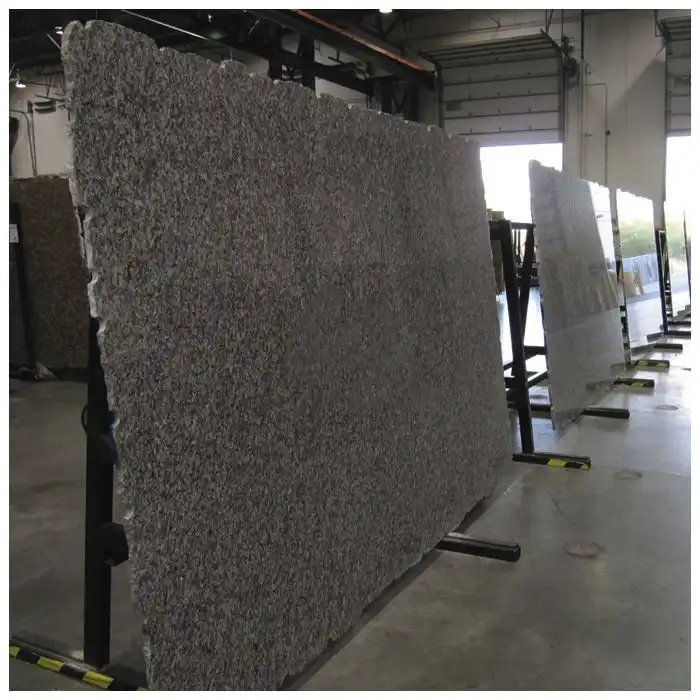
Caledonia Brown Granite is a natural crystalline stone recognised for its closely interlocking pattern of grey, brown, black and lighter mineral grains. Rather than displaying broad directional veins, the stone presents a more evenly distributed granular surface across the slab.
The Canadian Caledonia material is associated with quarrying in Quebec. Its grey-brown composition makes it distinguishable from strongly red-brown granites and from black stones with prominent white or gold veins. The colour is not a uniform brown: charcoal, taupe and grey minerals share the surface with warmer brown particles.
This relatively consistent grain structure is useful when a project requires several countertops, wall panels or floor tiles. Individual pieces do not have to be arranged around one dominant diagonal vein, although differences in background shade and mineral concentration can still become visible across separate blocks or batches.
Large slabs allow fabricators to plan finished products according to the required dimensions. Kitchen worktops, island tops, bathroom vanities, wall panels and stair components can be cut from suitable material, provided the available slab size, thickness and surface condition meet the approved fabrication requirements.
For countertop buyers, the usable portion of each slab matters more than the nominal overall dimensions. Natural defects, edge irregularities and the positions of cutouts can affect the number of finished components that can be obtained from one piece.
For architectural cladding or floor tile orders, a consistent colour group may be more important than selecting one unusually attractive slab. The finished installation is seen as a continuous surface, and differences between adjacent pieces become more apparent when large quantities are used.
Caledonia is also sold under overlapping commercial names, including New Caledonia. Because similarly named materials are marketed from different countries, the actual origin and selected slab appearance should be confirmed rather than inferred from the trade name alone.
Caledonia Granite Slab Colour Groups and Grain Consistency
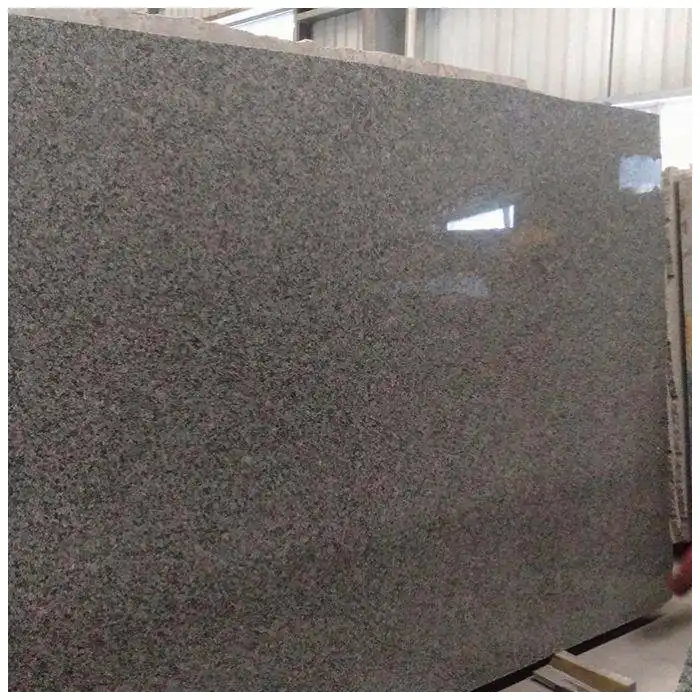
A Caledonia granite slab should be evaluated as a complete stone surface, not solely through a small sample. The overall balance of grey and brown minerals can vary, and the darker crystalline particles may appear more concentrated in certain selections.
On a polished slab, individual grains become more visible under directional lighting. The reflected light also makes the distinction between charcoal particles, warmer taupe areas and pale grey minerals easier to examine.
Background Tone and Mineral Distribution
Caledonia slabs may appear predominantly grey from a distance while revealing warmer brown tones at closer range. That balance influences how the stone works alongside cabinetry, flooring and adjacent architectural materials.
For an order involving repeated finished pieces, the material should be grouped by overall shade and grain distribution. Mixing a lighter grey selection with a notably darker group may create an uneven appearance even when both are commercially sold under the same name.
Slab Selection for Multi-Phase Projects
Caledonia’s relatively compact granular structure can make it easier to coordinate large quantities than stones with dramatic, irregular veins. However, natural stone remains subject to variation between blocks and extraction periods.
Where several delivery phases must maintain a close visual relationship, the required colour range should be established at the beginning of procurement. Representative slab photographs, approved samples and an agreed selection standard are more dependable than relying on the material name alone.
Polished Slab Surface Inspection
The polished face should be examined for consistent gloss, processing marks, chips and visible natural features that may affect the intended cutting layout. Angled lighting helps reveal differences that are less noticeable when the slab is viewed directly from the front.
Material selection should also account for slab geometry and usable cutting area. A suitably coloured slab may still be unsuitable for a large kitchen island if its dimensions or edge condition do not accommodate the finished piece.
Caledonia Brown Granite Slab and Tile Specifications
Caledonia granite can be supplied as large slabs, standard tiles and cut-to-size components. The dimensions below are reference configurations; actual sizes depend on the selected blocks, available slabs and required processing.
| Product Name | Caledonia Brown Granite Slabs |
| Natural Stone | Caledonia Granite |
| Origin Reference | Quebec, Canada; confirm against the selected material |
| Colour | Grey-brown, charcoal, black and lighter grey mineral grains |
| Primary Slab Size Reference | 2400mm up × 1200mm up |
| Additional Slab Size Reference | 2600mm up × 1400mm up; larger selections subject to availability |
| Common Slab Thickness | 20mm and 30mm |
| Additional Thickness Options | 40mm and 50mm by material and processing confirmation |
| Tile Size References | 305 × 305mm, 400 × 400mm, 300 × 600mm, 600 × 600mm |
| Tile Thickness Reference | 10mm, 12mm and 20mm according to the selected tile specification |
| Surface Finishes | Polished, honed, flamed, brushed, bush-hammered and selected textured finishes |
| Product Forms | Large slabs, countertop slabs, wall panels, floor tiles, stairs and custom stone components |
| Applications | Countertops, vanity tops, interior floors, wall cladding, selected exterior paving and architectural stonework |
| Minimum Order Reference | 100 SQM; subject to order and stock confirmation |
Polished, Honed and Textured Caledonia Granite Finishes
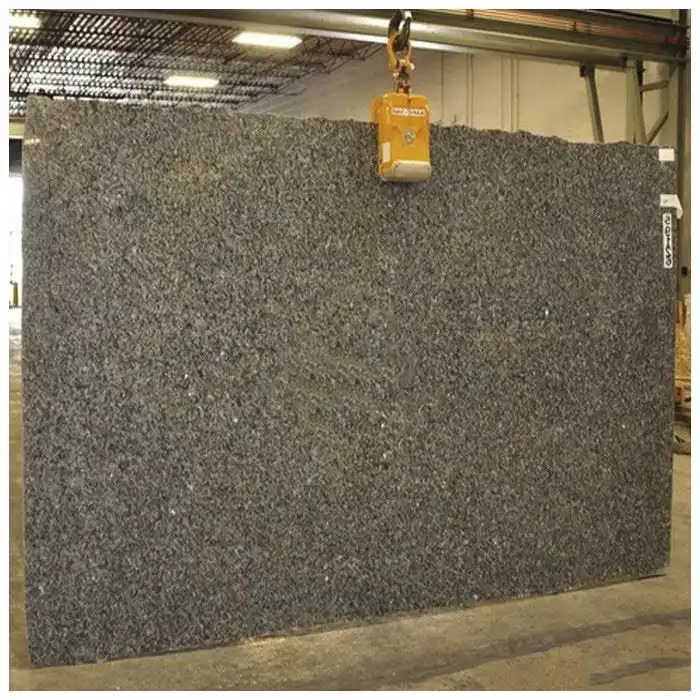
Surface treatment changes the appearance and practical characteristics of Caledonia granite. The same grey-brown material can show stronger mineral contrast after polishing and a more subdued colour balance after honing.
Polished Caledonia Granite Slabs
Polished slabs are commonly selected for kitchen countertops, bathroom vanities and decorative interior panels. The finish brings out the dark and light mineral grains, producing a relatively smooth surface with reflected light across the crystalline pattern.
A polished face can make processing scratches, chips and uneven gloss more apparent. Consistent finishing is particularly important when several countertop sections will be joined or multiple slabs installed next to one another.
Honed and Brushed Granite
Honing reduces surface reflection and changes the apparent depth of the darker minerals. Brushing introduces additional texture, although the exact result depends on the equipment, processing parameters and selected stone.
These finishes can be considered for interiors where a reflective polished surface is not preferred. The final appearance should be approved with a physical finish sample, since photographs do not always show subtle differences in texture.
Flamed and Bush-Hammered Granite
Flamed and bush-hammered surfaces introduce more pronounced texture and may be specified for selected exterior paving or architectural stonework. Their suitability depends on the actual stone, thickness, environmental exposure and installation requirements.
A textured finish should not be assumed to meet a specific slip-resistance classification without appropriate evaluation. Outdoor pedestrian areas and wet walking surfaces may require testing of the finished material under the applicable standards.
When one project combines interior and exterior Caledonia granite, separate finish samples are useful because polished, honed and heavily textured treatments can look noticeably different even when produced from the same material group.
Caledonia Granite Physical Test Reference Data
The following ASTM values are published reference data for Caledonia granite from the Rivière-à-Pierre area of Quebec, Canada. They describe a documented Canadian Caledonia material selection and must not be transferred to a different stone sold under a similar commercial name. The figures are not laboratory certification for MQ STONE’s current slab batch.
| Physical Property | Caledonia Granite Reference | Test Standard |
|---|---|---|
| Density | 2710 kg/m³ | ASTM C97 |
| Water Absorption by Weight | 0.12% | ASTM C97 |
| Compressive Strength | 193.2 MPa | ASTM C170 |
| Flexural Strength | 9.6 MPa | ASTM C880 |
| Modulus of Rupture | 11.8 MPa | ASTM C99 |
Public material reference only. The listed values correspond to documented Canadian Caledonia granite tested under the stated ASTM methods. They are not a current-batch MQ STONE test report, proof of a specific quarry allocation or a finished-product performance guarantee. Projects requiring certified values must verify the actual supplied stone and obtain applicable documentation.
Raw Caledonia Granite Slabs and Cut-to-Size Yield Planning
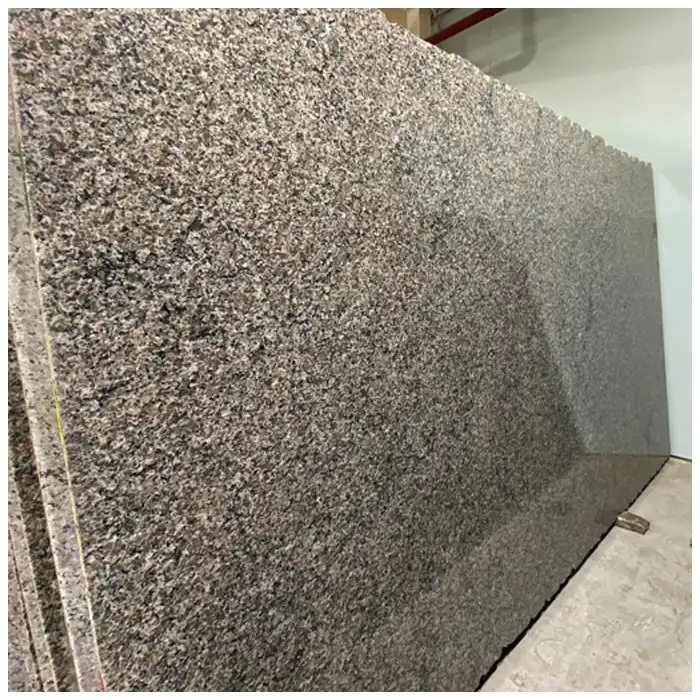
Raw slab dimensions determine how efficiently Caledonia granite can be converted into finished countertops, floor tiles or architectural panels. The cutting layout should be prepared using the actual measured slab rather than the minimum nominal size of a commercial category.
A slab may have irregular outer edges or natural features that cannot be included in the finished product. These areas reduce usable cutting space and may affect the number or dimensions of components obtained from one slab.
Countertop Cutting Layouts
For a kitchen countertop order, the cutting plan should identify finished lengths, depths, sink positions, cooking appliance openings and edge profiles. A large island may require a separate slab selection, while shorter countertop sections can sometimes be arranged around the principal piece.
Cutout positions should be coordinated with the supporting cabinetry. Narrow strips around sinks or cooktops need suitable geometry and support, particularly during lifting and transportation before the finished worktop is installed.
Wall Panels and Floor Tiles
Cutting Caledonia slabs into repeated wall or floor modules requires consistent finished dimensions and thickness. The allowable dimensional tolerances should be established according to the project requirements rather than assumed from the nominal tile size.
For large panel orders, cutting should also consider where adjacent pieces meet corners, openings and structural transitions. Accurate shop drawings reduce the risk of narrow filler pieces and poorly positioned joints.
Fabrication Allowance and Material Utilisation
Saw kerf, edge trimming, cutouts and natural slab limitations all affect the quantity of stone required. Ordering exactly the finished surface area without allowing for processing waste may leave a shortage after cutting.
A realistic quantity calculation distinguishes purchased slab area from finished product area. The difference becomes especially relevant for large countertops, irregular panels, shaped architectural pieces and layouts requiring colour grouping.
Caledonia Granite Countertop, Flooring and Exterior Stone Applications
Caledonia Brown Granite is used in several architectural product forms, each with different dimensional and installation requirements. The selected finish and fabrication specification should correspond to the intended surface rather than assuming that one standard slab configuration suits every application.
Kitchen Countertops and Bathroom Vanity Tops
Polished Caledonia granite can be used for kitchen worktops, islands, vanity tops and related benchtop surfaces. The granular pattern makes small differences in piece orientation less visually dominant than they might be in a strongly veined stone, but adjacent sections still require appropriate colour selection.
Cutouts, joints and finished edges should be defined through fabrication drawings. Cabinet support, appliance clearances and overhang requirements remain part of the finished countertop design.
Interior Flooring and Wall Cladding
Caledonia granite can be cut into square and rectangular tiles for interior paving and wall finishes. Its compact mineral pattern creates a relatively even visual texture across large areas, although colour grouping remains necessary when materials from different blocks are combined.
Large-format tiles require suitable substrate flatness, bedding support and movement-joint planning. Their finished thickness, dimensions and edge tolerances must be coordinated with the installation method.
Outdoor Paving and Architectural Stonework
Selected textured Caledonia granite may be considered for outdoor paving, steps and building stone. For exterior use, environmental exposure, drainage, substrate movement and the required slip resistance need to be addressed before the finish and thickness are approved.
Architectural stone elements such as window sills, stair treads or cladding components require project-specific edge detailing and support. Material strength values alone do not establish the adequacy of an installed fixing system.
Caledonia Brown Granite Kitchen Island Application Reference
The following kitchen island image illustrates one possible use of Caledonia Brown Granite as a fabricated countertop surface. It is a design reference and does not define the full product range, the actual stock dimensions or the performance of a particular installation.
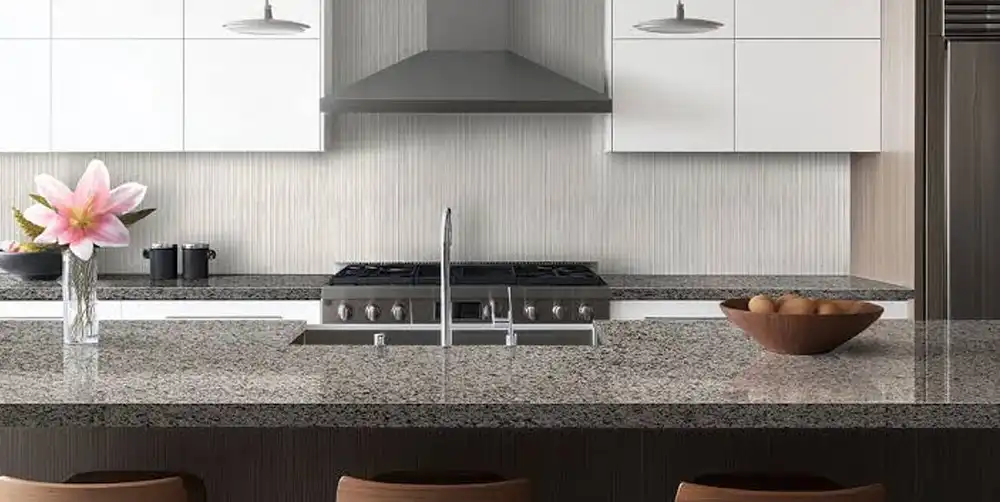
For a similar countertop, the finished slab size, edge profile, sink or appliance openings and cabinet support should be coordinated before cutting. Material selection remains important even with Caledonia’s relatively uniform grain because different slabs can show variations in grey-brown tone.
Caledonia Granite Compared with Four Alternative Granite Slab Colours
Caledonia is generally selected for its restrained grey-brown crystalline texture. The following granite collections introduce alternative light, warm or dark colour directions for countertops, slabs and architectural stone components.
| Granite Material | Visual Character | Selection Difference |
|---|---|---|
| Caledonia Brown Granite | Compact grey-brown, charcoal and black crystalline grains | Relatively even mineral pattern for coordinated slab and tile applications |
| Delicatus White Granite | Light background with darker natural mineral patterns | A brighter slab appearance with more prominent contrast between light and dark areas |
| Rosa Porrino Granite Slabs | Pink-grey crystalline granite with dark mineral grains | A warmer pink-toned alternative to neutral grey-brown granite |
| Black Galaxy Granite Slab | Dark black background with contrasting reflective mineral flecks | Stronger black surface and more noticeable reflective particles |
| Shanxi Black Granite Slab | Dense-looking dark black stone with comparatively subtle grain | A more uniform dark appearance rather than visible grey-brown mineral contrast |
These are separate natural stone selections, not interchangeable performance grades. The actual slab origin, surface finish, dimensions and applicable physical properties should be evaluated independently for each product.
Caledonia Granite Slab Inspection and Export Packing
Inspection should begin with the agreed stone selection. Caledonia slabs need to be checked for background shade, grain consistency, visible natural features and surface finish. For orders comprising several slabs, the colour balance should be reviewed across the group rather than judging each piece in isolation.
Slab dimensions and thickness should be measured against the purchase specification. Where the material will be cut into countertops or architectural components, the usable slab area and any edge limitations need to be considered before fabrication begins.
For polished products, surface inspection should include scratches, chips, processing marks and gloss consistency. Finished tiles and cut-to-size pieces also require checks of their dimensions, flatness and edge condition.
Granite slabs are typically transported in suitable reinforced bundles with support and restraint appropriate to their weight and dimensions. Cut-to-size tiles and smaller finished pieces can be protected in wooden crates with separation materials to reduce abrasion and edge damage.
Where a project requires a defined cutting or installation sequence, piece identification should correspond to the approved schedule. This helps distinguish matching countertop sections, wall panels and flooring components during unpacking and installation.
Caledonia Granite Surface Care and Fabrication Precautions
Routine maintenance of Caledonia granite should use cleaning products compatible with natural stone and the chosen surface finish. Grit and abrasive residues should be removed before cleaning polished countertops or floors to reduce the risk of scratching.
For kitchen worktops, spills should be cleaned promptly around sink cutouts, joints and areas of frequent food preparation. The suitability of any impregnating sealer should be determined through testing on the actual stone and finish.
Hot cookware should be placed on appropriate heat-resistant supports. Although granite is commonly used for countertops, localized thermal stress can affect joints, sealants or finished edges as well as the surrounding installation.
Fabrication processes such as sawing, drilling and grinding can generate respirable crystalline silica dust. Processing should use appropriate dust controls, including wet methods or suitable extraction systems and required worker protection.
The maintenance plan should match the finish and application. A polished kitchen countertop, a honed wall panel and a flamed exterior paver will not necessarily require identical cleaning equipment or treatment.
Common Caledonia Granite Procurement and Fabrication Mistakes
- Assuming every slab sold under the Caledonia or New Caledonia trade name originates from the same quarry.
- Applying technical data for a different commercial granite to the Canadian Caledonia material.
- Selecting only from a small hand sample without reviewing the grey-brown colour balance across full slabs.
- Treating nominal slab dimensions as the usable cutting area for a finished countertop or wall panel.
- Ordering a thicker slab option without confirming that the required dimensions and material are available in that thickness.
- Using the same surface finish specification for interior countertops and exposed outdoor pedestrian areas without reviewing their different requirements.
- Preparing a cutting schedule without allowing for saw kerf, trimming and irregular finished components.
- Combining separate material batches without agreeing on acceptable shade and grain variation.
FAQs About Caledonia Brown Granite Slabs
1. Where does Caledonia Brown Granite originate?
The Canadian Caledonia granite referenced on this page is associated with Quebec, Canada, including the Rivière-à-Pierre quarrying area. Similar commercial names are also used for other stones, so the actual origin should be confirmed for each material order.
2. What are the common Caledonia granite slab dimensions?
Reference slab dimensions include 2400mm up × 1200mm up and 2600mm up × 1400mm up. Actual dimensions depend on the selected blocks and available slabs, and custom finished sizes require a cutting layout.
3. Is Caledonia Brown Granite available in 20mm and 30mm thicknesses?
Yes. The principal slab thickness references are 20mm and 30mm. Thicker 40mm and 50mm options require confirmation of the selected material, required dimensions and processing arrangement.
4. Can Caledonia granite slabs be fabricated into kitchen countertops?
Yes. Caledonia granite can be processed into kitchen countertops, island tops and bathroom vanities. The finished drawings must establish dimensions, sink and appliance cutouts, edge profiles, seams and support requirements.
5. Which Caledonia granite finishes are suitable for indoor and outdoor use?
Polished and honed finishes are commonly considered for interior surfaces, while flamed, brushed and bush-hammered treatments can be reviewed for selected exterior applications. The final choice depends on the site conditions and required finished-surface performance.
6. Is Caledonia granite colour consistent between different slabs?
Caledonia has a relatively even crystalline pattern, but natural variation remains possible between blocks and material batches. Full-slab review and colour grouping are recommended for orders requiring closely coordinated finished pieces.
7. Can Caledonia Brown Granite be supplied as floor and wall tiles?
Yes. Reference tile sizes include 305 × 305mm, 400 × 400mm, 300 × 600mm and 600 × 600mm. Other cut-to-size dimensions can be reviewed against the available slab material and project drawings.
8. Are the published Caledonia granite test results certified for every supplied slab?
No. Published ASTM values are material references for a documented Canadian Caledonia selection. They are not certified test results for every current slab or fabricated product. Project-specific testing requirements must be confirmed against the actual supplied material.
9. What information is needed for a Caledonia granite slab quotation?
Provide the required slab or finished-piece dimensions, thickness, surface finish, quantity, application and delivery destination. For cut-to-size products, drawings and an approved material reference help determine the cutting requirements and quotation scope.
Caledonia Brown Granite Slab Ordering Requirements
A Caledonia granite purchase should identify the required material origin, approved colour group, slab dimensions, thickness and finish. When the order includes fabricated countertops, tiles or architectural panels, the finished cutting schedule should also be confirmed before processing. The main purchasing distinction is between buying natural slab area and ordering finished stone components: each requires a different quantity calculation, inspection standard and packing arrangement.
Recommended Granite Slabs for Countertops and Architectural Stonework

Delicatus White Granite
Light granite with contrasting dark mineral patterns for countertops and decorative stone panels.

Rosa Porrino Granite Slabs
Pink-grey granite slabs with granular texture for building stone and cut-to-size surfaces.

Black Galaxy Granite Slab
Black stone with reflective mineral flecks for countertops and decorative interior surfaces.

Shanxi Black Granite Slab
Dark black granite with restrained grain for cut-to-size stone and architectural components.

Caledonia Brown Granite Slabs and Custom Stone Supply
MQ STONE supplies Caledonia Brown Granite slabs for countertop fabrication, tile cutting and architectural stone requirements. Material selection should begin with the confirmed commercial stone identity, actual slab dimensions and preferred colour range. For custom orders, approved drawings establish the required finished sizes, surface treatment and cutting arrangement before production.
Request Caledonia Granite Slab Details
Send the required slab size, thickness, finish, quantity and delivery destination. For countertops or cut-to-size stone, include the finished dimensions and project drawings.