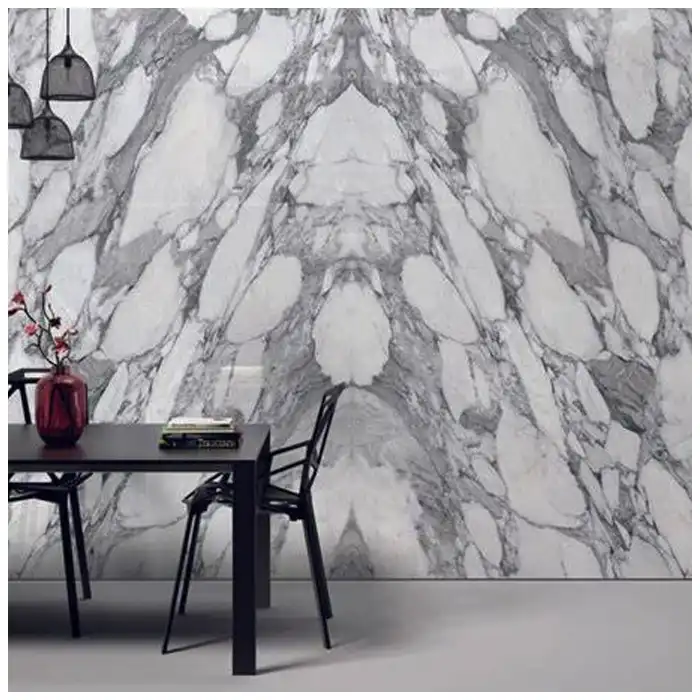
Quick Summary: Wooden Marble Tile for White Wood Grain Flooring and Walls
Wooden Marble Tile is a Chinese white wood grain marble product distinguished by fine grey lines running through a white-to-cream stone background. Cut into floor and wall tiles, it introduces the directional appearance of timber without using a wood-based material. Its linear pattern is suited to hotel lobbies, residential floors, corridors and coordinated interior wall panels. Tile orientation, actual slab selection and the chosen surface finish should be approved together, particularly for large flooring areas where changes in vein direction become immediately visible.

Chinese Wooden White Marble Tiles for Hotel Floors and Contemporary Interiors
Wooden White Marble is known for its distinctive linear pattern. Fine grey, silver and occasional beige lines extend through a pale stone background, creating the impression of timber grain without reproducing the knots or colour changes of an actual wooden board.
This pattern gives the marble a recognizable architectural character. When installed in one direction, the veins can visually extend the length of a corridor or connect the different areas of a large lobby. On a wall, the same lines create a quiet horizontal or vertical composition, depending on how the stone is cut and installed.
The material belongs to the Chinese White Wood Grain Marble family, which is also sold under White Serpeggiante and related commercial names. It should not be confused with Italian Serpeggiante merely because both stones contain wood-like lines. Their colour, geological source and performance must be considered separately.
For architects working with hotel entrances, residential apartments or commercial interiors, the main advantage is visual direction. The stone can make a floor feel continuous while providing a more restrained appearance than a heavily veined black or white marble.
White Wood Grain Marble: Understanding the Parallel Veins and Colour Range
The appearance of Chinese Wooden White Marble depends on the density, spacing and direction of its natural mineral layers. Some pieces have closely arranged grey lines, while others show broader pale bands separated by fine white areas.
Fine Grey Lines
Fine parallel veins create a relatively regular stone pattern. They are useful when the project requires an understated floor that complements wall panels, joinery and furnishings without becoming the dominant decorative element.
White and Cream Background Variations
Individual slabs may range from a cooler grey-white appearance to warmer ivory or beige-white sections. These differences should be reviewed across representative material samples, particularly where several rooms share an uninterrupted floor finish.
Linear and Irregular Mineral Features
Wood grain marble is not a printed pattern. Some lines may become wider, change direction or cross local mineral features. Small variations are part of the material, but large discontinuities or structurally significant veins need separate inspection before fabrication.
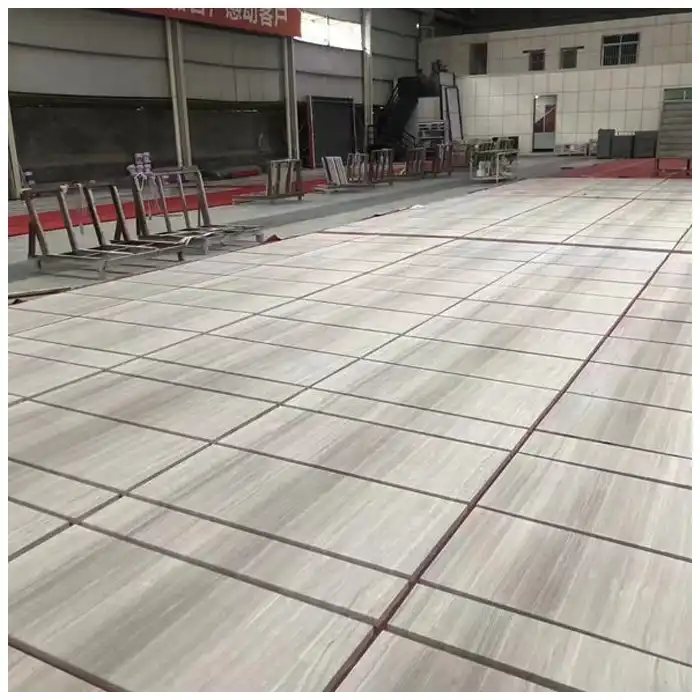
Wooden Marble Tile Sizes, Thickness and Surface Specifications
Wooden White Marble is supplied in several modular tile formats and can also be cut from larger slabs. The size references below are consistent with MQ STONE’s related Chinese Wooden White Marble range. Confirm the dimensions and thickness combinations available for the current selected material before approving a project cutting schedule.
| Product Name | Wooden Marble Tile / Wooden White Marble Floor Tile |
| Material | Chinese Wooden White Marble / White Wood Grain Marble / White Serpeggiante Marble |
| Origin | China; Chinese White Wood Marble is associated with Guizhou stone selections |
| Colour | White, light grey and cream with narrow grey or beige parallel veins |
| Tile Size 1 | 305×305mm (approximately 12″×12″) |
| Tile Size 2 | 300×600mm |
| Tile Size 3 | 400×400mm |
| Tile Size 4 | 600×600mm |
| Other Tile Formats | 457×457mm, 305×610mm and drawing-based custom sizes where the selected slabs permit |
| Small Slab References | Length 1800mm+; width approximately 600–800mm; actual inventory to be confirmed |
| Large Slab References | Length 2500mm+; width approximately 1300mm+ where available; usable dimensions subject to stock |
| Thickness References | 16mm / 18mm / 20mm / 30mm; other sections require confirmation |
| Surface Finishes | Polished and honed; additional textured finishes subject to sample and processing approval |
| Vein Orientation | Lengthwise, crosswise or project-specific arrangement according to the actual stone and cutting plan |
| Product Forms | Floor tiles, wall tiles, cut-to-size panels, stair cladding and selected architectural stone components |
| Main Applications | Hotel lobby flooring, commercial corridors, residential floors, interior wall panels and decorative stair areas |
Wood Grain Direction: How Tile Cutting Changes the Finished Floor
One of the most important decisions when using wooden marble is the direction of the grain. Two floors made with the same stone and tile size can have noticeably different appearances simply because the pieces are rotated during installation.
A lengthwise arrangement emphasizes the long direction of the floor. In a corridor, this can create continuous visual movement from the entrance toward the far end. A crosswise arrangement introduces lines across the walking direction and can make a narrow space appear more segmented.
Rectangular tiles such as 300×600mm are particularly useful for establishing a directional layout. Square tiles also allow vein alignment, but rotating individual pieces without an agreed pattern can disrupt the intended effect.
A dry-lay drawing should identify the main grain direction, tile sequence and changes of orientation at entrances, corners and feature areas. Where directional consistency is critical, the cutting workshop and installation team should follow the same approved layout reference.
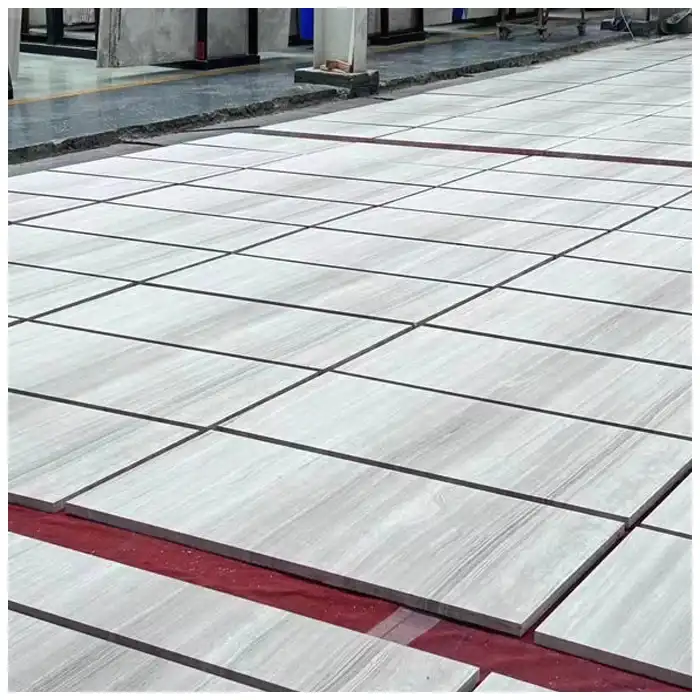
White Wooden Marble Flooring Tiles for Hotels and Residential Spaces
White wooden marble flooring brings a linear pattern to spaces that would otherwise rely on uniform neutral tiles. The subtle grey bands are particularly suited to large interiors where the flooring needs visible detail but should not compete with furniture, wall finishes or lighting.
In a hotel lobby, the grain can run toward the reception counter or follow a defined circulation route. For residential living areas, it can visually connect several rooms when the same marble selection and tile direction are used across the floor.
The material should be selected according to the expected traffic and cleaning conditions. A polished finish can emphasize the mineral lines, but high-use entrances require suitable abrasion and slip performance. Where water is regularly tracked indoors, the actual wet-floor characteristics deserve particular attention.
White marble flooring can also show dirt, dark staining and surface wear differently from darker materials. Entrance mats, suitable maintenance methods and appropriate floor protection during construction should be considered in the project specification.
Polished vs Honed Wooden White Marble: Choosing the Surface Finish
Surface finish changes how the fine wood-like lines are seen under natural and artificial light. Polished marble generally gives stronger reflection and contrast; honed marble produces a lower-sheen appearance that can be easier to coordinate with restrained contemporary interiors.
| Finish | Appearance | Project Considerations |
| Polished Wooden Marble | Reflective white and grey surface with clearly visible linear veins. | Decorative walls and selected interior floors where the finish meets the intended slip and wear requirements. |
| Honed Wooden Marble | Matte or lower-sheen appearance with softer grey wood-grain movement. | Residential floors, hotel interiors and wall panels; wet traction still requires verification. |
| Custom Textured Finish | Texture and appearance depend on the stone and processing method. | Confirm processing feasibility and the actual finished sample before specifying for a project. |
White Serpeggiante Marble Tiles for Coordinated Interior Wall Panels
Wood grain marble can continue from the floor to a feature wall, creating a consistent colour palette without requiring the grain to run in the same direction everywhere. Horizontal lines may emphasize the length of a wall, while vertical lines introduce a different architectural rhythm.
In an elevator lobby or corridor, large cut-to-size wall panels may reduce visible joints and make the linear pattern easier to read. Smaller tiles can be used around door openings, recessed shelves and other detailed areas where full panels are impractical.
The designer should establish how the wall grain relates to the flooring. A deliberate change from horizontal to vertical can work well, but an unplanned change in orientation can look like a material mismatch.
For taller wall panels, the supporting construction, panel dimensions and fixing method should be reviewed against the selected stone’s measured properties. Interior adhesive installation and mechanically restrained cladding are not automatically interchangeable.

Chinese Wooden White Marble Physical and Mechanical Test Data
The values below are published reference properties for Chinese White Wooden Marble, the stone family associated with this product. They are useful for preliminary material assessment, but they are not certified results for the current MQ STONE tile batch. Different Chinese white wood grain selections may report different figures, so formal project approval must use test documentation identifying the actual stone supplied.
| Physical Property | Published Reference | Technical Interpretation |
| Bulk Density | 2600–2800 kg/m³ | Reported material range; project-specific density is needed for accurate dead-load calculations. |
| Water Absorption | 0.58% | Published Chinese White Wooden Marble reference; not a guarantee of resistance to staining or moisture. |
| Flexural Strength – Dry | 11.2 MPa | Reported dry bending strength of the reference material. |
| Flexural Strength – Wet | 6.7 MPa | Reported wet bending strength; the difference is relevant when assessing moisture-exposed applications. |
| Compressive Strength – Dry | 110.5 MPa | Published dry compression value for the reference stone. |
| Compressive Strength – Wet | 83.0 MPa | Published wet compression value; not a direct floor loading or installation capacity. |
For formal specification, density and open porosity may be evaluated using EN 1936, water absorption using EN 13755, and flexural strength using an applicable method such as EN 12372. The reference figures above have not been verified against individual laboratory certificates carrying those methods. Abrasion resistance and slip resistance should be established separately for the actual floor finish.
Technical qualification: published White Wooden Marble datasets vary in density and water absorption, sometimes substantially. The figures shown here are a single consistent commercial reference set, not MQ STONE batch certification. Project acceptance values should be based on the actual selected material and the contract’s specified testing requirements.

White Wood Marble Lobby Flooring Project: Tile Alignment and Visual Continuity
The MQ STONE lobby flooring image illustrates the architectural use of Chinese White Wood Grain Marble. Its fine linear pattern creates movement across the floor while maintaining a relatively light and neutral overall appearance. For a large lobby, the completed effect depends on tile orientation and the distribution of individual stone pieces.
Main Entrance and Reception Axis
The wood grain can be aligned with the principal route through a lobby, creating an intentional direction toward the reception counter or main circulation area.
Large Open Floor Areas
The tile grid should account for columns, furniture zones and changes in room width. Balanced perimeter cuts help avoid abrupt changes in the visual pattern.
Connecting Corridors and Side Rooms
Where flooring continues into adjacent areas, decide whether the grain follows one consistent building axis or changes direction at an intentional transition.
Floor Finish and Lighting
Large windows and overhead fixtures can emphasize the finish and fine mineral lines. Review the installed appearance under the planned lighting, including any glare and cleaning implications.
Wooden Marble Tile Installation: Substrate, Grout Joints and Pattern Control
The underlying floor must be suitable for the selected marble tile size and thickness. Substrate flatness, movement joints, the chosen bedding system and the installation environment all affect the finished floor. A directional marble pattern cannot compensate for uneven construction or poorly coordinated joints.
Before installation, arrange representative pieces in the approved grain direction. This dry layout can reveal concentrated dark veins, abrupt colour changes and tiles that would be better positioned away from the principal viewing area.
Joint width and grout colour should be selected with the tile dimensions and natural stone movement in mind. Narrow visual joints do not eliminate the need for construction movement joints. Use materials and methods compatible with the actual stone and local installation requirements.
Wooden White Marble is stone, not timber flooring. Its installation does not follow the same principles as floating wood planks, and its chemical and mechanical behaviour must be evaluated as a marble or related carbonate stone.
White Wood Grain Marble vs Other Serpeggiante and Veined Marble Selections
The related MQ STONE materials below provide alternative linear and decorative marble patterns. Chinese Wooden White Marble is distinguished by its relatively light colour and fine parallel grain, while the alternatives range from blue-grey or cream-toned veining to much darker wave patterns.
| Marble Product | Appearance | Project Selection |
| Wooden Marble Tile | White-to-light-grey background with fine, mostly parallel wood grain lines. | Hotel lobby floors, residential flooring and coordinated wall panels requiring a restrained directional pattern. |
| Palissandro Bluette Marble | Blue-grey, white and warmer mineral movement with a stronger multicolour character. | Decorative floors and wall features where a more expressive colour combination is preferred. |
| Palissandro White Marble | Light-toned marble with a different directional mineral structure. | Alternative light decorative surfaces where the vein arrangement is selected from actual slabs. |
| Italian Serpeggiante Marble | Warm beige and cream linear wood-like bands associated with Italian Serpeggiante. | Warmer neutral interiors where the flooring and walls should have an Italian beige stone appearance. |
| Antique Wood Vein Marble | Dark black-grey marble with white, silver and brown wave-like mineral lines. | Dramatic feature walls and dark decorative floors requiring stronger contrast. |
Preparing a 3,000 SQM Wooden White Marble Flooring Order
For a 3,000 SQM project, the flooring schedule should establish the required tile modules and installation zones before stone cutting begins. A main lobby may use larger square tiles, while corridors and smaller rooms may require different dimensions or a more directional rectangular layout.
Separate the measured finished area from cutting allowance, breakage allowance and future maintenance stock. These depend on the floor geometry, chosen module, vein orientation and installation method. A quantity of 3,000 SQM should not be treated as 3,000 SQM of guaranteed finished coverage without accounting for these factors.
The supplied commercial price reference is USD 42–48/SQM. Final terms depend on the confirmed stone selection, tile dimensions, thickness, surface finish and packaging requirements. This project quantity is not automatically a minimum order quantity or a fixed online selling offer.
Inspection and Export Packing for White Woodvein Marble Tiles
Quality control begins with the approved colour range and vein direction. Representative tiles should be compared under consistent lighting, with particular attention to abrupt changes in grey-line density and warm background colour.
Finished tiles should be checked for dimensions, thickness, squareness, flatness, edge condition and surface finish against the agreed specification. Natural fissures, filled features and mineral boundaries must be assessed according to their position and effect on the finished piece.
Where the floor layout depends on continuous linear movement, production pieces should be identified by their intended direction or installation area. This reduces the chance that a batch of correctly manufactured tiles is installed with inconsistent grain orientation.
Export packing should protect polished or honed faces, corners and narrow edges. Crates should identify the material, finished size, thickness, quantity and relevant project zone. Packaging arrangements must correspond to the actual tile weight and shipping route.
Common Mistakes When Ordering White Wooden Marble Floor Tiles
- Ignoring grain direction: random tile rotation can interrupt the planned linear effect across corridors and large lobby floors.
- Assuming every Chinese White Wood Marble has identical colour: different selections may vary in background warmth, grey veins and mineral structure.
- Using Italian Serpeggiante test values: similar wood-like patterns do not establish identical geological or mechanical properties.
- Approving flooring from appearance alone: wet slip resistance, abrasion and substrate requirements must follow the actual application.
- Confusing nominal and usable slab dimensions: cutting losses and vein positioning can affect the number of finished tiles produced.
- Expecting marble to behave like timber: stone has different thermal, installation, chemical and maintenance characteristics from wooden flooring.
Cleaning and Maintaining Wooden White Marble Floors
Clean Wooden White Marble with a suitable pH-neutral natural-stone cleaner and remove loose grit regularly to limit surface abrasion. Avoid acidic descalers, vinegar, abrasive powders and aggressive cleaning tools. On polished floors, scratches and dull etching may become more noticeable under strong directional light. Spills should be removed promptly, and any impregnating sealer must be selected according to the actual stone and finish. For commercial entrances, an appropriate matting system can reduce the amount of grit and moisture carried onto the marble. Maintenance plans should address the actual traffic level rather than relying on a general claim that all marble floors are easy to maintain.
FAQs About Wooden Marble Tile
What is Wooden Marble Tile?
Wooden Marble Tile is a stone tile with natural linear mineral patterns resembling timber grain. This product uses Chinese Wooden White Marble, with a white-to-light-grey background and fine grey or beige veining.
Is Chinese Wooden White Marble the same as Italian Serpeggiante Marble?
No. Both can have wood-like veining, but they are commercially and geologically distinct stone selections. Chinese White Wooden Marble and Italian Serpeggiante should be assessed separately for colour, origin, dimensions and material properties.
What tile sizes are available for Wooden White Marble flooring?
Related MQ STONE references include 305×305mm, 300×600mm, 400×400mm and 600×600mm tiles, with other formats subject to the selected slabs and fabrication plan. Current product availability should be confirmed before ordering.
What thicknesses can be supplied for White Wood Grain Marble Tiles?
Common related-product references include 16mm, 18mm, 20mm and 30mm. The appropriate thickness depends on the tile dimensions, floor construction, expected use and confirmed production availability.
How should the wood grain run across a marble floor?
The direction should follow the approved architectural layout. Lengthwise grain can emphasize corridors or circulation routes, while a crosswise arrangement creates a different visual rhythm. A dry layout is recommended before installation.
Can White Wooden Marble Tiles be used in hotel lobbies?
White Wooden Marble can be considered for hotel lobby flooring when the selected material, finish, abrasion performance, slip resistance and installation system meet the project requirements. The directional pattern should be coordinated across large areas.
Is polished or honed Wooden Marble better for flooring?
Polished marble has a reflective surface that emphasizes the linear grain, while honed marble gives a lower-sheen appearance. The correct choice depends on design preference, floor use, maintenance and verified slip performance.
Can White Serpeggiante Marble Tiles be used on walls?
Yes. Selected Chinese White Serpeggiante or Wooden White Marble tiles can be used for interior wall cladding with suitable support and fixing. Horizontal or vertical vein orientation should be established in the wall elevation.
What are the physical properties of Chinese Wooden White Marble?
One published Chinese White Wooden Marble reference reports density of 2600–2800 kg/m³, water absorption of 0.58%, dry and wet flexural strengths of 11.2 and 6.7 MPa, and dry and wet compressive strengths of 110.5 and 83.0 MPa. These are material reference values, not verified MQ STONE batch results.
What information is needed for a 3,000 SQM Wooden Marble Tile quotation?
Confirm the tile dimensions, thickness, surface finish, preferred white wood grain appearance, required vein direction, quantity and delivery destination. For large lobby projects, provide layout drawings and the planned installation zones.
Recommended Wood Grain and Serpeggiante Marble Products

Palissandro Bluette Marble
Blue-grey and light mineral movement for decorative marble floors and feature walls requiring stronger colour.

Palissandro White Marble
Light marble with decorative mineral veining for coordinated white-toned interior stone selections.

Italian Serpeggiante Marble
Warm beige and cream wood-like grain for interior floors, wall cladding and decorative panels.

Antique Wood Vein Marble
Dark marble with silver-grey and brown wave-like grain for contrasting feature walls and floors.

Selecting Wooden White Marble Tiles for a 3,000 SQM Flooring Project
For a 3,000 SQM Wooden Marble Tile requirement, select the approved Chinese white wood grain marble before finalizing the tile cutting and laying plan. The direction of the parallel grey veins, tile dimensions and finish should be coordinated across the principal lobby and adjoining spaces. A representative dry layout and appropriate material documentation help establish the visual and technical acceptance criteria for the project.
Wooden Marble Project Details
- Chinese Wooden White Marble selection
- Tile sizes, thickness and finish
- Approved vein direction and layout
- Installation zones and total quantity