Quick Summary
Итальянский мрамор Порторо is a natural black-and-gold decorative stone quarried in the Portovenere area of Liguria, Italy. Its near-black background contains irregular golden veins and occasional pale calcite markings. Cut-to-size tiles are specified in 600 × 600mm, 600 × 300mm, 600 × 900mm and 457 × 457mm formats, with thickness options of 10mm, 12mm, 16mm, 18mm and 29mm. Polished and honed finishes accommodate different interior floor and wall specifications. The uneven distribution of gold veining makes tile grading and placement important, particularly where several modules meet across a continuous surface. Installation also requires appropriate joint planning and substrate preparation.
Italian Portoro Marble Tiles for Mansions and Residences Interior Floors and Wall Cladding
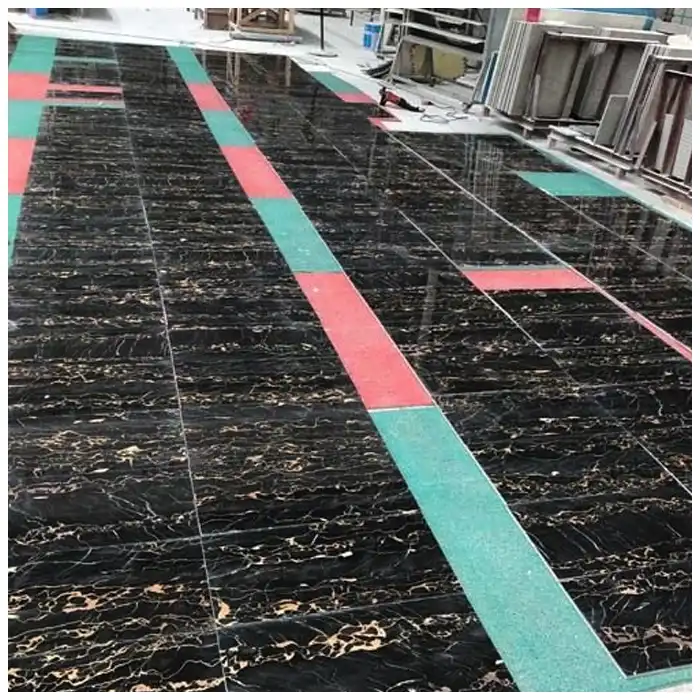
Итальянский мрамор Порторо is a black-and-gold natural stone associated with the Portovenere district near La Spezia in Liguria, Italy. Known commercially as Nero Portoro, the material has a dark, fine-grained background interrupted by irregular yellow-gold mineral veins.
Although traded as marble, Portoro is geologically a decorative black limestone. Its golden formations are associated with calcite and iron-bearing mineral material, while the dark background has a different composition from the pale crystalline marbles commonly used for white flooring.
The commercial distinction matters because the black-and-gold pattern is natural rather than printed or manufactured. A section containing dense golden veins may look considerably different from another piece with an almost uninterrupted black background.
When Portoro is processed into tiles, the continuous mineral pattern of the original stone is divided into smaller modules. The resulting surface depends on how those modules are grouped and positioned, not simply on the dimensions of the finished tiles.
Italian Portoro Marble Tiles are primarily specified for interior decorative flooring and wall cladding. Their dark colour creates a strong contrast against lighter adjoining stone, while the irregular golden markings remain individually visible within each tile.
The material can also be incorporated into coordinated architectural details, including skirting, wall returns and selected stair components. These elements require their own finished dimensions and edge treatments.
For large uninterrupted vein formations, Portoro is also available in slab form. This page focuses on repeatable cut-to-size tile modules, where dimensional calibration and the relationship between adjacent pieces determine the finished installation.
Nero Portoro Black Marble Tiles: Gold Vein Selection and Colour Grading
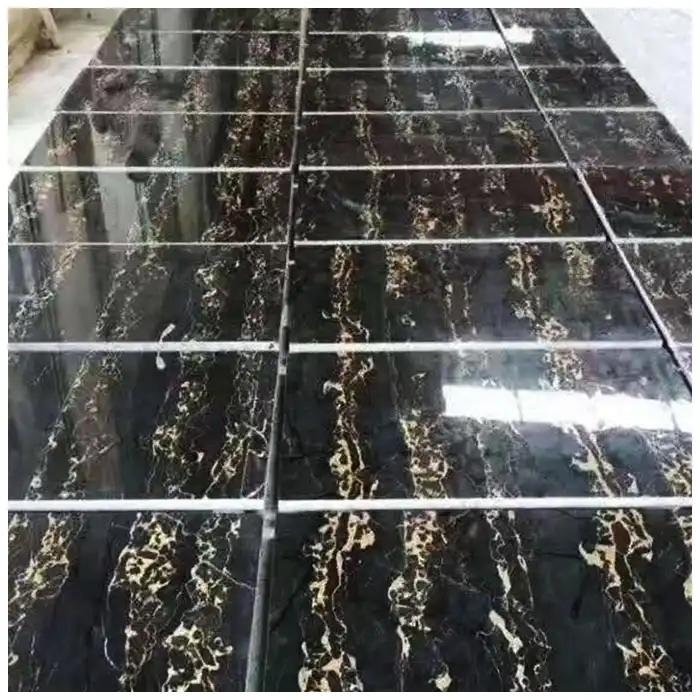
The defining characteristic of Nero Portoro Marble Tiles is the uneven movement of golden veins across the black base. Some formations are narrow and relatively continuous, while others appear as wider branches or irregular patches.
A single finished tile may contain one dominant gold marking, several intersecting lines or only a small amount of visible veining. These differences influence the final floor or wall appearance.
Wide Gold Veins and Fine Gold Lines
Broader gold formations create a stronger contrast within the tile. Fine veins introduce smaller decorative details and allow larger areas of black stone to remain visible.
A collection containing both types can form a natural composition, provided the accepted range of vein density is established for the finished installation.
Deep Black Background and Pale Mineral Markings
The Portoro background is typically very dark, although local grey-black variation may be visible. Some pieces contain pale calcite lines in addition to the better-known golden formations.
These lighter markings are part of the stone’s natural character. Their proportion affects the appearance of adjoining tiles, especially under strong overhead lighting.
Sorting Tiles for Continuous Surfaces
On a large floor, an isolated tile with exceptionally dense gold veining may become the focal point of the surrounding area. A dry-laid arrangement makes it possible to distribute stronger and quieter pieces throughout the approved layout.
The purpose of colour grading is not to make every natural tile identical. It is to establish a consistent visual range while retaining the irregular pattern that identifies genuine Portoro.
Italian Portoro Marble Tile Sizes, Thicknesses and Surface Finishes
The following specifications apply to the cut-to-size Italian Portoro tile selection. Size and thickness are distinct parameters; the available combinations are determined by the actual production order.
| Название продукта | Italian Portoro Marble Tiles |
| Commercial Stone Name | Italian Portoro / Nero Portoro Marble |
| Geological Material | Natural Decorative Limestone, Commercially Sold as Marble |
| Stone Origin | Portovenere / La Spezia, Liguria, Italy |
| Background Colour | Deep Black |
| Natural Pattern | Irregular Gold and Occasional Pale Calcite Veins |
| Tile Size A | 600 × 600mm |
| Tile Size B | 600 × 300mm |
| Tile Size C | 600 × 900mm |
| Tile Size D | 457 × 457mm |
| Варианты толщины | 10 / 12 / 16 / 18 / 29mm |
| Отделка поверхности | Полированный / шлифованный |
| Product Form | Cut-to-Size Natural Marble Floor and Wall Tiles |
| Edge Configuration | Machine-Cut Edges; Exposed Profiles to Specification |
| Main Applications | Interior Flooring and Wall Cladding |
| Related Stonework | Stair Components, Skirting and Decorative Inlays |
Nero Portoro Marble Floor Tiles: Module Layout and Joint Planning
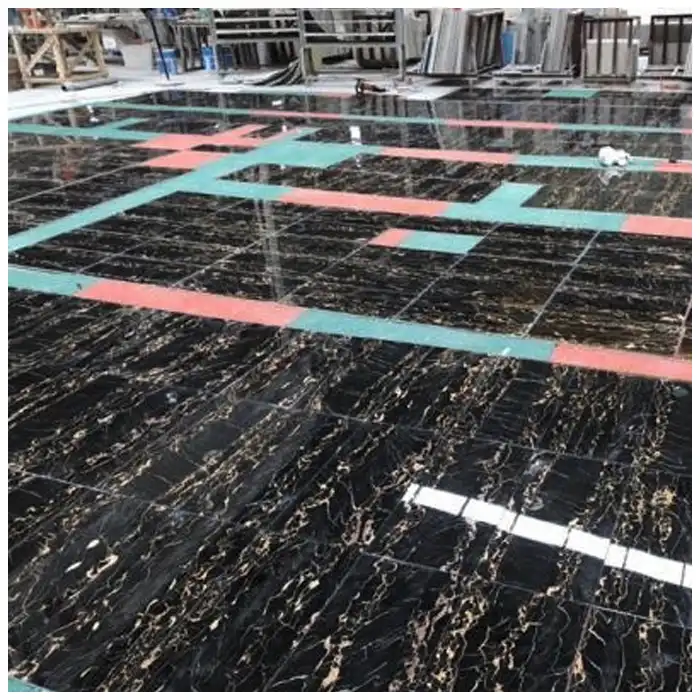
Мраморная напольная плитка Nero Portoro can be arranged in square or rectangular modules. The chosen format affects the number of joints, the direction of the finished surface and the distribution of visible gold veining.
Tile size also affects perimeter cutting. The layout must accommodate actual room dimensions rather than relying solely on the nominal tile module.
600 × 600mm Square Tiles
A 600 × 600mm format creates a regular square grid with relatively broad natural stone faces. The gold markings within each tile remain prominent, while the joints establish a consistent geometric structure.
This size can be used in suitable interior floor layouts where room geometry permits a balanced distribution of full and cut pieces.
600 × 300mm Rectangular Tiles
The 600 × 300mm format allows straight-stack and selected offset arrangements. Its rectangular proportion introduces a clear laying direction, which can influence the relationship between grout lines and natural veining.
Where the tiles are installed in running courses, the selected joint offset must account for dimensional tolerances and the condition of the supporting surface.
600 × 900mm Large Rectangular Tiles
A 600 × 900mm tile retains a larger portion of the stone’s natural pattern. It introduces fewer joints across a comparable surface area than smaller formats but requires greater attention to flatness and installation support.
The more extensive face can display both strong gold veins and dark areas within one piece, making the cutting position particularly visible.
457 × 457mm Square Tiles
The 457 × 457mm format, approximately 18 inches square, creates a smaller module for selected floor and wall layouts. The intermediate size can be coordinated with more compact architectural dimensions, provided the joint arrangement is established before installation.
Portoro Black and Gold Marble Tile Thickness and Surface Processing
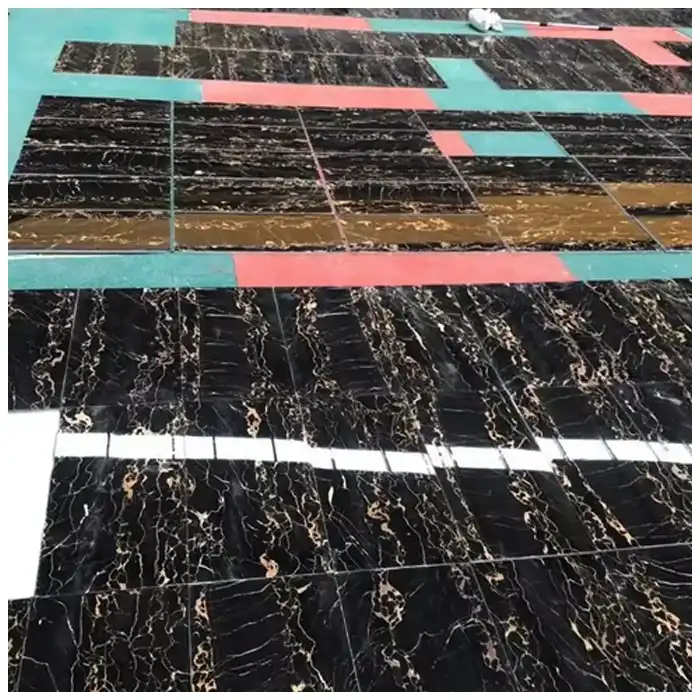
Black and Gold Portoro Marble Tiles are specified in several thicknesses, ranging from 10mm to 29mm. The choice depends on the tile format, supporting construction and intended installation.
A thicker tile increases material weight and may affect finished floor elevation. Thickness alone does not establish a universal permitted load or guarantee suitability for every substrate.
10mm and 12mm Portoro Tiles
The 10mm and 12mm options are relatively thin stone formats. They can be considered for suitable fully supported interior wall applications and other approved installations.
Natural stone of this thickness requires careful handling at corners and around narrow cuts. The setting surface must be suitable for the material and tile dimensions.
16mm and 18mm Portoro Tiles
The 16mm and 18mm options provide additional thickness for specified stonework. Their use in flooring depends on the finished tile dimensions, actual stone properties and the installation system.
At doorways or transitions to different materials, the finished level must include both stone thickness and bedding allowance.
29mm Portoro Stone Components
A 29mm specification produces a more substantial stone profile. This may be relevant for selected thicker tiles or matching architectural components, subject to the approved cutting schedule.
The exact finished thickness is a defined manufacturing requirement. It must not be treated as interchangeable with another nominal thickness without revising the specification.
Polished and Honed Surface Finishes
Polishing creates a reflective black surface and increases the visual contrast of the golden veins. This finish makes the mineral pattern particularly prominent under direct lighting.
Honed Portoro has a lower-sheen appearance. Its gold markings remain visible, but the surface reflects less light. The required finish must correspond to the installation and any applicable walking-surface requirements.
Italian Nero Portoro Marble Physical Property Reference Data
The following values represent one documented Italian Portoro natural-stone material reference. They describe tested stone specimens and are not current-batch laboratory certificates for MQ STONE finished tiles.
| Physical Property | Nero Portoro Reference Value | Test Method |
|---|---|---|
| Насыпная плотность | 2.71 g/cm³ | EN 1936 |
| Поглощение воды | 0.09% | EN 13755 |
| Прочность на сжатие | 157 MPa | EN 1926 |
| Прочность на изгиб | 10.2 MPa | EN 12372 |
Representative data for Italian Portoro natural stone. These results are not guaranteed minimum or maximum values for the current MQ STONE tile batch, and they do not replace project-specific material testing.
The tested stone’s strength does not independently determine the behaviour of an installed floor. Tile thickness, substrate support, bedding, joints and service conditions all affect the completed assembly. Slip resistance and exposure to exterior conditions require separate assessment.
Nero Portoro Marble Flooring: Bedding, Joints and Surface Protection
Nero Portoro Black Marble Tiles require an installation system compatible with natural carbonate stone. A polished face does not compensate for insufficient support beneath the tile.
Substrate Preparation and Bedding
The supporting floor must be sufficiently stable and prepared for the specified tile format. An uneven substrate can increase localized stress, particularly beneath large rectangular pieces.
Appropriate bedding coverage supports the stone and reduces the likelihood of unsupported areas. Setting materials must be compatible with the selected natural stone and surrounding construction.
Grout Colour and Joint Appearance
A dark grout can make the joints less prominent against the black background. A lighter joint colour creates a stronger visible grid, which can compete with the natural golden veining.
Joint width depends on tile dimensional accuracy and the installation specification. A narrow visual joint does not eliminate the need for appropriate movement accommodation.
Wet Areas and Slip Resistance
Polished Portoro may become slippery under wet conditions. Its suitability for bathrooms and other potentially wet floors must be determined using the actual finish and relevant slip-resistance requirements.
The material’s natural limestone composition also makes it sensitive to acidic substances. Careful selection of cleaning products and maintenance procedures is important throughout the installation’s service life.
Portoro Marble Wall Cladding, Skirting and Stair Components
Portoro can be used for interior wall cladding where its black background and gold veining remain visible across vertical surfaces. The rectangular tile formats create different joint arrangements from square modules, particularly near corners and architectural openings.
On a feature wall, the placement of heavily veined pieces can establish a clear visual focus. A balanced arrangement combines stronger gold formations with quieter black areas rather than relying on identical veining between each tile.
Matching skirting and wall returns can be fabricated from compatible Portoro material. Exposed edges require appropriate finishing because the cut stone may contain mineral formations different from those visible on the front face.
Stair treads and risers need separate finished dimensions and support details. A conventional floor tile is not automatically equivalent to a structural stair tread, even when both use the same black-and-gold stone.
When a decorative inlay combines Portoro with light marble, the materials may differ in movement, finish and maintenance characteristics. Joint design and surface level must accommodate those differences within the completed installation.
Italian Portoro Marble Round Table Application Reference
Italian Portoro also appears in decorative furniture applications. The following image illustrates the black-and-gold stone on round table surfaces, providing a visual reference for how the same natural mineral pattern can appear on a smaller finished component.
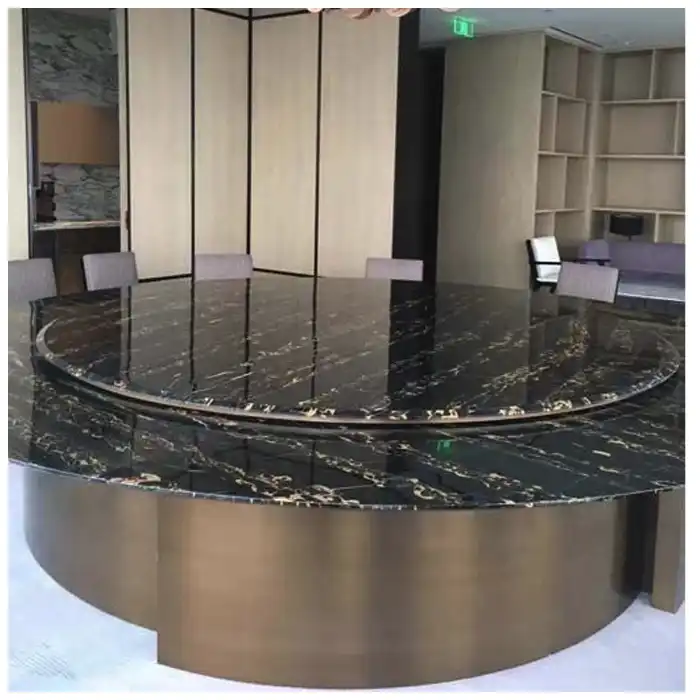
This is an application illustration rather than a specification for the modular floor and wall tiles sold on this page. Furniture components require separate dimensions, support arrangements and finished-edge details.
Italian Portoro Marble Tiles Compared with Four Related Stone Finishes
Portoro stands apart from other dark and patterned stones through its black limestone background and naturally occurring golden veins. The four related MQ STONE products below differ in material appearance and finished surface configuration.
| Stone Product | Appearance and Form | Principal Difference |
|---|---|---|
| Italian Portoro Marble Tiles | Deep black stone with irregular gold veins; modular floor and wall tiles | Distinctive gold calcite-rich formations on a black natural background |
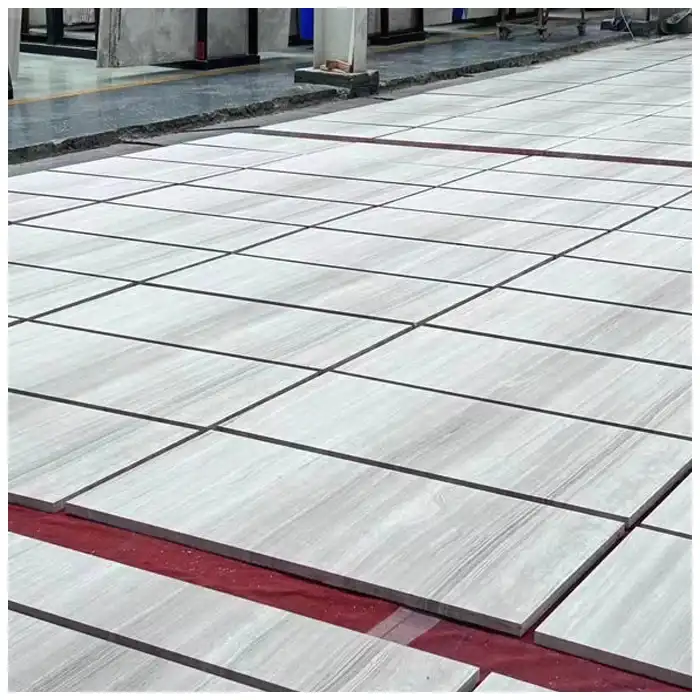
| Деревянная мраморная плитка | Light marble with directional, wood-like mineral bands | A pale stone with linear movement instead of black-and-gold contrast |
| Мраморная плитка Black Marquina | Black natural marble with contrasting white veins | White-vein contrast rather than Portoro’s golden formations |
| Темная мраморная плитка Emperador | Deep brown marble with irregular pale mineral veins | Brown background and lighter mineral network instead of black stone with gold veins |
| Ceppo Marble Tiles | Grey decorative stone with visible irregular fragments | A fragmented mineral pattern rather than Portoro’s flowing gold veins |
The listed stones are separate product selections. Their differences extend beyond colour: finished tile geometry, material composition and installation conditions must correspond to each individual product specification.
Italian Portoro Marble Tile Inspection and Export Packing
Inspection of Italian Portoro tiles begins with the accepted stone appearance. The colour grade establishes the intended balance between black background, wide golden veins and finer mineral markings.
Finished dimensions are checked against the selected tile format. Differences in length, width or squareness can become particularly visible on dark floors with narrow joints.
Polished surfaces require examination for visible scratches, edge chips and inconsistent reflection. Gold-veined areas are evaluated for their natural condition, including the stability of any mineral boundaries near an exposed edge.
The tile thickness and edge profile must correspond to the approved specification. Components intended for skirting or stairwork are identified separately from ordinary floor tiles.
Protective separation between polished faces helps limit contact damage during transportation. Suitable cartons and reinforced export crates support the stone and reduce movement during handling.
When an installation uses several vein-density groups, their identification can be maintained through packing. This assists with the intended distribution of stronger gold patterns across adjoining finished surfaces.
Cleaning and Maintenance of Nero Portoro Black Marble
Nero Portoro is a carbonate-based natural stone. Acidic cleaning agents can react with the surface and cause etching, particularly noticeable on polished black areas.
Routine cleaning with a compatible pH-neutral stone cleaner and soft equipment helps limit abrasion. Loose sand and grit should be removed from floors before wet cleaning.
Polished black stone can show dried water marks, fingerprints and cleaning residues under directional lighting. Removing these deposits promptly helps maintain the contrast between the black background and golden veins.
A compatible impregnating sealer may reduce certain staining risks, but it does not prevent acid etching or eliminate the need to maintain grout joints.
Floor maintenance must also consider traffic and moisture exposure. Surface wear and the condition of surrounding joints influence the appearance of the completed installation over time.
FAQs About Italian Portoro Marble Tiles
What is Italian Portoro Marble?
Italian Portoro Marble is a black-and-gold decorative natural stone originating from the Portovenere area of Liguria, Italy. It is commercially sold as marble but geologically classified as a black limestone.
What is the difference between Italian Portoro and Nero Portoro Marble?
Italian Portoro and Nero Portoro are commercial names for the same traditional black-and-gold stone family. Individual selections may differ in the width, density and arrangement of their golden veins.
What tile sizes are available for Italian Portoro Marble?
The specified tile formats are 600 × 600mm, 600 × 300mm, 600 × 900mm and 457 × 457mm. These are finished tile dimensions rather than full-slab sizes.
What thicknesses are available for Nero Portoro Marble Tiles?
The listed thicknesses are 10mm, 12mm, 16mm, 18mm and 29mm. The selected thickness must suit the tile dimensions, installation construction and approved specification.
Are the gold veins in Italian Portoro Marble natural?
Yes. The golden veins are natural mineral formations associated with calcite and iron-bearing material. Their position and intensity vary between individual tiles.
Can Italian Portoro Marble be used for indoor flooring?
Italian Portoro Marble can be specified for suitable interior flooring with an appropriate tile thickness, supporting substrate and installation system. Surface traction must be assessed for the expected walking conditions.
Are polished and honed Portoro Marble Tiles available?
Yes. Polished and honed finishes are available. Polished Portoro has a reflective black surface with pronounced gold veining, while honed Portoro has a lower-sheen appearance.
Can Portoro Marble Tiles be matched with stair and skirting components?
Matching Portoro stone can be fabricated for skirting, wall returns and selected stair details. These components require separate dimensions, edge profiles and structural specifications.
Are the listed Portoro Marble test values certified for this tile batch?
No. The published physical properties are reference measurements from documented Italian Portoro natural stone. They are not current-batch laboratory certificates for MQ STONE finished tiles.
What information is required for an Italian Portoro Marble Tile quotation?
The quotation specification includes tile dimensions, thickness, surface finish, quantity and delivery destination. Coordinated floor or stairwork may also require cutting schedules and finished-edge details.
Italian Portoro Marble Tile Specification and Vein Selection
Italian Portoro is distinguished by naturally occurring gold veins within a deep black carbonate stone. In modular tile form, the balance between vein density, tile dimensions and joint layout determines the completed surface. The four specified tile formats support different interior arrangements, while thickness and finish must correspond to the installation. Grading the stone before cutting helps establish a consistent visual range without removing the irregularity of the natural Portoro pattern.
Recommended Natural Marble Floor and Wall Tiles


Italian Portoro Black and Gold Marble Tile Supply
MQ STONE supplies Italian Portoro natural stone in cut-to-size tile formats for specified interior flooring and wall cladding. The selected vein grade, tile dimensions and surface finish determine the finished appearance. Coordinated skirting and architectural stone components can be processed according to approved drawings where required.
Request Italian Portoro Marble Details
Include tile size, thickness, finish, required quantity and delivery destination. Floor layouts and special cutting details can be included in the project specification.