Quick Summary: Rosso Damascus Marble Slabs for Red Stone Tables and Feature Walls
Россо дамасский мрамор is a Syrian natural red stone featuring ruby-red and crimson mineral areas, orange-yellow veins and irregular grey to black markings. Also known commercially as Rosa Damascus or Rosso Damasco, the material is used for decorative wall panels, marble dining tables, bathroom vanities and custom countertops. MQ STONE’s catalogue includes slab references of 2400mm+ × 1400mm+ and 2000mm+ × 1000mm+, with 16mm, 18mm and 20mm thickness options. The material can also be cut into interior tiles and architectural components. Slab selection is particularly important where the red and lighter mineral bands must continue across adjoining surfaces.
Rosso Damascus Marble Slabs: Syrian Ruby-Red Stone for Interior Feature Walls

Rosso Damascus Marble has an intense red background interrupted by mineral markings in yellow, orange, grey and darker charcoal tones. The red colour is not completely uniform. Some areas appear deep crimson, while others have a brighter ruby or reddish-brown character.
The stone is associated with Syria and is also traded under the names Rosa Damascus, Rosso Damasco and Syrian Ruby Red Marble. The Italian-language name does not establish Italian quarry origin. Materials sold under similar trade names can also come from other countries, which makes the source designation important when identifying a particular selection.
On an interior feature wall, the main attraction is the interaction between concentrated red mineral areas and the lighter veins. A broad crimson section can form the background of a reception wall, while the orange-yellow lines introduce movement across its surface.
Large panels reveal this composition more clearly than small modular pieces. A wall assembled from two or three suitably arranged slabs retains the relationship between darker red sections and the more intricate mineral markings. When many small tiles are used, the pattern becomes more fragmented.
Rosso Damascus can create a strong contrast with pale limestone, neutral plaster, dark timber and bronze-coloured metal. For a hotel bar or villa interior, concentrating the red stone on one prominent surface can give the material sufficient visual space without covering every adjoining wall in the same pattern.
Rosa Damascus Syrian Marble Slabs: Red Colour Grading and Vein-Matched Layouts

A single Rosso Damascus slab can contain several shades of red. Some sections show broad ruby-coloured mineral areas, while others develop more orange, brown or dark grey movement. This variation is an important part of the material’s appearance.
For a large wall, adjacent slabs need to be assessed as one composition. A dark red piece placed beside a much brighter orange-red selection can create a strong visual break. That contrast may be intentional, but it should be determined during slab layout rather than discovered after installation.
Ruby-Red and Orange-Red Selections
Ruby-dominant slabs create a deeper colour field, particularly under warm interior lighting. Pieces with stronger orange-yellow mineral passages have a more varied appearance and can introduce greater movement on a large wall or furniture surface.
Vein Matching and Bookmatching
Vein matching follows related mineral lines across adjacent pieces. Bookmatching creates a mirrored pattern using suitable corresponding slab faces. Rosso Damascus can produce striking symmetrical compositions when the natural mineral distribution and slab sequence permit it.
A large orange vein may appear to divide two crimson sections, while grey or black markings form the outline of a larger mineral shape. Mirroring these features can create a balanced reception wall. The effect cannot be guaranteed by the commercial stone name alone.
For projects involving several panels, the wall elevation should identify the central joint, panel orientation and any openings before cutting begins. A prominent yellow-grey formation removed by a doorway or display recess may substantially change the intended pattern.
Rosso Damascus Red Marble Slab Sizes and Fabrication Specifications
MQ STONE’s original product catalogue lists large slabs, modular tiles, vanity tops, kitchen countertop formats and stair components. The information below separates dimensional references from surface treatments and distinguishes stone slab thickness from finished countertop construction.
| Название продукта | Rosso Damascus Marble Slabs and Tiles |
| Материал | Natural Syrian Red Marble |
| Commercial Names | Rosso Damascus Marble, Rosa Damascus Marble, Rosso Damasco Marble, Syrian Ruby Red Marble |
| Страна происхождения | Syria |
| Цвет | Ruby red, crimson, orange-yellow, reddish brown and grey-black mineral markings |
| Main Jumbo Slab Reference 1 | 2400mm+ × 1400mm+ |
| Main Jumbo Slab Reference 2 | 2000mm+ × 1000mm+ |
| Additional Catalogue Slab Reference | 2400mm+ × 1800mm+; actual usable dimensions depend on the selected slab |
| Slab Thickness References | 16mm, 18mm and 20mm |
| Small Square Tile Formats | 305 × 305 × 10mm, 406 × 406 × 10mm and 457 × 457 × 10mm |
| Rectangular Tile Reference | 300 × 600 × 20mm |
| Large Square Tile Reference | 600 × 600 × 20mm |
| Vanity Top Size References | 25″ × 22″, 31″ × 22″, 37″ × 22″, 49″ × 22″ and 61″ × 22″ |
| Countertop Size References | 96″ × 26″, 108″ × 26″, 96″ × 36″, 72″ × 36″ and 96″ × 16″ |
| Fabricated Countertop Thickness References | 3/4″ and 1 1/4″ nominal finished-product references; construction may differ from the slab thickness |
| Stair Tread References | 1000–1500 × 300–350 × 20/30mm |
| Stair Riser References | 1000–1500 × 120–170 × 20/30mm |
| Main Surface Finish | Полированный |
| Additional Finishes | Honed, brushed, tumbled and selected decorative surface treatments |
| Finished Product Forms | Polished slabs, dining tables, vanity tops, kitchen countertops, interior wall panels, floor tiles and stair components |
| Primary Applications | Hotel reception features, residential dining rooms, decorative stone furniture, bathroom vanities and selected interior flooring |
Rosso Damascus Polished Marble Slabs for Reception Walls and Decorative Interiors

Polishing gives Rosso Damascus a reflective surface that intensifies the red background and reveals finer mineral differences around its veins. Darker grey areas become more defined, while yellow-orange markings introduce warmth within the crimson stone.
On a reception wall, this finish can make the stone’s pattern visible from across the room. Large red areas establish a continuous colour field, while the lighter veins remain recognizable as separate natural formations.
A honed finish reduces surface reflection and may soften the contrast between red and darker mineral areas. Brushed processing introduces a different tactile character, though the final texture and colour depend on the particular stone and abrasive treatment.
For red marble walls, lighting changes the perceived colour considerably. Warm lighting can emphasize orange and reddish-brown sections, while cooler lighting may make grey and black markings more apparent. Large samples are more informative than small chips because they reveal how different mineral areas respond across the same polished surface.
Acid treatments or aggressive surface processing should not be selected merely from a generic finish list. Rosso Damascus contains colour variations and natural mineral boundaries that may respond differently to processing. A finished sample is appropriate when a non-polished treatment is required for a particular architectural detail.
Rosso Damascus Red Marble for Dining Tables, Countertops and Vanity Tops

A dining table made from Rosso Damascus presents the ruby-red mineral pattern on a horizontal surface. Unlike a wall viewed from a distance, the stone is seen close to the user, making the smaller yellow, orange and grey lines part of the tabletop’s appearance.
A rectangular tabletop can retain a long mineral formation running through the centre. For round or oval designs, the cutting outline removes the corners of the original slab, which may alter the relationship between the red background and lighter veins.
Dining Table Edge and Support
A straight eased edge shows the natural thickness of the stone. A mitred build-up can create the appearance of a thicker tabletop, but the edge construction and supporting base need to accommodate the finished weight and span.
Large marble dining tables require stable support rather than relying on the stone to bridge an unsupported opening. Natural fissures and mineral boundaries should be considered where the tabletop is cut into narrow sections or where a fixing detail is proposed.
Bathroom Vanity Tops
In a bathroom, a Rosso Damascus vanity top introduces concentrated red colour around a sink. The countertop may be paired with neutral wall stone, timber cabinets or dark metal fittings. Sink cutouts should avoid leaving excessively narrow marble strips, and the exposed edges need appropriate machining and support.
Kitchen Countertop Performance
Rosso Damascus is a natural carbonate stone sold commercially as marble. It can be fabricated into kitchen countertops, but it is not immune to acid etching, scratches, staining or chipping. Its suitability for a working kitchen depends on maintenance expectations, the finish and the handling of exposed edges and openings.
Rosso Damascus Marble Countertop and Table Interior Application

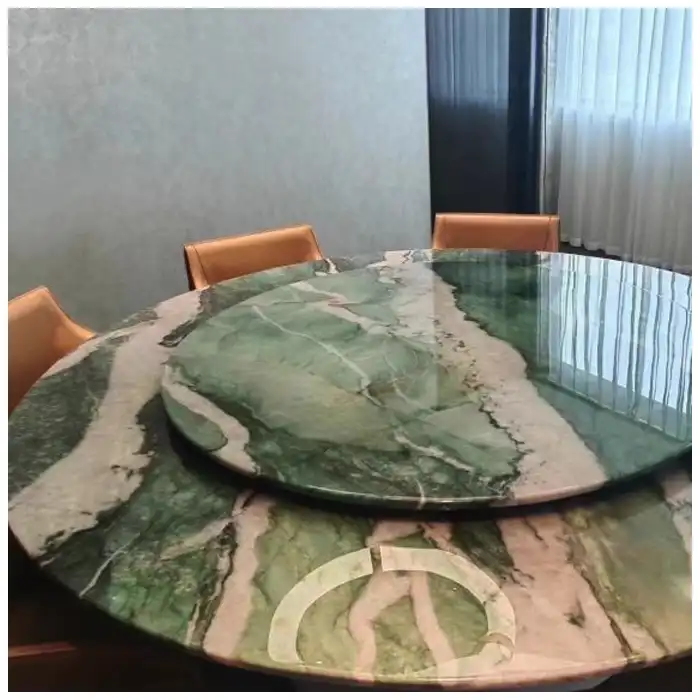
The Rosso Damascus countertop and table application image demonstrates how the material can be used on finished horizontal surfaces. Its strong red colouring allows an individual table or countertop to become the principal colour accent within a room.
For a dining area, the marble can be paired with neutral flooring and restrained wall finishes. This gives the red tabletop a clear visual identity without placing similarly intense patterns on every surrounding surface.
A countertop or bar surface introduces additional fabrication considerations. Its working height, edge profile and supporting structure determine how the finished stone relates to the cabinetry below. Openings and joints also influence which parts of the red mineral pattern remain visible.
The image represents the material’s application direction; it does not establish the dimensions, project location or construction details of a specific completed installation. Finished stone components are determined by their individual drawings and selected slabs.
Rosso Damascus Marble Tiles for Interior Walls, Floors and Stairs
Cutting Rosso Damascus into smaller tiles changes the visual distribution of its colours. A 305 × 305mm tile may contain mostly crimson stone with one short yellow vein, while a larger 600 × 600mm tile can preserve a broader section of the red and grey mineral movement.
For a decorative hotel wall, small tiles can create a repeating field of red colour. Larger wall panels retain more natural pattern continuity and reduce the number of joints crossing the mineral bands. The choice depends on whether the architecture calls for a modular finish or a more continuous stone composition.
Interior floor tiles require a different assessment. A polished red marble floor can look striking in a private entrance or selected decorative area, but gloss does not establish slip resistance. Public circulation areas and floors exposed to water need finish-specific testing and appropriate maintenance planning.
Rosso Damascus may also be fabricated into stair treads and risers. The tread edge, support conditions and walking-surface traction must be addressed independently of the colour selection. Exterior paving or exposed steps should not be assumed suitable without material-specific weathering and slip-performance evidence.
Physical and Mechanical Properties of Syrian Rosa Damascus Marble
A published technical listing for Syrian Rosso Numidia, also identified commercially as Rosa Damascus and Rosso Damasco, provides the reference values below. These measurements describe that commercial material selection. They do not establish the tested properties of every slab using the Rosso Damascus name or certify the current MQ STONE inventory.
| Material Property | Published Reference | Technical Interpretation |
| Насыпная плотность | 2650 kg/m³ | Indicative material density for preliminary stone weight assessment. |
| Water Absorption by Weight | 0.80% | Reference absorption of the listed material; not a guarantee against stains or moisture-related changes. |
| Прочность на изгиб | 18.0 MPa | Reference bending strength; the installed capacity of a panel or countertop also depends on its geometry and support. |
| Прочность на сжатие | 98.10 MPa | Published compression resistance for the commercial reference stone. |
| Устойчивость к истиранию | Not established for this reference | Relevant to flooring wear and surface-finish selection. |
| Wet Slip Resistance | Not established for this reference | Requires testing of the actual polished, honed or textured tile surface. |
Technical qualification: the listed figures relate to a Syrian Rosa Damascus / Rosso Numidia commercial reference. Similar Rosso Damasco names also occur for stones of other origins. No independent matching batch test certificate or laboratory standard identifier has been established for the current MQ STONE material, so the figures are reference values only.
Rosso Damascus Marble Compared with Four Decorative Marble Collections
Rosso Damascus introduces a colour direction that differs considerably from white, black and grey marble. The following collections provide alternative natural patterns for wall panels, countertops and stone furniture, allowing the material choice to be made according to vein character and intended architectural use.
| Comparison | Россо дамасский мрамор | Мраморные плиты Panda | Мрамор Calacatta Borghini | Мраморные плиты Arabescato | Большой античный мрамор |
|---|---|---|---|---|---|
| Natural Appearance | Ruby-red and crimson areas with yellow-orange and dark mineral veins | White background with broad black veins | White to ivory with sweeping grey-gold mineral lines | White with interlocking grey loops and irregular rounded formations | Angular black-and-white brecciated formations |
| Product Forms | Polished red slabs, tables, countertops and interior tiles | Slabs, feature walls, tiles and countertops | Polished slabs, kitchen islands and feature panels | Polished slabs, dining tables and interior tiles | Decorative slabs, tables, wall panels and countertops |
| Feature Wall Effect | Concentrated red colour with warm contrasting veins | Graphic black veins over a white field | Open white areas and warm grey-gold movement | Complex grey looping patterns | High-contrast angular stone composition |
| Table and Counter Design | Ruby-red tabletop with orange and grey mineral detail | White counters with prominent black veins | White islands with grey-gold vein movement | Grey-loop patterns on rectangular or oval tables | Black-and-white fractured stone furniture |
| Interior Tile Use | Red wall panels and selected decorative floor areas | Black-and-white decorative interior flooring | White and gold-grey marble floor tiles | White interior tiles with grey veining | Selected high-contrast floor and wall accents |
| Fabrication Priority | Red colour grouping, mineral boundaries and tabletop support | Black-vein direction and slab pairing | Grey-gold vein placement and island openings | Curved vein positioning and matching panels | Angular contrast and panel cutting arrangement |
| Visual Positioning | Strong red architectural accent with warm mineral movement | Bold monochrome design | Warm white-and-gold marble design | Decorative grey-on-white arabesque pattern | Dramatic black-and-white fractured pattern |
Rosso Damascus Slab Selection, Surface Inspection and Export Packing
The inspection of Rosso Damascus slabs begins with colour grouping. A set of pieces intended for the same wall or furniture package should have a compatible balance of ruby-red, orange and darker mineral areas. Red colour variation is often more noticeable when several polished pieces are placed directly beside one another.
The stone should also be checked for natural fissures, treated mineral boundaries and sound edges. These features matter when cutting table corners, vanity sink openings or narrow sections of decorative wall panels.
Polished slabs require protection between finished faces during transport. Custom tabletops, countertop components and wall panels should be packed according to size and shape, with additional edge protection for curved pieces or cutout sections. Matched wall panels need clear position identification so their intended vein arrangement can be reconstructed during installation.
Cleaning and Maintaining Rosso Damascus Red Marble
Clean Rosso Damascus Marble with a pH-neutral product suitable for natural carbonate stone and a soft cloth or non-abrasive cleaning pad. Remove loose grit before washing polished floors or tables. Acidic food, wine, citrus juice and unsuitable bathroom cleaners can cause etching on marble, while abrasive materials may dull the polished surface. An impregnating sealer can help reduce certain absorption-related stains after compatibility testing, but it does not prevent acid etching. For dining tables, use coasters and protective mats; for vanities, maintain the sealant around sinks and avoid prolonged exposure to aggressive cleaning chemicals.
FAQs About Rosso Damascus Marble Slabs
Where does Rosso Damascus Marble come from?
The Rosso Damascus Marble selection described here is identified as Syrian natural red marble. Rosso Damasco and Rosa Damascus are commercial names also used for similar materials, so the declared source should accompany the product name.
What colours appear in Rosso Damascus Ruby Red Marble?
Rosso Damascus contains ruby-red and crimson mineral areas, often accompanied by orange-yellow, reddish-brown and darker grey or black markings. The colour proportions vary across individual slabs.
Is Rosa Damascus Marble the same as Rosso Damasco Marble?
Rosa Damascus and Rosso Damasco are related commercial names used for red natural marble. Similar names may cover materials from different quarry regions, so the origin and actual slab appearance are necessary for accurate identification.
What sizes are available for Rosso Damascus Marble Slabs?
MQ STONE’s catalogue references large slabs of 2400mm+ × 1400mm+ and 2000mm+ × 1000mm+, with an additional 2400mm+ × 1800mm+ catalogue reference. Listed slab thicknesses include 16mm, 18mm and 20mm.
Can Rosso Damascus Marble Slabs be bookmatched?
Yes. Suitable corresponding slab faces can create mirrored compositions featuring the natural red, orange and grey mineral patterns. The result depends on the available slab sequence and planned panel arrangement.
Is Rosso Damascus Marble suitable for dining tables?
Rosso Damascus can be fabricated into rectangular, round and oval dining tables. The cutting outline, mineral boundaries, support structure and edge profile need to be considered, and the polished surface requires protection from acidic spills and impacts.
Can Rosso Damascus Marble be used for kitchen countertops?
Rosso Damascus can be fabricated into kitchen countertops, but it is a carbonate-based natural stone that may develop scratches, stains or acid etching. Sink openings, exposed edges and supporting construction are important fabrication details.
What tile sizes are listed for Rosso Damascus Marble?
Catalogue formats include 305 × 305 × 10mm, 406 × 406 × 10mm, 457 × 457 × 10mm, 300 × 600 × 20mm and 600 × 600 × 20mm, with cut-to-size processing for suitable interior applications.
What physical properties are published for Syrian Rosa Damascus Marble?
A published Syrian Rosso Numidia / Rosa Damascus commercial reference lists density of 2650 kg/m³, water absorption of 0.80%, flexural strength of 18.0 MPa and compressive strength of 98.10 MPa. These are representative values, not current MQ STONE batch-certified results.
How should polished Rosso Damascus Marble be maintained?
Use pH-neutral natural stone cleaners and avoid acidic or abrasive products. Remove grit before cleaning, wipe food and drink spills promptly and protect tabletop edges from impacts. Sealing may reduce certain stains but does not prevent acid etching or scratches.
Recommended Decorative Marble Slabs for Interior Stone Projects

Мраморные плиты Panda
Chinese white marble with strong black mineral bands for feature walls and graphic countertops.

Мрамор Calacatta Borghini
Italian white marble with warm gold-grey veins for kitchen islands and bookmatched walls.

Мраморные плиты Arabescato
Italian white marble with looping grey veins for dining tables, interior tiles and decorative panels.

Большой античный мрамор
Brecciated black-and-white marble for reception walls, decorative stone tables and countertops.

Rosso Damascus Marble for Ruby-Red Tables and Interior Feature Panels
Rosso Damascus is most effective when the finished stone piece preserves a coherent balance of crimson and lighter mineral movement. For a dining table, the main red and yellow formations need to fit within the tabletop outline. For a large feature wall, related slab faces can be arranged around the architectural elevation. The material selection therefore depends on the intended finished dimensions as well as the colour pattern of the available slabs.
Rosso Damascus Marble Project Enquiry
Send your slab dimensions, dining table drawings, countertop details or wall panel layout for a Rosso Damascus Marble quotation.