Arabescato Corchia Honed Finish: What It Does to Depth, Touch, and Repair Visibility
Run a hand across a honed Arabescato surface and the first thing you notice is not a shine. It is a quiet resistance, almost like paper with a polished mineral beneath it. The looping grey veins still move, but they stop flashing at every light source. A finish should reveal that time without turning the slab into a mirror.
Read the Whole Slab Before You Read the Detail
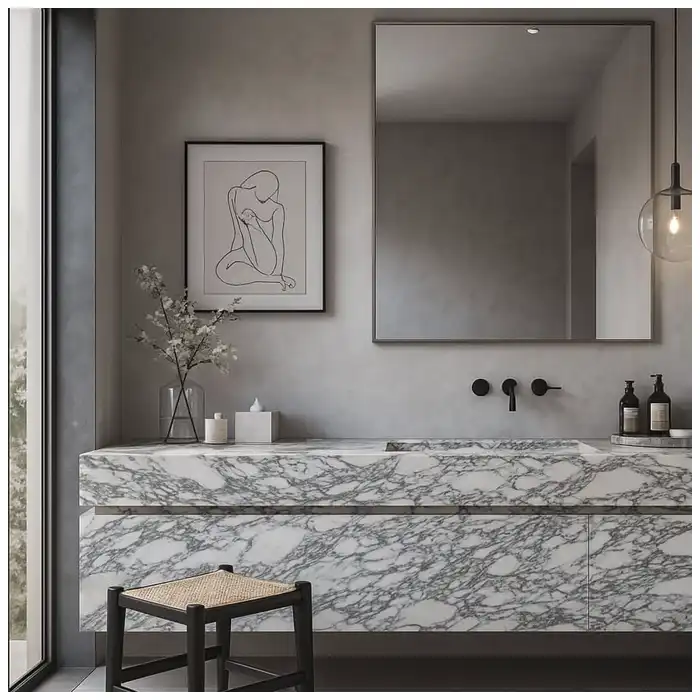
Honing removes the high reflection of a polished surface by stopping at a finer but non-gloss finish. On calcite-rich marble, that changes the way light returns to the eye. The white field can appear softer. The darker veins can appear more integrated. The effect is not a colour correction. It is an optical change caused by surface texture and scattered reflection.
Look at the actual Arabescato Corchia slab, not a generic honed sample. Fine mineral variation and tiny filled features can be more visible after honing, especially when light comes across the face at a low angle. The movement shows where a gentle finish supports the composition and where it reveals a line that should sit outside the principal view.
A finish decision belongs early in slab selection. It affects the way a client reads the selected crop, the edge profile, the appearance of joint lines, and the tolerance for later touch-up. Changing from polished to honed after a table outline has been approved can be like changing the room light after choosing paint. The composition is still there, but the balance shifts.
How an Arabescato Corchia honed finish changes the design decision
Honed marble feels more tactile because the surface does not throw a bright reflection between hand and stone. That can suit a dining top, console, or wall where the room asks for softness. In a low table, it can make the pale field feel broader and less formal. A calm finish often ages better than a constant sparkle.
Do not confuse honed with rough. A proper honed finish remains smooth enough for a table surface and consistent enough for cleaning. It is not a substitute for texture where traction is the main issue, and it does not remove marble’s sensitivity to acidic liquids. Finish choice and care choice are separate conversations.
Repair visibility changes with direction of light. A polished surface may hide a small filled line when the face reflects a window, then reveal it when you step aside. A honed surface can make a resin fill look flatter in one direction and slightly darker in another because it lacks the surrounding gloss. A repair needs assessment under more than one angle.
| Decision point | What to study | What changes downstream |
|---|---|---|
| Surface reflection | Direct and raking light on the actual slab | How veins and fills appear from seating height |
| Touch | Smoothness, drag, and edge feel | Suitability for frequent hand contact |
| Repair visibility | Face-on and oblique inspection photographs | Placement of filled or reinforced areas |
| Edge sample | Honed face beside chosen edge profile | Whether the profile reads too sharp or too heavy |
The Hard-Won Lesson: A late finish change moved the repair into view
The risk is created by sequence, not by the stone. The approval photograph is taken on a polished slab, then the finish changes to honed to reduce reflection in the room. A small filled area near the edge that the brighter reflection had hidden becomes a darker mark seen from the sofa. The stone did not fail; the approval sequence did.
The Lesson: Approve finish and slab crop together; never assume a honed face will show the same details as a polished one.
Material, Light, and the Way the Eye Returns
Natural stone holds more visual depth than a printed surface because the movement is part of the material, not a graphic laid on top. Arabescato Corchia can carry fine calcite crystals, grey mineral traces, and pressure-shaped lines through the body of the slab. Honing lets that depth read through diffuse light rather than a hard surface reflection.
That does not mean honed is always quieter. Under a warm source near 3000 K, tested on the sample for the project, a honed pale marble may look warmer and the grey veins may soften. Under a cooler source, the field can look crisper and a resin fill may become easier to spot. The finish test needs the likely lighting condition, especially for hospitality interiors where decorative lamps and daylight overlap.
For a wall, the viewing distance can forgive more. For a table, hands, glasses, and eyes come closer. Ask how the finish will meet an eased edge, a mitred return, and a possible repair zone. Some parts of the slab should be reserved for a calm central surface, while others can take a less perfect but structurally sensible area.
Where Fabrication Needs to Join the Conversation
The fabricator needs a finish sample signed beside the actual stone, rather than a word on a drawing. Photograph it dry, clean, and under raking light. Mark any accepted fill or natural fissure on the slab map. That saves a later argument about whether a feature appeared during fabrication or was visible before the cutter started.
If the material is for a dining table, test a small inconspicuous area with the maintenance routine approved for the project. Do not stage a harsh chemical test just to create a dramatic photograph. Marble care is about prompt wiping, neutral cleaning, and reasonable use; it is not an invitation to pretend the stone will behave like sintered material.
If the delivered finish looks different from approval, photograph the face under comparable lighting, include an oblique view, and keep the approved sample beside the top. Pause installation. Then compare the stone, finish sheet, and fabrication images before anyone tries to re-polish, re-hone, or apply a coating.
Making a Decision You Will Still Like Later
An Arabescato Corchia honed finish can be deeply satisfying when the room needs a lower-reflection surface and the slab has been selected for that way of seeing. It makes the stone feel less like an object behind glass and more like a material with weight and temperature.
The decision is not a contest between matte and shine. It is a question of what light, touch, edge, and daily use ask from one particular slab. I would rather live with a carefully tested honed finish than chase a generic idea of luxury.
Details That Change the Final Result
A finish sample should be larger than a business card. I want enough area to see how the pale ground holds light beside a vein and near a natural feature. A small polished chip can make any marble look bright. A larger honed sample reveals whether the slab still has depth when the reflection falls away.
Arabescato Corchia honed finish changes the room at different times of day. Daylight spreads across the surface and can make the calcite field look airy. Warm evening light can soften the grey into the surrounding furnishings. That is not a flaw. It is the material responding to light, and it needs to be part of the approval.
For a wall panel, a honed face may reduce glare from windows and lighting. For a table, it may make fingerprints and small dry spills read differently than a polished face. Neither observation is a reason to reject honing. It is a reason to decide how people will use the surface and how it will be cleaned.
An Arabescato Corchia honed finish can reveal a pale fill at a low angle because the surrounding reflection is subdued. Ask for an oblique photograph and a face-on photograph before accepting any feature. The same photographs show whether the repair sits inside active movement or interrupts a quiet field where the eye will stop.
A honed edge should be sampled with the same arris and profile planned for the job. A crisp cut may look sharper against a softer face than it did on a polished mock-up. A small easing can make the transition more natural while protecting a vulnerable edge from an everyday knock.
Do not let a broad claim about stain resistance choose a finish. Marble remains a calcium-rich material, so acidic liquids can etch it. The ordinary response is prompt wiping and neutral cleaning. A finish can change how that use mark is seen, but it does not change the material into another substance.
The value of honing is that it can make the geological depth feel nearer to the hand. The choice works when it supports the room and the slab. It is less convincing when it is selected only because a generic mood board calls for matte surfaces.
A balanced honed surface does that because it does not throw back every light source. It lets the eye stay with the pale ground, then find the darker turns of the Arabescato when it is ready.
Before the Room Becomes Fixed
Honing should be specified with a physical reference rather than a vague request for matte. There are degrees of surface reflection, and an approval sample makes the intended result visible to the fabricator, designer, and client. Words become too broad once the slab reaches the workshop.
Look at the sample beside its planned neighbours. Pale timber, dark metal, brushed brass, and soft textiles each change how the marble ground is read. A finish that looks quiet against one material may feel chalky or flat beside another. The stone deserves a room-level decision.
An Arabescato Corchia honed finish should be tested after the planned edge is made, rather than on a flat face alone. The edge catches light differently and may make a subtle difference in sheen more obvious. This is especially important on a table or console where hands naturally trace the perimeter.
A light repair can be technically stable yet visually noticeable when it crosses a quiet field. Place acceptable features in areas where the natural movement can hold them, and mark that acceptance before the finishing step. Honing cannot make an awkward repair disappear just because it lowers gloss.
Maintenance staff need a sample of the finish in the handover file when the project has several similar marble surfaces. It helps them compare a later mark with the original appearance rather than trying to remember how the stone looked before daily use began.
Arabescato Corchia honed finish works best when the decision comes from the selected slab and the actual room light. It should not be borrowed from a generic trend toward softer surfaces. A fine stone can be polished beautifully; it can also be honed beautifully. The answer belongs to its own face.
At final inspection, move the sample through the room rather than holding it in one bright spot. Reflection changes as the observer moves. The calm that matters is not a single camera angle but the repeated experience of living with the surface.
A well-resolved finish does not announce a technical process. It lets the material keep its depth, lets the edge feel deliberate, and gives daily use a surface that is honest about what it is.
Final Material Check Before Release
An Arabescato Corchia honed finish deserves a final light check after fabrication. View the top or panel under a side source and then under the room’s ordinary ambient lighting. One condition reveals surface texture; the other reveals whether the grey movement remains balanced.
Do not treat a finish sample as a separate decorative accessory. Its job is to show the actual material behaviour: reflection, touch, edge appearance, and any accepted natural feature. Keep it with the slab approval so later discussions begin from evidence.
An Arabescato Corchia honed finish can make a room feel quieter without making the material disappear. The white ground stays present, and the darker movement appears gradually as light moves across the surface. That slow reading is precisely the attraction.
For any repair near a visible edge, compare a finished offcut with the full face. A small adjustment may be reasonable, but it needs to sit comfortably within the selected finish before it is accepted.
The right Arabescato Corchia honed finish feels resolved because the stone, edge, lighting, and use all tell the same story.
Questions We Hear Before Production
1. Does an Arabescato Corchia honed finish make the marble darker?
It can change perceived tone because it scatters light differently from polish. Test the actual slab under the planned lighting before approval.
2. Is honed marble suitable for a dining or coffee table?
It can be suitable when the finish, edge, use, and care routine are chosen together. Honing does not remove the need for prompt cleaning.
3. Are repairs more visible on honed marble?
They can be more or less visible depending on light angle, resin tone, and surrounding movement. Inspect accepted features under direct and oblique light.
4. Should finish be decided before the slab crop is approved?
Yes. A polished and honed face can reveal the same veins and fills differently, so crop and finish should be approved together.
5. What should I do if the delivered finish differs from the sample?
Photograph the face under comparable lighting, include an oblique view, pause installation, and compare the piece with approved finish and fabrication records.
Quick-Reference Checklist
- Approve a honed sample beside the actual selected slab.
- Inspect face, edge, fill areas, and fissures under raking light.
- Record finish level and acceptable features on the slab map.
- Test the intended cleaner on an approved offcut.
- Compare delivered material with the approved sample before installation.
Final Conclusion
An Arabescato Corchia honed finish lets the stone hold light and time in a quieter way. MQ STONE would always approve that quietness on the real slab first, because the surface has to be judged as it will actually be finished.
References
- Dimension Stone Design Manual, Natural Stone Institute.
- ASTM C97 Test Methods for Absorption and Bulk Specific Gravity of Dimension Stone, ASTM International.
- ASTM C503/C503M Standard Specification for Marble Dimension Stone, ASTM International.
- ASTM C119 Standard Terminology Relating to Dimension Stone, ASTM International.
- Natural Stone Institute technical modules and installation standards, Natural Stone Institute.
- Мермер, Wikipedia.