Following Green Onyx Slab Selection from Quiet Stone to Backlit Wall
Onyx Slabs in Two Kinds of Light: What the Face Reveals before Fabrication brings the wider selection and fabrication decisions together. Green material adds a more specific question: how should one face be composed within the scale, light, and palette of a premium interior?
Replace the second paragraph containing the unlinked bold core title under “Keep Resin, Backing, and Support inside the Visual Record”.
Onyx Slabs in Two Kinds of Light: What the Face Reveals before Fabrication keeps thickness, treatment, fabrication, support, light, care, and service access within the same material decision.
Insert immediately after the paragraph about resin and fiberglass backing under “Keep Resin, Backing, and Support inside the Visual Record”.
If a mesh grid, resin halo, or filled fissure changes the glow, the cause belongs in the reverse-side record. Reading Onyx Slab Resin and Fiberglass Backing before Cutting connects those treatment zones with adhesive tests, openings, exposed edges, and the first fabricated piece.
RELATED PROJECT GUIDES
Replace the entire existing Related Project Guides section with this code.
A green onyx face can look like still water under front light. When illumination moves behind it, pale clouds open, dark lines gather weight, and one corner may turn almost golden. I let that change happen before making any promise. Green onyx slab selection begins with the full transition.
My direct method uses three views: the complete unlit face, the transmitted-light map, and the slab inside the proposed room palette. One view alone can make the material greener, cleaner, or more uniform than it is.
Begin Green Onyx Slab Selection with Mineral Color, Not a Color Name
Architectural green onyx is commonly calcite- or aragonite-rich decorative stone with layered mineral deposition. The English entry for calcite gives useful mineral background, but the selected slab can also contain inclusions, fissures, resin, and local treatment that change color and transmission.
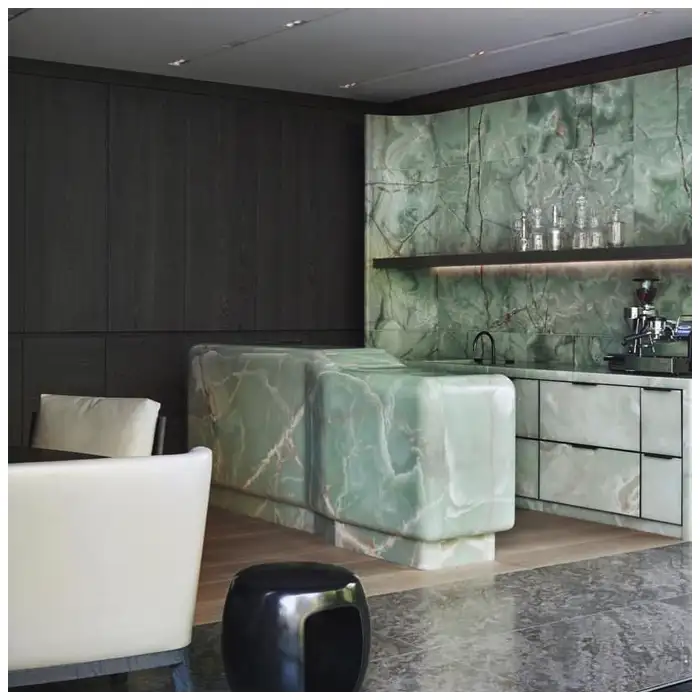
А Зелени оникс slab may hold pale mint fields, deep olive bands, white crystalline passages, and warmer mineral traces. I record those zones rather than reducing the face to “emerald green.”
Onyx Slabs in Two Kinds of Light: What the Face Reveals before Fabrication brings the wider selection and fabrication decisions together. Green material adds a more specific question: how should one face be composed within the scale, light, and palette of a premium interior?
The unlit face is the daytime material
Backlight can dominate approval, yet many rooms use daylight or reflected light for long periods. I inspect polish, haze, resin, repairs, scratches, and the balance of green and white with the light box off.
Green onyx backlighting should enrich the mineral face, not rescue a slab that looks unresolved without illumination. True luxury is something you never get tired of looking at.
Map Color and Transmission across the Whole Face
I use a broad source behind the slab or representative full-size area. A handheld lamp creates a small halo and tells me little about panel balance. The map separates high transmission, middle transmission, dense zones, fissures, filled areas, and backing effects.
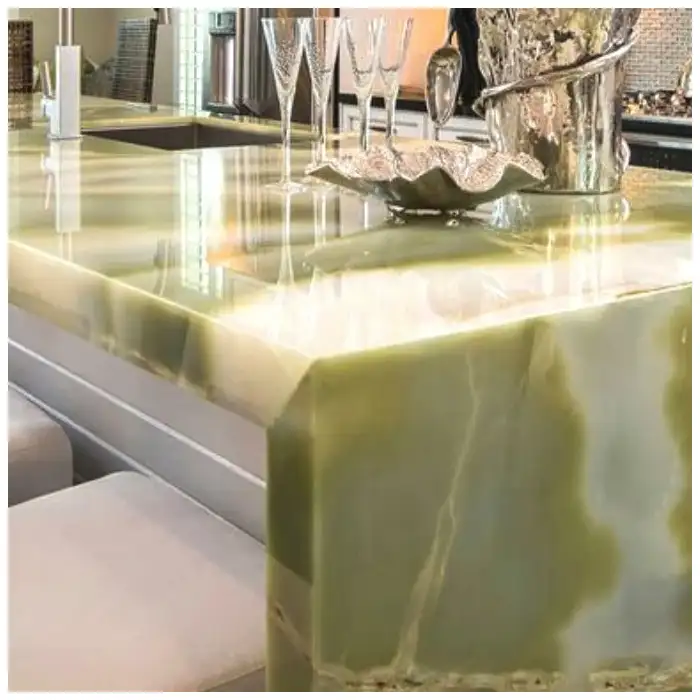
А Зелени оникс камени врх brings the material close to hands, glassware, edges, spills, and service lighting. The face used for a bar needs a different crop and care discussion from a wall seen across a lobby.
| Green-face feature | Unlit reading | Backlit reading | Layout response |
|---|---|---|---|
| Pale calcite cloud | Soft mint or cream field | Bright luminous pool | Use as breathing space or focal glow |
| Dense green band | Strong graphic line | Dark anchor or silhouette | Place deliberately near joint, edge, or center |
| White crystalline passage | Cool contrast | High transmission with sharp boundary | Check hot-spot risk and diffuser |
| Warm inclusion | Olive, ochre, or rusty note | May become amber under warm source | Compare with metal and timber palette |
| Resin or filled fissure | Gloss or tone may differ | Can flash, darken, or turn opaque | Keep visible on map and trial |
| Edge zone | Shows section color and polish | May glow more strongly than face | Approve profile and support shadow |
Choose the center from the light map, not from the slab midpoint
Place the elevation over the green face and move it until the brightest cloud, darkest band, and main vein create the intended balance. The geometric center of a slab is rarely the visual center of its geology. If the panel must be bookmatched, test both halves under the same source because mirrored veins can still transmit with different intensity.
Center the composition on mineral balance, then fit joints and edges around that decision.
Use Green Onyx Vein Layout to Control the Room’s Visual Weight
Green onyx vein layout decides whether the wall feels calm, vertical, horizontal, or turbulent. I mark dominant bands, cloud direction, possible pairings, crop losses, openings, and the nearest sightline.
Тхе Onyx Wall Panels: What to Confirm Before a Backlit Feature Wall Order takes the selected crop into panel sizes, joints, diffuser, support, and service access. A beautiful face is still only raw material until that assembly is proved.
The veins will tell you where the eye wants to travel. On a long bar, horizontal movement may extend the object. On a tall wall, one rising band can pull the composition upward. I do not rotate the slab because the cutting list nests better without comparing the visual consequence.
Bookmatch is an option, not a requirement
Some green faces produce a powerful mirrored center. Others become too symmetrical and lose the quiet irregularity that made the stone appealing. A slip match, continuous sequence, or single broad panel can suit the room better.
Тхе Semi Precious Stone Slabs and Onyx Wall Panels: How I Compare Light, Color, and Depth is useful when the project is deciding between layered onyx and more mosaic-like semi-precious surfaces. Scale and transmitted pattern are different, even when both glow.
Approve Green Onyx Edge Detail in Lit and Unlit States
The edge reveals the section. A polished bevel can gather a bright green line. A miter may introduce adhesive color or a shadow from backing. A thicker visible edge can make a bar or table feel geological, but it also increases the importance of support and close inspection.
Green onyx edge detail needs a physical corner with the actual face, thickness, backing termination, adhesive, polish, radius or bevel, and intended light direction. I touch the edge as well as photograph it.
А Ванила оникс плоча can serve as a deliberate pale contrast in a separate element, but I do not use it to patch a green composition. Clear contrast is honest. A near-match usually looks accidental.
Judge Green Onyx at the Room’s Viewing Distance
A warehouse test from half a metre exaggerates small repairs and local density. A lobby wall from ten metres can merge them into one field. Both distances matter if guests can approach the surface.
Тхе How Lighting Changes Colorful Marble, Quartzite, and Onyx Slabs helps establish daylight, side light, reflected light, and nighttime illumination. For green onyx slab selection, I add the room’s adjacent colors and dimming range.
Warm sources can push green toward olive or amber. Cooler sources can sharpen mint and white passages. I do not call one temperature correct without the material, interior palette, and lighting designer in front of the same mock-up.
Keep Resin, Backing, and Support inside the Visual Record
Resin and fiberglass backing may support fragile stone during handling, but they can also alter transmitted color or create a visible grid. The reverse photograph belongs beside the front and light map.
Onyx Slabs in Two Kinds of Light: What the Face Reveals before Fabrication keeps thickness, treatment, fabrication, support, light, care, and service access within the same material decision.
If the installed green differs from approval, photograph the complete face with lighting on and off, then record controls, source condition, slab code, panel position, and close details. Stop further installation or treatment. Compare the approved light map, crop, backing, diffuser, source layout, and inspection evidence before changing the assembly.
Release Green Onyx Slab Selection as a Complete Composition
The final green onyx slab selection record shows the entire numbered face in ordinary and transmitted light. I refuse crops that hide the dense zones likely to enter production.
For a bookmatched wall, green onyx slab selection includes the center joint under the proposed source. I check whether pale clouds balance or collapse into one bright vertical line.
At furniture scale, green onyx slab selection moves to the edge and corner. I want the color transition to remain deliberate when the viewer sees both face and thickness.
Before release, green onyx slab selection is compared with metal, timber, and upholstery samples under both light states. A green that works alone may fight the room around it.
With the slab chosen, green onyx backlighting moves to the actual diffuser and control range. I look for source lines, support shadows, and color drift before approving the visual center.
I then dim the assembly slowly and watch which mineral passages disappear first. That transition matters in hospitality rooms where the wall rarely operates at one fixed brightness all evening.
Frequently Asked Questions
1. Why does green onyx change color when backlit?
Light travels differently through pale calcite clouds, dense bands, inclusions, fissures, resin, and backing. The source color and diffuser also affect whether the face reads mint, emerald, olive, cream, or amber.
2. Is darker green onyx less translucent?
It may be denser in some zones, but color alone does not predict transmission. Map the complete face with a broad source and record local thickness, resin, repairs, and backing.
3. Should green onyx always be bookmatched?
No. Bookmatch, slip match, sequential panels, or one broad crop can each work. Choose the arrangement that respects cloud scale, main bands, transmission balance, joints, openings, and room proportion.
4. How is green onyx slab selection approved for a wall?
Approve numbered full faces in unlit and transmitted light, the crop and orientation, joints, bookmatch, thickness, resin, backing, edge, support, diffuser, source layout, controls, service access, and a physical mock-up.
5. What should happen first if installed green onyx looks too yellow or patchy?
Photograph the full wall with lighting on and off, stop further work, and compare source color, controls, slab map, crop, backing, diffuser, source spacing, and approved mock-up before selecting a correction.
Quick-Reference Green Onyx Selection Checklist
- Record the complete green face in reflected light with slab ID and scale visible.
- Map pale clouds, dense bands, inclusions, resin, fissures, backing, and transmission levels.
- Place the elevation, openings, joints, bookmatch, and edge strips on the light map.
- Compare the unlit and backlit face beside the room’s metals, timber, and textiles.
- Approve a physical edge and assembly trial at the nearest normal viewing distance.
- Retain the slab map, reverse photo, lighting settings, crop, and first-piece inspection.
Final Conclusion
Green onyx slab selection succeeds when the room accepts the complete face, not a cropped emerald moment. Map mineral color and transmission, choose the visual center, test joints and edges, and prove the assembly under its real light.
MQ STONE follows the green from unlit stone to luminous composition because the veins will tell you where the room should begin.

References
- Dimension Stone Design Manual, Natural Stone Institute.
- Natural Stone Institute Technical Bulletins for Translucent Stone, Natural Stone Institute.
- ASTM C97 Standard Test Methods for Absorption and Bulk Specific Gravity of Dimension Stone, ASTM International.
- ASTM C880 Standard Test Method for Flexural Strength of Dimension Stone, ASTM International.
- IES Lighting Handbook, Illuminating Engineering Society.
- Stone Conservation: Principles and Practice, Getty Conservation Institute.