Quick Summary
How to Choose Statement Slabs for Countertops, Walls, and Furniture
A statement slab should earn its place in the room. It may be a dramatic marble wall in a villa living room, a quartzite island in a kitchen, a blue marble reception counter, a green marble table, a sintered stone fireplace face, or a bookmatched stone backdrop in a hotel lobby. The purpose is the same: one surface carries the visual weight, while the rest of the room supports it.
The mistake is choosing the surface only because one photo looks strong. Natural stone and engineered panels behave differently once they are cut, edged, installed, lit, and used. A slab that looks perfect in a warehouse can become too busy on a small wall. A quiet slab can become excellent when it is centered on a table. A bookmatch can lose its effect if the centerline, outlets, or lighting are not planned before fabrication.
This guide is written for interior designers, architects, villa owners, hotel design teams, high-end residential renovation teams, and stone fabricators comparing current material gallery options for countertops, walls, furniture, bathrooms, reception areas, and project interiors. It explains how to choose a statement slab in a way that supports design quality and reduces avoidable fabrication risk.
Start with the surface and the role it plays
The first question is not “which stone is most beautiful?” The first question is where the surface will be used and what job it needs to do. A kitchen island may need a large, readable slab with practical cutouts. A wall may need a centered pattern and suitable fixing method. A table may need a balanced top and a safe base. A reception counter may need both visual strength and clean edge detailing.
When the surface has a clear role, the slab review becomes easier. A dramatic мермер can be a good choice for one strong wall, but it may feel too active across several rooms. A calm кварцит can suit an island because the veining can run across the top and down the waterfall side. A large-format sintered stone panel may suit a wall or furniture face where repeated pattern control matters.
Before choosing a material, collect the basic project information: finished surface size, application area, expected thickness, preferred finish, cutouts, seams, visible edges, lighting, installation access, and whether the surface will be a one-off feature or repeated across several rooms. These details decide which slab characteristics are helpful and which ones create problems.
For MQ STONE, a statement slab choice should connect three things: the actual available slab, the intended surface, and the fabrication plan. If one of those is missing, the decision is still incomplete.
Choose the material family with the application in mind
Different material families solve different problems. Marble is often selected for strong veining, color, and classic stone character. Quartzite can offer natural movement with a different performance profile from many marbles. Granite may suit projects that need a harder, more granular stone appearance. Sintered stone can provide large-format panels, controlled marble-look design, and modern detailing. Luxury stone is a broad category and should always be judged by the actual slab.
For a feature wall, the visual movement may matter most. The wall should be checked as an elevation, with centerline, panel seams, lights, outlets, signage, mirror positions, and furniture in front of it. For a countertop, daily use, cutouts, edge profile, seam position, and support matter more. For furniture, the table shape, base design, underside support, and edge finish are critical.
Some surfaces reward natural variation. A villa dining table or hotel reception wall can benefit from a slab that no other project has. Other surfaces need more control. Repeated hotel bathrooms, apartment counters, or commercial wall panels may be easier with a consistent stone batch or a manufactured panel system. The best material is the one that suits the surface, not the one with the most dramatic category photo.
When a named slab is involved, do not approve it by name alone. Ask for the current slab, size, finish, quantity, photos, video, and layout. Two slabs with the same commercial name may have different background tone, vein density, fissures, color movement, and usable areas.
Review the full slab before looking at details
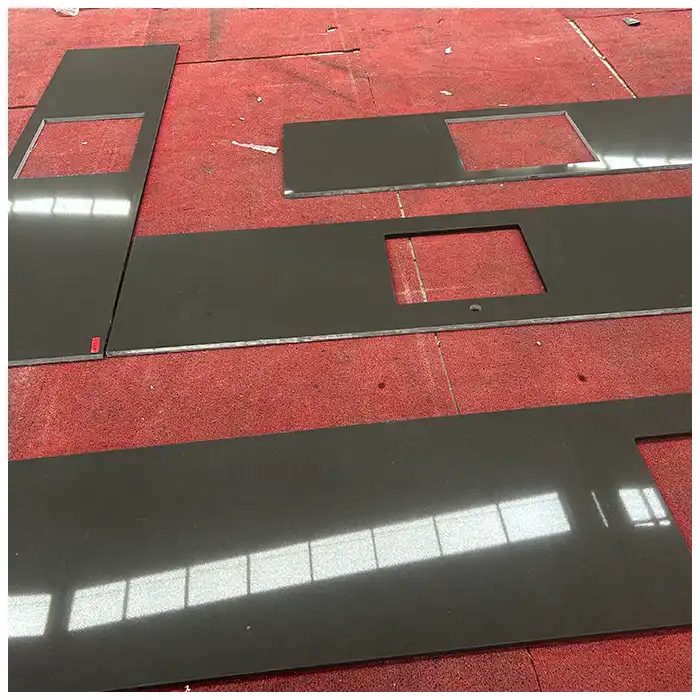
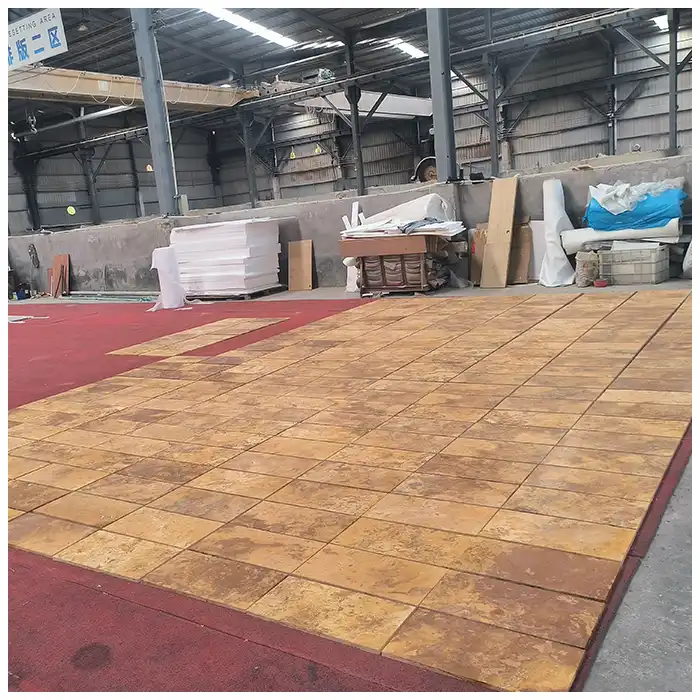
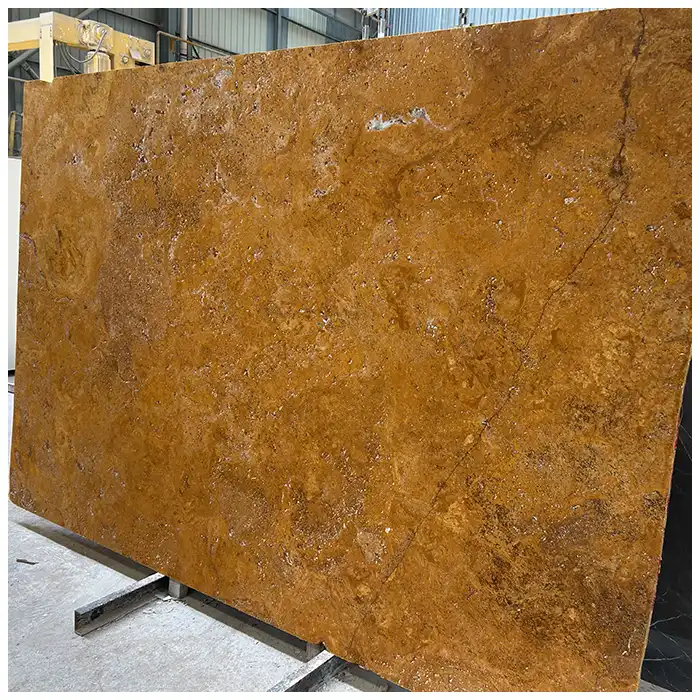
A close-up photo can make a slab look more powerful than it will be after cutting. It may show the strongest vein, the cleanest color, or the most polished area while hiding edges, cloudy sections, filled areas, shade changes, or layout problems. The full-slab photo is the first serious approval image.
A useful full-slab photo should show all four edges, the slab label or identification, and enough scale to judge size. It should be followed by close-ups of the background, main vein, edge condition, surface finish, and any natural features that may affect cutting. A slow video is also helpful because movement can reveal gloss, texture, small color shifts, fill, resin, and reflection.
For luxury stone, photo review is especially important because the strongest part of the slab may not be in the best position for the finished surface. A vein that looks impressive in the upper corner of a full slab may disappear after a table is cut. A dramatic center may be interrupted by a sink. A cloudy edge may become the most visible part of a waterfall end.
Good slab review should answer practical questions: where will the main movement land, which quiet areas are useful, where can seams go, what edge will be visible, and whether there is enough material for the whole project.
Plan movement, direction, and visual balance
Statement slabs are often chosen because they have movement. That movement can run vertically, horizontally, diagonally, or in several directions at once. Direction matters because a finished surface is rarely the same shape as the slab. A wall panel is read upright. A table is read from above. A kitchen island is read from above, from the seating side, and from the ends.
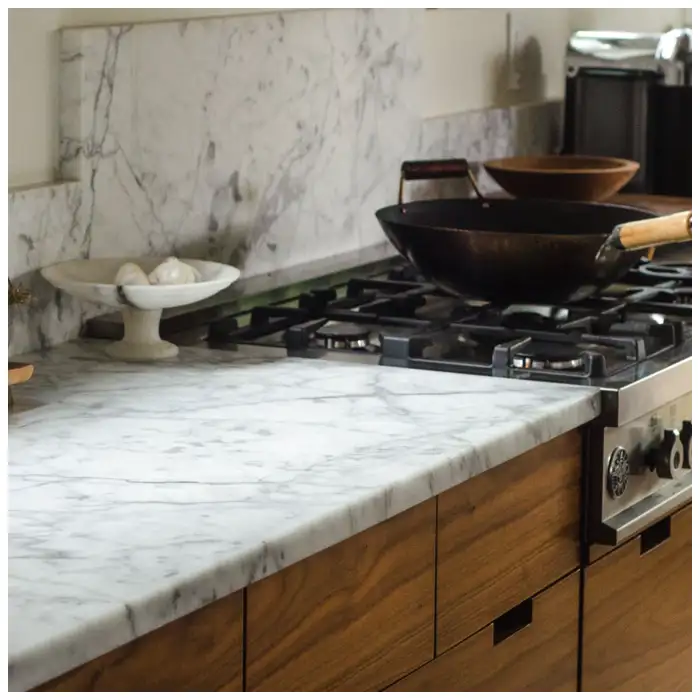
For walls, vertical or mirrored movement may create a strong focal point. For islands, horizontal or diagonal movement can run across the length of the counter. For tables, centered or softly balanced movement may be more comfortable than a strong vein pushed to one edge. For vanities and small surfaces, a quieter area of the slab may work better than the most dramatic section.
Negative space matters as much as veins. A quiet part of the slab can make room for a mirror, logo, sink, artwork, wall light, or table setting. If every part of the slab is active, the surface may become difficult to use in a room with other materials. If the slab has too much empty space, the finished surface may feel flat unless the color and finish are strong enough.
Ask for a marked layout before cutting. The layout does not need to be decorative, but it should show the surface outline, slab direction, seams, cutouts, edges, and the most visible areas. This step often prevents mistakes that no polishing or installation skill can fix later.
Bookmatch and vein match need early approval
Bookmatching is one of the clearest ways to turn stone into a focal surface. Two neighboring slabs are opened like a book so their natural movement mirrors across a shared line. It can work well for lobby walls, bathroom vanity walls, fireplace panels, reception backdrops, and large stone cladding areas.
Bookmatching should be planned before fabrication. The team should confirm whether the slabs are sequential, how the pair looks when opened, where the wall centerline sits, and whether cutouts or fixtures interrupt the pattern. The centerline may align with a doorway, desk, logo, fireplace, vanity, mirror, or room view, not only the physical center of the wall.
Vein matching is related but different. It tries to continue movement across seams without creating a mirror image. This can suit long counters, large islands, corridor walls, waterfall edges, and panels broken by openings. In some projects, vein matching is better than a strict bookmatch because the surface is not symmetrical.
Natural stone will not behave like printed wallpaper. A bookmatch may mirror movement while still showing tonal, crystal, fill, or vein-thickness differences. That is normal. The question is whether the actual pair works for the wall and whether the project team has approved the real layout.
Match the slab to countertops, walls, and furniture
| Површина | What to check first | Best material direction |
|---|---|---|
| Kitchen island or countertop | Slab size, sink and cooktop cutouts, seam position, edge profile, overhang, waterfall direction, and daily-use expectations. | Quartzite, selected marble, granite, sintered stone, or luxury stone depending on use and fabrication plan. |
| Feature wall or fireplace | Wall centerline, panel size, bookmatch or vein match, lighting, outlets, fixing method, and installation access. | Marble, quartzite, luxury stone, or sintered stone panels depending on pattern control and wall conditions. |
| Stone dining or coffee table | Top shape, center composition, thickness, edge detail, underside support, base design, and handling weight. | Marble, quartzite, granite, sintered stone, or selected luxury stone with a layout suited to the table shape. |
| Bathroom vanity wall or top | Mirror, faucet holes, sink cutout, backsplash height, finish, water exposure, cleaning routine, and lighting. | Marble, quartzite, sintered stone, or other surfaces chosen by finish, care, and project setting. |
| Hotel reception counter | Front elevation, logo position, edge return, lighting reflection, panel joints, and impact-prone corners. | Dramatic marble, quartzite, luxury stone, granite, or sintered stone depending on visual goal and use. |
Countertops and islands need practical detailing
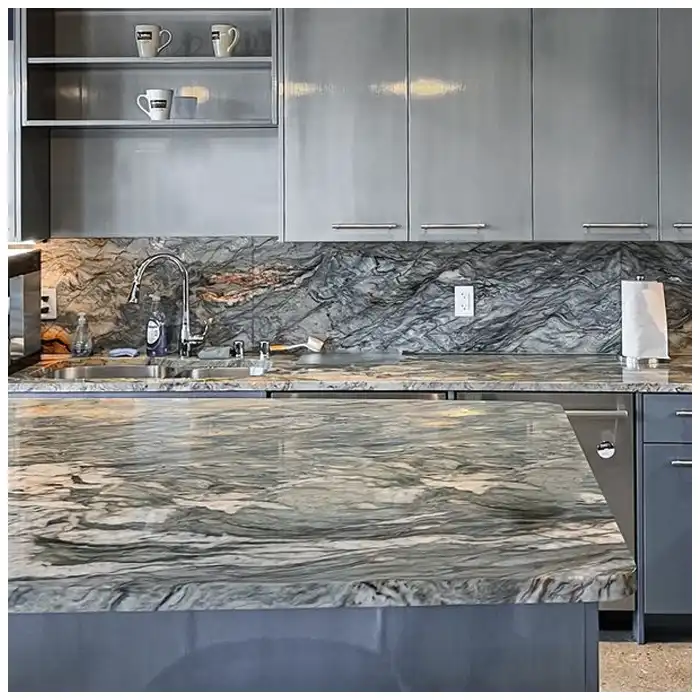
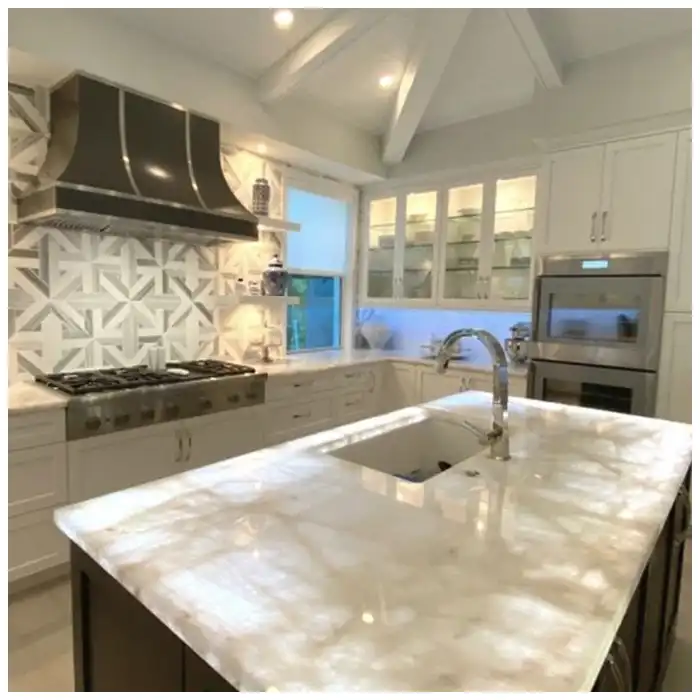
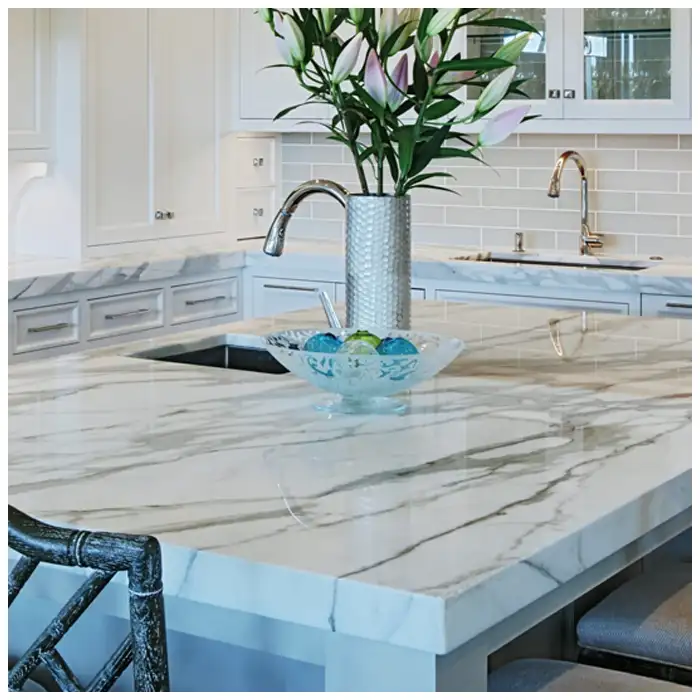
A statement island may be the largest visible stone surface in a kitchen. It is also a work surface. The slab should be reviewed for beauty and use at the same time. Strong veins should not be placed blindly through a sink cutout, cooktop opening, or heavy seam. The seating side, waterfall ends, and cabinet colors should all be considered.
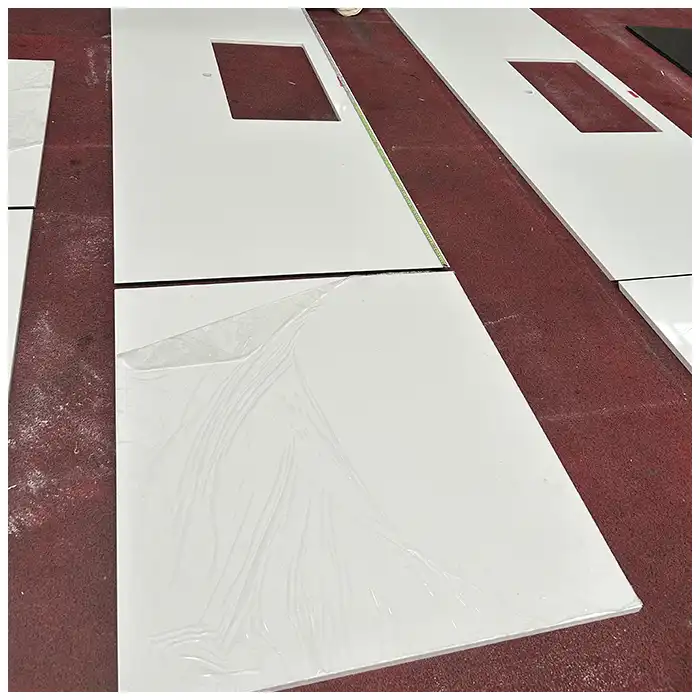
For kitchen countertops, confirm the stone type, finish, thickness, edge profile, seam plan, cutout positions, support needs, and whether the slab movement works with cabinet layout. If the counter uses natural stone, discuss sealing, cleaning, and normal variation. If it uses sintered stone, discuss edge construction, mitering, cutout rules, and handling.
Dark, blue, green, or highly patterned slabs can be powerful on an island, but they need a calmer surrounding palette. White cabinets, wood cabinets, black metal, bronze details, and pale flooring will all change how the slab reads. A photo of the cabinet sample beside the slab can prevent color mismatch.
For large islands, one slab may not be enough. Ask whether a matching slab is available and whether the seam can be placed in a less visible area. If the design uses waterfall ends, confirm whether the vein should continue over the edge or turn as a separate face. That decision should be visible in the layout.
Feature walls need drawings, not only inspiration images
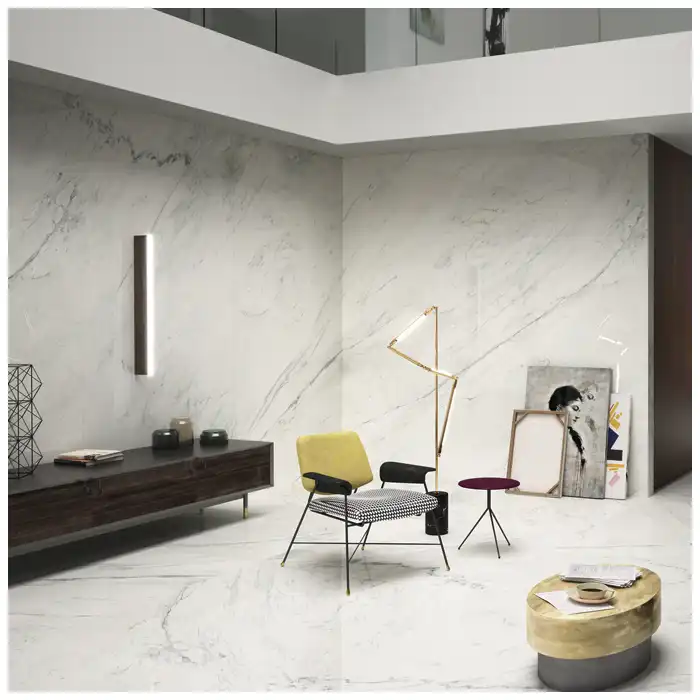
Feature walls are where statement slabs can look their best, but walls also expose mistakes. A wall is vertical, large, and often lit directly. If the panel alignment, bookmatch center, lighting, or fixing method is wrong, the issue is immediately visible.
Start with the finished wall elevation. Mark the width, height, centerline, panel breaks, outlets, switches, signage, mirrors, TV brackets, fireplace opening, doors, corners, and furniture that will sit in front of the wall. Then place the slab movement against that drawing. This shows whether the main vein lands where it should.
Lighting should be reviewed before fabrication. Polished dark stone can reflect ceiling lights and furniture. Side lighting can reveal lippage, texture, fill, or uneven installation. Large panels may need enough light to show depth without creating glare. A good lighting plan supports the slab instead of fighting it.
Installation access matters too. Large panels may be difficult to move through elevators, stairs, narrow corridors, or finished spaces. Smaller panels are easier to handle but create more seams. The final panel size should come from the slab, wall design, site access, and installer method together.
Stone tables and furniture need edge and support review
A stone table top is not just a small slab. It is a finished furniture surface, seen from above and touched at the edge. The shape, edge profile, base, underside support, and surface finish all affect the result. A strong slab can look awkward if the table shape cuts through the wrong part of the movement.
For stone table tops, confirm whether the top is rectangular, round, oval, square, or custom shaped. A rectangular table can use directional veining. A round table often needs balanced movement near the center. An oval table may need a softer long-axis layout. A custom shape should be marked on the slab before cutting.
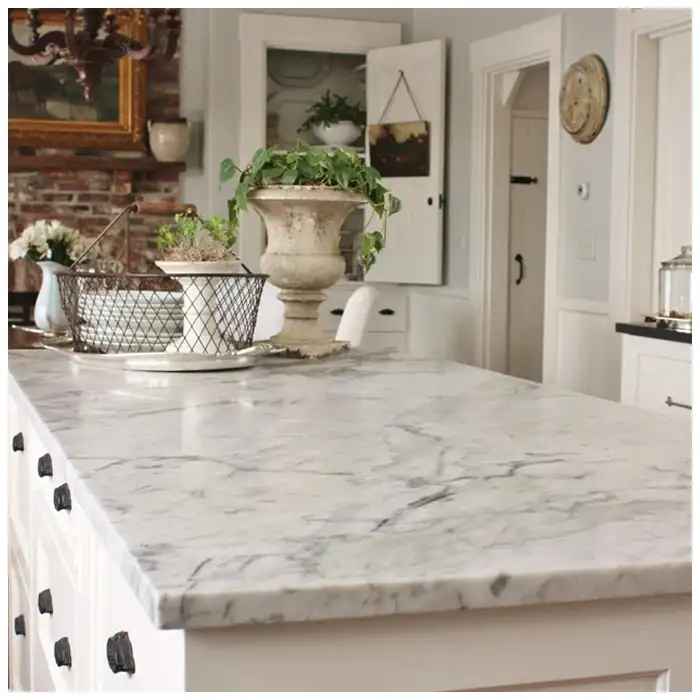
Thickness is not only a style decision. A thick edge feels substantial but increases weight and may need a stronger base. A thin top can look refined but may need backing, careful support, or a different material choice. Mitered edges can create a thicker look, but the fabrication quality and pattern direction must be checked.
For dining tables, meeting tables, hotel lounge tables, and villa coffee tables, ask how the surface will be packed, moved, installed, and supported. A table that looks beautiful in production still needs to survive transport and daily use.
Natural stone or sintered stone: how to decide
Natural stone is usually the better choice when the project wants a real slab with mineral depth, variation, and individual character. Marble, quartzite, granite, and other natural stones can create a surface that feels specific to the project. The tradeoff is that variation, fissures, resin, finish differences, and layout limits need careful review.
Sintered stone is often better when the project wants large-format panels, controlled marble-look pattern, thinner detailing, or repeated surfaces with a consistent appearance. It can suit modern walls, furniture faces, counters, fireplaces, and commercial interiors. The tradeoff is that edge details, body color, mitering, handling, and cutout rules need close attention.
For premium interiors, this is not a lower-versus-higher choice. It is a project-fit choice. A natural quartzite island can be the right decision in a villa kitchen. A marble-look sintered stone wall can be the right decision in a repeated hotel corridor. A dramatic marble table can be the right decision for a single dining room. The application decides the answer.
When comparing options, ask for the same evidence from each material: size, thickness, finish, available quantity, photos or panel images, layout notes, edge details, cutout restrictions, fabrication method, and care guidance. A fair comparison uses project facts, not only visual preference.
Check safety, fabrication, and handling before approval
Statement slabs are often large, heavy, and expensive to replace after cutting. Fabrication planning should begin before the order is approved. This includes slab handling, cutting sequence, edge work, holes, mitering, backing, packing, labeling, and installation access. Large-format panels need the same discipline, even when the material is thinner.
Dust control also matters. Cutting, grinding, polishing, and finishing natural stone or engineered surfaces can create respirable crystalline silica exposure if the work is not controlled. OSHA and NIOSH safety resources make clear that fabrication work requires appropriate controls, training, and workplace procedures. The article should not turn this into a scare point, but the project should treat it as a real fabrication requirement.
For designers and project teams, the practical step is to confirm that fabrication happens in a qualified environment with suitable methods for the material. Wet methods, dust collection, respiratory protection, equipment, and local rules are the fabricator’s responsibility, but the design should avoid last-minute site cutting where possible.
Packing and transport should also be discussed early. A bookmatched wall, a large island slab, or a custom stone table top needs clear labels, protection, crate planning, and installation sequencing. The better the documentation, the lower the risk of confusion after the stone leaves the factory.
Approval checklist before reserving a statement slab
1. Confirm the application
Write down the surface type, finished size, room, use condition, expected finish, and whether the surface is decorative, functional, or both. A wall, table, counter, vanity, and reception desk should not use the same approval checklist.
2. Review the full slab or panel
Ask for full-slab photos, close-ups, videos, slab number, size, thickness, finish, and available quantity. For sintered stone, ask for panel size, pattern direction, edge options, and product-specific fabrication notes.
3. Approve the layout
Use a marked drawing or layout image showing seams, cutouts, panel divisions, bookmatch direction, vein flow, edge returns, and visible areas. Do this before cutting, not after the slab has already been reserved.
4. Confirm the edge and support
Review edge profile, mitering, thickness, underside support, table base, overhangs, waterfall sides, wall fixing method, and panel handling. The edge is often where a good design becomes either precise or awkward.
5. Connect the material to the room palette
Check the slab beside cabinet color, flooring, wall paint, metal finish, lighting, furniture, and any nearby stone. A statement slab should lead the room, but it still needs surrounding materials that make sense with it.
How the four decision paths work together
Good statement-slab selection usually moves through four decisions. First, judge the slab from photos and videos so the team understands the actual material. Second, decide whether bookmatch or vein match makes sense for the surface. Third, consider color and focal-point use, especially for blue marble, green marble, or other dramatic stones. Fourth, compare natural stone with sintered stone when the project needs either natural depth or controlled repeatability.
These decisions are connected. A slab that photographs beautifully may fail the wall layout. A bookmatch may look good until the mirror and lights are added. A blue or green marble may need a quieter room palette. A quartzite may be better for one island, while a marble-look sintered stone may be better for repeated panels. The strongest projects make these choices before fabrication starts.
MQ STONE can support this process by providing current slab photos, videos, size details, finish options, bookmatch possibilities, and application advice. The more complete the drawing and room information, the more useful the material review becomes.
Final Conclusion
Choosing statement slabs is a project decision, not a photo contest. The right marble, quartzite, luxury stone, granite, or sintered stone surface should fit the drawing, the room palette, the edge detail, the lighting, the handling method, and the way the surface will be used. A strong slab becomes more effective when it has a clear role and enough planning behind it.
For MQ STONE projects, the best next step is to send the intended surface size, drawings, application area, finish preference, and design direction. With that information, current slab photos, videos, bookmatch options, layout suggestions, and fabrication details can be reviewed before the material is reserved or cut.

ФАК
1. What is a statement slab in interior design?
A statement slab is a stone or surface panel chosen to become a clear focal surface, such as a kitchen island, feature wall, reception counter, fireplace, vanity wall, or table top. It should be selected from the actual slab or panel, with layout, lighting, edge, and fabrication details reviewed before approval.
2. Which stone is best for a statement kitchen island?
The best stone for a statement kitchen island depends on the slab size, vein direction, cutouts, edge profile, cabinet color, and daily-use expectations. Quartzite, selected marble, granite, luxury stone, and sintered stone can all work when the layout and fabrication plan suit the kitchen design.
3. Should a feature wall use bookmatched slabs?
A feature wall should use bookmatched slabs when the wall has enough uninterrupted surface and the slab pair creates a strong center image. Bookmatching is not always the best choice. Long walls, broken elevations, shelves, mirrors, and doors may work better with vein matching or a simpler panel layout.
4. How do I choose a slab for a stone table top?
Choose a slab for a stone table top by checking the table shape, center composition, thickness, edge detail, underside support, base design, and surface finish. A rectangular table may suit directional veining, while a round or oval table often needs more balanced movement near the center.
5. What should I ask MQ STONE before approving a statement slab?
Ask for full-slab photos, close-up images, video, slab size, thickness, finish, available quantity, matching options, layout advice, edge details, and fabrication notes. If the project involves a wall, island, counter, or table, send drawings so the slab can be checked against the actual surface.
References
- Dimension Stone Design Manual 2024. Natural Stone Institute technical committee. Natural Stone Institute. Natural Stone Institute Resource Library.
- Bookmatching: Geology Meets Geometry. Karin Kirk. Natural Stone Institute / Use Natural Stone. Use Natural Stone.
- Standards and Specifications for Natural Stone Products. Natural Stone Institute. Natural Stone Institute. Natural Stone Institute technical resources.
- ASTM C119 Standard Terminology Relating to Dimension Stone. ASTM Committee C18 on Dimension Stone. ASTM International. ASTM Standards.
- ASTM C1528/C1528M Standard Guide for Selection of Dimension Stone. ASTM Committee C18 on Dimension Stone. ASTM International. ASTM Standards.
- ASTM C503/C503M Standard Specification for Marble Dimension Stone. ASTM Committee C18 on Dimension Stone. ASTM International. ASTM Standards.
- ASTM C616/C616M Standard Specification for Quartz-Based Dimension Stone. ASTM Committee C18 on Dimension Stone. ASTM International. ASTM Standards.
- OSHA/NIOSH Hazard Alert: Worker Exposure to Silica during Countertop Manufacturing, Finishing and Installation. Occupational Safety and Health Administration and National Institute for Occupational Safety and Health. Workplace safety publication.