Quick Summary: Book-Matched Carrara White Marble Is a Layout Strategy, Not Just a Stone Choice
Book-Matching Carrara White Marble Starts Before Fabrication
Carrara White Marble has always been one of the most recognizable white marbles in luxury interiors. Its soft grey veining, calm white background, and architectural elegance make it suitable for hotel lobbies, commercial atriums, villa bathrooms, luxury retail walls, fireplaces, stair halls, elevator lobbies, and high-end residential feature spaces.
But book-matching Carrara White Marble is not simply about buying beautiful slabs. It is about controlling how the veins open, mirror, flow, continue, and meet across panels. A good bookmatch can make a wall look like natural artwork. A poor bookmatch can make expensive marble look like a puzzle assembled during a power outage. Not ideal. Not cheap either.
For buyers comparing luxury white stone options, reviewing professional Marble Slabs and Tiles helps clarify available stone types, slab formats, finishes, and application directions before selecting Carrara White Marble for a bookmatched project.
What Is Book-Matched Carrara White Marble?
Basic Definition of Carrara White Marble
Carrara White Marble is a natural marble valued for its light white or soft grey background and delicate grey veining. Compared with highly dramatic Calacatta-style marble, Carrara White Marble is usually more understated, calmer, and easier to use across larger architectural spaces. This makes it popular for luxury walls, floors, bathrooms, reception areas, staircases, and commercial interiors.
In B2B sourcing, Carrara White Marble is commonly supplied as slabs, tiles, cut-to-size panels, vanity tops, wall cladding, floor tiles, stair treads, and decorative panels. Designers use it when they want natural stone identity without overpowering the room.
What Does Book-Matching Mean?
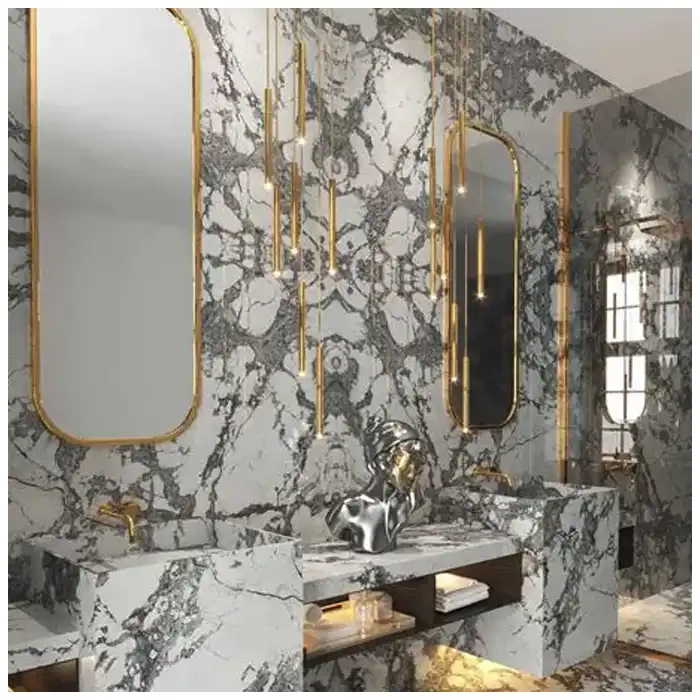
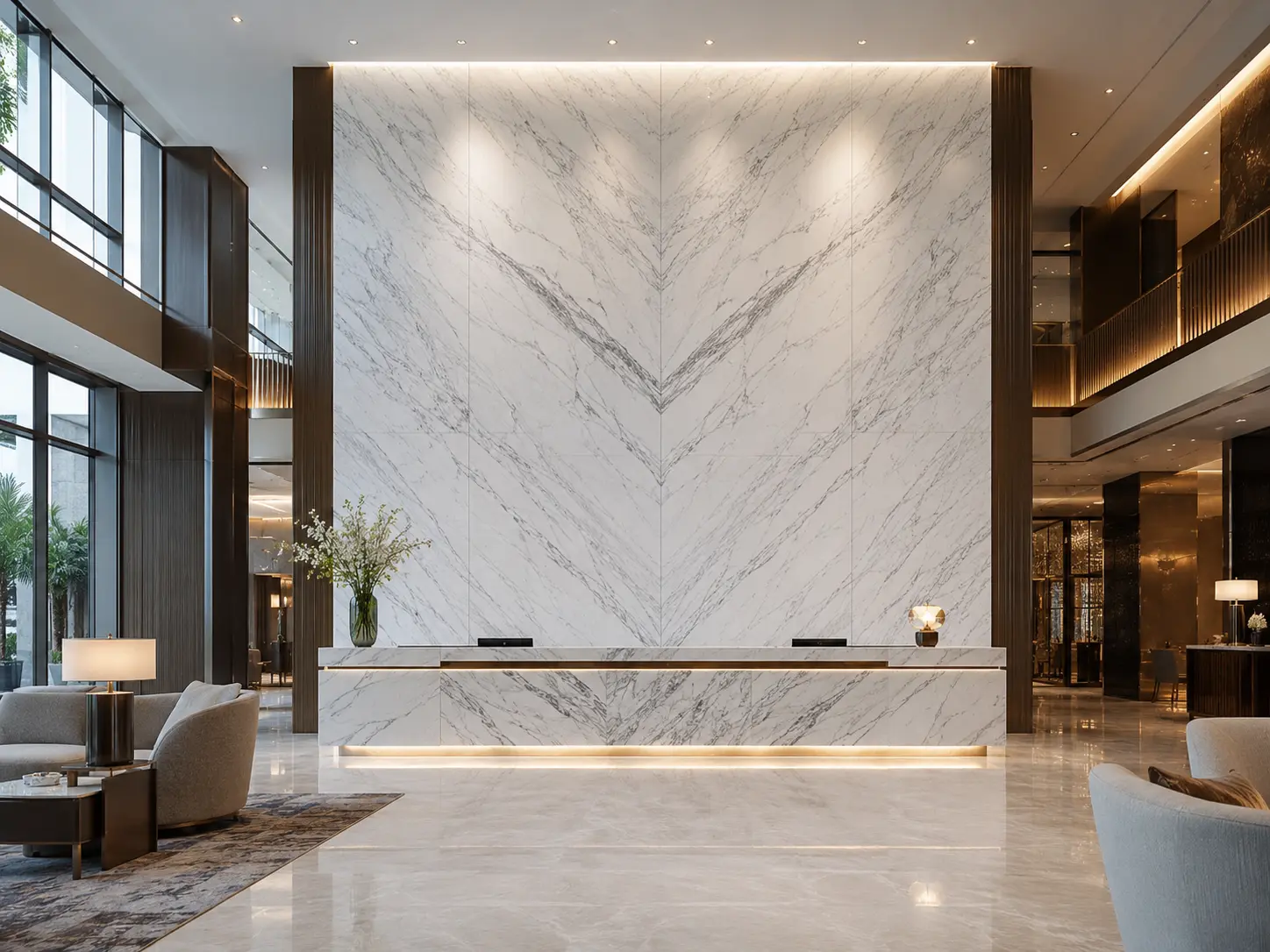
Book-matching means using consecutive slabs from the same marble block and opening them like pages of a book. The veins mirror each other across a central line, creating a butterfly-like pattern. This method is widely used for feature walls, hotel bathrooms, fireplace surrounds, reception backgrounds, lobby walls, and premium commercial atriums.
The success of bookmatching depends on slab sequence. If the slabs are not consecutive, the mirrored effect may fail. If the background tones are inconsistent, the wall may look patched. If the layout is not approved before cutting, the final installation becomes a very expensive guessing game. Luxury projects should not depend on luck; luck is not a project manager.
The Visual Dynamics of Linear Veining in Modern Commercial Atriums
Why Linear Veining Matters in Large Spaces
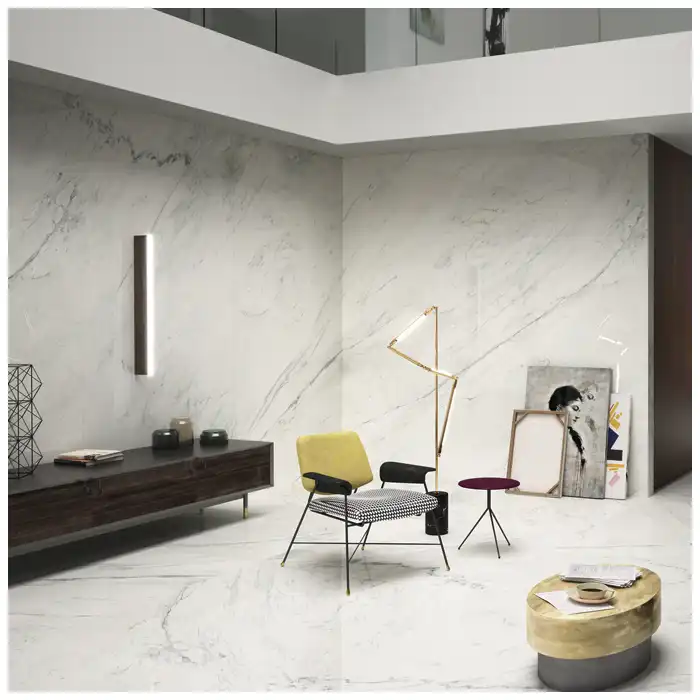
Linear veining in Carrara White Marble can guide the viewer’s eye and shape how a space feels. In commercial atriums, hotel entrance halls, office towers, and luxury retail spaces, the marble wall is often viewed from a distance. That means vein direction, panel scale, and visual rhythm become more important than small surface details.
Vertical veining can make a wall feel taller and more formal. Horizontal veining can make a reception wall feel wider and calmer. Diagonal movement can add energy to a boutique hotel or gallery-style space. Soft cloudy veining creates a quiet luxury effect, while strong butterfly patterns create a more dramatic focal point.
For project buyers selecting slab material, a product such as Carrara White Marble slab should be evaluated by full-slab movement, not only by color sample. In bookmatched work, the vein structure is the design language.
| Vein Direction | Visual Effect | Best Application | Buyer Warning |
|---|---|---|---|
| Vertical linear veining | Taller, more formal space | Atriums, lobby walls, stair walls | Needs slab height planning |
| Horizontal veining | Wider and calmer wall | Corridors, reception counters | Can look flat if overused |
| Diagonal veining | Dynamic and energetic | Feature panels, boutique hotels | Requires precise dry layout |
| Soft cloudy veining | Calm and elegant | Bathrooms, spa walls, villas | Needs tone consistency |
| Strong butterfly veining | Dramatic luxury | Feature walls, fireplaces | Needs consecutive slabs |
How to Select Consecutive Slabs for Flawless Butterfly Pattern Alignment
Why Consecutive Slabs Are Essential
Flawless butterfly alignment starts with consecutive slabs. When marble is cut from a block, each slab carries a similar but slightly shifting version of the same vein movement. If two adjacent slabs are opened in mirror orientation, the veins can meet naturally across the center. If slabs are selected randomly from different blocks or batches, the bookmatch may lose symmetry.
Professional buyers should request slab numbers, full slab photos, slab videos, and dry layout proposals. They should confirm that the slabs come from the same block or at least the same compatible batch. Background tone, vein thickness, resin repair, fissures, slab thickness, and finish must also be reviewed before cutting.
Professional Slab Selection Checklist
- Request full slab photos, not only close-up samples.
- Confirm slabs are consecutive or visually compatible.
- Check slab numbering and orientation.
- Review videos under natural and factory lighting.
- Inspect cracks, fissures, resin repairs, and mesh backing.
- Check thickness and surface finish consistency.
- Create a digital dry layout before cutting.
- Reserve extra material for replacement or site adjustment.
When tiles are used instead of large panels, buyers can still coordinate pattern direction and color tone. For flooring, bathrooms, and smaller wall sections, Carrara White Marble tile offers more modular design flexibility while still keeping the classic Carrara look.
Butterfly Alignment Rules
The central mirror line should be planned first. Strong veins should either meet intentionally at the center or be shifted deliberately to create movement. Random placement creates visual noise. Joint width must be considered because even a few millimeters can interrupt the vein connection. For polished slabs, designers should also consider light reflection because pendant lights and wall washers can reveal uneven alignment quickly.
Case Study: Achieving Vein Continuity in Monolithic Lobby Feature Walls
Project Scenario
Imagine a luxury hotel lobby that needs a 6-meter-wide by 4-meter-high Carrara White Marble feature wall behind the reception desk. The designer wants a calm but premium look, with soft grey veining that moves across the surface without becoming too dramatic. The client wants a monolithic wall effect, not a loud stone painting.
Selection Strategy
The stone team selects six consecutive slabs with medium grey linear veining and a consistent light background. Slabs with heavy yellowish tone, overly dense veining, or visible structural weakness are removed from the layout. The supplier prepares a digital dry layout showing left, center, and right panel groups. The design team approves the vein flow before cutting begins.
Designers comparing white marble options often look at Calacatta and Carrara together. A design resource such as Calacatta Marble Slabs vs White Marble can help buyers understand why Carrara White Marble is usually selected for softer, more controlled bookmatched walls, while stronger white marbles may be chosen for bolder statement effects.
Installation Strategy
Each panel is numbered according to the dry layout. Shop drawings confirm panel size, joint spacing, anchoring method, top and bottom direction, and installation sequence. The wall substrate is checked before installation. During installation, panels are protected from corner damage, and the center mirror line is aligned first. This prevents small layout errors from expanding across the full wall.
Result and Buyer Lesson
The final wall feels like one continuous stone surface because selection, layout, cutting, packing, and installation were controlled before the first panel touched the wall. The lesson is simple: luxury marble walls succeed before installation. Starting to plan after cutting is like opening an umbrella after the rain has already entered your shoes.
Top 10 Creative Design Layouts for Book-Matching Carrara White Marble
1. Classic Butterfly Feature Wall
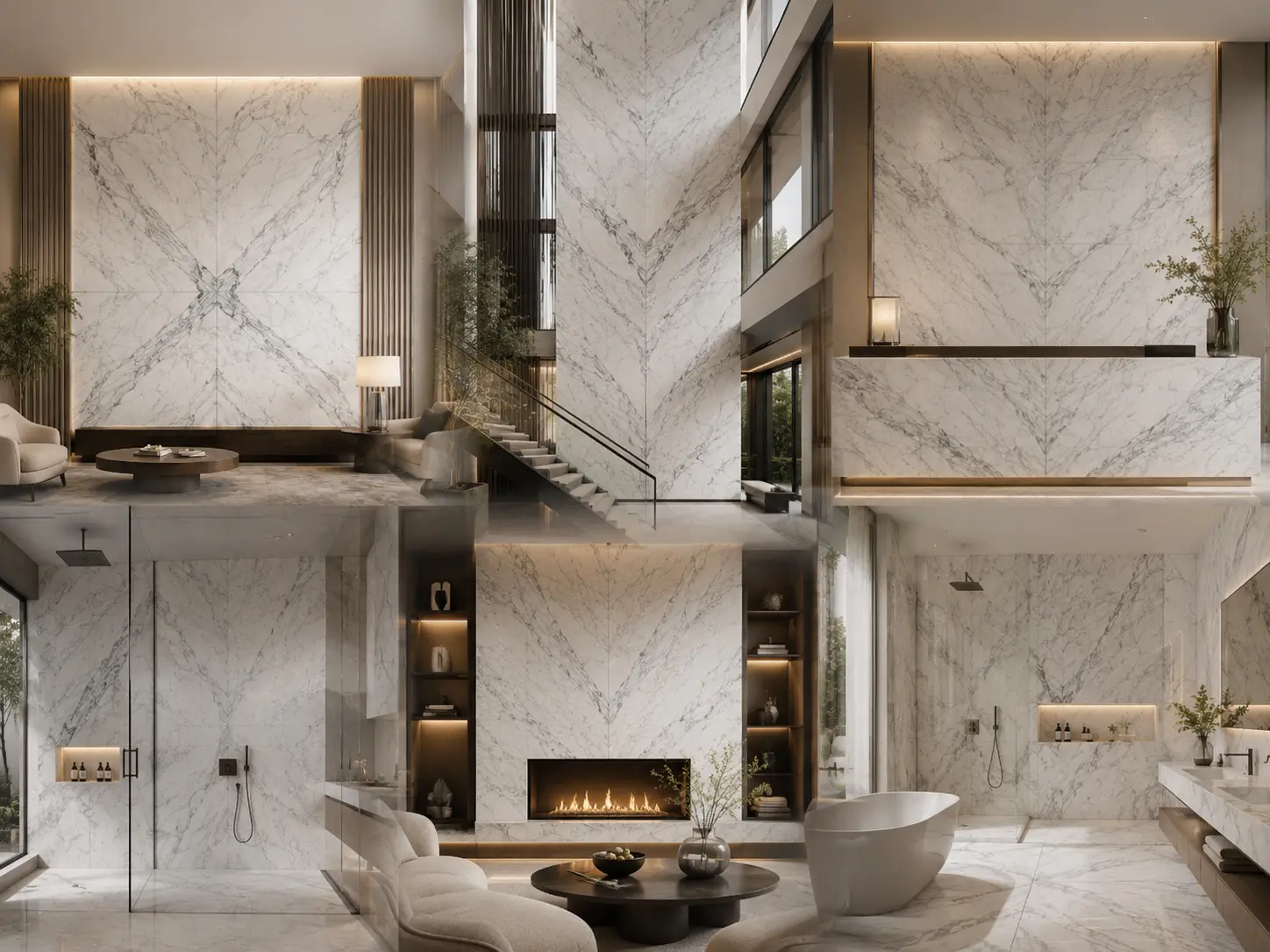
The classic butterfly layout uses two or four consecutive slabs mirrored around a central axis. It is one of the most recognizable bookmatching styles. This layout is ideal for hotel lobbies, villa living rooms, reception backgrounds, fireplace walls, and luxury residential spaces.
Choose this layout when the project needs an obvious luxury statement. The key is to keep the central mirror line clean and intentional. If the strongest veins do not meet properly, the whole design loses confidence.
2. Vertical Atrium Vein Flow
Vertical atrium layouts use tall panels with vertical or diagonal grey veins to create height. This design works well in commercial atriums, hotel entrance halls, office towers, and stair walls. The vertical movement helps the space feel larger and more architectural.
Choose this layout when the viewing distance is long and the wall height is significant. Avoid using short, visually broken panels unless the joint design is part of the concept.
3. Monolithic Lobby Wall Layout
A monolithic wall layout arranges large panels so the entire wall feels like one continuous stone surface. It is calmer than a dramatic butterfly layout and often works better for executive offices, gallery interiors, premium hotels, and reception areas where refined elegance is preferred.
For this design, tone consistency is more important than dramatic veining. The slabs should feel related, and the joints should be visually controlled.
4. Waterfall Staircase Wall
In staircase walls, Carrara White Marble veins can flow vertically beside the stairs or follow the movement of the stair direction. This layout is excellent for villa stair halls, hotel staircases, luxury apartment common areas, and clubhouse interiors.
Choose this layout when the wall is viewed while people move. Vein direction should support the movement instead of fighting it.
5. Bookmatched Bathroom Shower Wall
A two-slab bookmatched shower wall can turn a bathroom into a luxury spa zone. It works beautifully behind a bathtub, vanity, or shower area. Soft Carrara veining is especially effective because it creates visual interest without overwhelming a smaller room.
For wet areas, finish, sealing, waterproofing, grout, and maintenance planning must be confirmed. Beautiful marble still needs a sensible installation system. Fancy stone does not enjoy bad waterproofing. Nobody does.
6. Four-Panel Diamond Layout
The four-panel diamond layout mirrors slabs both horizontally and vertically to create a more graphic composition. It is suitable for large feature walls, retail interiors, clubhouses, and high-impact hotel spaces.
Choose this layout only when the wall is large enough to carry the pattern. In a narrow bathroom or small hallway, a strong diamond layout can feel visually crowded.
7. Fireplace Surround with Centered Veining
For luxury living rooms, fireplaces can be framed with centered Carrara White Marble veining. The veins should either rise above the fireplace opening or mirror around it. This creates a strong architectural anchor.
The main risk is awkward cutting. If the primary vein is cut randomly around the opening, the fireplace may look accidental rather than designed.
8. Reception Desk Front with Horizontal Vein Flow
Reception counters work well with horizontal vein flow because horizontal movement makes the counter feel longer and calmer. This layout is useful for hotels, clinics, galleries, retail stores, and office reception areas.
Designers can combine a Carrara counter front with metal trims, wood veneer, backlit signage, or neutral wall panels. For broader luxury interior inspiration, integrating Calacatta Marble in high-end interiors also helps compare how stronger white marble layouts differ from softer Carrara White Marble compositions.
9. Elevator Lobby Panel Sequence
In hotels, apartment towers, and commercial buildings, elevator lobbies repeat across multiple floors. Carrara White Marble can create consistent luxury if slabs are grouped by floor, wall, and panel sequence.
This layout requires strong batch control. If each floor uses a different tone or vein density, the building may feel inconsistent. For repeated spaces, controlled elegance is better than random drama.
10. Floor-to-Wall Continuity Layout
A floor-to-wall continuity layout coordinates Carrara White Marble floor tiles with wall slabs or panels. This creates a marble envelope effect in luxury bathrooms, spas, retail entrances, and villa foyers.
This layout does not require every surface to be bookmatched. Instead, the goal is tonal harmony. Floors may use tiles with softer variation, while walls use larger bookmatched slabs. The result feels immersive but not chaotic.
Layout Comparison Table: Which Book-Matching Design Should You Choose?
| Layout Type | Visual Impact | Best Space | Slab Requirement | Key Risk |
|---|---|---|---|---|
| Classic butterfly wall | High | Lobby, villa wall | 2–4 consecutive slabs | Misaligned center vein |
| Vertical atrium flow | Tall and elegant | Commercial atrium | Tall slabs or planned joints | Wrong vein direction |
| Monolithic wall | Calm luxury | Reception wall | Consistent tone slabs | Visible batch variation |
| Shower wall bookmatch | Premium and intimate | Bathrooms | 2 matching slabs | Poor cutout planning |
| Four-panel diamond | Dramatic | Large feature wall | 4 consecutive slabs | Too busy in small rooms |
| Fireplace surround | Focused | Living room | Centered vein planning | Veins cut awkwardly |
| Elevator lobby sequence | Repeated elegance | Multi-floor projects | Batch-controlled slabs | Floor-to-floor mismatch |
| Floor-to-wall continuity | Immersive | Spa, villa, retail | Slabs and tiles matched | Tone mismatch |
Scientific Material Parameters Buyers Should Check
Typical Carrara White Marble Performance Data
Natural marble performance varies by quarry, block, finish, thickness, reinforcement, and test method. The following values are general marble reference ranges and should not replace supplier-specific test reports for commercial or high-traffic projects.
| Parameter | Typical Marble Reference Range | Why It Matters for Carrara White Marble |
|---|---|---|
| Density | About 2.55–2.75 g/cm³ | Affects wall load, transport, and installation |
| Water absorption | Often 0.1%–0.6% | Important for bathrooms and wet walls |
| Mohs hardness | About 3–4 | Affects scratch sensitivity |
| Compressive strength | Often 50–140 MPa | Relevant for flooring and stairs |
| Flexural strength | Often 7–20 MPa | Important for large-format wall panels |
| Common slab thickness | 18–20 mm or project-specific | Affects handling and anchoring |
| Common tile thickness | 10–18 mm | Depends on wall or floor application |
| Extra material planning | Usually 5%–10% or more | Supports cutting loss and replacement |
Standards and Testing References
For marble dimension stone, buyers may reference ASTM C503. ASTM C97 supports absorption and bulk specific gravity testing, ASTM C170 supports compressive strength evaluation, and ASTM C880 supports flexural strength testing. For flooring, ANSI A326.3 may be relevant when slip resistance must be evaluated. For large wall panels, anchoring methods and local building codes must also be reviewed.
Surface Finish Selection for Book-Matched Carrara White Marble
Polished Finish
Polished Carrara White Marble deepens the grey veining and creates a glossy, luxury appearance. It works well for lobby walls, feature walls, reception backgrounds, fireplace surrounds, and commercial atriums. The main consideration is glare under strong lighting and the visibility of scratches or surface marks over time.
Honed Finish
Honed Carrara White Marble creates a softer, matte, low-glare appearance. It is suitable for bathrooms, spa interiors, floors, galleries, and calm luxury spaces. Honed marble often feels more contemporary, but it still needs sealing and proper maintenance.
Brushed or Textured Finish
Brushed or textured finishes are less common for formal bookmatched walls but may work in tactile interiors, spa projects, selected floors, and rustic luxury spaces. The cleaning routine should be considered because textured surfaces can hold more dust or residue.
Project Planning: From Slab Selection to Installation
Step 1: Confirm Design Intent
Before selecting slabs, define whether the wall should be dramatic, calm, symmetrical, vertical, horizontal, or monolithic. The design intent determines slab selection. A strong butterfly layout needs different slabs than a soft monolithic wall.
Step 2: Select Slabs by Pattern, Not Only Color
White background alone is not enough. The vein direction, density, and rhythm decide whether the bookmatch works. Buyers should choose slabs by full-panel composition, not by a small photo corner.
Step 3: Create a Digital Dry Layout
A digital dry layout uses slab photos to simulate the final wall before cutting. This step helps the designer confirm vein flow, panel order, joint position, and visual balance. It is one of the most important risk-control tools in bookmatched marble projects.
Step 4: Number Every Panel
Each slab and cut panel should be labeled by location, side, top, bottom, and installation sequence. Panel numbering prevents installation confusion and protects the bookmatch effect.
Step 5: Approve Shop Drawings
Shop drawings should confirm panel sizes, joint width, cutouts, anchoring, substrate condition, and installation sequence. For luxury projects, drawings are not paperwork. They are insurance against visual disaster.
Common Mistakes in Book-Matched Carrara White Marble Projects
Mistake 1: Buying Non-Consecutive Slabs
Non-consecutive slabs rarely create clean butterfly symmetry. They may have different background tone, vein thickness, or movement direction.
Mistake 2: Approving Only Small Samples
Small samples cannot show full vein movement. A sample may look calm while the full slab has strong directional veins or visible natural variation.
Mistake 3: Ignoring Lighting Conditions
Polished marble can look different under warm light, daylight, and spotlights. Commercial atriums and hotel lobbies should review the slab under lighting conditions close to the final environment.
Mistake 4: No Dry Layout Before Cutting
Without dry layout, vein continuity is mostly luck. Luxury marble projects should not depend on luck. Luck is cute in birthday cards, not in stone fabrication.
Mistake 5: Poor Panel Numbering
If panels are installed in the wrong sequence, even perfect slabs can lose the bookmatch effect. Panel labels should match shop drawings and crate labels.
Mistake 6: Using Too Dramatic a Layout in a Small Space
A large butterfly pattern may overpower small bathrooms or narrow corridors. Soft two-slab bookmatch or cloudy layouts may be better in smaller spaces.
Buyer Decision Logic: Which Layout Fits Your Project?
If You Need a Luxury Hotel Lobby
Choose a monolithic wall or classic butterfly layout with medium grey veining and strict consecutive slab selection. The wall should feel premium from both close and long-distance views.
If You Need a Commercial Atrium
Choose vertical linear veining to increase height and movement. Avoid random panel placement because large atriums expose every layout mistake.
If You Need a Villa Bathroom
Choose a soft two-slab bookmatch behind the bathtub, vanity, or shower wall. Avoid overly busy four-panel patterns unless the bathroom is large enough.
If You Need a Retail Feature Wall
Choose stronger veining or a four-panel diamond layout for visual memorability. Retail spaces can accept more drama because the goal is brand impact.
If You Need Repeated Elevator Lobbies
Choose controlled batches and repeatable panel sequences. For multi-floor projects, consistency is more important than extreme pattern variation.
Before confirming layouts, work with a supplier that understands project communication, panel labeling, and export packing. A professional Carrara White Marble supplier should help with slab selection, dry layout review, QC inspection, and project coordination.
Quality Control Checklist Before Ordering Carrara White Marble
- Confirm marble type and origin if required.
- Request full slab photos and videos.
- Confirm consecutive slab availability.
- Check slab numbering and orientation.
- Confirm thickness and surface finish.
- Inspect cracks, fissures, resin, and mesh backing.
- Check background tone and vein direction.
- Create and approve digital dry layout.
- Approve shop drawings and cutting plan.
- Confirm packing method and crate labeling.
- Reserve extra material for replacement.
- Request pre-shipment inspection photos.
- Ask for maintenance instructions.
For custom layouts, share wall size, slab preference, layout concept, finish, thickness, quantity, project drawings, and delivery schedule through a Carrara White Marble project consultation. Clear information helps the supplier recommend suitable slabs before expensive cutting decisions are made.
Industry Trends: Why Book-Matched White Marble Remains Popular
Luxury Projects Want Natural Art Surfaces
Bookmatched marble creates a natural artwork effect without extra decoration. This is why it remains popular for hotels, villas, commercial atriums, and premium residences.
Commercial Atriums Need Strong Visual Identity
Large open spaces need memorable materials. Carrara White Marble provides architectural identity while keeping the atmosphere refined and not overly heavy.
White Marble Still Works Across Design Styles
Carrara White Marble fits modern, classic, minimalist, spa, hotel, gallery, and retail interiors. Its soft grey veining allows designers to use it in both quiet and dramatic layouts.
Digital Dry Layout Is Becoming Standard
More buyers now expect digital layout approval before cutting. This reduces disputes, controls visual risk, and helps project teams understand the final result before fabrication.
|
|
|


Final Recommendation: Treat Book-Matched Carrara White Marble as a Project System
Book-matching Carrara White Marble is not only a stone choice. It is a project system involving consecutive slab selection, vein direction, dry layout, panel numbering, shop drawings, finish selection, lighting review, packing, and installation control.
For commercial atriums, vertical linear veining can create scale and movement. For hotel lobbies, monolithic or butterfly layouts can create controlled luxury. For villa bathrooms, soft two-slab bookmatch often works better than oversized drama. For repeated elevator lobbies, batch consistency matters more than one spectacular slab.
The best buying logic is simple: if the design depends on vein continuity, approve the layout before cutting. If the project uses large walls, confirm consecutive slabs. If the installation has multiple areas, number every panel. That is how Carrara White Marble becomes a luxury feature instead of a costly layout lesson.
FAQ About Book-Matching Carrara White Marble
1. What is book-matched Carrara White Marble?
Book-matched Carrara White Marble uses consecutive marble slabs opened like mirror pages to create symmetrical vein patterns. This layout is often used for luxury feature walls, hotel lobbies, villa bathrooms, fireplaces, reception areas, commercial atriums, and statement interiors. The best result requires consecutive slabs, full slab photos, digital dry layout, panel numbering, and careful installation sequencing.
2. Is Carrara White Marble good for luxury project walls?
Yes, Carrara White Marble is excellent for luxury project walls because it offers a soft white-to-light-grey background, elegant grey veining, and timeless architectural value. It is especially suitable for hotel lobbies, commercial atriums, villa bathrooms, gallery walls, reception backgrounds, and spa interiors. For large bookmatched walls, slab selection and dry layout approval are essential before cutting.
3. How do I select slabs for bookmatching?
To select slabs for bookmatching, choose consecutive slabs from the same block or visually compatible batch. Request slab numbers, full slab photos, videos, thickness confirmation, finish details, and repair inspection. Then create a digital dry layout to confirm butterfly alignment, vein direction, joint position, and panel sequence before fabrication begins.
4. What layout is best for a commercial atrium?
For a commercial atrium, vertical linear veining or a monolithic panel layout usually works best because it enhances height, movement, and architectural scale. Tall walls need controlled vein direction and careful panel sequencing. Random slab placement can make a large atrium wall feel broken, while planned vertical flow can make the space feel more elegant and intentional.
5. How can I avoid bookmatch installation mistakes?
To avoid bookmatch installation mistakes, use consecutive slabs, approve a digital dry layout, number every panel, confirm shop drawings, check crate labels, and follow the planned installation sequence. Buyers should also confirm slab thickness, surface finish, anchoring method, joint width, wall lighting, packing protection, and replacement material before shipment.
References
- “ASTM C503/C503M Standard Specification for Marble Dimension Stone” — ASTM Committee C18 — ASTM International — ASTM Standards Catalogue
- “ASTM C97/C97M Standard Test Methods for Absorption and Bulk Specific Gravity of Dimension Stone” — ASTM Committee C18 — ASTM International — Stone Testing Standards
- “ASTM C170/C170M Standard Test Method for Compressive Strength of Dimension Stone” — ASTM Committee C18 — ASTM International — Stone Testing Standards
- “ASTM C880/C880M Standard Test Method for Flexural Strength of Dimension Stone” — ASTM Committee C18 — ASTM International — Stone Testing Standards
- “Dimension Stone Design Manual” — Natural Stone Institute Technical Committee — Natural Stone Institute — Dimension Stone Design Manual
- “Care and Cleaning of Natural Stone” — Natural Stone Institute Education Team — Natural Stone Institute — Stone Care Guide
- “TCNA Handbook for Ceramic, Glass, and Stone Tile Installation” — TCNA Handbook Committee — Tile Council of North America — Tile Installation Handbook
- “Natural Stone Wall Cladding and Anchoring Design Guidance” — Technical Design Team — Stone Federation Great Britain — Stone Cladding Resource
Ready Buyer Insight for Book-Matched Carrara White Marble
What should buyers understand first? Book-matched Carrara White Marble uses consecutive slabs opened like a mirror to create symmetrical vein patterns for luxury walls, lobbies, bathrooms, fireplaces, commercial atriums, and feature panels.
Why does slab selection matter? Consecutive slabs control vein continuity, background tone, butterfly alignment, and panel rhythm. Random slabs may look acceptable individually but fail when installed as a bookmatched wall.
How should buyers choose the layout? Choose classic butterfly layouts for feature walls, vertical linear veining for atriums, monolithic layouts for calm lobby walls, two-slab bookmatch for villa bathrooms, and controlled panel sequences for elevator lobbies.
Option insight: Polished Carrara White Marble is stronger for glossy lobby and feature walls, while honed Carrara White Marble is better for softer bathrooms, spa interiors, and low-glare floors. Large panels create stronger luxury impact, while tiles give more modular flexibility.
Consideration insight: Buyers should check slab numbers, consecutive availability, thickness, finish, cracks, resin repair, dry layout, panel labels, shop drawings, anchoring, packing, and installation sequence before confirming the order.
Recommendation: Treat book-matched Carrara White Marble as a design-and-installation system. Approve the full slab layout before cutting, number every panel, and work with a supplier that understands luxury project coordination.
Before ordering, prepare wall dimensions, target layout, slab preference, finish, quantity, drawings, installation location, and delivery schedule. A professional supplier can then recommend the right Carrara White Marble slabs and layout strategy.