Natural Quartzite Table Base Support Before Fabrication
The first time I saw a large quartzite dining top lift from the polishing bed, the slab seemed almost quiet from above. Then the workers tilted it, and a pale green vein appeared along the side like a river trapped under ice. I touched the edge and felt the density before I thought about the base. This stone has been waiting for millions of years…, but it still needs a human structure that respects its weight.
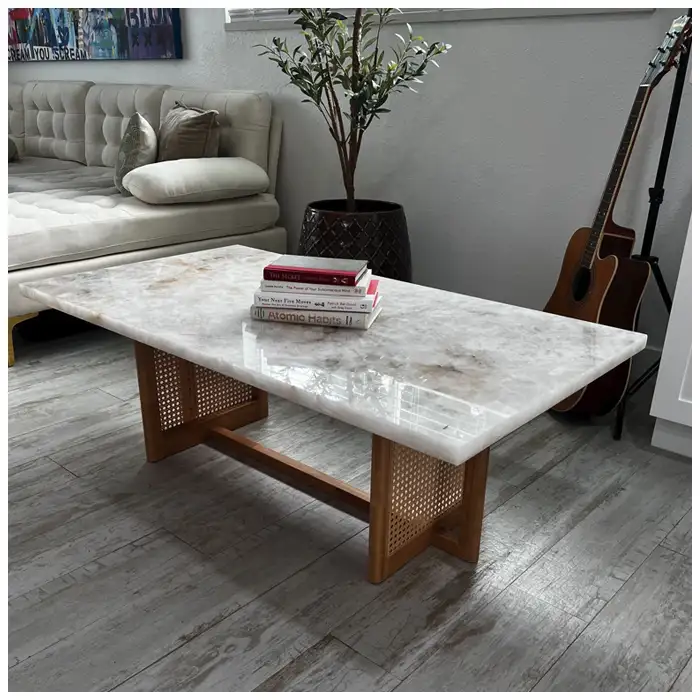
Natural quartzite table base support is where admiration becomes engineering. A slab can be rare, deep, and beautifully crystalline, yet the table can still feel wrong if the base footprint is too small or the overhang is too bold. The veins will tell you where the eye wants to travel. The base tells the stone whether it can rest there safely.
This article continues today’s stone table edge detail and yesterday’s natural quartzite table top discussion. We are moving from the rim to the structure below it. True luxury is something you never get tired of looking at, but it must also let people sit, dine, move chairs, and touch the edge without worry.
The comparison still circles back to Natural Quartzite vs Marble-Look Sintered Stone: The Definitive Comparison for Premium Interiors. Real quartzite carries body, weight, mineral depth, and edge truth. A base plan has to answer that reality.
Why Natural Quartzite Table Base Support Starts With The Slab
Quartzite begins as sandstone rich in quartz, then heat and pressure transform it into a dense crystalline stone. That geological history makes many quartzites strong, but it does not make every table shape safe. Long veins, mineral pockets, fissure-like movement, and thickness variation still need reading.
When I look at Aqua Vulcan Quartzite Tables, I see more than color. I look for where the visual weight gathers. A strong blue-green movement on one side may ask for a base that feels centered visually, not only mathematically centered.
A quartzite dining table also has human forces. People lean on the end. A server places dishes near the edge. Chairs bump the underside. Children sometimes press down where adults would not. The table must be designed for touch, not only photography.
Overhang Is A Feeling And A Calculation
A generous overhang can make a table comfortable, but stone does not behave like timber. A 300 mm overhang on one shape may feel safe; the same overhang on a thinner top with a narrow base may feel nervous. I ask for the side elevation before the factory cuts anything.
The veins will tell you… when the overhang is visually too long. If the strongest vein runs toward a cantilevered corner, the eye follows it there. If that corner also feels unsupported, the table looks unsettled even before anyone touches it.
Support Ratios I Check Before Fabrication
There is no single base rule for every stone table. Shape, thickness, top size, base material, fixing method, and final use all matter. Still, I keep a working table for early review.
| Table Condition | What I Check | Risk If Ignored |
|---|---|---|
| Large oval top | Base length, end overhang, center of gravity, lifting points. | End flex, nervous touch, or awkward chair clearance. |
| Round dining top | Pedestal diameter, foot ring, top thickness, tipping resistance. | Table feels unstable when weight is applied near the rim. |
| Coffee table | Low base spread, edge comfort, underside contact points. | Chipped edge or rocking after regular use. |
| Bookmatched top | Joint position, base support under seam, visual center line. | Seam stress or a base that fights the pattern. |
| Laminated thick edge | Apron joint, vein wrap, underside bracket clearance. | Heavy look without better structural behavior. |
The Hard-Won Lesson: A Beautiful Overhang Can Still Feel Unsafe
A private dining table used a 3.1-meter quartzite top with a slim bronze base. The rendering looked light and refined. During the factory balance test, two people pressed near one end and the table gave a small but visible lift on the opposite side. Nothing broke, but the feeling was wrong. The base had to grow by 180 mm, and the designer had to adjust chair positions before approval.
The Lesson: Test the table as people will touch it, not as the rendering wants it to behave.
How Thickness, Edge, And Base Work Together
Table top thickness changes both safety and mood. A thicker top can feel grounded, but it can also become visually heavy. A thinner top can feel elegant, but the base must work harder. I prefer to study the side profile with the real stone photo, not a generic line drawing.
On Dover White Quartzite Tables, a calm pale surface may accept a clean, restrained edge. The base can stay quiet. On a heavily veined slab, the base may need more visual gravity so the stone does not feel like it is floating without permission.
A stone furniture base also has to respect installation. How will the top be lifted? Where will hands go? Can the base be adjusted on site? Does the table need hidden pads? These are not dull questions. They protect the stone’s future.
Read The Floor Before Trusting The Base
A table can pass in the workshop and still feel wrong on an uneven floor. I ask where the table will live: stone floor, timber floor, carpet inset, raised platform, or private dining room with a rug under the chairs. The base contact points must suit that surface. A thin metal foot may look refined, but it can sink into soft flooring or make leveling difficult.
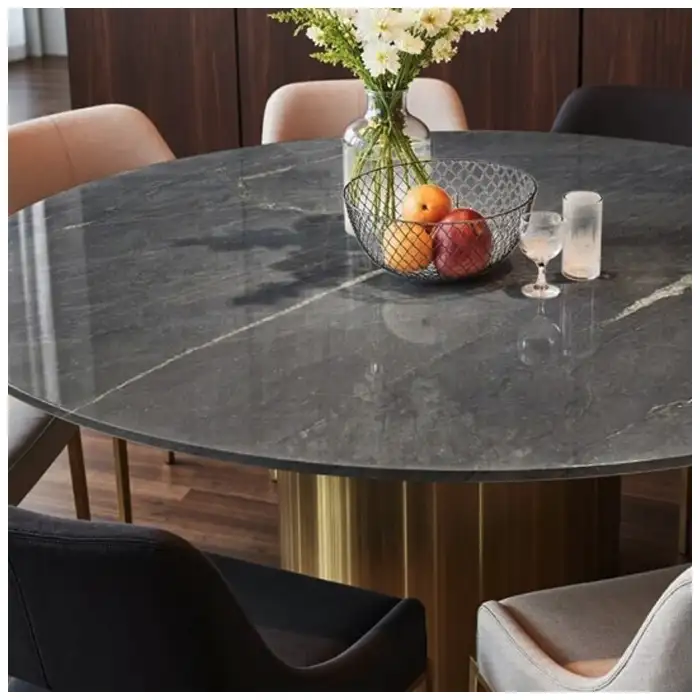
True luxury is something you never get tired of looking at, but it also needs to sit still. I have watched a beautiful stone table lose its dignity because one foot needed a visible shim. The slab deserved better planning. The veins will tell you where the eye goes; the floor tells you whether the base can stay quiet.
When the table will travel overseas, I also ask how the base and top separate. A single heavy assembly may sound convenient, but it can make unloading dangerous. A planned assembly route protects the stone, the base, and the installers.
I like to see the base shadow under side light before approval. A shadow that feels too small can make the top look heavier than it is. A shadow that spreads too wide can make the base feel clumsy. The stone and the base need a quiet agreement.
Why I Ask For A Mock Assembly
For large tables, I want a factory mock assembly or at least a dry support test. The top does not need to be in the final room, but it needs to sit on the planned base. Feel the edge. Push lightly at the end. Watch the base. The stone remembers pressure, even when we pretend furniture is only visual.
This stone has been waiting for millions of years…, and I do not like seeing it rushed into a base that was chosen only because it looked slender in a rendering.
Understanding Quartzite Table Support In Today’s Design Market
Why Heavy Natural Stone Still Feels Worth It
Designers keep returning to real stone furniture because it carries presence. A printed surface can repeat a pattern. Natural quartzite carries mineral depth through the body. The side, edge, and underside all reveal material truth.
Natural quartzite table base support gives that truth a stable platform. When the support is right, the table feels inevitable, as if the stone and base were always meant to meet. True luxury is something you never get tired of looking at, but stability is why you keep trusting it.
What To Do If A Table Feels Unstable On Site
If the table rocks, lifts, or feels nervous after placement, stop use. First, document the issue with photos and short videos showing the top, base, floor, and contact points. Second, do not proceed with public placement until the base and top connection are reviewed. Third, contact the supplier with the fabrication drawings, inspection photos, delivery records, and site condition photos for comparison.
SSS
1. What is natural quartzite table base support?
It is the structural and visual planning that lets a quartzite table top sit safely on its base. It includes base footprint, top thickness, overhang, joint position, weight distribution, fixing method, and handling plan. The goal is a table that feels stable and looks resolved.
2. How much overhang can a quartzite dining table have?
There is no single number for every slab. The safe overhang depends on stone thickness, slab size, base footprint, support material, and how people will use the table. I ask for a side elevation and support test before approving a large overhang.
3. Is a thicker quartzite table top always safer?
No. Thickness helps, but base design still matters. A thick top on a poor base can still feel unstable, and a thinner top with smart support can work well. The top, edge, base, and installation method must be checked together.
4. Should the base align with the main vein direction?
Often, yes. The base does not need to copy the vein, but it should not fight the slab’s visual movement. The veins will tell you where the eye travels. A base that ignores that movement can make the table feel off balance.
5. What should I do first if a quartzite table feels unstable after delivery?
Take photos and a short video showing the top, base, floor contact, and movement. Do not put the table into regular use until the issue is reviewed. Then send the supplier the fabrication drawings, inspection photos, packing records, and site photos for comparison.
Quick-Reference Checklist for Quartzite Table Support
- Confirm slab size, thickness, and estimated weight before base design.
- Check overhang from the side elevation, not only from the plan view.
- Place support under seams, weak-looking zones, or heavy mineral movement.
- Test the top on the planned base before final approval when possible.
- Confirm lifting points and handling routes before packing the table.
- Record final base contact points with inspection photos.
Final Conclusion
Natural quartzite table base support is not a hidden technical footnote. It is what lets the stone live with confidence. The slab brings mineral depth, crystalline movement, and geological patience. The base decides whether that presence feels secure.
This stone has been waiting for millions of years…, and it deserves a base that can carry both its weight and its quiet authority. True luxury is something you never get tired of looking at, and I would rather adjust one base drawing than let an MQ STONE project place a nervous table into a room built for permanence.

References
Dimension Stone Design Manual, Natural Stone Institute.
ASTM Stone Standards, ASTM International.
Natural Stone Surface Care Guidelines, Natural Stone Institute.
Kitchen Trends 2026: The Latest from Milan Design Week, Archiproducts.
Material Intelligence in Interior Design, Dezeen.
Google Search Central Editorial Notes, Google Search Central.