Arabescato Corchia Fireplace: Where the Veins Meet the Opening
Low amber light can make Arabescato Corchia look almost liquid. The white field recedes, the graphite bands deepen and smaller mineral threads appear between them like pencil marks beneath glass. Around a fireplace, that light is never static. It rises, flickers and catches the polished surface from below. Yet the first line I draw is not a vein. It is the appliance opening, copied from the current installation manual with the noncombustible facing zones and required access kept visible. The marble can shape the room only inside those boundaries.
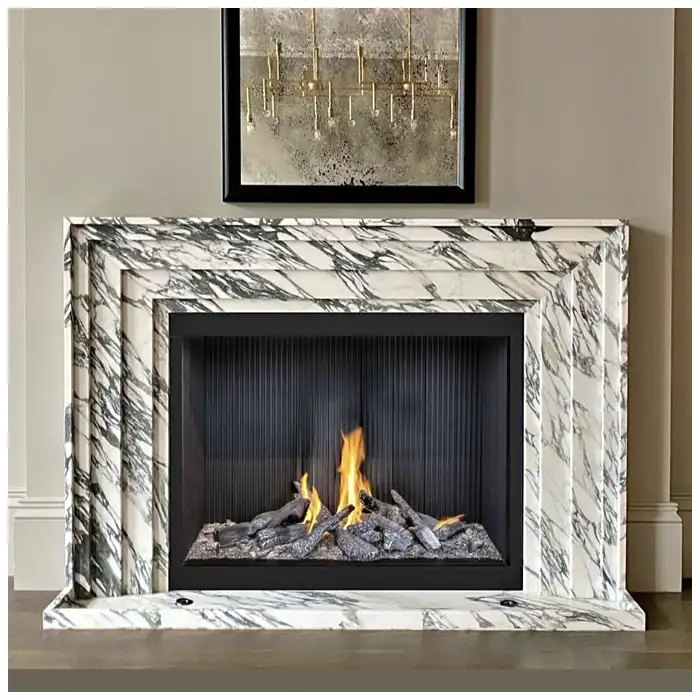
Begin the Arabescato Corchia fireplace with the appliance
Fireplace requirements are model-specific. The manufacturer identifies clearances, permitted finishing methods, ventilation or service access and the surfaces that may receive noncombustible decorative facing. I use the exact model and revision, not a generic fireplace diagram. A measurement borrowed from another appliance may be unsafe even when both openings look alike in a rendering.
Natural marble is noncombustible, but that statement does not approve every material attached to it. Resin, mesh, adhesives, sealants, backer boards and adjacent framing each have their own limits. Ask the responsible designer and product manufacturers to establish the complete assembly. I will not describe a decorative slab as a tested fireplace system unless the relevant evidence actually says so.
ال Arabescato Corchia marble slab enters the process after those zones are fixed. I overlay the available stone on the approved elevation, including panel joints and returns. The firebox or appliance opening removes a large part of the natural drawing. That absence has to feel intentional on all four sides.
An Arabescato Corchia fireplace may use full-height panels, a conventional surround with a mantel, or a simpler facing band. Each geometry cuts the stone differently. I ask for the finished opening, not merely the rough framing. Decorative trims and doors can overlap the stone or require removal space. Their dimensions belong on the slab layout.
Compose the veins around an empty centre
A fireplace slab layout begins with the void. Place the dominant grey band in several positions and see what remains after the opening is removed. A vein that sweeps beautifully across a whole slab may become two unrelated dark corners. Another, less obvious crop can create a calm rise on one side and a measured return across the lintel.
I read the visual weight above the opening first. A heavy horizontal band can lower the room, while an upward diagonal can pull the eye toward a tall chimney breast. Neither effect is universally better. The ceiling height, mantel and adjacent artwork determine whether the composition needs movement or restraint.
On a marble fireplace surround, symmetry is one option rather than an obligation. Bookmatched side panels can form a broad V above the fire, but the centre joint and appliance position must cooperate. A flow-matched arrangement may preserve the stone’s geological direction with fewer mirrored gestures. I test both when the slab sequence allows it.
The full-face Arabescato Corchia marble deserves more than a cropped screen view. Raking light can disclose repaired fissures or resin work that a flat image hides. Record those areas and keep unsuitable features away from narrow bridges, exposed corners and machining locations according to the fabricator’s assessment. Natural character and fabrication risk should not be confused.
Joints have visual and technical work
On an Arabescato Corchia fireplace, panel dimensions, handling and the support design determine where joints can occur. The pattern then determines how conspicuous they become. I prefer to draw the real joint width on the elevation. Closing slabs together for a photograph can create a false promise when the installed gap later cuts through a fine vein.
At the lintel corners, four mitred joints can produce clean geometry, but they demand accurate fabrication and a suitable assembly. A butt joint changes the way the vein terminates. The responsible fabricator needs the actual stone thickness, edge condition and handling plan. I choose the visual route only after those constraints are understood.
For an Arabescato Corchia fireplace, a central vertical joint above the opening can support a bookmatch. An off-centre joint can disappear into a darker band. Both choices need a numbered slab map. If one panel is later replaced, the team must know whether adjacency or mirror sequence formed the original design.
The principles in Bookmatched Stone Walls: What to Confirm before Fabrication help organise face orientation and sequence. A fireplace adds an appliance opening and heat-related material constraints, so its drawing must go further. The wall pattern cannot erase a service panel or manufacturer’s finishing boundary.
Check the reverse, edge and attachment materials
A polished face tells me nothing about what a fabricator has placed on the reverse. Inspect resin, mesh, local reinforcement and repairs. Then ask the relevant manufacturers whether those materials fit the intended location and conditions. Removing backing without written agreement may alter the piece; leaving incompatible backing creates another problem. Resolve it before nesting.
The substrate must support the selected stone assembly and comply with the appliance design. Noncombustible does not mean structurally adequate, and a cement board name does not explain its framing, joints or attachment. Coordinate stone loads and panel geometry with the project professional. The stone supplier can provide dimensions and material records, but should not invent the wall design.
A marble fireplace surround often includes a return toward the appliance trim. That edge may reveal the stone body and any built-up construction. Show its thickness, joint and finish. If a dark vein turns the corner, source the return from the correct zone rather than attaching a random pale strip after the face has been approved.
Sealants near the appliance need compatible temperature and installation requirements from their manufacturers. Colour matters too, particularly against a pale marble field. Test potential migration or staining where the joint contacts stone. Do not use a generic clear sealant because it looks discreet in a sample photograph.
Heat changes the viewing condition
Firelight changes contrast across an Arabescato Corchia fireplace, but it does not change the marble’s mineral composition during normal viewing. Amber illumination warms the reflected appearance and can hide some cool grey. Daylight may reverse that balance. I review the surround with the appliance off and under the room lighting, then consider the firelit scene as a second condition.
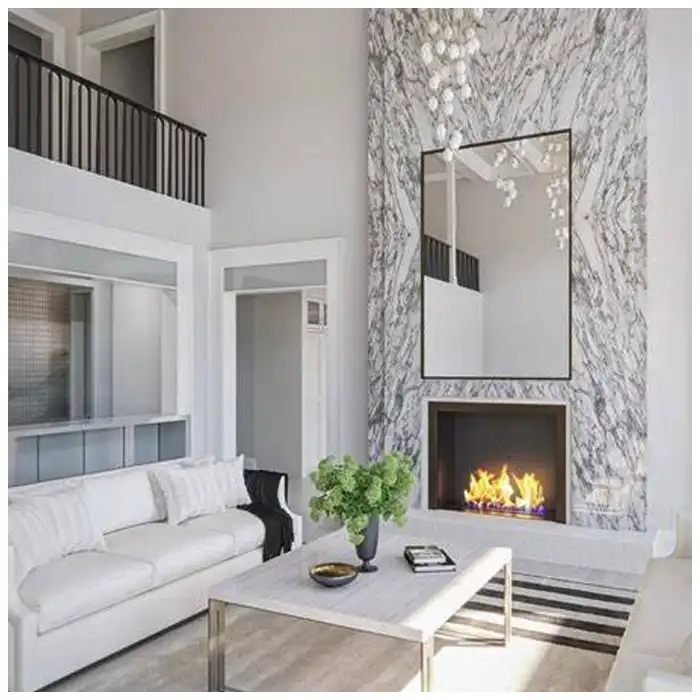
Polish reflects moving points and gives the dark bands deeper optical contrast. Honing spreads the light and makes the white field feel quieter. Both finishes still require care appropriate to marble. I test the selected finish from the reserved slab, especially where flame reflections are part of the interior concept.
An Arabescato Corchia fireplace viewed only at night can surprise the client in daylight. Place a large physical sample beside the surrounding wall paint, metal trim and flooring. A cool white wall may make the marble appear warmer; a dark bronze frame may strengthen nearby grey. These relationships are contextual, so the full material board matters.
Soot, ash and combustion residues depend on fireplace type and operation. Follow the appliance and maintenance instructions. Marble is acid-sensitive, so avoid improvised acidic cleaning mixtures. If staining occurs, identify the material before treatment rather than scrubbing a polished surface with an abrasive household product.
Do not extend decorative stone into the wrong zone
The appliance manual controls permitted facing and clearances. Do not carry Arabescato Corchia into the firebox or another exposed area unless the complete design and materials are specifically approved for that use. Decorative marble around an opening and refractory material inside a combustion chamber have different jobs.
Mantels introduce combustible-clearance questions even when the facing itself is stone. Timber, upholstered furniture and decorative objects may fall within regulated or manufacturer-defined zones. I keep those boundaries on the elevation until the final room is approved. A later styling decision should not conceal or contradict them.
A fireplace slab layout must also preserve ventilation and service. Removable fronts, controls and access panels need their stated clearances. Mark them as no-stone or removable zones. A continuous vein is not a reason to trap an appliance component behind a bonded panel.
I compare the final proposal with Luxury Natural Stone Slabs and Furniture: Complete Guide to Materials, Applications, Edges, Lighting, and Support because the broader material choice still matters. Arabescato Corchia offers marble’s natural depth and acid sensitivity. A quartzite or another stone would bring a different pattern and performance discussion, but none overrides the appliance documentation.
Fabrication follows a controlled elevation
The approved Arabescato Corchia fireplace drawing should contain stone IDs, face direction, joints, finished opening, returns, edge profiles and the relevant appliance reference. It should identify the latest architectural dimensions. If site framing differs, stop before cutting. Grinding the stone to absorb an unknown discrepancy can disrupt the pattern and reduce a critical edge.
For an Arabescato Corchia fireplace, I would dry lay all visible pieces together. Include temporary spacers representing the intended joints and an opening template at the finished dimension. Photograph the entire elevation square-on, then make closer records of corners, repairs and veining transitions. A beauty shot without labels is not enough.
Pack and stage pieces in installation order while protecting the finished face. Large lintel or full-height panels may need project-specific lifting provisions. The installer and fabricator establish the method using actual dimensions and route. Do not add unapproved holes or clamps on site merely because the panel is difficult to position.
Keep a small approved finish offcut for later cleaning tests. It will not recreate every installed condition, but it is safer than trying an unfamiliar product in the most visible area above the fire. Label it with the slab and finish, then store the care information beside the appliance handover documents.
Where the visual idea usually goes wrong
The first mistake is selecting a slab before fixing the appliance opening. The centre is then redrawn after approval, and the strongest vein may disappear. Start from the final opening and permitted facing zones. Stone crop options remain flexible until the fixed technical boundaries are known.
The second mistake is assuming stone makes the full wall noncombustible. A facade of marble does not reveal the substrate, framing, adhesive or nearby mantel. Review every layer. If a manufacturer instruction conflicts with a decorative detail, the detail changes.
The third mistake is treating a rendering as proof of continuity. Rendered veining can bend around corners or ignore the saw kerf. The physical slabs cannot. Use the real faces, actual joint widths and usable boundaries to build the final elevation.
The fourth mistake is leaving repair locations outside the drawing. Raking light above a fire can make a filled area more apparent. Record repairs during slab approval and place them deliberately. If the project rejects one in the visible lintel, move the crop before cutting rather than negotiate after installation.
| Layer | Question to settle | Evidence to retain |
|---|---|---|
| Appliance | Where may decorative facing and access occur? | Exact model manual and approved elevation |
| Wall system | What supports the stone and adjacent materials? | Designed substrate and attachment detail |
| حجر | Which faces and usable boundaries form the composition? | Numbered full-slab layout and repair map |
| Joints | How do panels meet the opening and returns? | Full-size joint and edge drawing |
| Viewing | How do daylight, room light and firelight differ? | Reserved-slab finish sample in agreed conditions |
The Hard-Won Lesson: An Arabescato Corchia fireplace opening can erase the chosen vein
A full-slab photograph may be approved because one charcoal sweep dominates its centre. Once the finished appliance opening is overlaid, most of that sweep falls into the removed area and only two blunt fragments remain. Replacing the slab delays the design; keeping it creates a surround nobody selected. I now require the exact finished opening and trim overlap before presenting any crop as final.
The Lesson: Put the appliance void on the slab before approving the veins.
What I need before the stone is released
The appliance rules are visible on the stone drawing
An Arabescato Corchia fireplace elevation should identify the exact appliance and current finishing boundaries. I want those constraints carried into the dry layout, not stored in a separate folder nobody opens at the slab. This keeps the composition honest and prevents stone from covering a functional or restricted area.
Every visible edge has a source
The face, return and joint must come from named regions of the approved slabs. Where a mitred edge is intended, show the relationship rather than writing match pattern. The fabricator then knows which visual expectation belongs to the piece and which material conditions still need technical resolution.
A site concern is contained immediately
If a panel conflicts with the opening or appears damaged, photograph its face, reverse, labels and relationship to the appliance before alteration. Pause installation of the affected work. Contact the supplier with the approved elevation, inspection record and current site measurements so the project team can compare the physical condition against the same revision.
Frequently Asked Questions of Arabescato Corchia Marble Fireplace
1. Can Arabescato Corchia be used around a fireplace?
An Arabescato Corchia fireplace can use this marble as decorative facing where the specific appliance, local requirements and complete assembly permit it. Natural marble is noncombustible, but resin, mesh, adhesives, sealants, substrate and nearby combustible materials need separate verification. Follow the exact appliance manual and the responsible designer’s detail.
2. Should the fireplace surround be bookmatched?
Bookmatching can give the opening a strong centre, but it is not mandatory. Compare it with a flow match using the actual consecutive faces and joint widths. Choose the arrangement that works with the opening, room axis and usable slab boundaries rather than assuming symmetry is always more luxurious.
3. Can stone cover the metal edge of the appliance?
Only where the appliance manufacturer explicitly permits the proposed finishing method. Some models allow certain metal surfaces to receive noncombustible facing; others need clearances or removable access. Use the exact manual and trim detail. Do not infer permission from another fireplace photograph.
4. Is polished or honed marble better near firelight?
Polish reflects the moving light more sharply and makes dark veining look deeper. Honing diffuses reflection. Both remain marble and require suitable care. Finish samples from the selected slab should be judged under daylight, room fixtures and the expected firelit view before the full surround is processed.
5. What should I do if the finished opening differs from the drawing?
Record the site dimensions and photograph the opening, trim and affected stone pieces. Stop cutting or installation at that location. Compare the condition with the approved appliance and slab elevation, then ask the designer, installer, fabricator and supplier for a controlled revision before altering an edge or joint.
Final Conclusion
An Arabescato Corchia fireplace begins with the exact appliance and ends with a numbered stone elevation. Keep clearances, access, substrate and material compatibility visible while the veins are arranged around the opening. At MQ STONE, I would rather move the slab crop again than let one beautiful charcoal line persuade the room to ignore the fireplace it surrounds.
References
- Dimension Stone Design Manual, Natural Stone Institute.
- Marble, Onyx, and Serpentine, Natural Stone Institute.
- Natural Stone Care and Cleaning, Natural Stone Institute.
- ASTM C503/C503M Standard Specification for Marble Dimension Stone, ASTM International.
- ASTM C1242 Standard Guide for Selection, Design, and Installation of Dimension Stone Attachment Systems, ASTM International.
- Installation Manual and Finishing Requirements for the Selected Fireplace Model, Appliance Manufacturer.
- المدفأة, Wikipedia.