Breccia Grey Marble Slab: Fragment Scale, Joint Placement, and Quiet-Space Balance
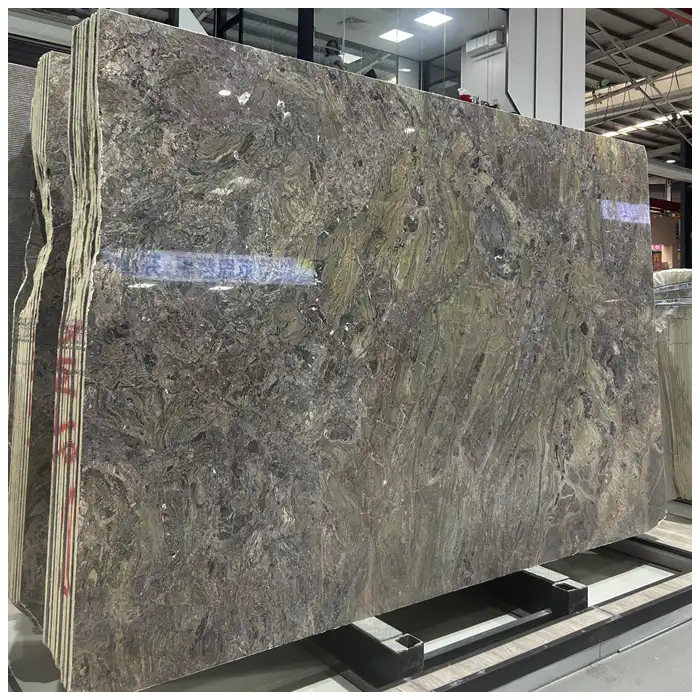
The first Breccia Grey face that held my attention did so by becoming quiet in the middle. Pale and charcoal fragments pressed around it like broken porcelain, yet one mist-grey interval gave the eye a place to rest. Without that pause, the slab would have felt noisy.
A breccia grey marble slab is a study in fragment scale. I map dense and quiet zones, seams, finish, repairs, joints, and the proposed crop. A small sample often includes one fragment and misses the rhythm.
This stone has been waiting for millions of years, but it does not need to occupy every visual sentence in the room. Calm areas are as valuable as fractured ones.
Map Dense and Quiet Zones in Breccia grey marble slab
At a quiet hotel lounge, I stand back before tracing the large pale fragment. I photograph and annotate the face while the slab can still be seen as one geological field. Without this reading, a sample understates activity. Across a quiet hotel lounge, crystals, healed fissures, and mineral bands change tempo; the selected area must still hold together at wall, table, or fireplace scale.
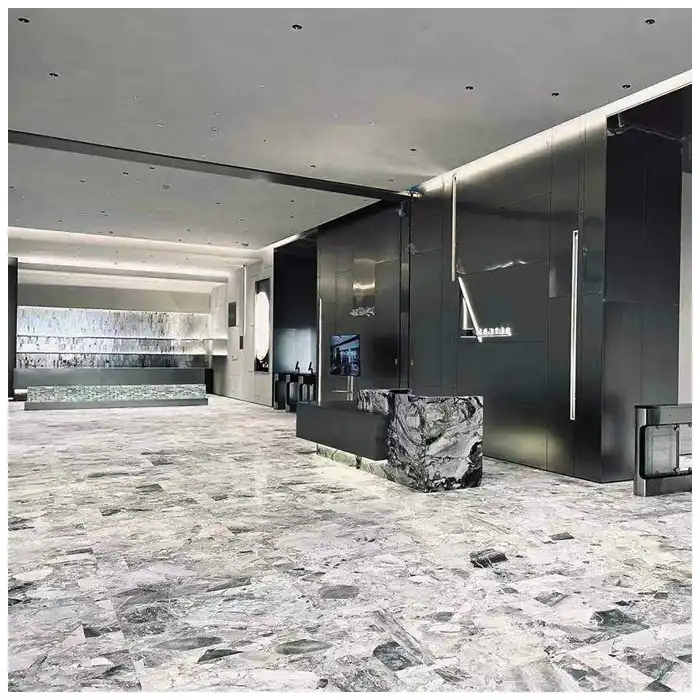
The approved study joins joint study and corner mock-up. One records why the crop was chosen; the other preserves its practical limits. Replacement material can answer the pace and orientation of mist-grey interval.
Then I study the mitred fragment return. I mark dense, medium, and quiet zones and read mitred fragment return for changes in depth, resin, texture, and mineral structure. The crop loses authority if a sample understates activity. At a quiet hotel lounge, the detail must still belong after joints, openings, edges, and supports enter the composition.
I place this reading within Luxury Natural Stone Slabs Guide, where full-face character, finish, fabrication, scale, and authentic material value remain connected.
Read Fragment Scale at Installation Distance
Walking past the face, I watch the large pale fragment. I view candidates from final distance and read large pale fragment for changes in depth, resin, texture, and mineral structure. The light exposes whether dense zones overwhelm small objects. At a fireplace surround, the detail must still belong after joints, openings, edges, and supports enter the composition.
When I inspect a fireplace surround, I compare the quiet and force around the small charcoal chip. I mark dense, medium, and quiet zones while the slab can still be seen as one geological field. An isolated photograph misses how dense zones overwhelm small objects. Across a fireplace surround, crystals, healed fissures, and mineral bands change tempo; the selected area must still hold together at wall, table, or fireplace scale.
In Breccia Grey marble, I look for the mineral depth and full-face movement that will remain persuasive after cutting and installation.
For breccia grey marble slab, map density before choosing the dramatic crop.
Choose Crops for Walls and Furniture
While viewing a compact coffee table, I map the mist-grey interval before choosing a crop. I view candidates from final distance while the slab can still be seen as one geological field. The finished object suffers when quiet areas are lost to cutouts. Across a compact coffee table, crystals, healed fissures, and mineral bands change tempo; the selected area must still hold together at wall, table, or fireplace scale.
For future work, I keep repair map and companion stock by density. That evidence allows a future replacement to respect the original visual weight. The full-face intention remains legible in repair map when later work begins.
At close range, I inspect the small charcoal chip. I overlay applications and openings and read small charcoal chip for changes in depth, resin, texture, and mineral structure. This matters because quiet areas are lost to cutouts. At a compact coffee table, the detail must still belong after joints, openings, edges, and supports enter the composition.
| Decision point | Evidence to inspect | Release condition |
|---|---|---|
| Density | Dense, medium, quiet full-face zones | Application receives intended weight |
| Scale | Fragment sizes at viewing distance | Crop suits surface dimensions |
| Layout | Openings, joints, centre, companions | Quiet intervals remain |
| Finish | Pale and dark areas under room light | Contrast remains acceptable |
| Context | Edges, adjacent finishes, replacements | Room retains balance |
The Hard-Won Lesson in breccia grey marble slab: Do not spend the quiet zone on an opening
A slab may be selected because one mist-grey interval balances its fractured field. If a fireplace opening removes that interval, only dense fragments remain around the frame and the result feels harsher.
The Lesson: Mark the visual rest area before locating openings.
Place Joints through Visual Pauses
I examine the mist-grey interval. I place joints in natural pauses and read mist-grey interval for changes in depth, resin, texture, and mineral structure. A face-on image may hide the fact that a joint splits a balanced group. At a reception desk, the detail must still belong after joints, openings, edges, and supports enter the composition.
As I look at a reception desk, I follow the fine seam across the whole face. I overlay applications and openings while the slab can still be seen as one geological field. Ignore that rhythm, and a joint splits a balanced group. Across a reception desk, crystals, healed fissures, and mineral bands change tempo; the selected area must still hold together at wall, table, or fireplace scale.
With breccia grey marble slab, judge pattern scale from the room rather than a sample.
Test Finish on Pale and Charcoal Areas
During a check of a polished face in gallery light, I let my eye travel along the dense brecciated zone. I place joints in natural pauses while the slab can still be seen as one geological field. The risk appears when polish makes contrast too sharp. Across a polished face in gallery light, crystals, healed fissures, and mineral bands change tempo; the selected area must still hold together at wall, table, or fireplace scale.
My layout record keeps room palette and fragment-size scale. One holds the compositional decision and the other tells the workshop how to maintain it. A spare piece can preserve the visual weight first found in joint through a pause.
From another angle, I revisit the fine seam. I compare finishes across tones and read fine seam for changes in depth, resin, texture, and mineral structure. The danger is that polish makes contrast too sharp. At a polished face in gallery light, the detail must still belong after joints, openings, edges, and supports enter the composition.
I study Port Laurent marble under side light before deciding where its crystalline passages should meet an edge, joint, or support.
Coordinate Edges without Repeating Noise
I lower my viewpoint toward the dense brecciated zone. I inspect repairs under side light and read dense brecciated zone for changes in depth, resin, texture, and mineral structure. That moving view can reveal that hone flattens grey differences. At a honed slab beside plaster, the detail must still belong after joints, openings, edges, and supports enter the composition.
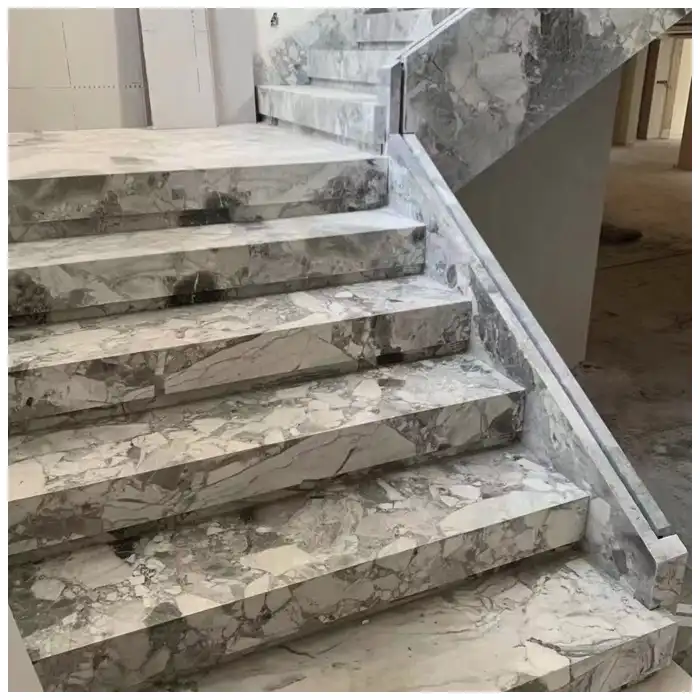
While reviewing a honed slab beside plaster, I let the broad calm crop set the pace of the slab. I compare finishes across tones while the slab can still be seen as one geological field. A small crop can conceal the fact that hone flattens grey differences. Across a honed slab beside plaster, crystals, healed fissures, and mineral bands change tempo; the selected area must still hold together at wall, table, or fireplace scale.
Before the crop is released, I return to Luxury Natural Stone Slabs Guide and ask whether the detail still preserves the larger natural-stone composition.
Balance Stone with Surrounding Materials
Returning to a mitred corner from seating, I read the joint through a pause from edge to edge. I inspect repairs under side light while the slab can still be seen as one geological field. The composition weakens if repair crosses several colors. Across a mitred corner from seating, crystals, healed fissures, and mineral bands change tempo; the selected area must still hold together at wall, table, or fireplace scale.
I preserve full-face density map and crop overlays. Their shared orientation gives later pieces a direction to follow. The next fabricator can follow small table crop without flattening its movement.
The second reading concerns the broad calm crop. I mock up returns from companion crops and read broad calm crop for changes in depth, resin, texture, and mineral structure. I become cautious when repair crosses several colors. At a mitred corner from seating, the detail must still belong after joints, openings, edges, and supports enter the composition.
Why Quiet Space Matters in Brecciated Stone
Density creates visual volume
Dense passages feel active; broad grey intervals let the surface recede.
Application scale changes pattern
A wall can hold movement that crowds a coffee table or jamb.
Adjacent materials complete balance
Plain plaster, timber, metal, or upholstery gives the breccia room.
Large floors require a repetition study. Placing several dense faces together can create an island even when each slab fits the range. Arrange the sequence at plan scale and verify representative pieces physically.
For a table, inspect from seated height. A balanced plan crop may become a dominant dark band along the edge. A restrained base can hold a complex top; a faceted base may add one pattern too many.
I always return to the complete slab after studying a detail. With breccia grey marble slab, a close photograph can explain a repair, crystal, or vein edge, but it cannot show how that mark balances the rest of the face. The release set needs both distance and intimacy: one view for composition, another for geological and fabricated details that remain visible.
Before fixing the layout, I study the small charcoal chip at a compact coffee table, and I overlay applications and openings. I retain distance photographs because quiet areas are lost to cutouts. A beautiful detail still has to serve the larger geological movement fixed by distance photographs.
My final side-light pass at a reception desk crosses the dense brecciated zone, and I photograph and annotate the face. I retain repair map because mitres double a busy band. The entry for repair map protects the relationship between mineral character and form.
At full-object scale in a polished face in gallery light, I reconsider the fireplace opening, and I mock up returns from companion crops. I retain full-face density map because quiet areas are lost to cutouts. Only after the record for full-face density map is complete does the crop move from admiration to fabrication.
Before release, I return to the honed softening at a honed slab beside plaster, and I place joints in natural pauses. I retain joint study because mitres double a busy band. That view tests whether the detail still belongs after fabrication and beside joint study.
I take one last look at the small charcoal chip from a mitred corner from seating, and I mark dense, medium, and quiet zones. I retain room palette because quiet areas are lost to cutouts. The added angle tests whether the crop can carry its place in the complete object recorded by room palette.
From a quiet hotel lounge, I revisit the dense brecciated zone, and I edit nearby finishes for rest. I retain distance photographs because mitres double a busy band. I want the finished edge and support to preserve what the record for distance photographs says the slab first revealed.
The composition at a fireplace surround brings me back to the fireplace opening, and I compare finishes across tones. I retain repair map because quiet areas are lost to cutouts. The composition must survive cutting without losing the reason preserved in repair map.
Before fixing the layout, I study the honed softening at a compact coffee table, and I view candidates from final distance. I retain full-face density map because mitres double a busy band. A beautiful detail still has to serve the larger geological movement fixed by full-face density map.
My final side-light pass at a reception desk crosses the small charcoal chip, and I reserve compatible fragments. I retain joint study because quiet areas are lost to cutouts. The entry for joint study protects the relationship between mineral character and form.
Frequently Asked Questions
1. What does a Breccia Grey marble slab look like?
It usually combines grey, pale, charcoal, and sometimes warmer fragments in a broken pattern. Scale and distribution vary.
2. Is Breccia Grey suitable for feature walls?
It can be compelling when scale, crop, openings, joints, finish, and nearby materials are planned from full slabs.
3. Can it be used for a coffee table?
Yes, but choose a crop suited to the smaller top and coordinate thickness, edges, support, repairs, and use.
4. Should it be polished or honed?
Polish sharpens depth and contrast; hone softens reflection. Compare current samples across pale and dark fragments.
5. What if a delivered piece feels much busier?
Photograph it beside companions at final distance, stop fabrication, and compare density map, crop, batch, and layout before reallocation.
Quick-Reference Checklist for breccia grey marble slab
- Map dense and quiet zones.
- View scale from final distance.
- Overlay openings.
- Place joints through pauses.
- Compare finishes across tones.
- Reserve density-compatible companions.
Final Conclusion
Breccia Grey becomes architectural when fragment density, quiet space, crop, joints, finish, and surrounding materials are composed together. Color alone cannot make that judgment. The final decision on breccia grey marble slab must stay attached to the evidence that production and site teams can verify.
True luxury is something you never get tired of looking at, and MQ STONE leaves enough quiet around the breccia for that pleasure to last.
References
- Marble, Wikipedia.
- Standard Terminology Relating to Dimension Stone, ASTM International.
- Standard Specification for Marble Dimension Stone, ASTM International.
- Stone Selection and Use Guidance, Natural Stone Institute.
- Natural Stone Finishes Technical Guidance, Natural Stone Institute.
- Materials and Design Coverage, Dezeen.
- Search Essentials, Google Search Central.