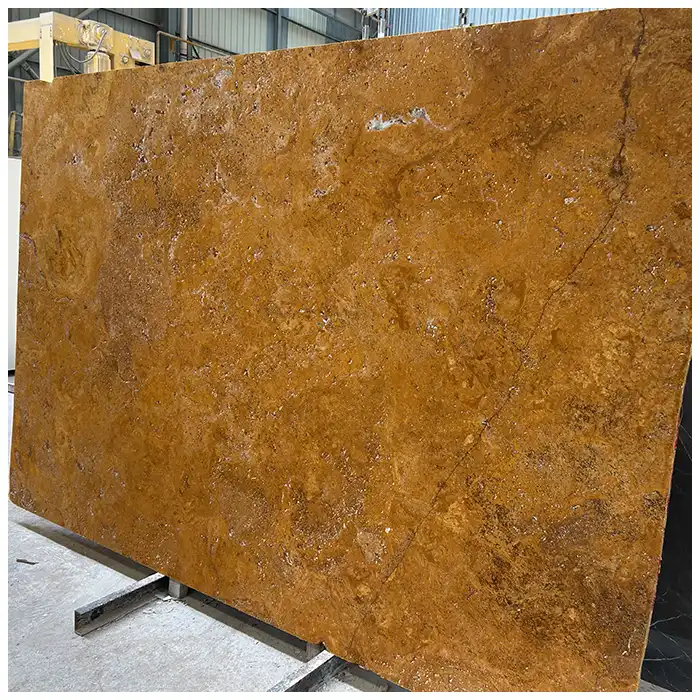
Arabescato Corchia Coffee Table: How a Low Surface Changes Vein Direction and Edge Choices
I do not begin with the base when I look at a low stone table. I begin with the moment light enters the polished face from a side window and the grey veins flatten, then rise again as I move around the slab. Arabescato Corchia carries a pale field with looping graphite movement, shaped as calcite recrystallised under heat and pressure. A low surface gives that mineral time to speak.
Read the Whole Slab Before You Read the Detail
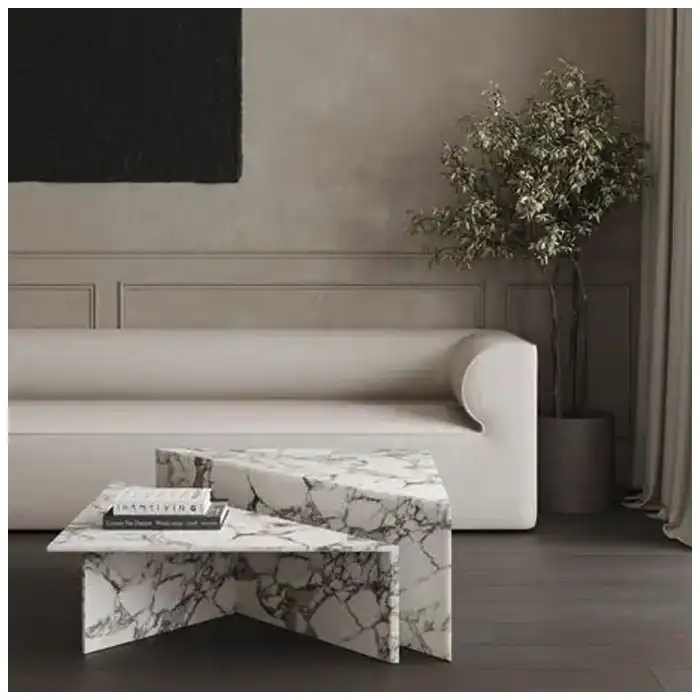
A coffee table is viewed from above, from the sofa, and while people walk around it. Those three angles do not read a slab in the same way. A strong diagonal line can lead the eye across a long top. A central whirl can anchor a square one. The slab itself decides whether the planned shape follows the movement or interrupts it.
Do not crop from a thumbnail. Lay a paper outline at full scale over the slab photograph, then compare it with the actual face. Ask where the calm field will sit, where the dense area will fall, and what will happen at the corners. A dramatic vein cut at one corner may feel alive on a wall panel yet look accidental on a table that people circle every day.
Arabescato Corchia is marble, formed chiefly from calcite crystals. Its darker lines arise from mineral variation and deformation in the original limestone before metamorphism. That geological history creates depth, but it does not give a fabricator permission to cut without a map. A good furniture layout respects the stone’s internal rhythm and the practical limits of the selected top.
How an Arabescato Corchia coffee table changes the design decision
The edge is a second drawing. A squared 20 mm edge gives a clean, fine shadow. A built-up mitred edge can make a top feel more monolithic, but it can also create a dark perimeter that changes the apparent thickness. A softened arris catches light gently and is kinder to knees near a sofa. No edge is automatically more refined; it must belong to the table height and room.
For a low surface, heavy visual mass can be useful when the room has tall ceilings and quiet upholstery. In a smaller sitting room, a deep mitred edge may make the table feel bulky. I prefer an edge that still looks honest after the first surprise of a thick stone profile fades.
Base position changes what the eye believes about the slab. A narrow pedestal can make the top seem to float, but it requires a careful conversation about span, thickness, material properties, and use. A broader timber or metal frame reads differently: it introduces another horizontal line, and it can either support the vein direction or compete with it.
| Decision point | What to study | What changes downstream |
|---|---|---|
| Slab crop | Full-scale top outline over the actual face | Corner movement and calm-field placement |
| Vein direction | Long flow, diagonal movement, or central composition | Where the eye travels from seating positions |
| Kantenprofil | Squared, eased, mitred, or shaped return | Visible thickness and impact resistance |
| Base footprint | Support position relative to top size and weight | Perceived balance and fabrication requirements |
The Hard-Won Lesson: The best vein was placed where the base hid it
The risk pattern is easy to create. A graceful grey sweep is centred under the proposed coffee-table outline, then the base moves toward the middle on the later support drawing. From the principal seating view the strongest movement now sits behind the pedestal, while a busier fragment faces the sofa. Nothing about the stone changed; only the reading of it did.
The Lesson: Approve the slab crop and the base footprint together; a beautiful top cannot be judged as if it were floating alone.
Material, Light, and the Way the Eye Returns
Light carries Arabescato differently across the day. In diffuse morning light, the pale ground can feel almost silvery. In a warmer evening room, the grey becomes softer and the polished portions hold small reflections. The mineral structure is not translucent in the way onyx can be, yet fine calcite grains still give the face a depth that printed pattern rarely holds at close range.
A honed finish softens reflection and brings the tactile surface forward. A polished finish makes the pale ground brighter and makes a fine line feel sharper. Neither is a shortcut to taste. The choice is about the use of the room, the quality of light, and whether the table is meant to recede beneath objects or remain readable when it is clear.
Do not overfill the surface with trays just to make it feel safer. A table top earns its place when there is room to see the stone. The movement shows where a book, vase or low bowl can sit without blocking the part of the composition that matters.
Where Fabrication Needs to Join the Conversation
Fabrication begins with more than thickness. The team needs the actual crop, vein orientation, edge profile, base drawing, joint plan if any, and position of any under-top reinforcement. A marble top may contain natural fissures or filled areas that are acceptable when known and placed thoughtfully, but not when they arrive unexpectedly at a thin corner.
Use photographs taken straight on and at a shallow angle. The shallow view reveals reflection, fill visibility, and edge shadow. The straight-on view confirms the larger composition. Ask for both before cutting. It deserves more attention than a single compressed image on a phone.
If a problem is noticed on arrival, photograph the whole top, the detail, the underside, and the base relationship before it is moved again. Do not install it to see whether the issue disappears. Pause, keep the packaging and inspection record, and compare the piece with the approved slab and fabrication drawing.
Making a Decision You Will Still Like Later
An Arabescato Corchia coffee table works best when the top shape has a reason. The stone can carry an open oval, a long rectangle, or a compact square, but each crop makes a different promise. The right one is the crop that still feels intentional from the chair where people will actually sit.
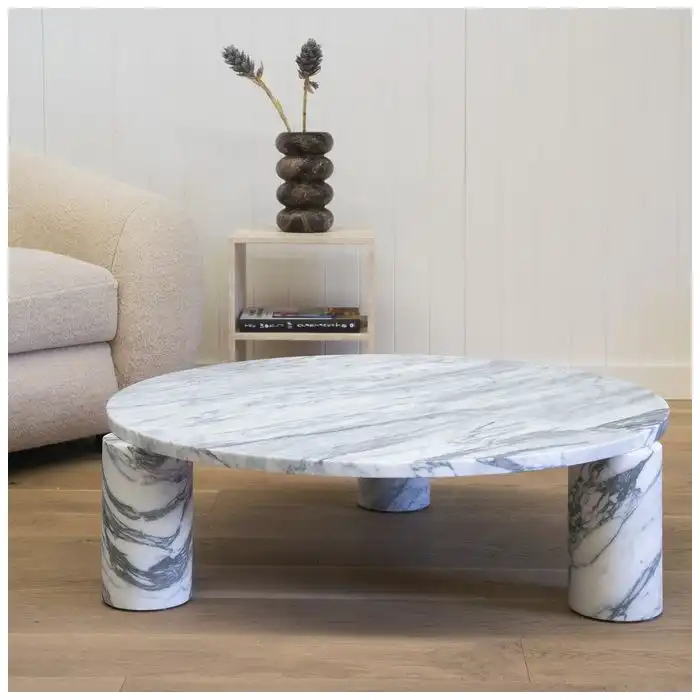
The material does not need theatrical help. Its white ground, looping grey veins, and compressed geological history are already enough. Good furniture design gives those qualities space, a stable support, and an edge that belongs to the proportion.
Details That Change the Final Result
A coffee table sees more than decoration. Cups are set down, feet brush the edge, and someone will lean against it while speaking. The top needs enough visual quiet for those ordinary actions, otherwise the most expressive part of the slab becomes buried beneath daily objects. Reserve the strongest movement for a part of the surface that remains visible.
An Arabescato Corchia coffee table gains character from the contrast between its white calcite field and its folded grey movement. At a low height, that movement reads slowly. A long vein can feel like a path from one sofa to another; a compressed cluster can feel heavy when it sits directly in front of the main seat.
The selected base material changes the stone’s temperature in the room. Dark metal can sharpen the grey lines. Pale oak can warm the ground. A concealed support makes the slab seem lighter, but it must be judged with the actual dimensions and fabrication advice rather than an attractive rendering alone.
For an oval top, follow a vein that turns gently through the centre. For a rectangle, decide whether the long edge should run with the movement or cross it. Neither choice is universal. A cut that fights the direction of the movement is usually obvious at full scale.
A small change in corner radius can alter the crop. Before cutting, put the finished outline on the slab image with edge allowances and any mitred return. The outer line is not the whole story. The visible face can change when an edge fold removes a few centimetres from the selected composition.
Natural features deserve an honest location. A filled fissure may be acceptable in a quiet side area if the material and repair are understood. It should not be placed on a thin projecting corner where movement and impact meet. Treating it with care is not the same as pretending it is uniform.
Delivery and installation are part of furniture planning. A stone top may need to travel on edge and be set onto the base only after the room is ready. Confirm the route, lift points, and final support before the slab becomes a finished object. A beautiful crop cannot solve an impossible turn through a finished doorway.
The table will be seen in daylight, lamp light, and the dimmer hour when conversation slows. The slab should keep offering depth without requiring every person in the room to notice it at once.
Before the Room Becomes Fixed
Before finalising a top, place the proposed furniture in the room plan with surrounding rugs, sofa depths, and walking paths. A stone surface needs enough distance to be seen, but it also needs enough clearance to be used without people grazing the corners. Proportion is part of the material decision.
Ask the fabricator for a clear view of the underside. The visible face takes the attention, yet support details, reinforcement if required, and base attachment need to work without causing a visible distortion at the edge. A drawing that only renders the top is unfinished.
An Arabescato Corchia coffee table should be photographed upright at the slab stage and again after edge work. The first image records the intended crop. The second shows whether the edge has changed the apparent weight and whether the key movement still falls where the design intended.
When a vein arrives at an edge, decide whether it should wrap around the return or stop at the face. A wrap can make a thick profile feel continuous. A stop can create a cleaner boundary. The choice depends on the stone and the edge construction, not on a universal rule.
Use felt or a similarly appropriate protection between the finished base and the stone only when the furniture design calls for it. The top must still have proper, level bearing. A casual pad cannot correct an uneven support or a base that has moved during delivery.
An Arabescato Corchia coffee table needs a final viewing test with the base in position. Stand at the main sofa, then at the side chair and room entry. A crop that looks balanced from above can feel weighted from one seated view. The table is furniture, not a slab display on the floor.
If the table will receive a glass top or other overlay, decide this early. It changes reflection, touch, edge exposure, and the amount of natural stone that remains visible. Do not treat an overlay as an easy answer after the material has already been selected.
The most satisfying stone tables have a simple internal logic: the slab crop, edge, base, and room angle all agree. The eye does not have to work to understand why the piece belongs there.
Final Material Check Before Release
An Arabescato Corchia coffee table must also be judged at the height where people sit. Photographing from directly above is useful for crop approval, but it does not show the edge shadow or the way one side of the stone faces the main sofa. Use both views.
Ask whether the top will carry objects most of the time. If a tray permanently covers the central movement, move the best vein toward the visible perimeter or choose a crop that keeps interest at the edges without looking crowded. Furniture must allow ordinary life.
An Arabescato Corchia coffee table can hold a quieter crop than a feature wall because it receives closer, longer attention. The strongest selection is not always the one with the most grey. It is the one whose composition stays balanced after books, light, and people enter the room.
At final inspection, hold the approved crop image beside the finished top before delivery. Confirm orientation, edge profile, and any accepted natural features. A stone object should leave the workshop with its identity intact.
The beauty of an Arabescato Corchia coffee table comes from proportion as much as material. Give the slab a sensible shape, a stable base, and enough empty surface for its geological movement to remain visible.
Questions We Hear Before Production
1. How do I choose the vein direction for an Arabescato Corchia coffee table?
Place the full-scale table outline over the actual slab and judge it from likely seating views. Keep the most meaningful movement where people will see it.
2. Is a mitred edge suitable for a marble coffee table?
It can be, when the thickness, base, and room proportion support the deeper visual profile. Approve the edge sample beside the actual stone.
3. Does Arabescato Corchia need reinforcement in furniture?
The need depends on the crop, thickness, span, natural features, edge profile, and base design. Let the fabricator review the exact top drawing.
4. Should a coffee table use polished or honed Arabescato Corchia?
Choose polished for more reflected light and honed for a softer tactile reading. Test both finishes under the room lighting when possible.
5. What should I do if the delivered table top differs from approval?
Photograph the whole top, detail, underside, and base relationship. Pause installation and compare the piece with approved slab and fabrication records.
Quick-Reference Checklist
- Approve a full-scale crop over the actual slab face.
- Review the table from primary seating positions.
- Choose an edge profile beside the selected stone finish.
- Confirm base footprint before cutting the slab.
- Photograph face, edge, and underside before final fabrication.
Final Conclusion
I would choose the crop that keeps revealing a new quiet turn of grey without demanding attention. That is how an Arabescato Corchia coffee table becomes lasting furniture, and MQ STONE treats that lasting calm as the sign of a well-read slab.
References
- Dimension Stone Design Manual, Natural Stone Institute.
- ASTM C97 Test Methods for Absorption and Bulk Specific Gravity of Dimension Stone, ASTM International.
- ASTM C503/C503M Standard Specification for Marble Dimension Stone, ASTM International.
- ASTM C119 Standard Terminology Relating to Dimension Stone, ASTM International.
- Natural Stone Institute technical modules and installation standards, Natural Stone Institute.
- Marmor, Wikipedia.