Labradorite Table Top: Orient the Flash Before Cutting
Move a lamp across a dark labradorite slab and the color seldom spreads evenly. A blue arc may open near one edge, a green flare may appear through the center, while the opposite corner stays almost graphite. Shift the viewing position and the whole order changes. That is the honest beginning of a labradorite table top: the stone asks the viewer to move.
My first answer is simple. Do not select the slab from one bright still image. Record the face from the actual table directions, map the finished outline, and decide which seats deserve the strongest flash. Then coordinate thickness, edge, repair zones, base contact, and handling with the fabricator.
Why a Labradorite Table Top Changes as You Walk
Labradorite is a feldspar mineral known for labradorescence. Light interacts with fine internal structures produced during mineral formation and separation, creating flashes that can appear blue, green, gold, copper, or silver. The effect depends on crystal orientation, surface plane, viewing direction, and light.

This is why a dark slab under flat front light may look quiet while a raking beam releases a band like cold fire beneath the surface. The color is not printed on top. It appears through a relationship between mineral structure and the observer.
Labradorite slab orientation decides where that relationship happens around furniture. A dining table has several viewing positions. A reception table may have one dominant arrival axis. A console is usually read from the front and above. I map those views before I decide which edge becomes the head.
Luxury Natural Stone Slabs for Walls, Furniture, and Light places this choice inside the broader natural-stone furniture decision. Labradorite deserves a narrower method because its best color can disappear when the outline rotates only ninety degrees.
Review the Full Face in Motion, Not through a Filter
I ask for a square full-face photograph, but I never stop there. A slow video moves the light and camera across the slab while the slab number and orientation remain visible. The movement should be smooth enough to reveal where flash begins, peaks, and fades.
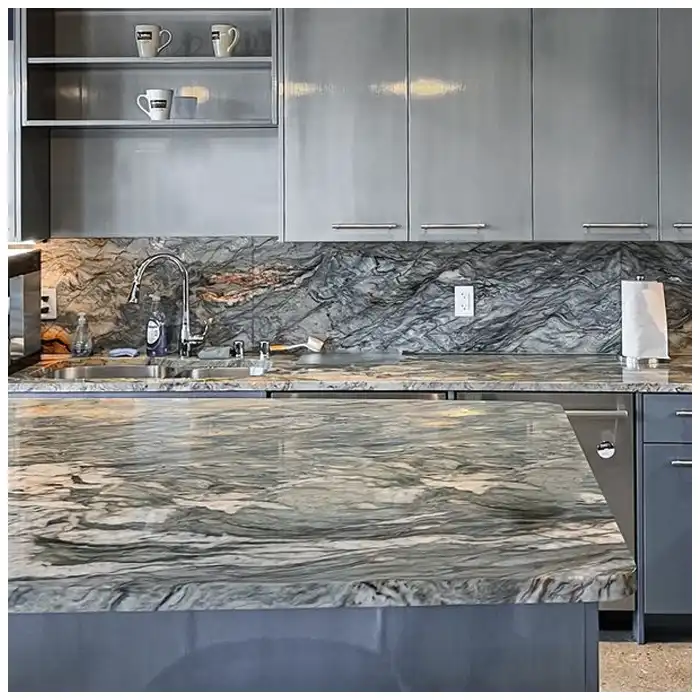
A Lemurian Labradorite granite table top can carry large blue and green mineral events across a dark ground. I want to know whether those events connect across the proposed table shape or break into isolated patches after cutting.
The veins will tell you where the eye wants to travel, but the feldspar flash tells you where the body wants to stand. I mark both on the slab image. One is visible in steady light; the other appears through movement.
Use three viewing heights
I review the slab near standing eye level, seated eye level, and the steeper angle used when approaching the table. A dramatic overhead flash may disappear for every seated guest. Conversely, a quieter area may glow beautifully from the end chair.
Labradorite table lighting must therefore be tested with the furniture height and room geometry in mind. A handheld lamp close to the slab can exaggerate effects that a distant ceiling fixture will never produce.
| Design checkpoint | What I record | What it reveals | Reason to reposition |
|---|---|---|---|
| Full-face movement | Slow video from front, sides, and intended approach | Direction and duration of mineral flash | Best event disappears from normal views |
| Table overlay | Final shape, seating, edge labels, base footprint | Which mineral areas survive cutting | Cut removes or splits the main flash |
| Oberflächengüte | Polished or tested alternative under same light | Reflection, depth, and visible repair response | Glare hides mineral color from key seats |
| Edge sample | Profile, thickness, lamination line, corner radius | How the dark body frames the luminous face | Built edge interrupts color or exposes mismatch |
| Support map | Base contact, hidden reinforcement, overhang, fixing zones | Where structure may shadow or stress the stone | Support crosses a fragile or repaired area |
| Room light | Fixture direction, beam spread, dimming scene, daylight | Whether flash appears during normal use | Only a temporary test lamp creates the effect |
Place the Finished Shape before Falling in Love with the Slab
A labradorite table top is a crop of a larger geological composition. An oval removes corners. A round top can turn a long mineral band into a crescent. A rectangular top may preserve direction but place the strongest event under a centerpiece or base connection.
I draw the finished outline on the full-face image with edge labels and seating positions. Then I review the top from each chair. A hotel lounge table may need its best color toward the arrival side, while a private dining table benefits from a more even sequence around the perimeter. That walk tests the labradorite slab orientation against the room rather than the cutting yield alone.
The published How to Choose Statement Slabs for Countertops, Walls, and Furniture explains how full-face movement becomes an architectural composition. Here the table outline adds a mobile audience. People circle furniture in a way they do not circle a fixed wall.
Protect repair zones from the most exposed views
Natural slabs can contain fissures, resin, mesh, filled areas, or local repairs. The fabricator assesses whether the selected face and proposed geometry can be made safely. I ask for those zones to be marked on the overlay rather than hidden until polishing.
A repair near the center may be visually quiet. The same repair at a thin edge or rounded corner can become conspicuous. True luxury is something you never get tired of looking at, and that includes honest placement of the stone’s necessary interventions.
The Brightest Flash Faced the Empty Wall
Suppose a rectangular labradorite top is approved from a video filmed along its long edge. The cutting overlay is later rotated to improve yield, but the room plan is not rotated with it. In the furniture mock-up, the strongest blue flash appears from the service side while the guest approach reads nearly black. The top has not failed. The orientation record has. The team returns to the slab map and assigns front, back, head, and service-side labels before fabrication proceeds.
Mark the room’s viewing directions on the slab overlay before any yield-driven rotation is accepted.
Choose an Edge That Holds the Mineral Depth
Stone table edge design changes how labradorite’s dark body frames the flashing surface. A clean straight edge can feel monolithic. A soft radius catches a moving highlight and makes the perimeter easier to approach. A built-up edge adds visual mass but requires careful matching and a controlled joint.
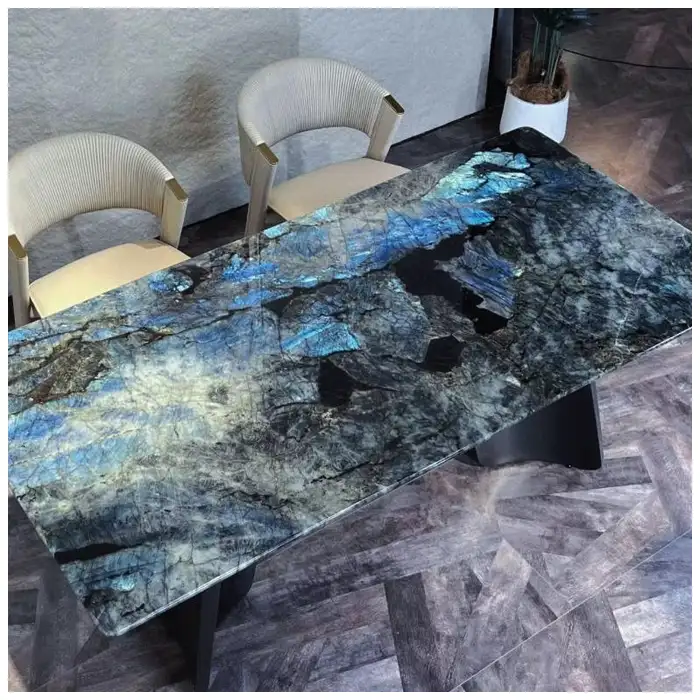
I test the edge on the actual material where practical. The face may carry blue fire while the edge appears charcoal, speckled, or quieter because the cut crosses crystal structures differently. That full-thickness trial keeps the stone table edge design honest.
A Blue Labradorite granite table needs corner geometry that suits both the visual weight and the room’s circulation. The fabricator and furniture engineer decide thickness, reinforcement, corner radius, and tolerances from the actual size and support plan.
Coordinate Base Support without Hiding the Best Stone
The base cannot be chosen from appearance alone. Finished dimensions, material properties, top mass, edge profile, overhang, openings, transport route, connection method, floor condition, and expected use all affect support. I provide the slab map to the engineer or qualified fabricator so the structure does not cross a sensitive zone by accident.
A labradorite table top may look visually balanced with a narrow sculptural base, yet the required support footprint can be larger. I adjust the base before fabrication rather than ask the stone to span farther because the rendering looked clean.
Die Stone Table Supplier Guide for Marble Dining Tables, Coffee Tables, and Custom Bases covers the wider supplier and coordination questions. This decision remains specific to flash direction, slab placement, and the way structural contact can affect light and composition.
Mock up the underside before closing the base
Access matters for assembly and later service. The team should understand how the top is supported, restrained, lifted, and removed without prying against a finished edge. A decorative base can conceal the connection, but it should not make inspection impossible.
If lighting is integrated nearby, keep heat, drivers, cables, and service access separate from the stone support decision. Labradorite is reflective, but it is not normally used like translucent onyx. The design should light the surface, not pretend to illuminate through it.
Light the Labradorite Table Top for Daily Movement
Labradorite table top color often responds best to directional light that reaches the surface at an angle and still allows viewers to move through the reflection. Broad flat illumination can make the stone readable but reduce the sudden flash. A narrow beam can create drama but also glare.
I test daylight, the normal evening scene, and any accent scene. The How Lighting Changes Colorful Marble, Quartzite, and Onyx Slabs provides the wider lighting framework. I record the accepted labradorite table lighting from seated eye level, with the objects that normally occupy the surface.
Polish usually strengthens reflection and perceived depth, but it may also mirror ceiling fittings. A honed experiment can soften glare while reducing some flash intensity. Do not assume one finish is always better; compare samples cut in the same orientation.
Approve the Finished Table from Every Important Side
I review top view, long sides, short sides, corners, underside transitions, base alignment, and the shadow line where stone meets structure. Then I walk the actual viewing path. A still photograph is the last record, not the whole approval.
Die Natural Quartzite Or Marble-Look Sintered Stone for Premium Interiors explains why natural depth differs from a printed marble-look surface. Labradorite makes that distinction immediate. Manufactured decoration can imitate a blue mark, but it does not reproduce this directional optical event inside feldspar.
Labradorite table top approval also includes handling. Crate orientation, lifting frame, edge protection, base packaging, assembly sequence, and final placement need written records. The most expressive face still has to survive the route.
Escalation when the flash appears in the wrong direction
First, photograph and film the complete top from the agreed viewing positions under the recorded light. Second, do not continue fixing or altering the top until orientation, finish, and support are reviewed. Third, contact the supplier with the original slab video, cutting overlay, room plan, edge sample, and inspection records for comparison.
What I Want the Room to Remember
I do not need every square centimeter to flare blue. The dark intervals give the mineral color somewhere to arrive. A good composition moves between graphite quiet, silver grain, and sudden ocean light without exhausting the eye.
Labradorite table top design succeeds when geology, viewing direction, shape, edge, support, and lighting describe the same object. This stone has been waiting for millions of years; rotating it carelessly at the final drawing would be a poor ending.
Frequently Asked Questions
1. Why does a labradorite table top change color?
Labradorescence comes from light interacting with fine internal structures in the feldspar. The effect depends on crystal orientation, surface plane, viewing angle, and light direction. That is why one seat may see blue or green flash while another sees a darker field.
2. How should a labradorite slab be approved for a table?
Use a square full-face image plus slow videos from the intended approach and seating directions. Mark orientation, repairs, table outline, edge labels, base footprint, and viewing positions. Approve the crop and direction, not merely the strongest still photograph.
3. Is polished or honed labradorite better for furniture?
Polish often increases reflection and perceived depth, while honing can soften glare and reduce some flash intensity. The response varies by slab and orientation. Test the actual material under the intended lighting before selecting the production finish.
4. Can the base be selected after the stone top is cut?
That is risky. Top mass, dimensions, thickness, overhang, edge, repair zones, connections, transport, and floor conditions affect the support design. Coordinate the qualified fabricator or engineer with the full slab and furniture drawings before cutting.
5. What should I do if the installed flash faces the wrong direction?
First, photograph and film the top from agreed views under the recorded light. Second, stop fixing or alteration. Third, compare the site orientation with the slab video, cutting overlay, room plan, edge sample, and inspection record before deciding whether repositioning is possible.
Quick-Reference Checklist for Labradorite Furniture
- Film the numbered full slab from every intended viewing direction.
- Mark front, back, head, service side, and seated eye lines on the overlay.
- Place the final shape before approving flash, repairs, and usable yield.
- Test the production finish and edge profile on the actual material.
- Coordinate base footprint, connections, overhang, and handling before cutting.
- Review daylight, normal evening light, and accent scenes at furniture height.
- Inspect the finished top by walking the same route the room will use.
Final Conclusion
A labradorite table top should be selected in motion. Film the face, map the room views, place the finished shape, protect the mineral event, test the edge, coordinate support, and walk around the completed table before approval.
The veins will tell you where to look, and MQ STONE would rather follow that changing blue fire than flatten the stone into one convenient still image.

References
- Dimension Stone Design Manual, Natural Stone Institute.
- ASTM C615 Standard Specification for Granite Dimension Stone, ASTM International.
- ASTM C97 Standard Test Methods for Absorption and Bulk Specific Gravity of Dimension Stone, ASTM International.
- ASTM C880 Standard Test Method for Flexural Strength of Dimension Stone, ASTM International.
- Mineralogy Reference Manual, Mineralogical Society of America.
- Natural Stone Care and Cleaning Guidance, Natural Stone Institute.
- Architectural Lighting Design Guidance, Illuminating Engineering Society.