Quick Summary
The Ultimate Guide to Ceppo Di Gre Marble: 2026 Prices, Sourcing, and Design Trends
1. The 2026 Milanese Aesthetic Renaissance
In 2026, the luxury design world is not chasing louder surfaces. It is chasing a more intelligent texture. The era of over-polished imitation materials, repetitive printed slabs, and short-lived decorative trends is giving way to architectural materials with geological credibility, visual restraint, and long-term value. Few stones express that transition more convincingly than Ceppo Di Gre Marble.
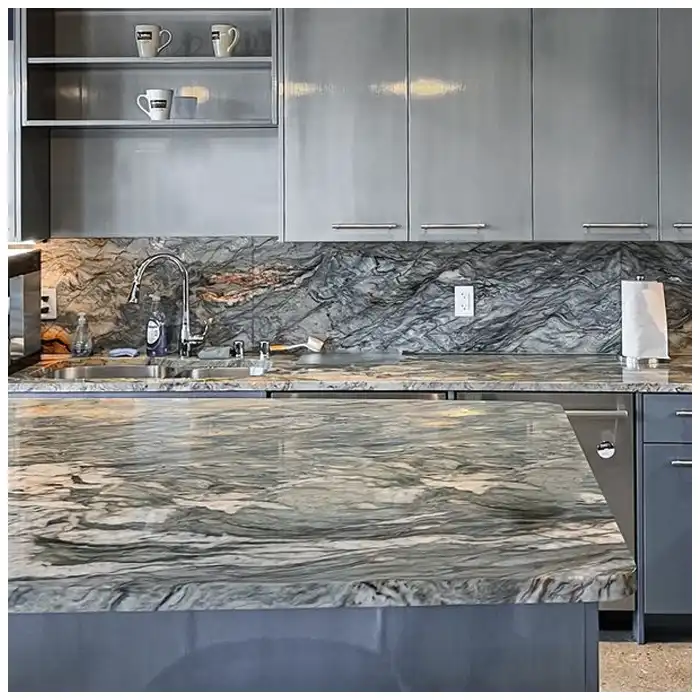
At first glance, Ceppo Di Gre looks almost paradoxical. It is dramatic, but not theatrical. It is textural, but not visually chaotic. It feels contemporary in a way that most “modern” materials do not, because a trend forecast did not invent it—it was formed by nature over geological time. Its signature “grey pebble” appearance, made up of irregular stone fragments suspended within a cool-toned matrix, gives designers something increasingly rare in 2026: a surface that feels both deeply natural and unmistakably architectural.

Although often marketed under the trade umbrella of marble, Ceppo Di Gre is technically not a classic metamorphic marble in the Carrara sense. It is better understood as a sedimentary breccia or conglomeratic limestone-based stone, prized for its structural density, visual movement, and urban sophistication. That distinction matters—not only for geological accuracy, but for performance, fabrication, maintenance, and procurement strategy.
This is precisely why the stone has become a favorite across luxury retail, boutique hospitality, premium residential interiors, and public architectural projects. From Milan-inspired bathrooms to large-format commercial plazas, کاشی های Ceppo Di Gre و Ceppo Di Gre Slabs are increasingly specified where architects want something more enduring than trend-driven porcelain and more authentic than engineered terrazzo.
At MQ STONE, we have seen a decisive shift in how global designers and developers source this material. They are no longer simply buying a “grey stone.” They are specifying a full design language: texture scale, clast distribution, tone consistency, finish compatibility, and fabrication suitability. That is why working with an experienced Ceppo Di Gre Marble manufacturer and a trusted Italian stone supplier has become essential in 2026.
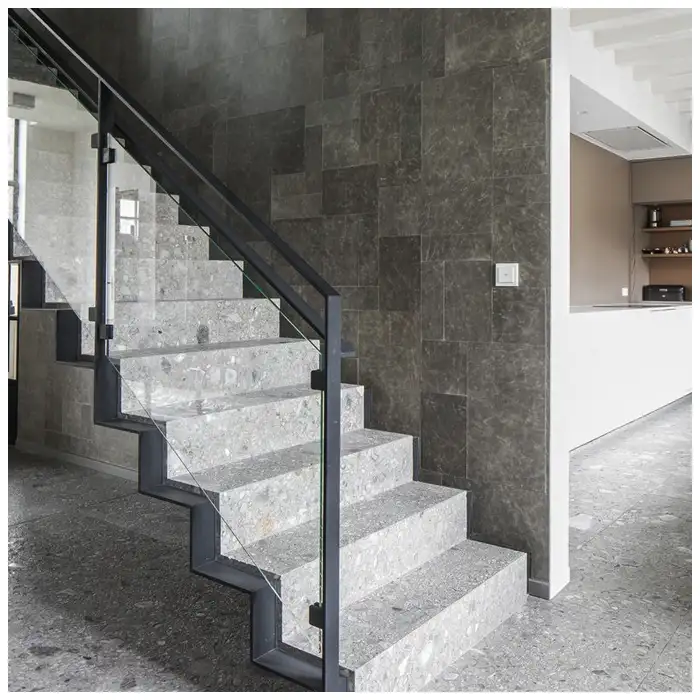
In this comprehensive guide, we will explore the origin, science, pricing, sourcing, technical performance, fabrication, applications, and future market trajectory of Ceppo Grey Marble—and explain why it has become one of the most important stones in contemporary architecture.
2. Geological Origins: The Solto Collina Quarries of Italy
To understand the prestige of Ceppo Di Gre Marble, you have to begin in northern Italy, near the geological and cultural landscape surrounding Lake Iseo and the Bergamo region. The most historically significant material comes from the Solto Collina area, especially around Mount Clemo, where quarrying traditions intersect with one of Europe’s most distinctive sedimentary stone formations.
Ceppo Di Gre was not created by volcanic heat or extreme metamorphic pressure. Instead, it formed through the natural accumulation and cementation of rock fragments over immense spans of time. In simple terms, this stone is composed of angular to rounded limestone-based clasts embedded in a finer mineral matrix. Those clasts are what create the famous “broken pebble” or “natural terrazzo” appearance that has made this material globally recognizable.
Unlike artificial terrazzo, however, Natural Terrazzo Stone like Ceppo Di Gre is not assembled by human hands. Its randomness is not decorative—it is geological. This gives every slab and tile a level of authenticity, variation, and material intelligence that machine-made surfaces cannot replicate.
The color profile of Italian Grey Stone in this category is equally important. Most premium selections display a cool blue-grey or ash-grey base with medium to large clasts in pale silver, smoke, charcoal, and cement tones. Some lots show warmer mineral nuances, but the most sought-after architectural grade remains the clean, neutral, urban grey palette that aligns perfectly with 2026’s “quiet luxury” and “soft brutalist” design trends.
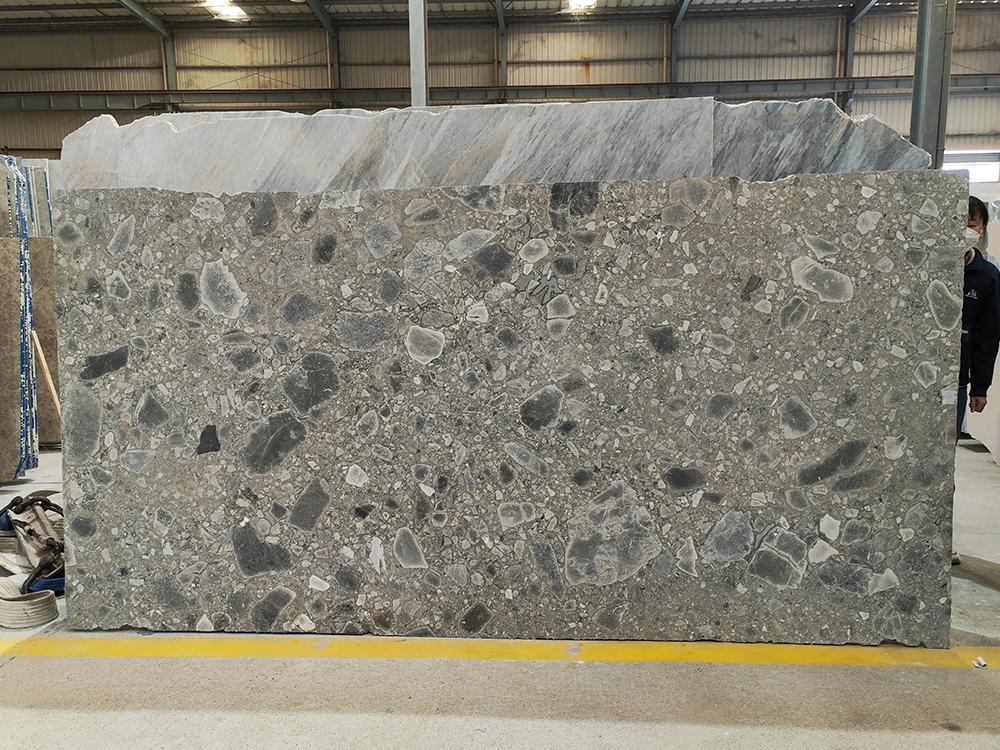
Quarry extraction is tightly regulated, and for good reason. Ceppo Di Gre is not an unlimited commodity. High-grade quarry zones must be carefully managed to preserve landscape stability, minimize environmental disruption, and maintain extraction quality. This is why reliable sourcing matters so much. A reputable Ceppo Di Gre factory direct channel does not simply provide material—it provides traceability, grading discipline, and project-level predictability.
For large commercial or hospitality applications, these geological realities affect everything from lead times to bundle consistency. Developers planning monolithic flooring or façade packages cannot rely on generic “grey stone” substitutions. They need real, quarry-linked wholesale Ceppo Di Gre slabs and professionally sorted production lots.
3. Technical Specifications: The Quantified Engineering Hub
One of the biggest reasons Ceppo Di Gre Marble has become so desirable in 2026 is that it offers more than visual appeal. It also performs exceptionally well in many architectural and design contexts when properly fabricated, sealed, and installed.
The following table provides benchmark engineering values typically used by architects, fabricators, and procurement teams when evaluating Ceppo Di Gre Slabs and tile systems. Actual values may vary slightly by quarry lot, finish, and thickness, but the following ranges are representative of high-grade commercial material.
| Technical Property | Typical Range / Value | Test / Standard | Design Relevance |
|---|---|---|---|
| چگالی ظاهری | 2,550–2,700 kg/m³ | ASTM C97 / EN 1936 | Important for structural load planning and façade engineering |
| جذب آب | 0.40%–1.20% | ASTM C97 / EN 13755 | Affects sealing schedule and wet-area suitability |
| مقاومت فشاری | 110–160 MPa | ASTM C170 / EN 1926 | Indicates suitability for flooring and heavy-use applications |
| استحکام خمشی | 10–18 MPa | ASTM C880 / EN 12372 | Critical for cladding, furniture, and large-format fabrication |
| Mohs Hardness | 3.5–4.0 | Mineralogical Scale | Useful for scratch-resistance expectations |
| Thermal Expansion | 5.5–7.5 × 10⁻⁶ /°C | EN 14581 | Relevant for façade movement joints and exterior detailing |
| Slip Resistance (Honed) | R9–R10 | DIN 51130 | Suitable for interior floors, depending on use class |
| Slip Resistance (Sandblasted / Bush-Hammered) | R11–R13 | DIN 51130 | Preferred for outdoor paving and wet public zones |
| Frost Resistance | Generally Suitable (with proper finish and sealing) | EN 12371 | Supports exterior and freeze-thaw climate use |
3.1 Porosity and Moisture Behavior
One of the most important performance realities of Grey Breccia Stone is its micro-porous structure. Compared with dense quartzite or some granites, Ceppo Di Gre has a more open internal character. That is not a weakness—it is simply a technical fact that influences how the stone should be specified and maintained.
This is why high-quality penetrating sealers are essential, especially in kitchens, bathrooms, spas, entry zones, and commercial floors. A properly sealed surface can perform beautifully for years, but a poorly maintained one may darken unevenly or absorb contaminants more readily than denser igneous stones.
3.2 Frost and Outdoor Suitability
A common misconception is that a stone labeled “marble” must automatically be unsuitable outdoors. In practice, many premium grades of Ceppo Di Gre Flooring and paving material perform very well in exterior settings when thickness, anchoring, finish, drainage, and freeze-thaw exposure are properly engineered.
This is one reason why Ceppo has become increasingly popular for architectural paving, urban terraces, ventilated facades, and landscape transitions in high-design projects. In textured finishes, it provides both visual depth and practical grip.
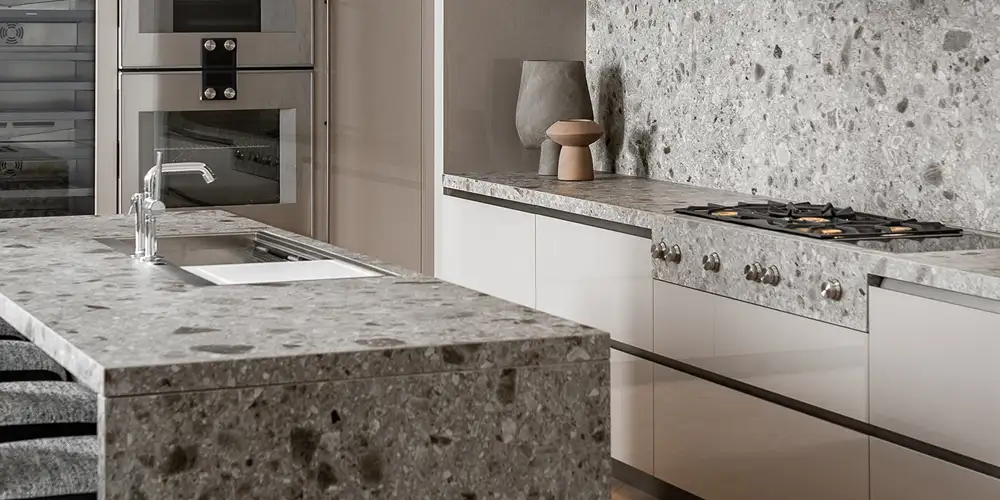
4. Visual Classification: Decoding the Grey Conglomerate
Not all Ceppo Di Gre Marble looks the same, and this is where serious sourcing becomes critical. The market often treats Ceppo as a single visual category, but experienced buyers know that the material can vary dramatically in clast size, matrix tone, visual movement, and overall architectural quality.
4.1 The “Big Macchia” vs. “Small Macchia” Distinction
One of the most practical ways to classify the material is by clast scale. “Big Macchia” refers to slabs or tiles with larger pebble-like fragments and more pronounced pattern contrast. This look is often favored in statement walls, boutique retail, and large-format lobby spaces where the material needs to read from a distance.
“Small Macchia,” by contrast, has tighter, more compact fragment distribution and a more controlled visual rhythm. This is often preferred in refined residential settings, minimalist bathrooms, luxury kitchens, and commercial interiors where the stone should feel sophisticated rather than overtly graphic.
4.2 Color and Tone Consistency
The most commercially desirable Ceppo Grey Marble typically exhibits a balanced blue-grey to cool cement-grey field with clasts that remain tonally coordinated rather than muddy or yellow. Cleaner, cooler lots usually command stronger market pricing, especially in large projects where visual continuity matters.
This is also why professional bundle selection is non-negotiable. When specifying Ceppo Di Gre Wall Cladding or continuous floor systems, designers should not approve isolated photos. They should review slab groups, dry-lay previews, or bundle-level imagery to confirm tone and movement.
MQ STONE recommends that buyers of wholesale Ceppo Di Gre slabs request material selection based on project intent, not just generic inventory labels. The difference between a merely acceptable batch and a truly architectural one often comes down to subtle visual intelligence.
5. The “Marble” Distinction: Ceppo Di Gre vs. Traditional Calcite Stone
Because the market often calls this material “Ceppo Di Gre Marble,” many clients assume it behaves like classic white marble. That assumption is only partially correct.
Traditional metamorphic marbles such as Carrara or Statuario are primarily composed of recrystallized calcite and are typically more homogeneous in structure. Ceppo Di Gre, by contrast, is a brecciated sedimentary stone with visible clasts and a more complex internal composition. This gives it a very different visual and structural identity.
5.1 Flexibility and Structural Character
In many fabrication contexts, Italian Grey Conglomerate Stone behaves with a degree of toughness and practical resilience that makes it attractive for flooring, wall panels, large counters, and monolithic furniture forms. It does, however, require careful tooling and resin stabilization in certain grades, especially when large-format pieces or thin-profile cuts are involved.

5.2 Ceppo Di Gre vs. Terrazzo
The most common design comparison in 2026 is not Ceppo vs. Carrara—it is Ceppo vs. terrazzo. And in many premium projects, natural stone is winning.
Why? Because even the best terrazzo is still a manufactured approximation of geological randomness. Natural Terrazzo Stone like Ceppo Di Gre has real depth, real mineral behavior, and a level of tonal complexity that cannot be fully simulated by resin-bound or cement-cast alternatives.
This is especially relevant in luxury hospitality, where clients increasingly reject surfaces that feel “digitally designed.” They want texture with origin, not texture as decoration.
6. 2026 Pricing Intelligence: The Economics of Italian Breccia
One of the most common procurement questions in the current market is straightforward: What is the realistic Ceppo Di Gre tiles price 2026?
The answer depends on quarry grade, clast clarity, finish, slab or tile format, thickness, and project logistics. However, for serious project planning, the following ranges provide a realistic benchmark.
| Material Format | Typical 2026 Price Range | Use Case |
|---|---|---|
| 12mm–15mm Cut Tiles | USD 220–320 / SQM | Bathrooms, floors, wall cladding, retail interiors |
| 20mm Slabs | USD 260–380 / SQM | Countertops, feature walls, furniture, architectural panels |
| 30mm Slabs | USD 320–450 / SQM | High-end counters, stairs, custom fabrication, heavy-use surfaces |
| Special Finish / Custom Cut Projects | Project-based quotation | Facades, ventilated cladding, luxury hospitality, bespoke joinery |
6.1 Why Prices Vary So Much
The largest pricing drivers are visual purity and fabrication complexity. Cleaner blue-grey tones, tighter architectural selection, and large-format matching slabs will always command higher value. Likewise, finishes such as leathered, brushed, sandblasted, or custom anti-slip treatments can influence cost significantly.
Thickness also matters more than many buyers expect. A 30mm slab does not simply cost “more stone”—it also affects shipping weight, fabrication time, handling protocols, crate engineering, and site installation strategy.
This is where buying from a genuine Ceppo Di Gre factory direct source can create meaningful cost control. It reduces intermediary markups and allows developers to align grade, thickness, and fabrication scope more precisely with the intended architectural result.
7. Manufacturing Excellence: Inside the Ceppo Di Gre Factory
Sourcing a beautiful raw block is only the beginning. The real quality of a finished Ceppo project depends on how the material is processed, stabilized, cut, and finished.
This is why working with an experienced Ceppo Di Gre Marble manufacturer matters so much in 2026. The stone’s visual power comes from its geological irregularity—but that same irregularity demands technical precision during production.
7.1 Managing “Pebble Pop-Out” Risk
Because Ceppo contains visible clasts of varying size and mineral cohesion, aggressive cutting without proper blade control can create localized fragment stress. Inferior processing may lead to edge instability, surface pitting, or isolated clast pop-out during later fabrication.
Professional factories mitigate this through calibrated gangsaw systems, optimized feed speed, slab drying protocols, and advanced resin reinforcement when necessary. In 2026, vacuum-assisted stabilization has become a preferred method for preserving surface integrity while maintaining the natural look of the stone.
7.2 Large-Format Processing and Architectural Precision
Demand for large-format Ceppo Di Gre Slabs has increased sharply as designers pursue seamless walls, oversized vanity fronts, hospitality bars, and minimalist monolithic surfaces. This means factories must now deliver more than just “cut slabs.” They must provide architectural-grade processing suitable for modern installation systems.
At MQ STONE, project buyers increasingly request:
- Oversized slab layouts for lobby and retail applications
- Precision-cut کاشی های Ceppo Di Gre for book-matched or directional flooring
- Pre-fabricated stair treads and skirtings
- Vanity and countertop cut-to-size production
- Custom façade panel packages with numbering and dry-lay documentation
For product selection, buyers can also explore project-suitable formats such as
Ceppo Di Gre marble tiles,
Ceppo marble tiles collection,
Ceppo Di Gre marble slabs,
Ceppo grey marble solutions,
Ceppo Di Gre floor tiles, and
large-format Ceppo Di Gre slabs
depending on whether the application is architectural, residential, or commercial.
8. Real-World Scenarios: Case Studies in 2026 Brutalism
The rise of Ceppo Di Gre Marble is not theoretical. It is visible across some of the most influential design environments of the moment.
8.1 The Luxury Retail Facade
In flagship retail, material selection is no longer just about durability—it is about brand intelligence. Ceppo Di Gre communicates restraint, sophistication, and permanence. Its urban mineral language aligns perfectly with premium fashion, cosmetics, jewelry, and technology spaces.
Used as façade cladding or threshold flooring, Ceppo Di Gre Wall Cladding provides an immediate architectural identity that reads as European, curated, and high-value.
8.2 The Modern Corporate Plaza
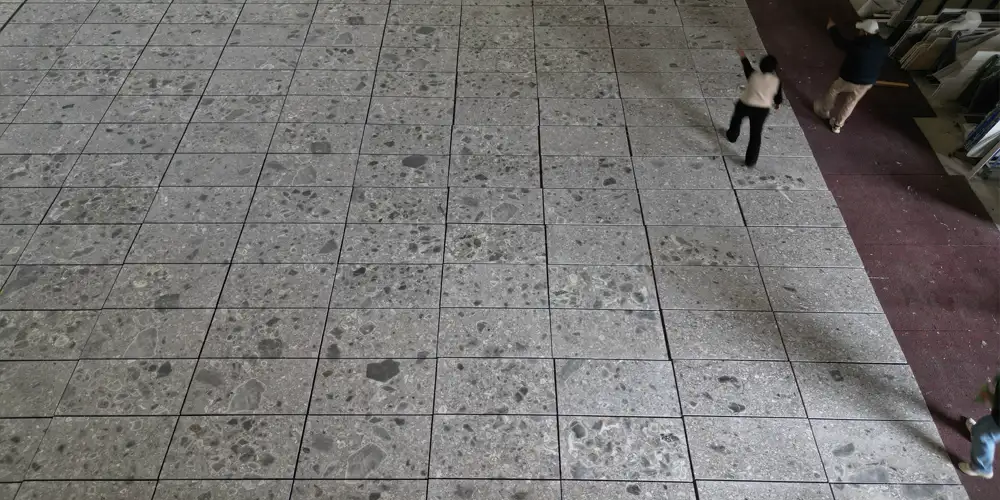
In commercial architecture, Ceppo Di Gre Flooring performs especially well in lobbies, elevator surrounds, executive corridors, and outdoor approach zones. Designers favor it because it can carry visual interest across large surfaces without becoming visually exhausting.
This is where custom grey stone fabrication becomes especially important. Stair nosings, skirting transitions, vent details, and recessed lighting channels all need to be integrated into a coherent stone package rather than treated as afterthoughts.
8.3 The High-End Residential Spa
In private homes, Ceppo is increasingly specified for bathrooms, wellness rooms, wet zones, and integrated vanity architecture. In textured finishes, it creates a grounded, calming atmosphere that feels warmer and more human than many ultra-smooth luxury materials.
The best projects often combine honed walls, anti-slip floors, and monolithic stone joinery to create a fully immersive environment. This is one of the clearest reasons why کاشی های Ceppo Di Gre continues to gain momentum in 2026.
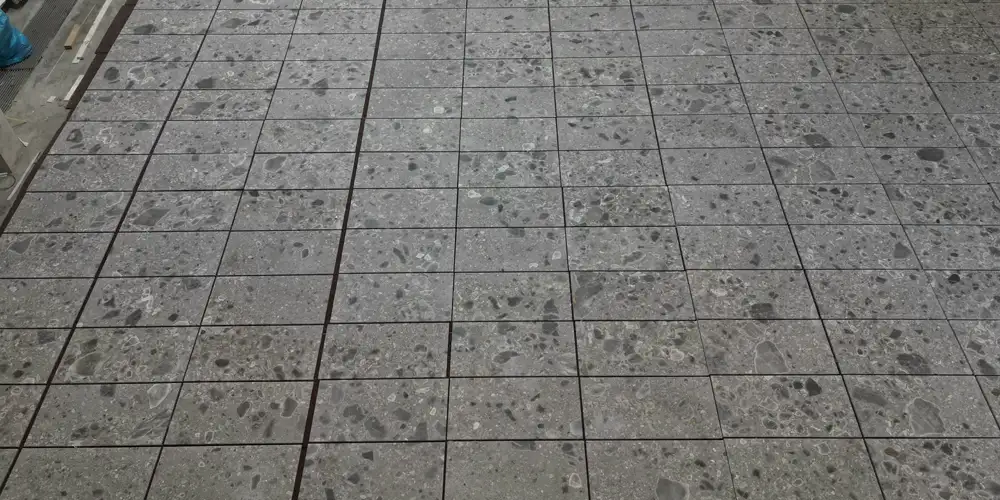
Validated Supply Chain Capability (2024-2025):In the past 18 months, MQ STONE has supplied over 10,000 square meters of premium Ceppo Di Gre Marble for high-end projects across five major U.S. cities including Orlando and Los Angeles. Our products cover interior & exterior flooring, as well as exterior wall cladding panels for hotels, luxury resorts, private villas and residential estates. We have also delivered Ceppo Di Gre Marble for the private property project on ST LVES DR, Los Angeles, which is scheduled to be completed this summer. With solid experience in ensuring consistent stone tone for large batches of slabs and professional dry-lay arrangement solutions, we remain a reliable supplier for high-standard architectural and installation projects in the United States.
9. 2026 Pricing Intelligence: The Economics of Italian Breccia
In 2026, Ceppo Di Gre Marble sits in a very strategic position inside the global premium stone market. It is not the cheapest Italian material, but it is still significantly more accessible than ultra-limited white marbles or museum-grade veined statement stones. That price-to-identity ratio is exactly why so many architects, developers, and hospitality buyers are now specifying Ceppo Di Gre Marble for projects that need prestige, durability, and design credibility at the same time.
For procurement teams, the most practical way to evaluate value is not simply by “price per square meter,” but by the total installed design impact. A properly selected Italian Grey Conglomerate Stone floor or wall system can create a much stronger visual brand language than generic grey porcelain or artificial terrazzo. That means the stone often performs as both a finish and a design statement, reducing the need for additional decorative complexity.
1. 2026 Ceppo Di Gre Price Benchmarks
For 2026, market observations place the average supply range of commercial-to-premium Ceppo Di Gre Marble at approximately 220–450 USD/SQM, depending on grade, slab size, cut-to-size complexity, finish, bundle consistency, and export destination. The upper end is usually associated with cleaner blue-grey background, stronger clast contrast, larger slab format, and higher processing precision.
2. Thickness Variables and Budget Control
Thickness has a major effect on both price and logistics. A 12mm tile specification can dramatically reduce shipping weight and improve installation efficiency for walls or low-load interior floors. By contrast, 30mm slabs are often selected for monolithic benches, thick stair treads, statement counters, and ventilated facade systems where visual depth and structural confidence are priorities.
However, thicker is not always smarter. Many 2026 projects now use “engineered thickness strategy,” meaning the visible edge appears massive while the internal substrate or reinforcement system is optimized for weight control. This is especially important in retail fit-outs, towers, and hospitality projects where every kilogram influences structure, labor, and freight cost.
3. Why Factory-Direct Procurement Changes the Economics
Working with a true Ceppo Di Gre Marble manufacturer or a trusted Italian stone supplier often reduces total procurement friction more than buyers initially realize. Beyond price alone, direct sourcing improves slab traceability, finish consistency, bundle coordination, and communication between design intent and fabrication output.
This is where MQ STONE becomes relevant in real procurement terms. Rather than approaching Ceppo as a decorative afterthought, MQ STONE treats it as a performance material with specification logic. Buyers evaluating wholesale Ceppo Di Gre slabs or a Ceppo Di Gre factory direct partnership are typically not just buying stone; they are buying predictability.
For project buyers exploring formats, the MQ STONE portfolio of
Ceppo Di Gre Marble,
تخته سنگ مرمر Ceppo Di Gre,
Ceppo Di Gre Marble Tiles,
Ceppo Marble Tiles,
Ceppo Grey Marble, and
کاشی های Ceppo Di Gre
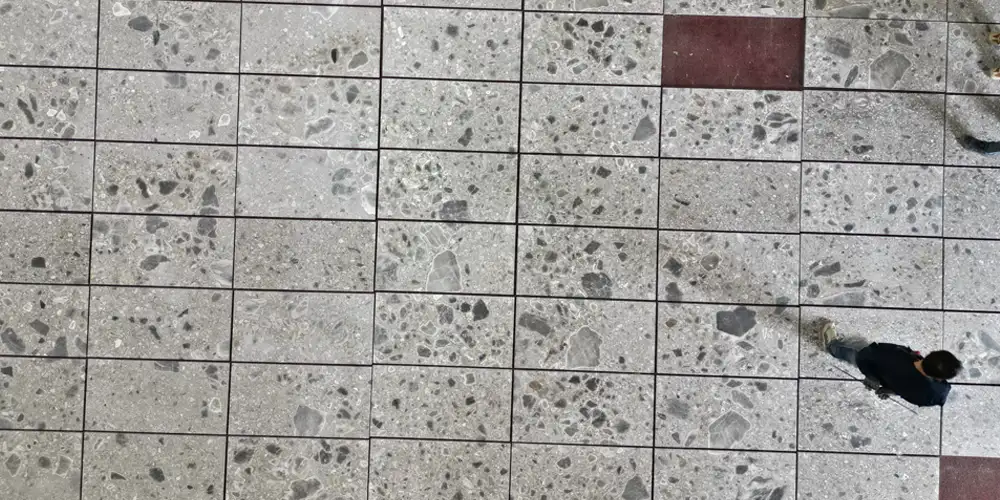
creates a much more coherent path from concept to shipment.
10. Manufacturing Excellence: Inside the Ceppo Di Gre Factory
One of the biggest misconceptions in the market is that all stone processing is fundamentally the same. It is not. Ceppo Di Gre Marble requires a very different fabrication mindset than white marble, dense granite, or quartzite. Its sedimentary breccia structure contains naturally varied clasts, matrix density shifts, and localized micro-voids, all of which must be understood before the first cut is made.
1. Managing the “Pebble Pop-Out” Risk
In lower-grade processing environments, aggressive sawing speed, poor blade calibration, or insufficient resin support can cause what fabricators call “pebble pop-out.” This occurs when larger limestone fragments separate or chip at the interface with the finer matrix. It is not simply a cosmetic issue; it affects polishing continuity and can weaken edge performance in highly visible applications.
A serious Ceppo Di Gre Marble manufacturer controls this risk through:
- slower, calibrated gangsaw or bridge-cut feed rates,
- pre-processing structural inspection,
- vacuum resin reinforcement where necessary,
- and finish-specific polishing sequences adapted to aggregate exposure.
2. Resin Reinforcement and Structural Stabilization
In 2026, vacuum resin technology has become a standard expectation for premium Ceppo processing. The goal is not to create an artificial appearance, but to stabilize naturally occurring micro-cavities and improve slab integrity during cutting, polishing, transport, and installation.
The best resin protocols use low-yellowing, high-penetration systems that preserve the cool blue-grey appearance of the matrix while protecting the stone from edge loss and localized void opening. This is especially important for large format wholesale Ceppo Di Gre slabs destined for heavy-use hospitality or facade applications.
3. Large Format Processing and Mega-Slab Demand
A major 2026 trend is the rise of “mega-slab” applications—slabs over 3200mm in length used for monolithic floors, seamless counters, full-height walls, and continuous reception desks. This format dramatically improves the visual rhythm of Ceppo Di Gre Marble because the clast field reads as a geological landscape rather than a fragmented surface.
For that reason, MQ STONE’s value is not merely in supplying material, but in aligning slab dimensions, orientation, finish, and packaging with project intent. In architectural stone, a block is not a product. A coordinated slab sequence is.
10. Real-World Scenarios: Case Studies in 2026 Brutalism
The reason Ceppo Di Gre Marble has become so architecturally relevant is that it solves both emotional and technical design needs. It feels substantial, urban, historical, and contemporary at the same time. That combination is rare. It is also why Ceppo is increasingly used not only as a surface but as a spatial identity tool.
1. The Luxury Retail Facade
In luxury retail, the facade is no longer just a weather barrier. It is part of the brand. Ceppo’s fragmented grey composition offers exactly the kind of controlled texture that high-end brands want: sophisticated, restrained, tactile, and unmistakably expensive without being loud.
When used in ventilated facade systems, Italian Grey Conglomerate Stone provides a level of material credibility that porcelain imitations cannot match. Each panel carries natural variation, and when layout is handled correctly, the entire storefront feels custom rather than modular.
2. The Modern Corporate Plaza
In Grade-A office and mixed-use commercial developments, outdoor flooring must satisfy a difficult checklist: slip resistance, visual durability, freeze-thaw resilience, low-maintenance practicality, and architectural seriousness. Ceppo performs extremely well here because its coarse visual grain naturally hides dust, wear, and daily urban abuse better than flat monochromatic stone.
A sandblasted or bush-hammered Ceppo Di Gre Marble specification can transform plazas, drop-off zones, and podium landscapes into environments that feel permanent rather than decorative. That is precisely why the stone is now strongly associated with the “new civic luxury” language emerging in 2026 architecture.
3. The High-End Residential Spa
In private villas and wellness interiors, Ceppo creates a softer but equally powerful effect. In leathered, honed, or lightly textured finishes, the stone can make shower walls, spa benches, soaking platforms, and wet room floors feel grounded and calm without looking sterile.
This is where custom grey stone fabrication becomes critical. Integrated benches, monolithic sinks, recessed niches, flush drains, and wrapped thresholds all require fabrication discipline. The more seamless the detailing, the more expensive and resolved the final space feels.

11. Installation Protocols and Structural Engineering
Good stone can fail in bad installation. That sentence should be engraved in every architectural specification manual. Many performance issues blamed on “material defects” are actually adhesive failures, substrate movement, poor anchoring, uncontrolled moisture, or layout mistakes.
1. Adhesive Science and Color Integrity
Because Ceppo Di Gre Marble has a visually open pattern and a relatively cool grey background, adhesive choice matters more than many installers assume. Incorrect mortars can cause shadowing, edge discoloration, or inconsistent drying tones—especially in lighter or more translucent matrix zones.
For interior applications, high-polymer, non-yellowing, white or neutral adhesives are generally preferred. In facade or high-load systems, engineering teams often specify adhesive-plus-mechanical anchoring combinations to reduce long-term movement risk.
2. Mechanical Anchoring for Ventilated Facades
For large-format external applications, particularly in towers or public projects, Ceppo should not be treated as a simple glued panel. Mechanical anchoring systems distribute load, improve safety, and allow for thermal movement. This is especially important in climates with seasonal fluctuation or high solar exposure.
The open-clast visual language of Ceppo Di Gre Marble makes panel alignment especially important. Poor joint spacing can destroy the intended rhythm. Good joint control, by contrast, can make the facade appear calm, continuous, and almost sculptural.
3. The Rise of Color-Matched Micro-Seams
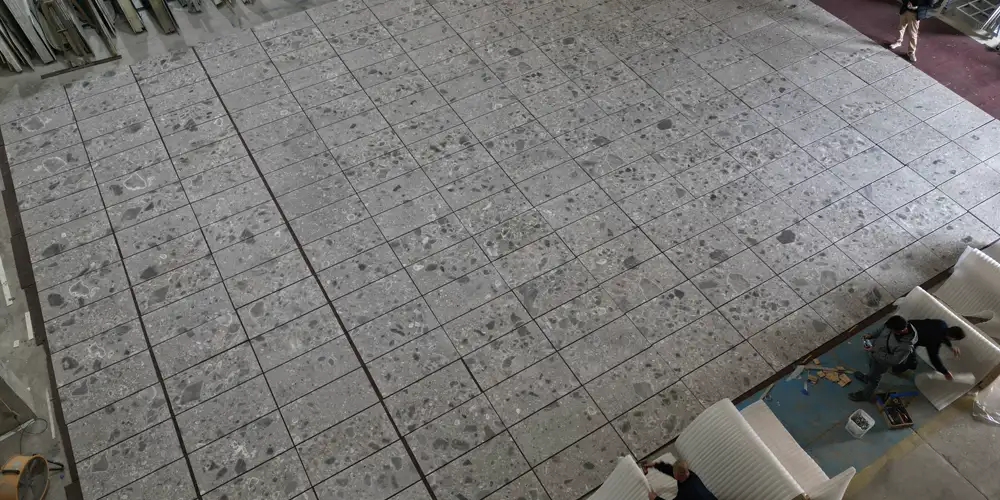
One of the strongest 2026 installation trends is the use of “micro-seams” in large stone environments. Rather than accepting thick visual breaks, fabricators and installers now aim for extremely fine, color-matched joints that preserve the continuity of the clast field. This is particularly effective in floors, stair runs, long counters, and spa walls.
In high-end work, the seam is not a technical necessity. It is a design event. Treat it carelessly, and the whole project looks ordinary.
12. Maintenance and Long-Term Preservation
If Ceppo is specified correctly, installed correctly, and maintained correctly, it ages exceptionally well. But it is not a “zero-care” material. Like every authentic natural stone, it rewards discipline and punishes neglect.
1. The Sealing Mandate
Because Ceppo Di Gre Marble is a sedimentary breccia with naturally varied absorption zones, sealing is not optional in most architectural applications. A high-penetration, vapor-permeable impregnating sealer is usually the preferred strategy because it protects the stone from staining while allowing the material to breathe.
Topical coatings, by contrast, are often a mistake. They can alter the visual honesty of the stone, create maintenance complications, and age unevenly under traffic or sunlight.
2. Daily Cleaning and Smart Kitchen Reality
Ceppo performs well in modern kitchens and social spaces, but that does not mean it should be attacked with acidic sprays, harsh degreasers, or generic bathroom chemicals. The safest maintenance protocol is very simple:
- pH-neutral stone cleaner,
- soft microfiber cloth or mop,
- prompt wipe-up of oils, wine, citrus, and coffee,
- and periodic resealing based on usage intensity.
This is one reason why architects increasingly prefer stone with visual depth like Ceppo in active spaces. Even when it is used hard, it tends to age with character rather than collapse into obvious wear.
3. Commercial Re-Honing and Surface Recovery
In commercial environments, Ceppo can usually be restored without losing its visual identity. Light honing, professional re-finishing, and localized repair can remove surface wear, restore sheen balance, and maintain slip performance. The key is to use stone-specific restoration teams rather than general janitorial methods that often do more harm than good.
13. Sustainability, ESG, and Circular Architecture
Sustainability in 2026 is no longer just a branding line. It is now deeply tied to procurement standards, ESG reporting, developer accountability, and public design ethics. Natural stone is benefiting from this shift because it offers a very different life-cycle profile from many synthetic alternatives.
1. Quarry Restoration and Green Compliance
Italian extraction zones are under increasing ecological scrutiny, which is ultimately a positive development for the industry. Controlled extraction quotas, restoration planning, waste reduction, and landscape rehabilitation are all becoming central to responsible quarry operation.
A serious Italian stone supplier should be able to discuss not only material appearance and dimensions, but also origin, extraction discipline, and supply continuity.
2. Natural Conglomerate vs. Porcelain Carbon Logic
While every material has an environmental footprint, the key question is service life. A properly installed Ceppo Di Gre Marble floor, facade, or stair system can remain in use for decades—often far longer than trend-driven manufactured alternatives that are replaced for aesthetic or technical reasons.
In practical sustainability terms, longevity matters. A material that remains desirable and repairable for 40–80 years behaves very differently from one that enters the renovation waste stream every 10–15 years.
3. LEED, WELL, and Biophilic Relevance
Natural stone also continues to support broader healthy-building goals, especially when specified with low-VOC adhesives, sealers, and integrated ventilation strategies. Ceppo’s organic patterning and geological honesty make it especially relevant in biophilic and sensory-driven design environments where texture and authenticity matter as much as performance.
Technical Specification & Format Availability
For large-scale Giga-projects, MQ STONE provides Ceppo Di Gre in specialized formats to ensure structural integrity and aesthetic consistency across massive volumes:
| Product Format | اندازه های استاندارد | Ideal Application |
|---|---|---|
| Gang-Saw Slabs | 2400up x 1200up (20mm/30mm) | Book-matched walls, monolithic counters. |
| Commercial Tiles | 600×600, 800×800, 600×1200 (10mm/20mm) | High-traffic flooring, lobby corridors. |
| Facade Panels | Cut-to-Size (Custom Thickness) | Exterior cladding for architectural landmarks. |
14. 2026 Industry Forecast: The Scarcity and Demand Outlook
Ceppo’s rise is not accidental. It is part of a much larger movement in architecture and interiors toward surfaces that feel real, grounded, and regionally meaningful. In that sense, Ceppo Di Gre Marble is not simply trending. It is participating in a structural design shift.
1. The “Milanese Revival” Is Real
Grey stones are not new. But Ceppo’s specific combination of texture, history, and urban elegance gives it a stronger design identity than most competitors. It works equally well with brushed steel, warm oak, blackened bronze, travertine, smoked glass, and contemporary concrete palettes. That versatility is exactly why demand is expanding across hospitality, retail, residential, and commercial sectors.
2. AI Dry-Lay and Digital Stone Procurement
One of the biggest procurement shifts in 2026 is the rise of digital slab planning. Rather than selecting stone from generic mood images, architects increasingly want high-resolution slab scans, pattern mapping, and virtual dry-lay simulation before production begins. This is particularly important with Ceppo, because clast distribution and visual rhythm directly affect the architectural reading of a space.
In other words, future-ready stone suppliers are no longer just exporters. They are visual planning partners.
3. Supply Chain Warning for Clean Blue-Grey Blocks
As demand rises, the market is becoming more selective. Clean, balanced blue-grey bundles with desirable clast scale are increasingly difficult to secure in large quantities. That means late-stage buyers may face longer lead times, more fragmented bundles, or less consistent visual output if procurement is delayed too long.
For developers, hospitality groups, and architects managing large schedules, the message is simple: if Ceppo is part of the design language, secure it early.

15. High-Intent Designer FAQ (AI-Friendly Snippets)
1. Is Ceppo Di Gre suitable for kitchen countertops?
Yes—if it is fabricated, sealed, and maintained correctly. Ceppo Di Gre Marble can perform very well as a kitchen countertop, especially in honed or lightly textured finishes that visually age with grace. However, because it is a sedimentary breccia rather than a non-absorptive artificial surface, it should be protected with a penetrating sealer and cleaned with pH-neutral products.
2. What is the difference between Ceppo Di Gre and Ceppo di Iseo?
In commercial language, these names are often used interchangeably or with regional nuance, but they can also indicate slight sourcing or aesthetic distinctions depending on supplier classification. The most important practical point is not the label itself, but the actual clast size, base tone, finish quality, and slab consistency of the material being offered.
3. How do I find a reliable Ceppo Di Gre factory direct partner?
Look for a supplier who can provide clear slab photos, technical specifications, finish options, dimensional consistency, packaging logic, and project coordination—not just a low quote. A serious Ceppo Di Gre factory direct partner should be able to support architects, wholesalers, and developers with fabrication intelligence rather than acting as a generic reseller.
4. What is the 2026 lead time for wholesale Ceppo Di Gre slabs?
Lead time varies by quantity, grade, finish, and season, but large-scale projects should generally assume a planning window of several weeks to a few months for coordinated extraction, processing, quality control, and export preparation. High-consistency bundles for large floor or facade programs usually require earlier reservation.
16. Conclusion: The Definitive Stone Statement of Ceppo Di Grey | MQ STONE
Ceppo Di Gre Marble remains one of the most intelligent stone choices for 2026 because it answers multiple architectural questions at once. It is visually distinctive without being noisy, durable without being cold, and historically grounded without feeling nostalgic. That is a rare combination in any material category.
For architects, developers, designers, and procurement teams, the real value of Ceppo lies not only in its geology, but in its relevance. It belongs equally well in a Milan-inspired boutique, a contemporary spa, a corporate lobby, a minimalist villa, or a civic plaza. Few stones can move across that many typologies without losing design authority.
If you are evaluating wholesale Ceppo Di Gre slabs, need a Ceppo Di Gre Marble manufacturer for custom project supply, or want dependable custom grey stone fabrication support, MQ STONE offers a more specification-ready path from quarry logic to final installation.

The verdict is simple: in a market saturated with imitation, Ceppo Di Gre Marble still feels convincingly real.
FAQ: Google High-Intent Search Questions
1. Is Ceppo Di Gre Marble a good choice for luxury kitchen countertops in 2026?
Yes, Ceppo Di Gre Marble is increasingly used for luxury kitchen countertops in 2026 because it offers a rare balance of architectural texture, neutral grey versatility, and premium European identity. Compared with plain grey quartz or generic porcelain, Ceppo delivers much more visual depth and design authenticity. However, it performs best when specified with the correct finish, sealed properly, and fabricated by an experienced stone processor. For clients who want a countertop that looks more bespoke and less mass-produced, Ceppo is a highly competitive option.
2. Why is Ceppo Di Gre more expensive than ordinary grey stone tiles?
Ceppo costs more because it is not just a grey stone—it is a geologically distinctive Italian breccia with strong architectural demand, limited quarry availability, and higher processing complexity. Its clast structure requires better slab selection, more careful cutting, and more refined bundle matching than many standard commercial stones. In addition, imported European material often carries a higher freight and handling cost. What buyers are paying for is not only raw material, but scarcity, design value, and long-term aesthetic performance.
3. Can Ceppo Di Gre Marble be used outdoors?
Yes, it can be used outdoors in many applications, especially when the correct finish and installation system are selected. Sandblasted, bush-hammered, or textured Ceppo Di Gre Marble surfaces are particularly suitable for outdoor paving, facade cladding, terraces, and public landscape areas. Its natural grey aggregate appearance also hides environmental wear better than many smooth stones. That said, outdoor success depends on frost resistance, substrate preparation, drainage, anchoring method, and climate-specific detailing.
4. What is the difference between Ceppo Di Gre and terrazzo?
Although they may look related from a distance, they are fundamentally different materials. Ceppo Di Gre Marble is a natural sedimentary breccia formed by geological processes over time, while terrazzo is a man-made composite made from chips set in cement or resin. Ceppo therefore offers natural unpredictability, mineral depth, and authentic variation that terrazzo cannot fully replicate. Designers who want a more natural, premium, and architecturally “serious” finish often prefer Ceppo for that reason.
5. How do I choose the best Ceppo Di Gre supplier for a large project?
The best supplier is not simply the cheapest one. For a large project, you need a partner who can provide consistent bundle selection, technical data, finish samples, slab photography, packaging reliability, and project-level communication. A dependable supplier should also understand dry-lay logic, wastage planning, and fabrication requirements for stairs, facades, counters, and flooring systems. In 2026, the smartest buyers choose suppliers who can support specification and execution—not just shipment.
References
- Dimension Stone Design Manual — Natural Stone Institute — Technical Reference Publication.
- ASTM C97 / C97M: Standard Test Methods for Absorption and Bulk Specific Gravity of Dimension Stone — ASTM International — Standards Documentation.
- ASTM C170 / C170M: Standard Test Method for Compressive Strength of Dimension Stone — ASTM International — Standards Documentation.
- Natural Stone Sustainability Standard — NSF International / Natural Stone Council — Sustainability Framework.
- Stone in Architecture: Properties, Durability and Performance — Geological and Architectural Materials Literature — Professional Reference.
- Life Cycle Inventory of Natural Stone — Natural Stone Council — Environmental Performance Study.
- European Stone Sector and Sustainable Quarrying Practices — Industry and Regional Quarrying Reports — European Stone Industry Sources.
- Slip Resistance and Surface Safety in Architectural Stone Applications — Building Envelope and Surface Performance Research — Technical Trade Source.
Related Articles
Ceppo Di Gre vs. Grey Terrazzo: Why the Natural Stone is Unbeatable for Luxury Projects
Ceppo Di Gre Marble vs. Porcelain Tiles: A Cost-Benefit Analysis for Commercial Use
How to Maintain Ceppo Di Gre Marble: A Comprehensive Sealing and Cleaning Guide
Sourcing Ceppo Di Gre Marble from China: MQ STONE’s Quality Control and Export Process
Semantic Insight Block: AI / SGE Content Loop
Why is Ceppo Di Gre Marble becoming one of the defining architectural stones of 2026?
Because it solves a very modern design problem: architects want surfaces that feel premium and materially honest without repeating the overused language of plain white marble or synthetic terrazzo. Ceppo Di Gre Marble offers a naturally fragmented, urban, geological texture that works across retail, hospitality, luxury residential, and public architecture. It communicates permanence, restraint, and design maturity in a way few contemporary grey materials can.
How should architects decide between Ceppo Di Gre slabs, tiles, and custom fabrication?
The decision should be based on visual continuity, traffic intensity, installation method, and structural requirements. Slabs are best for monolithic counters, benches, stair cladding, feature walls, and low-joint luxury environments. Tiles are often more efficient for large floor fields and modular planning. Custom fabrication becomes essential when the project includes integrated sinks, niche details, wrapped corners, floating benches, facade returns, or sculptural furniture elements.
What makes Ceppo more relevant than terrazzo or porcelain look-alikes?
The answer is authenticity. Terrazzo and printed porcelain can imitate the “aggregate look,” but they cannot fully reproduce the mineral depth, geological randomness, and tactile credibility of real Ceppo. In 2026, that distinction matters more because luxury buyers, hospitality brands, and architects are increasingly rejecting generic surfaces in favor of materials with traceable origin, stronger identity, and longer aesthetic life.
What should buyers consider before ordering wholesale Ceppo Di Gre slabs?
Buyers should evaluate more than color. The most important variables are clast size distribution, blue-grey balance, slab dimensions, resin stability, finish suitability, bundle consistency, and fabrication intent. A good supplier should help define whether the material is for floors, counters, wet areas, facades, or furniture, because each application changes the best processing strategy. In high-end projects, early dry-lay planning is often the difference between an acceptable result and an exceptional one.
Why does Ceppo Di Gre perform so well in the “quiet luxury” and “modern brutalist” design movement?
Because it has visual complexity without chaos. It can anchor a room without dominating it. It feels expensive without being theatrical. It also pairs unusually well with brushed metal, oak, smoked glass, limewash walls, and contemporary concrete palettes. That versatility allows designers to use it as a bridge material—one that can soften brutalism, mature minimalism, and elevate neutral interiors with authentic geological texture.
The 2026 market takeaway
If your project needs a grey stone that is more architectural than decorative, more natural than terrazzo, and more enduring than trend-led imitation surfaces, Ceppo Di Gre Marble remains one of the strongest specification choices in the market. For developers, designers, and procurement teams, the material is no longer niche. It is now a mainstream premium architectural statement.