Quick Summary
Beige Travertine Storage Cabinets include this freestanding three-drawer design in Turkish Roman Beige travertine. Its broad, flat drawer fronts display warm horizontal stone layers, while a vertically fluted accent panel introduces a contrasting carved texture. Overall size options are 66 × 51 × 61cm and 81 × 51 × 61cm, with 20mm or 30mm stone components specified according to the construction. Filled-honed and unfilled-honed finishes are available for consideration. The cabinet is suited to bedroom storage, living spaces and selected hospitality interiors. Drawer hardware, internal arrangement and stone finishing can be coordinated with the approved furniture drawings.
Roman Beige Travertine Three-Drawer Cabinet and Storage Configuration
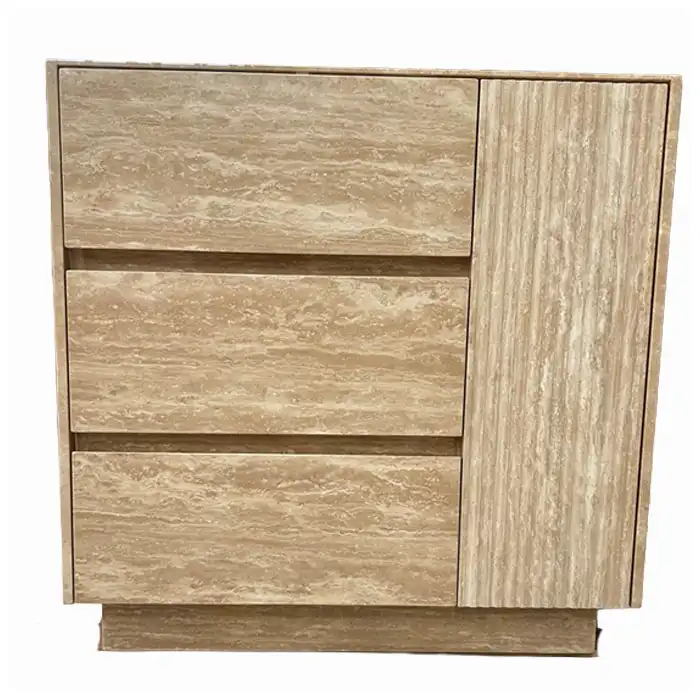
The Roman Beige travertine storage cabinet combines three horizontal drawer fronts with a tall, vertically grooved accent panel. The broad, uninterrupted drawer faces display the stone’s natural layers, while the fluted section adds a narrower, more closely spaced surface pattern.
The three drawers form the principal storage configuration. Their flat fronts maintain a restrained appearance without prominent external handles. The opening mechanism and internal drawer construction can be specified according to the required hardware arrangement.
Roman Beige Travertine Cabinets are characterised by natural cream, sand and pale brown sedimentary layers. On this model, those layers remain particularly visible across the wide drawer fronts. The pattern varies from one stone selection to another, making the natural material an integral part of the furniture design.
The right-hand fluted panel creates a different visual rhythm from the smooth drawer faces. Its vertical grooves contrast with the predominantly horizontal stone movement and introduce shadow lines across the front elevation.
A supporting plinth forms the cabinet’s floorstanding base. The relationship between this lower section, the drawer assembly and the outer stone surfaces gives the piece its substantial architectural proportions.
The cabinet is a finished storage product rather than a decorative slab or a conventional washbasin vanity. Its design incorporates working drawer components, finished stone surfaces and furniture-specific assembly requirements.
The exposed panels can be coordinated in colour and vein direction during fabrication. Natural variation remains visible, particularly where the horizontal drawer fronts meet the vertical accent panel or surrounding stone edges.
Travertine Drawer Fronts, Opening Clearances and Internal Hardware
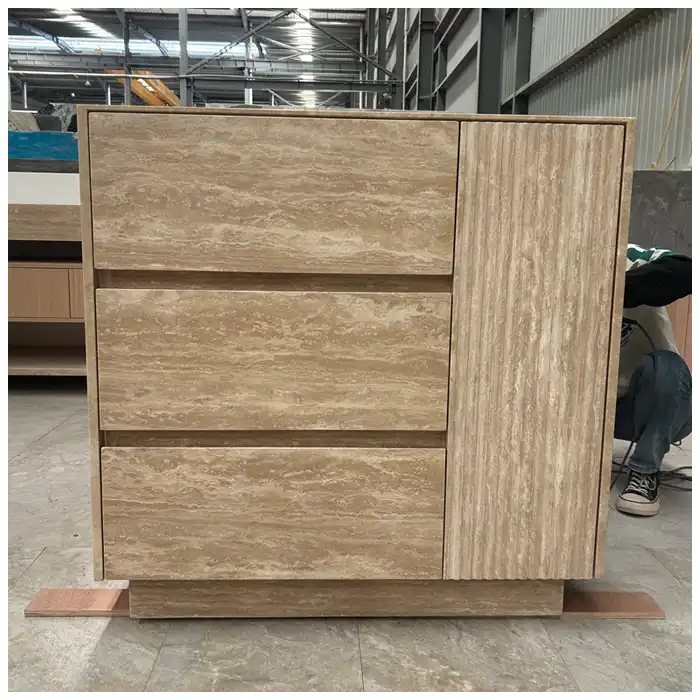
A natural stone drawer front requires different detailing from an ordinary timber or laminate cabinet front. The stone has its own weight, edge condition and dimensional requirements, while the moving drawer assembly must remain accurately aligned within the cabinet.
The three horizontal fronts create a consistent arrangement with narrow reveals between adjoining sections. Those gaps must allow the drawers to operate without contact between finished stone edges.
Drawer Movement and Hardware Selection
The internal drawer system determines the opening travel, closing action and load capacity. Hardware selection must account for the mass of the finished drawer fronts as well as the expected contents.
Concealed slides, soft-closing mechanisms or alternative configurations can be considered as custom hardware choices. Their inclusion depends on the approved construction rather than the appearance of the stone exterior.
Drawer Front Alignment
The top, middle and bottom drawer fronts form a continuous visual sequence. Their horizontal edges and side reveals need consistent alignment so the furniture reads as one coordinated stone assembly.
A small difference in the position of one drawer becomes more apparent against the straight cabinet frame. Drawer adjustment and final assembly therefore influence both function and the appearance of the finished elevation.
Internal Storage Arrangement
Drawer depth, internal dividers and hardware arrangements can be adapted within the available cabinet dimensions. The usable internal storage volume depends on the carcass construction, stone thickness and selected drawer mechanism.
The exterior dimensions do not represent the clear internal drawer dimensions. These are established separately in the approved furniture drawings.
Turkish Roman Beige Travertine Colour, Vein Direction and Natural Pores
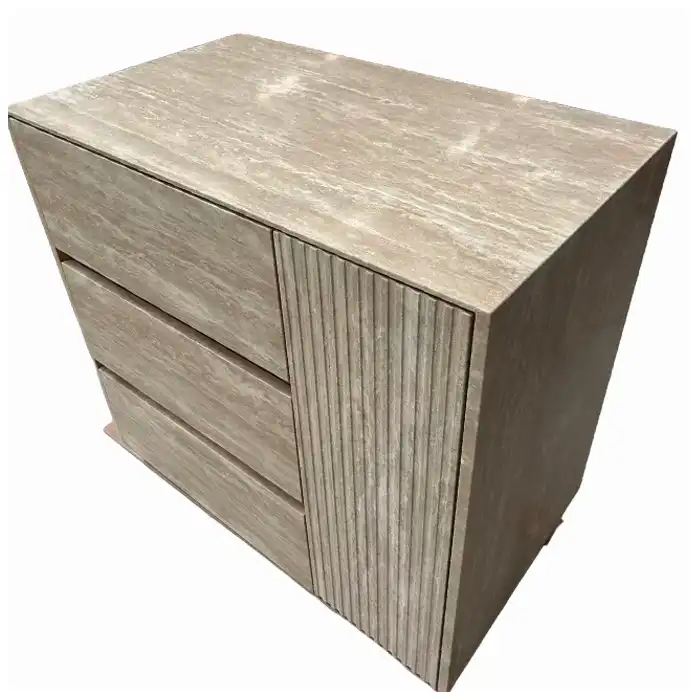
Turkish Roman Beige travertine is a natural carbonate stone formed through mineral deposition. Its characteristic layered appearance contains cream, sandy beige and pale brown tones, with natural pores distributed throughout the material.
The stone used on this cabinet displays horizontal movement across the broad drawer faces. These layers may vary in thickness and contrast, so the finished furniture retains the irregularities of the selected travertine rather than repeating a manufactured pattern.
Travertine Layering Across Drawer Fronts
Wide drawer fronts expose a substantial area of natural stone. Relatively continuous beige layers can be positioned across these surfaces, while smaller mineral markings and pale deposits interrupt the broader bands.
Matching the movement of the stone between drawer fronts depends on the available slabs and cutting arrangement. Closely coordinated layers may be possible with suitable material selection, but exact continuity is not inherent to every travertine slab.
Natural Pore Structure
Beige Travertine Cabinets retain the visual character of a naturally porous stone. Small cavities and variations in the mineral layers are normal features of travertine, although the surface treatment determines how prominently the openings remain visible.
Unfilled pores create deeper surface relief and shadow. Filling reduces open cavities and produces a more continuous finish, especially on surfaces that are touched or cleaned frequently.
Stone Selection for Furniture Components
The front faces, outer panels and carved details are cut from selected stone material. Their visual relationship depends on background colour, layering and the distribution of natural pores.
The strongest natural markings need not be identical across every surface. Their placement can be coordinated so that the cabinet maintains a balanced appearance without disguising the variation of genuine travertine.
Roman Beige Travertine Storage Cabinet Specifications
Two overall dimensions are specified for the three-drawer model. The sizes refer to the furniture assembly, while the stated stone thicknesses apply to selected components according to the construction drawings.
| Nome del prodotto | Premium Roman Beige Travertine 3-Drawer Storage Cabinet with Fluted Side Panel |
| Materiale | Natural Turkish Roman Beige Travertine |
| Product Type | Freestanding Natural Stone Storage Cabinet |
| Cabinet Configuration | Three Drawers with a Vertical Fluted Accent Panel |
| Overall Size Option A | 66 × 51 × 61cm |
| Overall Size Option B | 81 × 51 × 61cm |
| Stone Component Thickness | 20mm or 30mm according to the approved construction |
| Finiture di superficie | Filled Honed and Unfilled Honed |
| Decorative Processing | CNC-Cut Vertical Fluting and Finished Stone Edges |
| Drawer Hardware | Custom hardware configuration according to furniture drawings |
| Custom Options | Overall Dimensions, Drawer Configuration, Surface Finish and Internal Storage Details |
| Primary Applications | Bedrooms, Living Areas, Guest Suites, Lounge Interiors and Selected Bathroom Storage Areas |
| Installation Type | Floorstanding with a supported, level base |
CNC Fluted Side Panel, Stone Thickness and Edge Processing
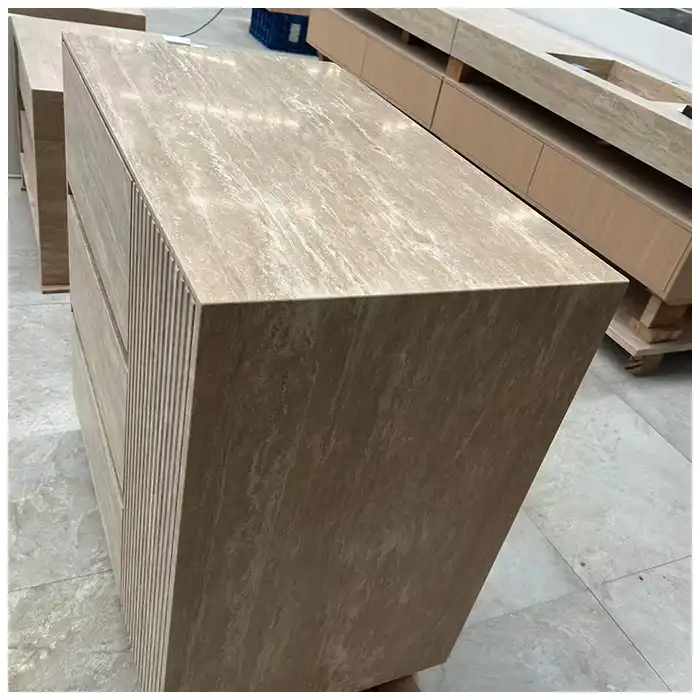
The fluted panel is a distinctive fabricated element of the cabinet. Its parallel vertical grooves are cut into the travertine surface, producing repeated raised and recessed sections that respond differently to light.
CNC machining allows the fluting to follow a controlled spacing and profile. The depth of each groove, the width of the remaining raised ribs and the finished stone thickness must be coordinated within the fabrication drawing.
Vertical Groove Geometry
The fluted surface is more sensitive to cutting consistency than a flat panel. Changes in groove spacing or depth may create irregular shadow lines, particularly when the cabinet is illuminated from one side.
The direction of the grooves also affects the way natural travertine layers are perceived. Stone markings remain visible through the carved pattern instead of being concealed beneath an applied decorative covering.
20mm and 30mm Stone Components
The specified 20mm and 30mm options refer to stone components used in the selected construction. The actual thickness allocated to drawer fronts, outer panels and carved areas depends on the finished geometry and assembly method.
Fluting removes material from the original stone face. The remaining stone section must be sufficient for the intended component, particularly where grooves approach an exposed edge or a connection point.
Eased Edges and Stone Connections
Exposed cabinet corners and drawer edges require controlled finishing. A small eased edge can reduce sharpness without substantially changing the straight-lined furniture profile.
The complete cabinet assembly may incorporate internal supports, mechanical fittings and other non-stone components. Their arrangement must be defined by the selected construction rather than assuming the entire cabinet is carved from one monolithic stone block.
Connection details are particularly important where moving drawer components meet the natural stone exterior. The finished assembly must accommodate both the stone’s weight and the selected hardware operation.
Filled-Honed and Unfilled-Honed Roman Beige Travertine Finishes
Filled-honed and unfilled-honed finishes retain the same natural travertine material but differ in how the surface pores are treated. This distinction affects both appearance and routine maintenance.
Filled-Honed Travertine
A filled-honed finish reduces open cavities before the final surface is honed. The result is comparatively smooth and easier to wipe, making it a practical option for drawer fronts and other frequently handled furniture surfaces.
Fill material should be visually compatible with the selected stone. Noticeably different fill colour or uneven finishing can become apparent across the broad drawer faces.
Unfilled-Honed Travertine
Unfilled-honed travertine retains more of its natural cavities. Small openings create additional shadow and surface relief, particularly on the carved panel where recessed grooves already introduce texture.
Open pores can retain dust and residues, so an unfilled finish has different cleaning implications from a filled surface. The choice is particularly relevant to the cabinet top and horizontal ledges where particles may accumulate.
The selected finish should remain consistent across the visible stone components unless the design intentionally combines different treatments.
Floorstanding Support, Cabinet Stability and Furniture Clearance
Beige Travertine Floorstanding Cabinets transfer their weight through the supporting base. Natural stone components contribute substantial mass, making the floor condition and cabinet assembly important parts of the installation.
The cabinet requires a stable, level support surface. Uneven bearing can affect the alignment of the outer stone panels and the operation of the drawers.
Travertine Freestanding Cabinets also require attention to tip stability, particularly when drawers are opened and loaded. Where the configuration presents a tipping risk, the appropriate restraint must be determined for the finished weight, drawer travel and installation environment.
Drawer clearance should be coordinated with nearby furniture, walls and circulation space. The finished unit needs sufficient room for the selected drawers to open without interference.
The cabinet is not a structural building element. Furniture stability, floor bearing and any fixing requirements depend on the complete assembled product rather than the strength of travertine alone.
Travertine Bathroom Cabinet Placement and Moisture Considerations
Travertine Bathroom Cabinets can provide storage in suitable bathroom interiors where the furniture is protected from standing water and direct shower exposure. The three-drawer arrangement is a storage configuration; it is not supplied as an integrated washbasin or plumbing fixture.
Travertine is naturally porous and can be affected by moisture and staining. Surface treatment may reduce absorption, but it does not make every stone cabinet component or drawer mechanism waterproof.
Bathrooms also introduce humidity and repeated temperature changes. The selected hardware, internal construction and fixing materials must be appropriate for the conditions of the intended location.
Dry bathroom storage areas provide a different service environment from shower enclosures or constantly wet vanity surrounds. These applications should not be treated as interchangeable without an appropriate construction specification.
Roman Beige Travertine Cabinet Interior Application References
The following images illustrate the cabinet within bathroom and living-room settings. They show potential interior arrangements rather than documented installation performance or completed project details.
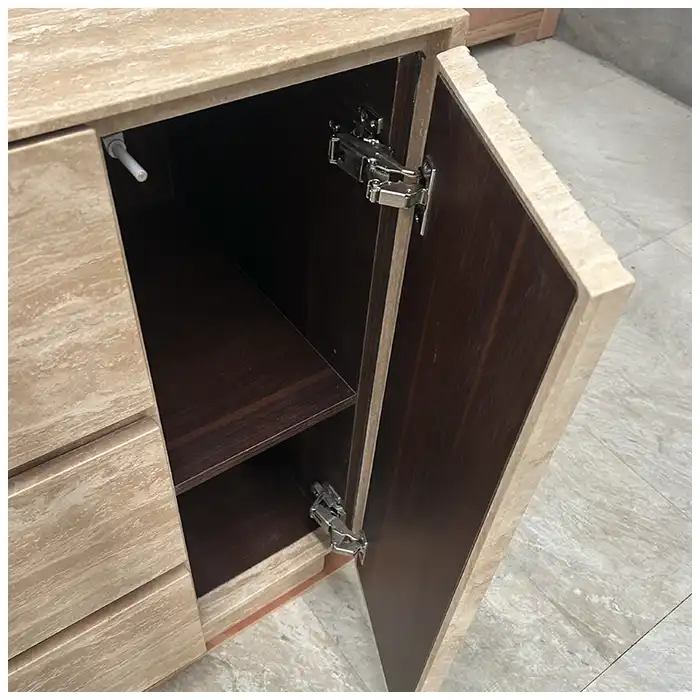
Bathroom storage application reference
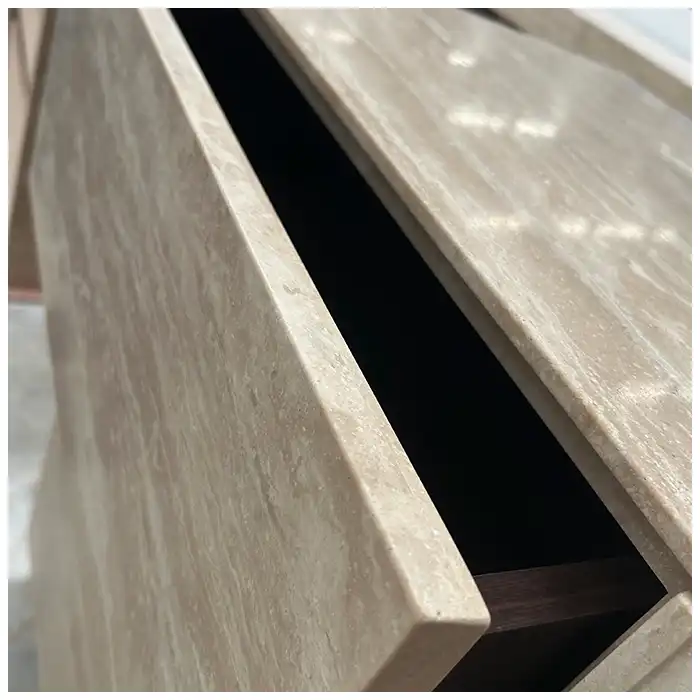
Living-room storage application reference
In bedrooms and guest suites, the cabinet can serve as a low storage piece with a natural stone exterior. In lounges, the horizontal drawer arrangement works as a compact furniture element. The suitability of any location depends on the available space and the complete cabinet construction.
Roman Beige Cabinet Compared with Grey and Silver Travertine Stones
The featured product is a finished Roman Beige travertine storage cabinet. The four related materials below are travertine stone collections rather than identical three-drawer cabinets. Their main relevance is the alternative colour and mineral character they introduce to a stone furniture or interior material specification.
| Product or Stone Selection | Material Appearance | Product and Design Difference |
|---|---|---|
| Roman Beige Travertine Storage Cabinet | Warm beige stone with layered cream and sand tones | Finished three-drawer furniture with carved fluting |
| Grey Travertine Slabs | Silver-grey and cooler natural travertine tones | A slab material for separately specified architectural stonework |
| Marmo travertino titanio | Darker grey-brown and titanium-toned natural movement | A deeper colour direction for custom stone applications |
| Light Grey Travertine | Paler grey natural travertine colouring | A cooler, lighter stone selection rather than warm Roman Beige |
| Travertino persiano d'argento | Silver-grey to deeper grey layered stone | A stronger silver-grey travertine alternative for architectural finishes |
Substituting another travertine in the same cabinet design would require a separate stone selection and fabrication assessment. The existence of a slab product does not establish availability of a corresponding finished furniture model.
Travertine Cabinet Fabrication Inspection and Export Packing
Inspection of a natural stone cabinet must address both the finished travertine and the moving furniture components. Surface appearance alone cannot establish correct drawer operation or the stability of the assembled product.
Stone inspection includes the consistency of the selected beige tone, the condition of exposed pores, the quality of filled areas and the finish of corners and visible edges. The fluted panel is checked for regular groove spacing and a consistent carved profile.
The three drawer fronts need accurate alignment with the surrounding cabinet frame. Functional checks cover movement, closing clearance and the operation of the specified hardware. The actual load rating depends on the chosen drawer system and complete assembly.
For transport, moving drawers must be secured against unintended opening. Finished travertine faces, carved edges and projecting corners require protective separation and support to reduce abrasion and impact damage.
Reinforced export packing should accommodate the finished cabinet dimensions and the distribution of weight through its supporting structure. The fluted panel needs particular care because exposed ribs and grooves are more vulnerable to local damage than a flat surface.
MQ STONE coordinates the selected travertine, CNC processing, finished assembly checks and export packing for custom stone furniture orders. Final construction details follow the approved drawings and hardware specification.
Cleaning Roman Beige Travertine Furniture and Drawer Surfaces
Roman Beige travertine should be cleaned with materials and products compatible with natural carbonate stone. Mild, pH-neutral stone cleaners and soft cloths are preferable to acidic bathroom cleaners or abrasive cleaning powders.
Acidic substances can etch travertine, while oils and coloured liquids may cause staining. Surface impregnation can be considered where appropriate, but a sealer does not prevent acid etching or make the cabinet waterproof.
Unfilled cavities and carved grooves can retain dust. A soft brush and careful dry cleaning help remove particles without scratching the finished surface or damaging pore edges.
Water should not be allowed to remain around drawer openings, cabinet joints or metal hardware. The internal storage areas and moving components also require maintenance appropriate to their selected materials.
Heavy or sharp objects placed directly on stone edges can cause local damage. Routine care should preserve the natural finish without relying on aggressive cleaning or polishing treatments.
FAQs About Roman Beige Travertine Storage Cabinets
1. What material is used for the Roman Beige Travertine Storage Cabinet?
The cabinet features natural Turkish Roman Beige travertine with warm cream and beige layering. Its visible stone surfaces include three drawer fronts and a vertically fluted accent panel.
2. What are the available cabinet dimensions?
The listed overall sizes are 66 × 51 × 61cm and 81 × 51 × 61cm. The dimension orientation and detailed component measurements are established in the approved furniture drawings.
3. Does the cabinet have three functional drawers?
Yes. The product is specified as a three-drawer storage cabinet. Drawer travel, closing mechanisms and internal storage arrangements depend on the selected hardware configuration.
4. What is the purpose of the fluted side panel?
The vertically fluted panel is a decorative stone feature that contrasts with the smooth horizontal drawer fronts. Its groove dimensions and construction are established through the CNC fabrication drawings.
5. Are 20mm and 30mm travertine thicknesses available?
Yes. The stone component thickness options are 20mm and 30mm. The thickness used for each part depends on the cabinet construction and the approved fabrication details.
6. What is the difference between filled-honed and unfilled-honed travertine?
Filled-honed travertine has its natural cavities treated to create a more continuous surface. Unfilled-honed travertine retains more open pores and visible texture, with different cleaning requirements.
7. Can this travertine storage cabinet be used in a bathroom?
The cabinet can be considered for suitable bathroom storage areas away from standing water and direct shower exposure. The complete furniture assembly, hardware and surface treatment must be appropriate for the expected moisture conditions.
8. Can the drawer layout and cabinet dimensions be customized?
Custom overall dimensions, drawer configurations, internal storage details, hardware and surface finishes can be reviewed through the furniture drawings. Changes to the layout may require adjustments to the stone panel and support construction.
9. Does a freestanding travertine cabinet need wall restraint?
The restraint requirement depends on the cabinet’s finished weight, geometry, drawer travel and installation environment. A stable, level floor is necessary, and an appropriate anti-tip arrangement may be required for the completed configuration.
10. What information is required for a custom Roman Beige travertine cabinet order?
The order specification includes the selected overall size, stone thickness, finish, drawer and hardware configuration, intended installation location and delivery destination. Detailed furniture drawings establish the internal construction and fabrication requirements.
Roman Beige Travertine Cabinet Specification Summary
This three-drawer cabinet combines horizontally layered Roman Beige travertine with a vertically carved accent panel. The two overall size options and selected stone thickness determine the furniture proportions, while the hardware and internal construction establish drawer operation. Filled-honed and unfilled-honed finishes have different surface textures and maintenance requirements. The completed specification must coordinate the stone components, drawer assembly and floorstanding support as one furniture product.
Recommended Travertine Stone Collections

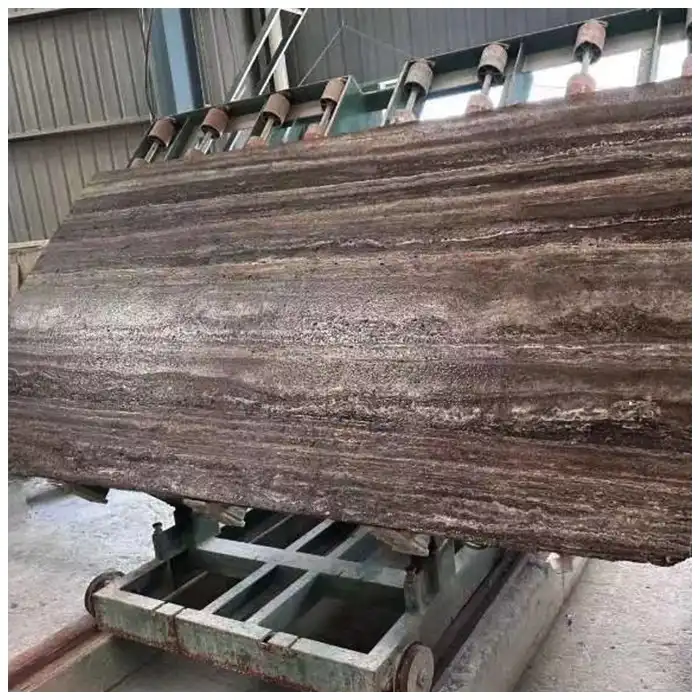
Marmo travertino titanio
Darker travertine with varied grey-brown mineral movement.


Travertino persiano d'argento
Silver-grey travertine with expressive natural layering.

Custom Roman Beige Travertine Three-Drawer Storage Cabinets
MQ STONE supplies Roman Beige travertine storage cabinets with custom stone finishing and furniture details. The three-drawer model features broad natural stone fronts and a carved vertical accent panel. Overall dimensions, component thickness, drawer hardware and the selected travertine finish are coordinated through the final furniture specification.
Request a Travertine Cabinet Quotation
Send the preferred cabinet dimensions, stone finish, drawer configuration and delivery destination. Custom drawings can be included for modified furniture arrangements.