Quick Summary: Dover White Quartzite for Slabs, Walls, Floors, and Countertops
Quarzite bianca di Dover is a pale Brazilian quartzite with creamy white, light grey, and softly swirling mineral movement. Current MQ STONE references include 3100up×1900upmm and 2600up×1400upmm slabs, 18/20/30mm thicknesses, and polished, honed, brushed, or leathered surfaces. It can be fabricated into countertops, wall panels, floor tiles, vanity tops, stairs, tables, and façade pieces. Project buyers should approve the actual slab range, vein direction, crystalline structure, finish, thickness, cutting yield, panel layout, and fabrication drawings before production.
 |
Dover White Quartzite Slabs with Soft Grey Veining and Mineral DepthDover White Quartzite does not read as a flat white surface. Grey veins, cloudy mineral movement, light beige undertones, and occasional silver-toned crystalline areas give each slab depth while keeping the overall palette light. That makes full-slab approval important. A small sample can confirm the basic colour family, but it cannot show the complete distribution of stronger veins, pale mineral fields, fissures, repairs, crystalline areas, or the usable cutting zones required for walls, countertops, tables, and large floor pieces.
|
What to Check When Selecting Dover White Quartzite Slabs
Compare complete slabs for background tone and grey concentration. One project may favour a cleaner pale selection, while another may deliberately use slabs with stronger movement.
Pale quartzite can contain translucent-looking mineral zones and crystalline depth that appear differently under warehouse light, daylight, warm interior lighting, and grazing light on finished walls.
Review natural fissures, resin-filled areas, mesh reinforcement where present, and repaired zones before deciding where sinks, mitred edges, narrow strips, wall-panel corners, or long furniture components will be cut.
Finished-piece drawings should be compared with each approved slab so stronger veins and natural features can be positioned deliberately while controlling yield and keeping important project pieces within suitable slab zones.

Full-slab selection gives the project team a better view of vein strength, mineral depth, repaired areas, cutting yield, and the relationship between pieces that will appear together after installation.
Product Overview: Dover White Exotic Quartzite for Architectural Projects
Dover White Quartzite is also marketed as Oyster White Quartzite and is sometimes sold commercially under the name Dover White Marble. For project specification, Quarzite bianca di Dover is the clearer material identity and should be used when distinguishing it from actual marble products.
Its pale white-to-grey palette allows it to work across kitchen countertops, bathroom vanity tops, floors, wall panels, fireplace areas, stairs, reception surfaces, dining tables, furniture tops, and exterior wall applications without introducing the strong colour contrast found in many exotic quartzites.
Quartzite is often selected for countertop and architectural use where buyers want a harder stone family than many decorative marbles, but fabrication quality still matters. Veins, crystalline areas, natural fissures, edge design, cutouts, support, sealer selection, and handling should be reviewed for the actual slab rather than relying on broad material-category claims.

The pale mineral structure makes the stone suitable for bright interiors, but project approval should still be based on actual slabs rather than expecting every piece to reproduce one catalogue image.
Dover White Quartzite Slab Sizes, Tile Formats, Thicknesses, and Finishes
| Nome del prodotto | Quarzite bianca di Dover |
| Materiale | Dover White Quartzite / Oyster White Quartzite |
| Related Search Terms | Dover White Exotic Quartzite, Dover White Quartzite Slabs, Dover White Quartzite Tile, White Quartzite Stone, Luxury Quartzite Stone |
| Origine | Brazil — current MQ STONE product-page reference |
| Visual Character | Creamy white to light-grey field with grey swirls, cloudy mineral movement, subtle beige tones, and occasional silver-like crystalline effects |
| Current Main Slab Reference | 3100up×1900upmm, 2600up×1400upmm |
| Additional Slab Reference | 1800up×600upmm, 2400up×1200upmm, 2800up×1500upmm and custom sizes appear in the detailed page reference |
| Current Tile Reference | 12″×12″, 24″×12″, 24″×24″ and custom cut-to-size pieces |
| Current Main Thickness | 18 mm, 20 mm, 30 mm |
| Additional Thickness Reference | 15mm and 25mm also appear in the detailed product reference; current availability should be confirmed by product form |
| Main Surface Options | Polished, honed, brushed, leathered; additional architectural finishes require project confirmation |
| MOQ | 100 SQM current product-page reference |
| Product Forms | Slabs, tiles, wall panels, flooring, countertops, vanity tops, stairs, paving, wall cladding, tables, and custom architectural pieces |
Polished, Honed, Brushed, and Leathered Dover White Quartzite
Polishing increases reflection and reveals more contrast between the pale background, grey veins, and crystalline zones. This finish is commonly considered for countertops, tables, feature walls, and other visible interior surfaces.
Honing produces a lower-reflection appearance and can make the white-grey palette feel softer. A representative finish sample should be approved because honing can change perceived depth and colour.
Textured finishes introduce tactile variation and reduce mirror-like reflection. They can be useful for furniture, feature surfaces, selected floors, or projects that want a less glossy interpretation of the material.
Exterior paving, wet floors, steps, and exposed wall work should be specified from project requirements rather than colour alone. Slip resistance, drainage, anchoring or bedding, freeze-thaw exposure where relevant, sealing, joints, and current material test data may need separate confirmation.

Compare finish samples under the intended project lighting because surface reflection changes how strongly the grey veins, pale mineral fields, and crystalline structure appear.
Dover White Quartzite for Countertops, Wall Cladding, Floors, and Mansion Facades
Kitchen Countertops and Islands
Large slabs can be fabricated into kitchen worktops, islands, waterfall ends, backsplashes, and bar counters. Sink and cooktop openings, seams, edge profiles, overhangs, cabinet support, and vein placement should be finalized before cutting.
Feature Walls and Interior Cladding
The pale background works well for lobby walls, villa living rooms, fireplace surrounds, reception areas, lift surrounds, bathrooms, and bookmatched or vein-flow wall compositions where stronger colour would dominate the interior.
Floor Tiles and Stairs
Floors and stair packages should coordinate tile module, finish, thickness, vein distribution, dry-lay sequence, grout, nosing, risers, landings, and slip requirements where applicable.
Tables and Stone Furniture
Dover White Quartzite can also be fabricated into dining tables, round tables, meeting tables, console tops, and other stone furniture. Tabletop thickness, edge detail, underside reinforcement, base connection, stone orientation, and packing support should be resolved with the furniture design.
Exterior Wall and Facade Panels
For mansion facades or other exterior cladding, panel dimensions, anchoring system, substrate, joints, wind-load design, exposure, surface finish, edge condition, and any required current testing should be reviewed before production.
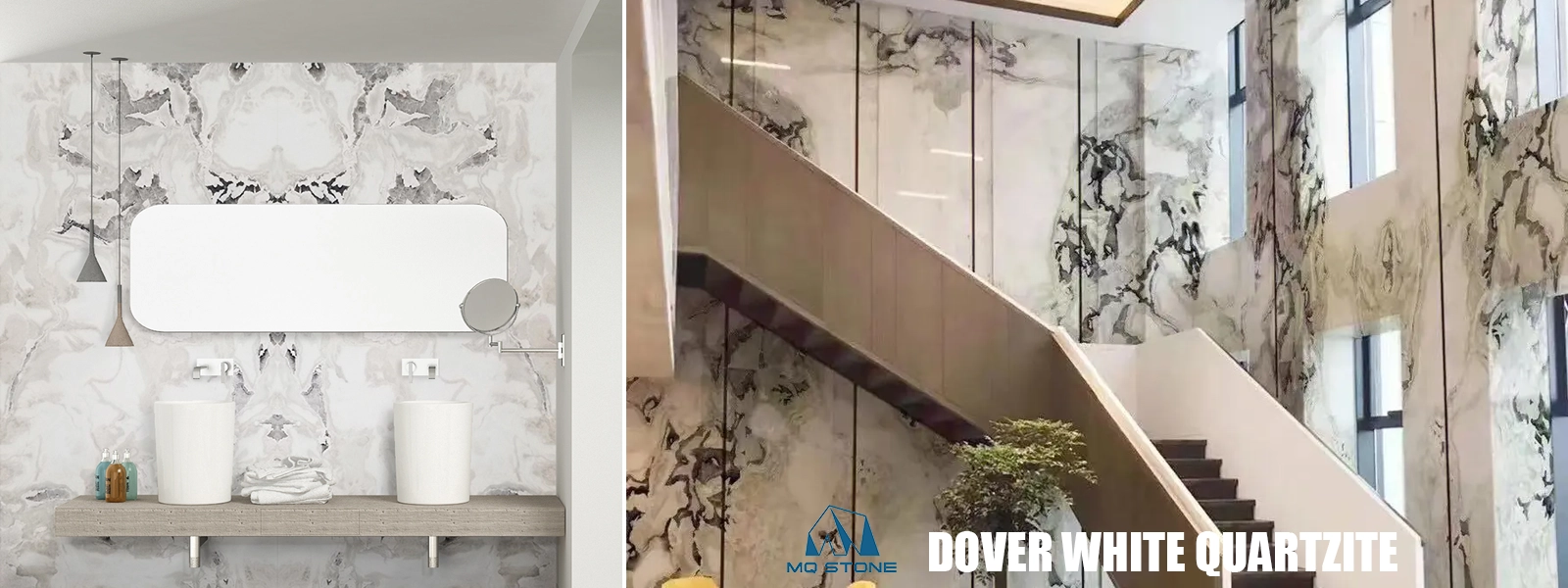
Large wall and facade projects require panel-level control of dimensions, vein direction, anchoring or installation method, joint layout, piece coding, packing sequence, and current project-specific performance requirements.
Dover White Quartzite Compared with Other Decorative Quartzite Slabs
| Materiale | Visual Character | Project Direction |
| Quarzite bianca di Dover | Creamy white and light-grey background with flowing grey veins, mineral clouds, and subtle crystalline depth. | Bright countertops, walls, floors, furniture, stairs, and facades where a pale quartzite surface is preferred. |
| Quarzite di Dedalus | Green, blue, grey, and dark mineral movement with a much stronger exotic pattern. | Feature countertops, walls, tables, and interiors where dramatic green-blue colour is intended to dominate. |
| Bianco Cristallo Quarzite | Cool white and ivory crystalline field with grey movement and areas that may support backlit design depending on the selected slab. | Countertops, backlit walls, bars, vanities, and feature surfaces where crystalline translucency is part of the design concept. |
| Pietra lavica atlantica | Ash-grey to blue-grey base with dark grains, white streaks, and occasional warmer mineral inclusions. | Leathered floors, countertops, exterior paving, walls, stairs, and contemporary projects requiring a darker grey material. |
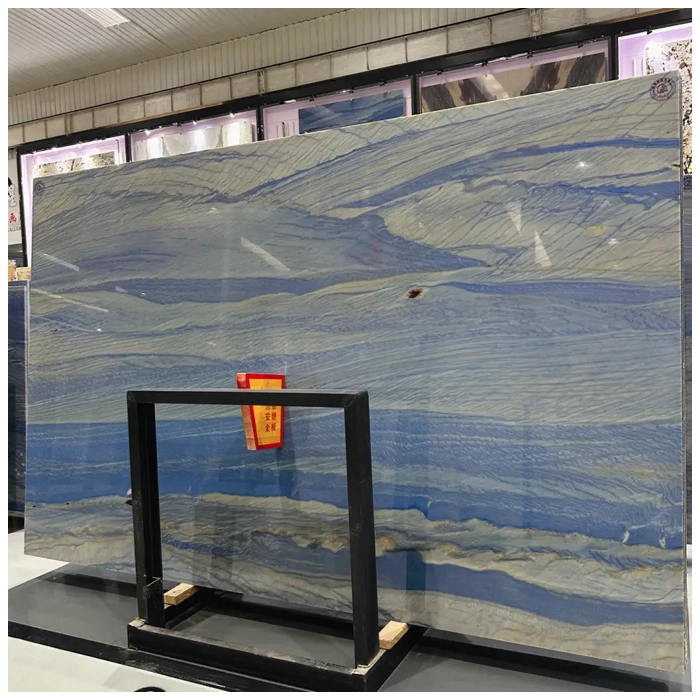
| Quarzite blu di Macaubas | Distinct blue background with white and darker linear mineral movement. | Statement countertops, vanity tops, fireplaces, walls, and luxury interiors where blue stone is the visual focus. |
MQ STONE Slab Selection, Fabrication QC, and Export Packing
Dover White Quartzite inspection should compare the approved slabs for background tone, grey-vein distribution, crystalline areas, visible fissures or repairs, dimensions, thickness, surface finish, usable cutting area, and the relationship between pieces intended to appear together.
Finished countertops, wall panels, floors, stairs, vanity tops, and table components should then be checked against approved drawings for dimensions, cutouts, edges, finish, piece numbers, visible-face orientation, and any matched layout.
The existing MQ STONE page references standard export packing and also lists detailed legacy QC targets for polished degree, thickness tolerance, flatness, and diagonal tolerance. These should be treated as page references rather than assumed current-batch certification; project-specific acceptance values should be confirmed in the order documents before production.
Order Execution Risks for Dover White Quartzite Slabs and Cut-to-Size Pieces
- Mixing slabs with noticeably different white-grey backgrounds can create abrupt transitions across one wall, floor, staircase, or countertop run.
- Crystalline fissures and repaired areas should be considered before assigning sink cutouts, narrow strips, mitred edges, or long unsupported pieces.
- Countertop seams and waterfall ends can interrupt intended vein flow if slab allocation is not reviewed before fabrication.
- Wall and facade panels can lose an approved pattern sequence when panel numbers, crate marks, and installation drawings are not synchronized.
- Large furniture tops and thin wall pieces need support and packing designed for their actual dimensions rather than standard tile handling.
- Exterior projects require separate confirmation of finish, anchoring or bedding, exposure, drainage, joints, slip requirements, and current performance data where specified.
Cleaning and Maintenance for Dover White Quartzite
Use clean water, pH-neutral stone cleaner, and non-abrasive cloths or pads for routine care. Remove food residue, oils, cosmetics, coloured liquids, and standing water before deposits build up. Sealer selection and maintenance frequency should follow the actual slab, finish, fabrication, exposure, and installed application rather than a fixed schedule. Strong acids, harsh chemical cleaners, and abrasive products should not be used without checking compatibility with the stone and any applied treatment.
Common Specification Mistakes for Dover White Quartzite
- Specifying only “white quartzite” without defining the acceptable Dover White background, grey-vein strength, and crystalline range.
- Approving a small sample without reviewing complete slabs for a large wall, countertop, table, floor, or facade package.
- Using one thickness assumption for slabs, floors, wall panels, stairs, countertops, and furniture components.
- Treating polished, honed, brushed, and leathered finishes as visually interchangeable without representative finish approval.
- Releasing countertop cutting before sink, cooktop, seam, edge, backsplash, and support details are finalized.
- Specifying exterior facade or paving solely from visual preference without defining structural, weather, joint, drainage, finish, and testing requirements.
FAQs About Dover White Quartzite
What is Dover White Quartzite?
Dover White Quartzite is a pale quartzite with a creamy white to light-grey background, flowing grey veins, mineral clouds, and subtle crystalline movement. It is used for slabs, countertops, wall panels, floor tiles, vanity tops, stairs, tables, and architectural stonework.
What slab sizes are listed for Dover White Quartzite?
The current MQ STONE summary lists 3100up×1900upmm and 2600up×1400upmm. The detailed page also references 1800up×600upmm, 2400up×1200upmm, 2800up×1500upmm, and custom sizes. Actual slab dimensions should be confirmed from current inventory.
What thicknesses are available?
The current product summary lists 18mm, 20mm, and 30mm. The detailed page also references 15mm and 25mm, so final availability should be confirmed according to the selected slab, tile, countertop, wall, stair, or furniture product.
Which finishes are available for Dover White Quartzite?
MQ STONE currently lists polished, honed, brushed, and leathered surfaces in the product summary. Additional architectural finish references appear in the detailed page and should be confirmed for the current order.
Can Dover White Quartzite be used for kitchen countertops?
Yes. Countertops are one of the applications listed on the current page. Kitchen fabrication should confirm sink and cooktop cutouts, seam positions, edge details, backsplash, cabinet support, slab selection, and sealing requirements before cutting.
Can Dover White Quartzite be used for wall cladding and facades?
Yes. The current page lists wall panels and wall cladding among the applications. Exterior facade projects should additionally confirm panel dimensions, anchoring system, substrate, joints, finish, exposure, and any required current test documentation.
Is Dover White Marble the same commercial material name?
Dover White Marble appears as an alternative commercial name on existing MQ STONE content, but the product is sold on this page as Dover White Quartzite. For project specifications, Dover White Quartzite is the clearer material name.
What is the MOQ for Dover White Quartzite?
The current MQ STONE product summary lists an MOQ of 100 SQM. Final quantity should be reconfirmed with the current slab selection, thickness, finish, product form, and fabrication scope.
What to Confirm Before Ordering Dover White Quartzite Slabs and Tiles
Confirm current slab photos, accepted white-grey range, crystalline areas and repairs, slab or tile dimensions, 18/20/30mm thickness where applicable, polished / honed / brushed / leathered finish, countertop or furniture drawings, wall or floor layout, vein direction, facade requirements where relevant, piece numbering, inspection scope, packing sequence, current MOQ, destination, and shipment schedule before production.
Related Quartzite Slabs for Countertops, Walls, and Interior Projects

|

|

|
|

Dover White Quartzite Slabs for Countertops, Walls, Floors, Furniture, and Facade Projects
For a Quarzite bianca di Dover quotation, send the required slab, tile, countertop, vanity top, wall panel, stair, table, facade, or cut-to-size quantity; finished dimensions; thickness; polished, honed, brushed, or leathered finish; accepted white-grey material range; fabrication drawings; installation application; destination; and project schedule.
For larger architectural packages, also identify slab sequence, countertop cutouts, wall or floor zones, furniture support details, facade panel sizes, piece codes, inspection requirements, packing sequence, and any current technical documentation required by the project.