Jacaranda Quartzite Honed Finish under Interior Light
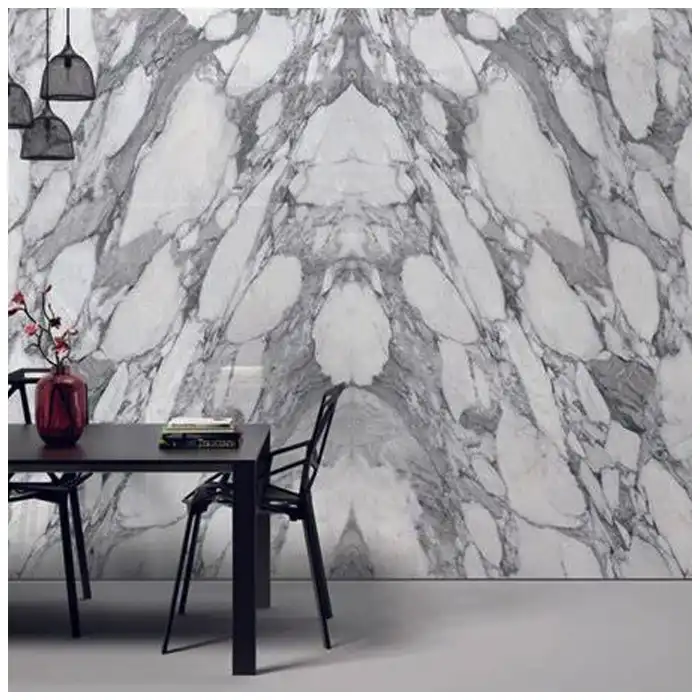
The first thing I remember is not a color. It is the change in sound when my fingertips moved from a polished corner into a freshly honed trial area. The reflected warehouse doors disappeared. What remained was a pale mineral field crossed by darker lines that looked settled inside the stone.
A finish can do that. It does not redraw the geology, yet it changes which part of the geology reaches the eye first. Polish sends the room back at you. Honing lowers that reflection and asks you to look into the slab itself.
That is why Jacaranda quartzite honed should be approved as an actual slab-and-finish decision. A catalogue photograph cannot show the finish under the project’s window, pendant, wall washer, or evening light, and a small sample cannot reveal the full movement.
Finish Reading
Read the Geological Structure
Compare Honed and Polished Faces
Test the Interior Light
Choose Wall or Furniture Use
Resolve Edges and Support
Inspect and Care for the Finish
What Jacaranda Quartzite Honed Reveals in the Stone
Quartzite forms when quartz-rich sandstone is transformed by heat and pressure. Quartz grains recrystallize and interlock, producing a hard natural stone. Mineral impurities and structural changes create the colors, lines, clouds, and occasional translucent zones that distinguish one slab from another.
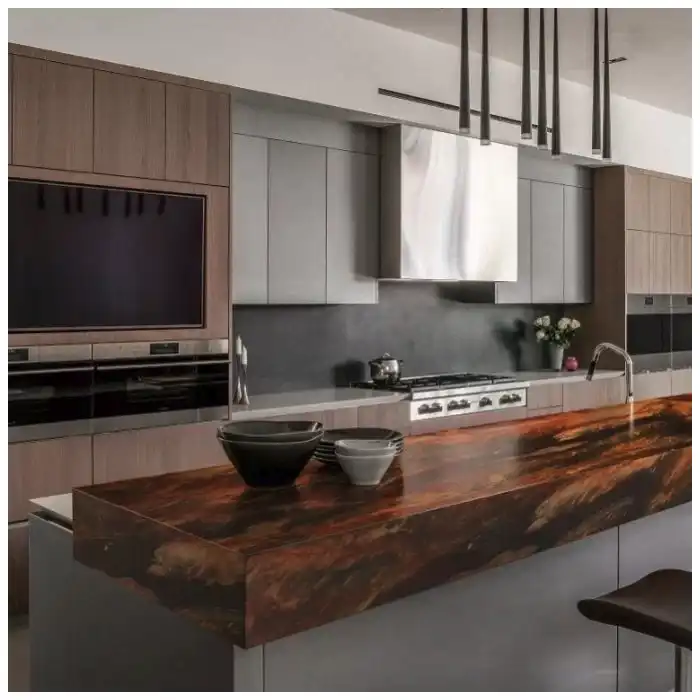
Commercial names identify a design family, not a manufactured pattern. Two Jacaranda slabs may share a broad character while differing in background, movement, fissures, mineral concentration, and repaired areas. The actual group must be viewed together.
The Exotic Quartzite Slabs collection provides the broader material path. This page narrows the decision to one named stone and one finish. It should answer what honing does to Jacaranda, not repeat a general quartzite definition.
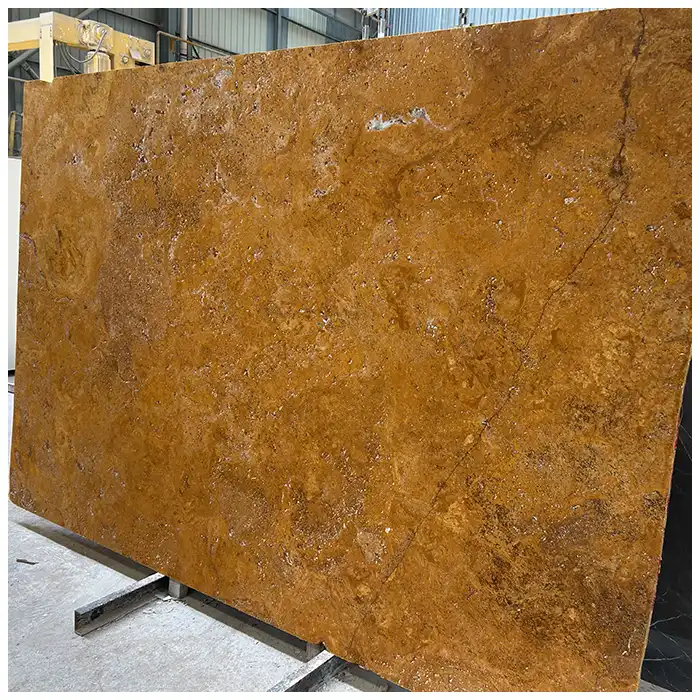
When light falls across a honed face, the white and grey regions can resemble soft paper fibers, while darker veins read as ink absorbed below the surface. Fine crystalline points still catch light, but they do not compete with a full reflected room. The stone becomes quieter, not flatter.
| Observation | Honed face | Polished face | Approval check |
|---|---|---|---|
| Reflection | Diffuse and subdued | Sharper room and lamp reflections | View under actual light angles |
| Color depth | Often softer and lighter | Often deeper and more saturated | Compare same slab zone |
| Mineral texture | Fine crystalline structure can read clearly | Reflection may dominate at some angles | Inspect diffuse and raking light |
| Repairs and resin | May show contrast in sheen or texture | May merge or flash under reflection | Map actual repaired zones |
| Touch | Low-sheen, smooth without mirror gloss | Slicker visual and tactile impression | Approve full-size sample |
The comparison is descriptive, not a universal performance ranking. Finish quality, mineral structure, resin, use, care, and fabrication change the result. Test the selected slab and process.
Compare Honing Stages on the Actual Jacaranda Slab
“Honed” is not one exact appearance. Abrasive sequence, machine pressure, water, operator technique, final grit, resin, and the stone’s local mineral composition affect sheen and touch. Two factories can use the same word and produce noticeably different surfaces.
For Jacaranda quartzite honed, I want a finish ladder on actual offcuts or an agreed representative slab zone. The samples should show at least the proposed finish and a polished reference. Label the process and keep the approved piece for production comparison.
Inspect the transition between hard quartz-rich zones and other mineral bands. Uneven abrasion can leave local gloss, drag, or texture changes. Raking light reveals those differences quickly. A ceiling grid reflected across the face can also expose inconsistent sheen.
Resin and repair behavior matters. A resin line may remain glossier than the surrounding honed stone. A filled fissure may feel smooth yet catch light as a narrow ribbon. Map those areas before cutting, especially for table centers and eye-level wall panels.
The live Exotic Quartzite Finish Selection article explains the wider honed, polished, and textured comparison. Here the work is narrower: approve the Jacaranda response, because another quartzite does not prove it.
Keep the edges in the same finish family
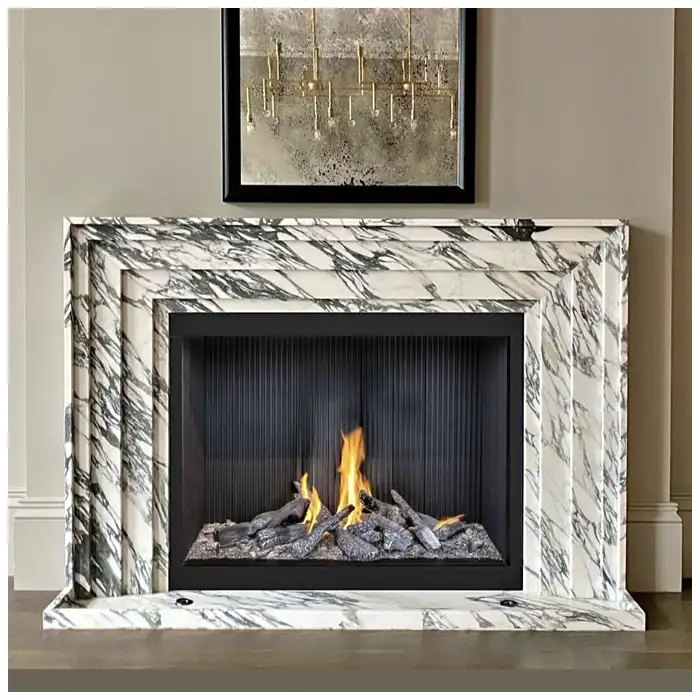
A honed top with a highly polished edge creates a dark glossy band. Sometimes that contrast is deliberate. Often it is simply an edge team following a default process. State face, edge, underside return, hole, and miter finish on the drawing.
Feel the edge. A low-sheen face invites touch, so the arris, corner, and profile become part of the experience. Fine chips, resin, or sanding lines that hide in a photograph may be obvious to the hand.
I do not accept the word “honed” as a complete finish specification. The approval sample needs an identity, an orientation, a date, and a record of the abrasive stage used to produce it. Keep one protected reference with the fabricator and one with the project team. When production begins, both sides can compare the same physical baseline instead of arguing over a photograph whose exposure changed on a phone screen.
Inspection distance also changes the judgment. At three meters, I look for broad sheen bands and an uneven relationship between adjacent pieces. At arm’s length, I look for resin contrast, drag marks, pinholes, edge transitions, and local polish left around a repaired fissure. With my hand flat on the face, I can feel a change that diffuse photography misses. All three readings belong in the approval record.
Water can temporarily deepen a low-sheen surface and hide fine abrasion differences. Let trial pieces dry fully before comparing them. Clean them with the agreed method, then view them again under the strongest project light. A damp sample beside a dry production piece is not a fair finish comparison, and it can send a good batch back through unnecessary reworking.
For repeated furniture or wall pieces, choose inspection points that the team can reproduce: one face-on view, one low-angle view, one edge detail, and one photograph beside the reference sample. That routine gives Jacaranda quartzite honed a measurable visual baseline without pretending natural mineral zones will reflect identically.
Read Jacaranda under Window Light and Evening Light
North-facing diffuse light can make a honed slab appear pale and calm. A warm pendant can bring cream or bronze traces forward. A narrow wall washer can sharpen surface inconsistency. The same slab should be tested under the important conditions of the project.
A Jacaranda quartzite honed wall beneath raking light may show every shift in finish. On a dining table, the light moves as people and objects move. A ceiling pendant creates a fixed pool, while daylight travels across the surface during the day.
The veins will tell you where the composition wants space. A dark current crossing a pale field may need the uninterrupted width of a table, while tighter movement can suit a smaller console. Honing helps us read that structure without the room reflected over it.
Photograph full slabs face-on and at a low angle. Use a neutral reference and record light type. Avoid judging a slab from an automatically brightened phone image. If color is contract-sensitive, agree a professional capture and review process.
The Hard-Won Lesson: Approve the finish beside the project light
A small honed sample can look even under diffuse warehouse light, while the finished wall sits beneath a linear fixture only a short distance from the face. The installation then reveals alternating dull and slightly glossy bands created by inconsistent final abrasion. The stone range was acceptable; the viewing condition was absent from approval.
The Lesson: Reproduce the strongest raking light on a full-size finish mock-up before releasing the wall or furniture batch.
Choose the Finish by Application, Not by Fashion
Honed quartzite can suit dining tables, consoles, side tables, interior walls, vanity surfaces, and other designed elements when the complete specification supports that use. The right choice depends on slab condition, contact, cleaning, light, edge, support, and maintenance expectations.
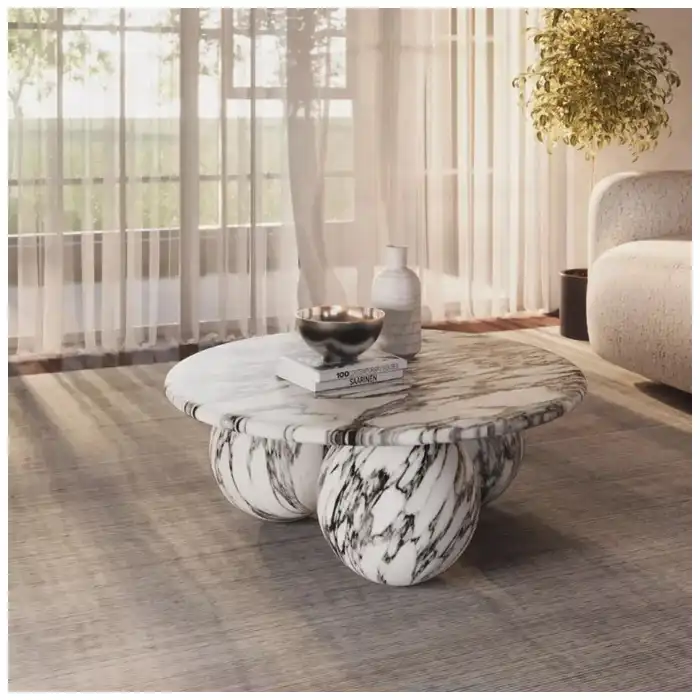
For a Jacaranda quartzite honed dining top, study the main viewing side, seat positions, pendant location, base footprint, edge, and centerline. The pattern should not feel accidentally cut by the base or hidden under a large centerpiece.
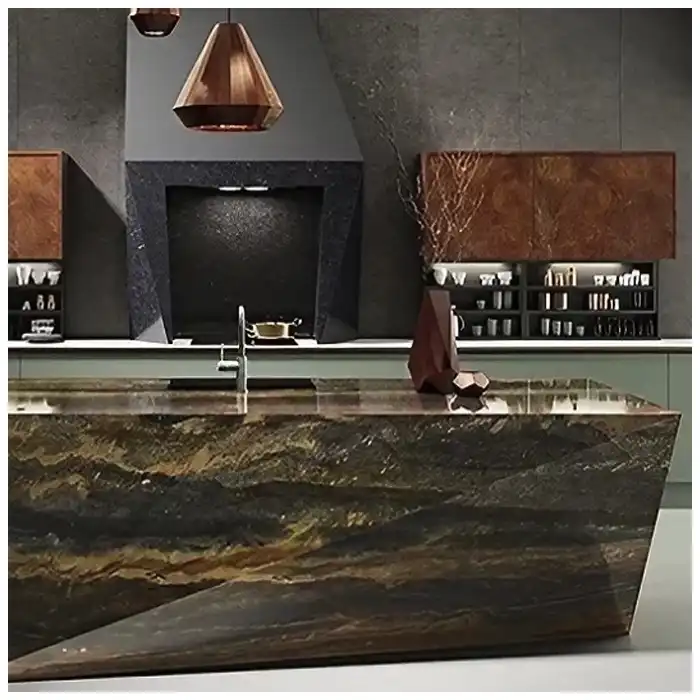
The Jacaranda quartzite slabs selection provides a direct material route. A separate Jacaranda quartzite slab option can help compare available imagery. Neither replaces viewing the reserved slabs at full scale.
For a wall, map joints, corners, openings, reflected light, and viewing distance. Honed finish often lets the geological movement carry the wall without a mirror-like surface. Yet it can also expose resin sheen or abrasion differences under grazing light.
For furniture, determine top dimensions, thickness, underside support, base contact, overhang, fastening, transport route, assembly, and floor capacity with qualified parties. Natural stone is heavy and brittle under the wrong support geometry despite strong mineral hardness.
True luxury is something you never get tired of looking at. That does not mean the loudest slab or glossiest finish. It means the composition, touch, light, and room remain convincing after novelty has passed.
Coordinate Thickness, Edge, Base, and Slab Layout
Apparent thickness can come from a solid section, mitered build-up, laminated edge, or another engineered detail. Each changes weight, vein continuity, repair exposure, corner behavior, and the support interface. Draw the section and allocate matching edge material.
A Jacaranda quartzite honed edge should be viewed beside the face. If the profile cuts across dark movement, its color can deepen on the vertical plane. If a miter turns the pattern, dry-fit and inspect the joint under the room light.
Base design should support the stone according to its size, thickness, cutouts, natural features, overhang, and use. The designer, engineer, fabricator, and base maker should agree contact areas, tolerances, isolation materials, fixings, lifting, and assembly. A beautiful pedestal cannot compensate for an unsupported span.
Overlay the top shape and base footprint on the slab photograph. The base may hide the calm center or sit under a repaired zone. For a sculptural table, the relationship between natural movement and the base silhouette is part of the design, not a factory afterthought.
The material has waited through geological time; fabrication should not rush its final direction. This stone has been waiting for millions of years, and one careful layout meeting is not an unreasonable delay.
Inspect the Honed Face and Set a Care Baseline
Before packing, inspect full-face sheen, raking-light consistency, dimensions, edge, corners, holes, cutouts, repairs, labels, and underside support zones. Photograph the top dry and clean. Keep the approved finish sample in the frame where practical.
For Jacaranda quartzite honed, test proposed sealers and cleaners on representative spare material. Quartzite behavior can vary with porosity, resin, finish, and mineral zones. A sealer may change color or sheen. Follow manufacturer instructions and record the product and application.
Use pH-neutral cleaning guidance unless the stone and product testing support another method. Wipe spills promptly. Avoid abrasive pads or unapproved chemicals that can alter the low-sheen face. Furniture protection should also address hot items, metal bases, dragged objects, and grit.
At site, compare the piece with the approved slab map and finish sample before assembly. If a sheen band, repair, color shift, or edge issue appears, photograph it under diffuse and raking light. Pause modification and compare the original inspection and packing records.
The handover should retain slab codes, finish process, sealer test, care method, repair map, base drawing, inspection, and spare reference. If refinishing is ever needed, a specialist needs the original baseline.
Quick-Reference Checklist for Honed Jacaranda
- Approve a finish ladder on the actual slab or representative identified offcut.
- Compare the same mineral zones in polished and proposed honed conditions.
- Inspect resin, repairs, abrasion, face, and edges under diffuse and raking light.
- Overlay wall joints or furniture shape and base footprint on the slab photograph.
- Coordinate thickness, support, overhang, fixing, lifting, transport, and assembly.
- Test sealer and cleaner on spare material and record any color or sheen change.
- Pause disputed installation until finish evidence is compared with the approved baseline.
Frequently Asked Questions
1. Does honing make Jacaranda quartzite lighter?
It often makes the surface appear softer or lighter because it reduces reflection and color saturation, but the result varies by slab, mineral zone, resin, and abrasive process. Compare honed and polished samples from the same identified area.
2. Is a honed quartzite finish suitable for dining tables?
It can be suitable when the actual slab, finish, edge, support, base, cleaning, sealer testing, and use expectations are coordinated. Approve a full-size sample and establish a care baseline before delivery.
3. Will honing hide repairs in a quartzite slab?
Not necessarily. Resin and repaired fissures may differ in sheen, color, or texture from the surrounding stone. Raking light can make that contrast more visible. Map repairs and judge them in their intended position.
4. Should honed edges match the face exactly?
State the intended relationship. A polished edge can create a darker glossy band beside a honed face. A matching low-sheen edge may feel more continuous. Approve the actual profile, arris, corner, and finish together.
5. What should I do if Jacaranda quartzite honed finish looks uneven after delivery?
Photograph the full surface under diffuse and raking light, then capture the affected zone, piece code, approved sample, and packaging condition. Stop refinishing or installation. Compare the factory finish inspection, repair map, and handling records before choosing a remedy.
Final Conclusion
Jacaranda quartzite honed is not simply polished stone with the shine removed. Honing changes reflection, color depth, touch, repair visibility, edge character, and the way mineral structure meets interior light. Approve the actual slab, actual process, actual edge, and actual use together.
I would rather let the Jacaranda whisper through a well-judged finish than force it to shout through reflected light, and that is the kind of lasting natural-stone judgment MQ STONE keeps close.
References
- Dimension Stone Design Manual, Natural Stone Institute.
- ASTM C616 Standard Specification for Quartz-Based Dimension Stone, ASTM International.
- Natural Stone Institute Technical Bulletins on Quartzite and Surface Finishes, Natural Stone Institute.
- Stone Furniture and Countertop Fabrication Guidance, Natural Stone Institute.
- Natural Stone Care and Maintenance Guidance, Natural Stone Institute.
- Salone del Mobile Milano 2026 Design Programme, Salone del Mobile.Milano.
- Quartzite, Wikipedia, English edition.