Round Stone Dining Table: Balance the Slab from Every Seat
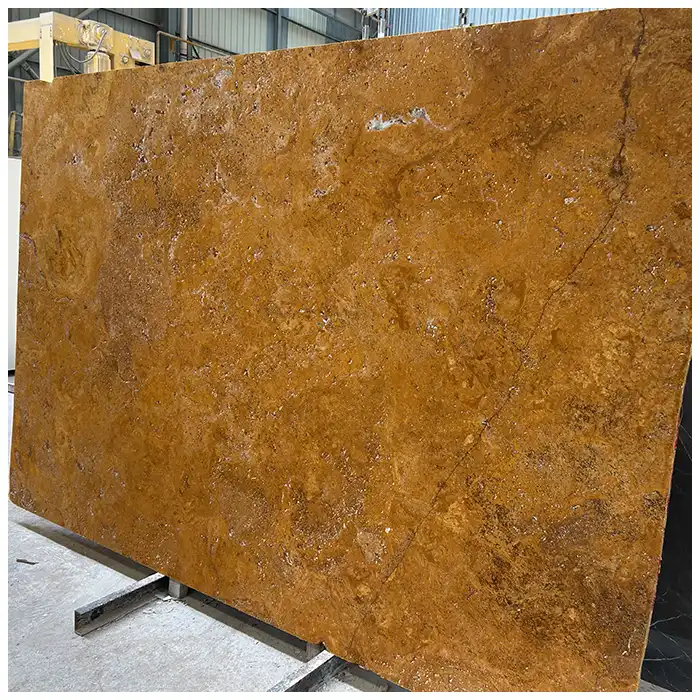
A circular outline passes through a gray vein four times. At one point the line reaches the edge like a brushstroke; opposite it, the same vein dissolves into pale crystal. That changing perimeter is the first question in a round stone dining table, because there is nowhere to hide a careless cut.
I rotate the circle over the slab and watch the visual weight move. A small turn can center the composition without forcing symmetry that the stone never had.
Set Round Stone Dining Table Diameter from Place Settings
Seat count on a plan means little without plate width, glass positions, serving space and the reach to the center. I draw the actual setting and chair envelope at full scale.
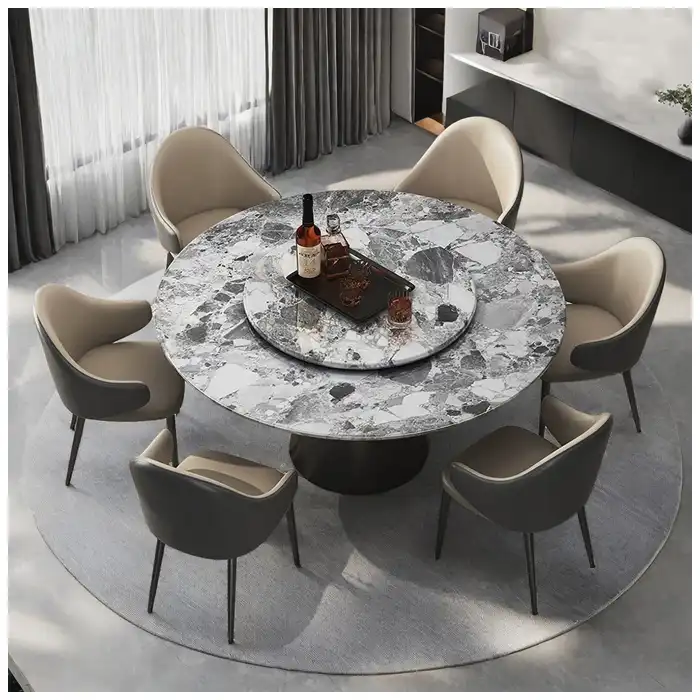
A larger diameter improves center space but increases reach and changes support geometry. A smaller top can feel intimate yet crowd elbows and serving pieces.
The room plan also includes circulation with chairs pulled back. The table cannot borrow clearance from a wall or cabinet that will exist on site.
Rotate the Circle across the Full Slab
A circle changes long veining into arcs and repeated edge events. I test several rotations, saving each view with the slab number and finished diameter.
Сайт round marble dining table demonstrates how a continuous edge makes the full face visible from all sides. Marble movement should remain intentional at every chair.
The selected rotation preserves machining allowance and avoids placing a weak or repaired feature at the narrowest edge decision. Beauty and fabrication review happen on the same overlay.
Use Circle Geometry without Forcing Symmetry
A circle has one center, but natural stone does not need a centered vein. A slightly off-center cloud can create movement, while a forced bullseye may feel static.
The geometry of a circle keeps every perimeter point equally distant from the center. The stone pattern remains free to cross that geometry in its own way.
I mark the room axis and pendant center separately. Aligning all three is one option, not a rule. The final composition should feel deliberate from the principal approach.
Coordinate a Stone Pedestal Table with Hidden Support
The visible pedestal may be compact while the hidden frame extends under the top. I draw bearing, attachments and service access with the exact diameter.
A center base clears the outer edge for chairs, but its foot or columns can occupy leg space near the middle. Sit at the prototype and move feet naturally.
The qualified technical team checks stability against uneven floor contact and realistic edge loading. A centered base does not automatically mean a stable table.
Read the Continuous Edge as a Mineral Band
Every seat sees a different section of the edge. A solid profile may reveal changing crystals and veins around the circumference; a built-up edge needs controlled joints and pattern returns.
I run a hand around the full perimeter, checking easing, repaired points and transitions. One sharp segment is enough to change daily use.
Сайт Stone Table Edge Detail gives profiles their own fabrication review. The circular table adds a continuous touch path and no hidden end.
Plan Round Table Seating Clearance
Chairs approach radially, so their legs and arms can collide differently from rectangular seating. I draw the actual chair, not a generic icon.
Pedestal width at floor, knee and underside levels all matter. A sculptural flare can look narrow from above while occupying the foot zone.
The room test includes pulling out each chair without striking another or blocking the main passage. Seating count is accepted only after that movement works.
Choose Material by Daily Use and Visual Depth
Marble offers calcite softness, veining and a patina that needs an informed owner. Quartzite often offers a quartz-rich crystalline body, though actual identification and slab condition remain important.
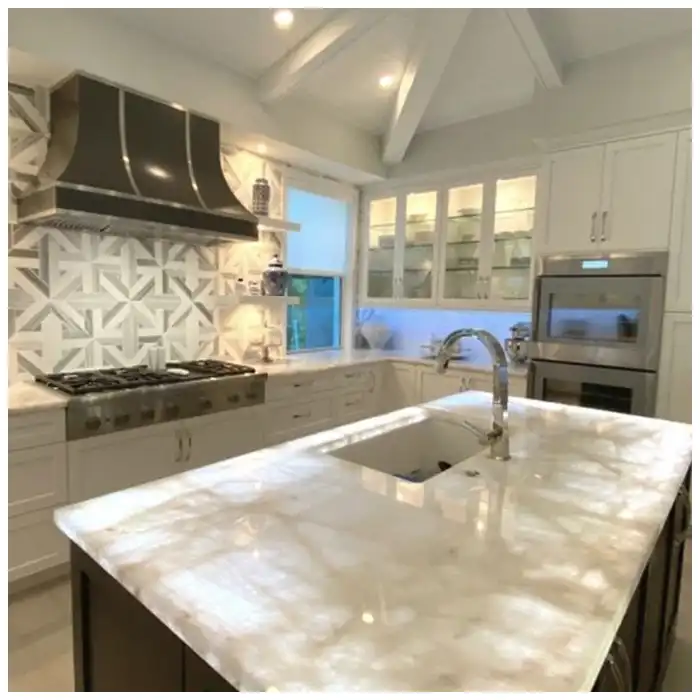
A Dover White quartzite table can read as pale mist with crystalline flashes around the edge. The circle lets those flashes appear one seat at a time.
Сайт Quartzite vs Marble Dining Table comparison should settle material behavior before the circle is nested.
Center the Pendant without Losing the Stone
A pendant often follows the table center, but its beam can make one crystal band dominate. I test the fixture height, spread and color on the selected finish.
Polished stone mirrors the source and can create a bright disc. Honed material softens it, revealing color more evenly while changing the touch.
The veins will tell you where light catches the body. I record the approved lamp condition so warehouse and site photographs can be read honestly.
Prototype the Full Diameter
Use the real top or a weight-representative prototype with actual base, chairs and floor condition. Check reach, movement, knee space, rocking and visual center.

Walk around the complete perimeter. A table that feels balanced from the entrance can reveal a dense dark edge from the opposite side.
The prototype record includes level, support, chair clearance, pendant position and every principal view. A small material sample cannot approve this geometry.
Control Packing and Assembly without Making Logistics the Design
Large circular tops need a handling and assembly plan from the responsible fabricator, but the public design record stays focused on finished geometry and support.
Protect the continuous edge and preserve orientation marks until installation. Rotating the top on site can break the approved relationship with the room and pendant.
After assembly, verify centerline and level before removing orientation marks. Photograph the final north reference for future movement or service.
Set the Acceptance View
Normal standing and seated views carry more weight than extreme grazing inspection unless the project specifies otherwise. I define the distance, light and room axis before sign-off.
Natural variation remains visible. The goal is a balanced circle, not a digitally mirrored pattern unless actual sequential slabs support that design.
True luxury is something you never get tired of looking at, and a round table has to earn that judgment from every side.
| Round-table input | Design check | Physical test | Release record |
|---|---|---|---|
| Diameter | Place settings and reach | Full-scale paper or prototype | Approved seating plan |
| Circle rotation | Vein balance around edge | Scaled slab overlay | Numbered cut map |
| Pedestal | Visible form and hidden support | Knee, foot and stability test | Base and underside drawing |
| Continuous edge | Touch and mineral transitions | Full perimeter inspection | Edge photographs |
| Room center | Pendant and circulation | Installed layout mock-up | Centerline record |
The centered pedestal occupied every diner’s foot space
A pedestal looked compact in elevation, but its base flared outward below the drawing cut line. Once chairs surrounded the prototype, several foot positions met the pedestal before knees reached the table. The top diameter was generous; the usable seating was not.
The Lesson: Test the pedestal at floor, knee and underside levels with the actual chairs before approving seat count.
Where the Round Table Decision Is Won
At full scale
Draw place settings, chair movement, diameter and pedestal zones at real size. A neat plan icon hides conflicts that bodies find immediately.
On the slab
Rotate the complete circle over the numbered face and inspect the entire edge path. Preserve natural balance without pretending the pattern is printed.
At assembly
Photograph level, support, orientation and every seating view. If rocking or clearance differs from approval, stop use and compare the original records.
Check Round Stone Dining Table Edge Segments
I divide the perimeter into numbered arcs during fabrication review. Each arc is photographed with the corresponding slab area so a repaired point, open mineral or color transition can be traced after the circle is cut.
Сайт round stone dining table has no back edge, yet room orientation still matters. A quieter arc may face the main passage while stronger movement sits beside seating where it can be appreciated closely.
Balance the Center without Drilling through the Best Feature
Pedestal connections and any required underside work need the support drawing overlaid on the slab map. A visually centered mineral cloud may occupy the same zone the assembly needs for its connection system.
I do not move a technical feature without engineering review, and I do not let a hidden frame erase the visual map. Both teams need the same center reference before machining.
Use Round Stone Dining Table Place-Setting Arcs
Each setting occupies an arc, not a straight segment. Plates and elbows widen toward the outside while serving space narrows toward the center. A full-scale paper circle shows this immediately.
For a round stone dining table, increasing diameter changes reach as well as circumference. Test the center use with the intended service pattern instead of assuming more edge automatically means better seating.
Inspect the Pedestal from Every Gap between Chairs
As chairs move, the base appears and disappears through different openings. I rotate around the prototype and judge whether the visible structure supports or interrupts the stone composition.
A twin-column or faceted pedestal can create changing shadows under a circular top. The hidden support remains a technical matter, while the visible rhythm belongs in the furniture approval.
Control Round Stone Dining Table Orientation on Site
The slab overlay gives the top an orientation reference even though the geometry can rotate freely. Keep that mark through packing, assembly and final room placement.
A round stone dining table rotated after pendant and doorway approval may place its darkest edge at the primary view. Record the final orientation before removing temporary marks.
Plan Cleaning and Service around a Continuous Edge
Every part of the perimeter receives hands, chairs and cleaning cloths. Inspect easing and finish around the complete circle, including the section nearest a wall or fixed banquette.
The support and leveling points should remain serviceable without levering against stone. Maintenance instructions separate surface care from mechanical adjustment so one problem does not create another.
Release the Round Stone Dining Table as a Complete Object
Final acceptance covers top face, continuous edge, pedestal center, hidden-frame visibility, level, chair movement and project light. A face photograph alone cannot close the furniture decision.
Сайт round stone dining table passes when each seat works and the mineral movement remains balanced through a full walk around the room.
Compare a Single Pedestal with a Clustered Base
A single pedestal gives one visual center. A clustered base creates several vertical elements and changing gaps between chairs. Both can work, but they divide the stone’s circular composition differently.
I view the prototype at chair height and from the doorway. The responsible technical team still owns support and stability, while the furniture approval decides whether the visible base rhythm competes with the veins.
Set a Replacement Orientation Record
If the top can be removed for service, mark its approved orientation discreetly on the underside. The handover drawing connects that mark to the room axis and pendant.
A later reassembly should restore level, connections and orientation before use. The mineral face may be circular, but its composition is not rotationally identical.
Keep the original chair plan with that record. A different chair can change knee space and reveal more of the pedestal, even when the top and base return to the same marks. Recheck the furniture relationship instead of assuming the circular geometry makes every replacement chair equivalent.
Photograph the reassembled table from each original seat before returning it to normal use and preserve the dated level check for future service.
Frequently Asked Questions
1. How large should a round stone dining table be?
Size depends on the actual seat count, chair width, place settings, center serving space, room circulation, support and reach. Draw the intended arrangement at full scale instead of relying on a universal diameter.
2. Is one center pedestal suitable for every round top?
No. The exact top, material, diameter, mass, concealed support, connections, stability and floor condition require project-specific technical design and prototype testing.
3. Should the vein be centered in a round table?
It may be centered, offset or allowed to cross the circle asymmetrically. Rotate the outline on the actual slab and choose the composition that works from all seats.
4. What edge works best on a circular stone top?
The profile should fit material, touch, visual thickness and fabrication. Inspect a complete curved sample because a straight sample does not reveal the continuous transition.
5. What should happen first if a round table rocks after assembly?
Photograph the full table, floor contacts, level, underside and base connections, stop use or adjustment, and contact the responsible supplier or fabricator with the approved drawings.
Round Stone Dining Table Approval Checklist
- Draw actual chairs and place settings at full scale.
- Rotate the finished circle over the numbered slab.
- Map visible pedestal and hidden support.
- Test foot, knee and chair movement.
- Inspect the full curved edge by hand and light.
- Prototype stability on the intended floor condition.
- Record final orientation before removing marks.
Final Conclusion
A round stone dining table must work from every chair. Rotate the slab honestly, test the pedestal with real bodies and approve the continuous edge at full scale.
The circle is simple only on paper; MQ STONE reads the mineral movement all the way around before the stone becomes furniture.

References
- Dimension Stone Design Manual, Natural Stone Institute.
- Natural Stone Care and Cleaning Guidance, Natural Stone Institute.
- ASTM C97 Standard Test Methods for Absorption and Bulk Specific Gravity of Dimension Stone, ASTM International.
- ASTM C170 Standard Test Method for Compressive Strength of Dimension Stone, ASTM International.
- ASTM C880 Standard Test Method for Flexural Strength of Dimension Stone, ASTM International.
- ANSI/BIFMA X5.5 Desk and Table Products, Business and Institutional Furniture Manufacturers Association.