Quick Summary: Titanium Travertine Slabs for Silver-Grey Walls and Floors
Титанијум травертин is a natural Iranian travertine with charcoal-grey, silver and brown-grey sedimentary layers. Its directional bands and characteristic pores distinguish it from uniformly coloured grey limestone. MQ STONE supplies Titanium Travertine Marble as brushed slabs, exterior wall tiles, interior flooring and cut-to-size architectural components. Catalogue references include large slabs measuring approximately 2200–2700 × 1400–1800mm and smaller strip slabs. Vein-cut selections emphasize parallel mineral bands, while the choice of filled, unfilled, honed or brushed surfaces affects appearance and maintenance. Exterior cladding and floor applications require separate assessment of fixing, moisture exposure and surface performance.
Titanium Travertine Marble Slabs: Dark Silver-Grey Stone from Iran
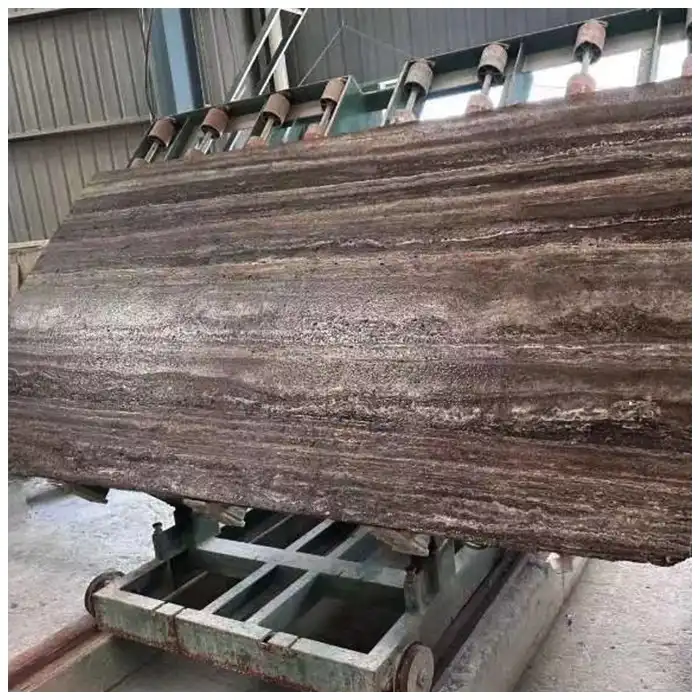
Titanium Travertine is a dark-coloured natural stone associated with the travertine deposits of Iran. Its background ranges from charcoal grey and smoky silver to brown-grey, with lighter mineral layers creating irregular parallel bands across the slab.
Although the product is commercially described as Titanium Travertine Marble, its geological material family is travertine. It is a sedimentary carbonate stone formed by mineral deposition around springs and related water systems. The name Titanium refers to its commercial appearance and should not be interpreted as a declaration of metallic titanium content.
Compared with many pale beige travertines, Titanium Travertine has a darker and more contrasting colour structure. Some slabs show long silver lines against a charcoal background. Others contain substantial brown-grey sections separated by narrow cream or light-grey deposits.
This variation becomes important in large interior wall panels. A slab with evenly spaced silver bands creates a directional architectural surface, while material containing broader dark formations produces a heavier visual composition.
The stone works particularly well beside concrete-coloured plaster, dark bronze, natural oak and black metal. On an entrance wall or fireplace surround, its layered appearance creates movement without the large, irregular veins characteristic of many decorative marbles.
Persian Titanium Travertine Slabs: Vein-Cut Layering and Colour Selection
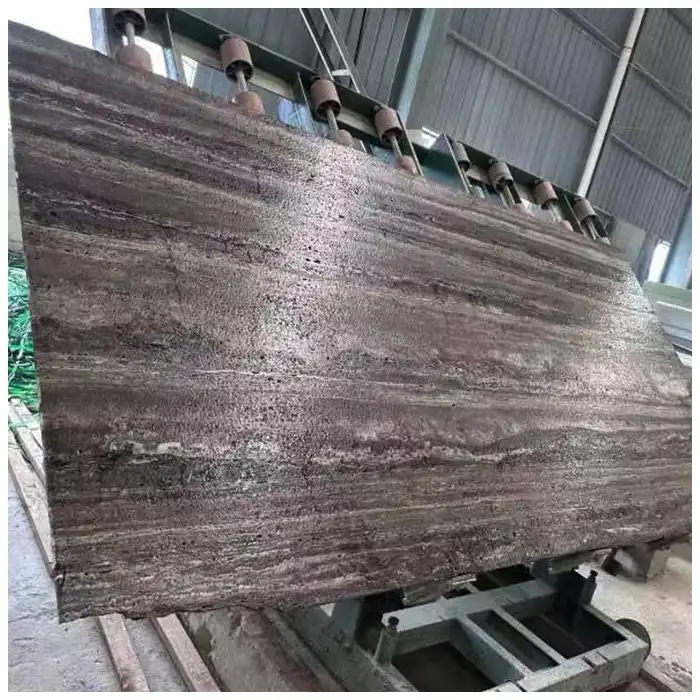
The linear pattern of Titanium Travertine is closely related to the orientation of its sedimentary layers. When the stone is vein-cut, the saw exposes the edges of those layers, producing elongated silver, grey and brown bands.
The bands may run almost parallel or change thickness as they move across the slab. Dark sections can appear between lighter layers, creating a striped composition with local variations in pore concentration and mineral density.
Horizontal and Vertical Vein Direction
Horizontal installation emphasizes the width of a wall, particularly in long reception areas and corridors. Vertical placement draws attention to height and can work on narrow entrance elevations or the full-height walls of a villa.
The direction must be established before fabrication. Rotating individual tiles after cutting may change how the natural layers connect at the joints, making the finished wall appear discontinuous.
Dark Titanium and Silver-Grey Material Groups
Titanium Black Travertine typically describes darker selections with stronger charcoal or brown-black areas. Titanium Silver Travertine places more visual emphasis on silver and lighter grey layers. These descriptions are commercial colour distinctions, not universally standardized quarry grades.
For a multi-panel wall, matching the background colour is often more important than aligning every narrow vein. A noticeably brown slab beside a cool charcoal-grey piece can create an unintended division, even if their mineral bands run in the same direction.
Titanium Travertine Slab Sizes, Wall Tiles and Fabrication Specifications
MQ STONE’s catalogue lists two principal slab formats, modular flooring tiles and several cut-to-size architectural products. The dimensions below are catalogue references; actual usable sizes depend on the selected block, cut direction, thickness and finishing treatment.
| Назив производа | Titanium Travertine Marble Slabs and Tiles |
| Стоне Типе | Natural sedimentary travertine limestone |
| Порекло | Iran |
| Commercial Names | Titanium Travertine, Persian Titanium Travertine, Titanium Black Travertine, Titanium Silver Travertine, Titanium Grey Travertine |
| Боја | Dark silver, charcoal grey, smoky grey, brown-grey and lighter mineral bands |
| Main Large Slab Reference | 2200–2700mm length × 1400–1800mm width |
| Large Slab Thickness Reference | 17mm nominal |
| Narrow Slab Reference | 2400mm+ length × approximately 650–1200mm+ width |
| Narrow Slab Thickness | 15mm nominal |
| Standard Floor Tile References | 300 × 300mm, 300 × 600mm and 600 × 600mm |
| Additional Cut-to-Size Tiles | 450 × 450mm and 800 × 800mm |
| Tile Thickness Reference | 15mm for selected standard tile formats |
| Custom Thickness Options | 10mm, 20mm, 25mm and 30mm according to product form |
| Stair Treads | 1100–1500 × 300–330 × 20/30mm catalogue references |
| Stair Risers | 1100–1500 × 140–160 × 20mm catalogue references |
| Countertop References | 96″ × 36″, 96″ × 25.5″, 78″ × 36″ and 72″ × 36″ |
| Mosaic References | 300 × 300 × 8mm, 457 × 457 × 8mm and 600 × 600 × 10mm |
| Featured Surface Finish | Брусхед |
| Other Finishes | Honed, polished, filled, unfilled, sandblasted, bush-hammered and selected split-face treatments |
| Primary Applications | Exterior wall cladding, interior feature walls, floor tiles, architectural stairs, vanity surfaces and custom panels |
Brushed Titanium Travertine Slabs: Natural Texture and Pore Treatment
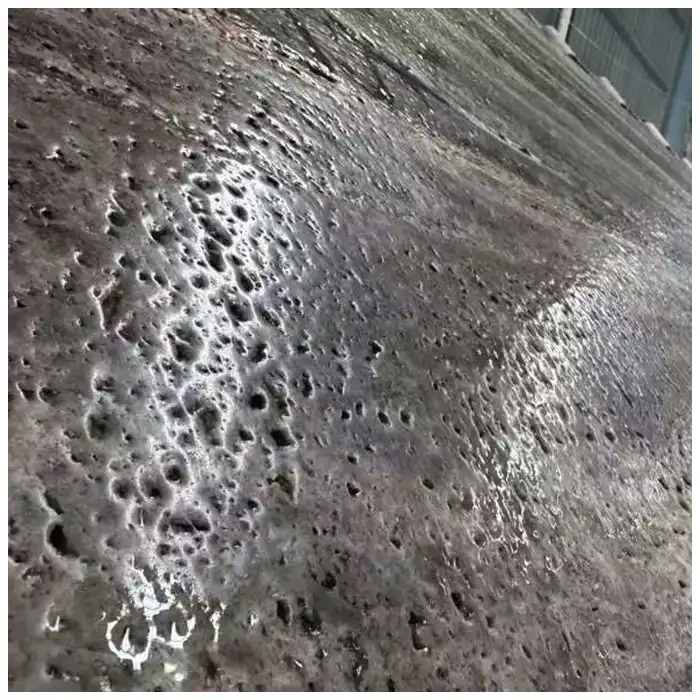
Brushing modifies the surface of Titanium Travertine without removing its underlying layered pattern. The worked face has lower reflection than polished stone, allowing the silver and dark-grey bands to remain visible through a tactile texture.
The texture is not necessarily uniform. Natural variations in mineral hardness and pore concentration can produce small changes in surface relief. These differences become more noticeable under grazing light, especially on large architectural wall panels.
Filled and Brushed Travertine
A filled surface closes selected cavities before or during finishing. Filling can make the surface easier to clean and reduce the amount of debris that collects in open pores. The filler must be compatible with the stone and the intended conditions of use.
Filler colour also affects appearance. A dark filling may blend with charcoal mineral areas, whereas light filling can make small pores conspicuous against the darker background. The finished sample should establish the acceptable visual range.
Unfilled Brushed Travertine
An unfilled surface retains the naturally open cavities. On a decorative vertical wall, this creates additional shadow and texture. In areas exposed to dirt, cooking residue or frequent washing, however, open pores can complicate maintenance.
For exterior work, pore treatment requires additional consideration. A filling material suitable for an interior wall is not automatically appropriate for repeated rain, strong sunlight or freezing conditions. The actual exposed application should determine the required treatment.
Titanium Travertine External Wall Tiles for Villa Facades and Architectural Cladding
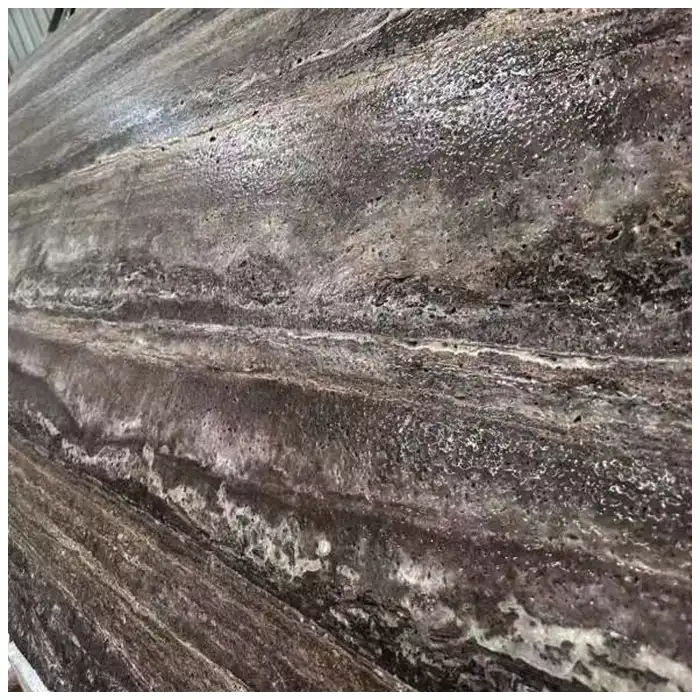
Titanium Travertine External Wall Tiles create a dark silver-grey facade with visible horizontal or vertical mineral layering. The stone can be cut into rectangular cladding panels that coordinate with glass, dark metal, concrete and timber elements.
The most important distinction between an interior wall panel and an exterior facade tile is the installation environment. Exterior stone must accommodate wind loads, moisture, movement and changes in temperature. These conditions influence panel size, stone thickness and the method of fixing.
Dry-Hung and Mechanically Fixed Facades
Large mechanically fixed panels require a designed anchoring arrangement. Anchor locations, edge distances and stone thickness must be determined using the appropriate material performance information and structural calculations.
Natural bedding and pore distribution can influence the behaviour of a panel near its fixing points. A fixing detail suitable for dense granite should not be copied directly to a porous travertine without checking the actual material.
Weather Exposure and Drainage
Rainwater entering open pores, joints or the rear of a cladding assembly can create moisture-related problems. Exterior wall construction therefore requires suitable drainage, movement joints and details that avoid trapping water behind the stone.
In freezing climates, freeze-thaw resistance must be evaluated for the selected Titanium Travertine. A material’s attractive exterior appearance does not establish that it will perform equally well in every climate.
For facade projects, approval should be based on the actual panel size, finish, filling treatment, exposure conditions and fixing design. The catalogue’s smaller slab thicknesses are not automatic recommendations for unsupported exterior cladding.
Titanium Travertine Floor Tiles for Interior Circulation and Stair Applications
Titanium Travertine Floor Tiles bring the layered grey stone pattern into a modular installation. A 300 × 600mm format can emphasize the direction of a corridor, while 600 × 600mm tiles create a regular joint grid for residential rooms and selected commercial interiors.
Larger 800 × 800mm pieces retain more of the mineral bands within each tile. The orientation of those bands becomes particularly visible across an open floor. Mixing horizontal and vertical grain directions can produce a deliberately varied appearance, but this is different from a coordinated linear layout.
Flooring requires a service-specific surface specification. Brushed or honed finishes may reduce reflections, yet neither automatically guarantees adequate traction when wet. The actual finish must be evaluated under the applicable slip-resistance method.
Travertine’s pores and any filling materials also affect long-term surface maintenance. Heavy foot traffic, abrasive grit and repeated cleaning can expose weak filler or alter the appearance of the worked surface.
Stair treads require support, appropriate nosing geometry and slip consideration at the walking edge. For exterior steps, drainage and frost exposure become additional concerns. The tread dimensions in the catalogue are fabrication references rather than universal structural specifications.
Titanium Grey Travertine Surface Finish Comparison
| Заврши | Appearance | Application Consideration |
| Брусхед | Tactile silver-grey surface with reduced reflection. | Interior wall panels, facade cladding and selected architectural flooring. |
| Filled and Honed | Smooth, low-sheen stone with selected pores filled. | Interior floors, bathroom walls and surfaces requiring easier cleaning. |
| Unfilled Honed | Matte mineral bands with visible natural cavities. | Decorative dry walls and selected low-contact vertical surfaces. |
| Полирано | Higher reflection and stronger contrast between dark and silver bands. | Decorative panels, furniture and selected interior surfaces. |
| Sandblasted / Bush-Hammered | Coarser worked texture with altered mineral colour appearance. | Specified exterior or pedestrian applications following material and finish testing. |
Titanium Silver Travertine Floor and Wall Interior Application
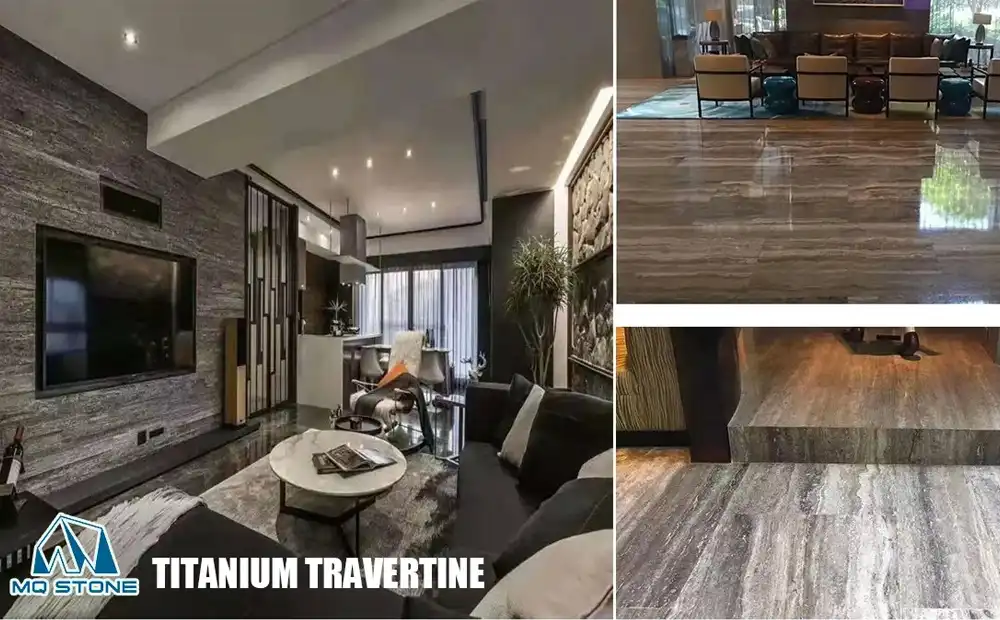
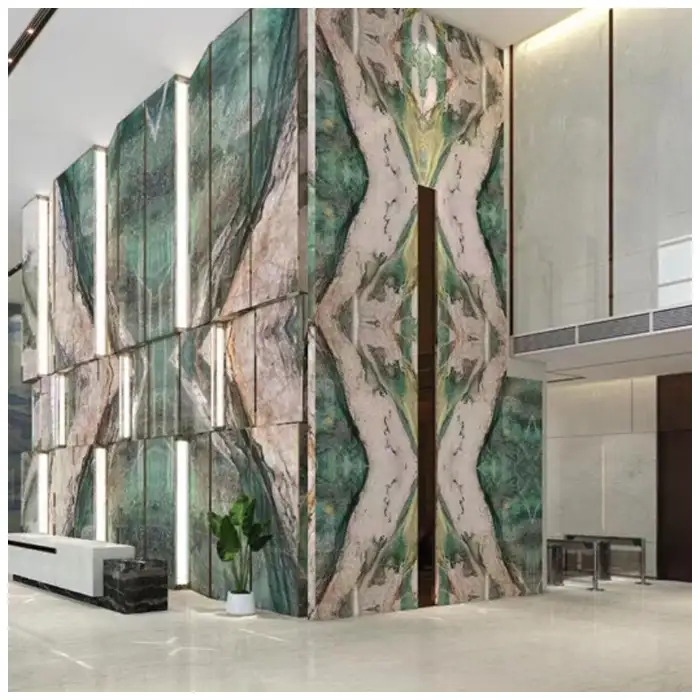
The Titanium Silver Travertine application image illustrates how a dark, layered stone can be incorporated into coordinated interior walls and floors. Its silver-grey bands create a visual connection between surfaces without requiring them to use the same tile dimensions.
For an entrance or lobby, the main wall may use large vein-cut panels to retain the stone’s layered character. Smaller floor tiles can then repeat the grey colour in a more regular modular layout.
Where both walls and floors use a dark material, the surrounding ceiling, lighting and furniture affect how the mineral pattern is perceived. Brushed surfaces reduce strong reflections, while polished pieces can create brighter highlights across the silver bands.
The illustrated application does not establish a tested floor traction value or a particular fixing system. Those details depend on the finished material, its installation location and the structural and environmental requirements of the project.
Titanium Travertine Physical and Mechanical Reference Data
The following commercial reference data concerns an Iranian Titanium Travertine selection within the same broad stone trade family. The figures have not been matched to the specific quarry block or current MQ STONE inventory. They provide an indicative material range and must not be treated as certified structural design values.
| Physical Property | Reference Value | Technical Interpretation |
| Bulk Density | 2400 kg/m³ | Indicative density for preliminary stone weight assessment. |
| Упијање воде | 3%–6% | Published commercial range reflecting moisture uptake in the reference material. |
| Отпорност на савијање | 12–15 MPa | Reference bending strength relevant to stone panel assessment. |
| Јачина притиска | 70–80 MPa | Indicative compression resistance of the commercial reference selection. |
| Mohs Hardness | Approximately 3 | Indicative hardness associated with carbonate-based travertine. |
| Wet Slip Resistance | Not established | Requires testing of the actual honed, brushed or textured floor finish. |
| Freeze-Thaw Resistance | Not established | Relevant to exterior cladding and paving in freezing climates. |
Reference limitation: published Titanium Travertine performance varies among Iranian quarry selections, blocks, cutting orientations and pore treatments. No matching MQ STONE batch laboratory certificate or complete test-method record has been established for these figures. Facade design and other structural applications require verified material properties appropriate to the selected stone.
Titanium Travertine Compared with Four Related Travertine Collections
Titanium Travertine is selected for its darker grey and brown-grey layering. The four related MQ STONE products provide alternatives in neutral grey, warm red, silver and lighter grey, with different implications for wall composition and cut-to-size installations.
| Comparison | Титанијум травертин | Grey Travertine Slabs | Травертин Россо плоча | Silver Travertine Slabs | Light Grey Travertine |
|---|---|---|---|---|---|
| Appearance | Charcoal, dark silver and brown-grey layered veins | Ash grey, silver grey and neutral mineral movement | Burgundy, brick red and terracotta with cream bands | Silver-grey layers with darker and lighter mineral variation | Pale grey background with softer mineral patterns |
| Product Forms | Brushed slabs, facade tiles, floor tiles and stair components | Slabs, wall cladding, floor tiles and pavers | Red slabs, honed wall panels and interior tiles | Silver slabs, decorative panels and cut-to-size tiles | Light grey slabs, wall panels and floor tiles |
| Wall Application | Dark linear facades and architectural feature walls | Neutral grey architectural cladding | Warm red bathroom and decorative walls | Silver-banded wall compositions | Light-toned bathroom and interior walls |
| Flooring Application | Dark grey floor tiles with directional stone movement | Neutral grey interior and selected exterior flooring | Red decorative floor sections | Silver-grey modular flooring | Pale grey interior floor surfaces |
| Finish Direction | Brushed, honed and selected filled or textured finishes | Honed, brushed, polished and selected textured finishes | Filled-honed and decorative unfilled finishes | Honed, polished and textured stone selections | Honed and filled surfaces with softer grey appearance |
| Fabrication Priority | Vein direction, pore treatment, facade fixing and dark tone grouping | Grey grading, panel sizing and finish coordination | Red layer direction, colour grouping and pore filling | Silver band alignment and panel layout | Pale grey consistency and modular cutting |
| Design Positioning | Deep silver-grey architectural stone with prominent layering | Balanced neutral grey architectural finishes | Strong warm red stone accent | Cool silver-grey layered stone | Light neutral grey interior surfaces |
This comparison addresses appearance, fabrication and intended design use. The five products do not necessarily share the same quarry origin, porosity, structural properties or weathering performance.
Titanium Travertine Slab Inspection and Export Packing
Titanium Travertine slab inspection includes the balance of dark and silver layers, consistency of the surface finish and the presence of open or filled pores. Panels intended for the same facade or interior wall should be assessed together because differences in background tone can become conspicuous after installation.
For cut-to-size pieces, dimensional inspection must address length, width, thickness, squareness and sound edges. Wall panels with anchor details require additional checks against the approved fabrication drawings. Filled stone should be examined for incomplete filling or loose material around cut edges.
Large slabs require stable transport support and separation between finished surfaces. Exterior wall panels and floor tiles should be packed according to their dimensions, finishes and installation zones. Identification of vein direction and panel position is particularly useful where adjoining pieces must maintain the intended linear pattern.
Cleaning and Maintaining Titanium Travertine
Use pH-neutral cleaning products suitable for natural travertine and avoid acidic descalers, vinegar and abrasive powders. Remove loose grit before washing floors, and clean residue from brushed surfaces using equipment compatible with the stone texture. Open pores may retain dirt and moisture, while filled surfaces require periodic inspection for loose or worn filler. An impregnating sealer may reduce some absorption-related staining after testing, but it does not prevent acid etching or compensate for an unsuitable filling material. For exterior cladding, keep drainage paths and joints clear and inspect areas where water could remain trapped.
FAQs About Titanium Travertine Slabs and Tiles
What is Titanium Travertine Marble?
Titanium Travertine Marble is a commercial name for a natural dark silver-grey travertine from Iran. Its geological material type is sedimentary travertine limestone, characterized by layered mineral bands and natural pores.
Where does Persian Titanium Travertine come from?
Persian Titanium Travertine originates from Iran. Different Iranian quarry selections may vary in dark-grey colour, silver banding, pore structure and mechanical properties.
What colours appear in Titanium Black Travertine?
Titanium Black Travertine typically contains charcoal, smoky silver, brown-grey and lighter mineral bands. Some selections are noticeably darker, while others emphasize silver-grey layering.
What slab sizes are listed for Titanium Travertine?
MQ STONE’s catalogue includes large slabs of approximately 2200–2700 × 1400–1800mm at a nominal 17mm thickness, together with narrower 2400mm+ slabs in approximately 650–1200mm+ widths and 15mm thickness.
Can Titanium Travertine be used for exterior wall cladding?
Titanium Travertine can be considered for exterior wall panels when the selected stone, thickness, fixing system, drainage, weather exposure and applicable structural requirements are assessed. Freeze-thaw performance must be established where relevant.
What sizes are available for Titanium Travertine Floor Tiles?
Catalogue tile references include 300 × 300mm, 300 × 600mm and 600 × 600mm, with additional 450 × 450mm and 800 × 800mm cut-to-size formats. Thickness varies according to the selected product form.
What is the difference between brushed and honed Titanium Travertine?
Brushed Titanium Travertine has a mechanically worked surface with more tactile relief. Honed travertine has a smoother, low-sheen appearance. Surface texture, pore treatment and finish-specific performance must be considered separately.
Should Titanium Travertine be filled or unfilled?
Filled surfaces close selected natural cavities and can be easier to clean. Unfilled travertine preserves its open pores and is often selected for decorative walls. Wet areas, floors and exterior applications require additional consideration of filling durability and maintenance.
What physical properties are published for Titanium Travertine?
One Iranian Titanium Travertine commercial reference lists density of approximately 2400 kg/m³, water absorption of 3%–6%, flexural strength of 12–15 MPa and compressive strength of 70–80 MPa. These are reference ranges, not current MQ STONE batch-certified test results.
How should Titanium Travertine tiles be maintained?
Clean Titanium Travertine with pH-neutral natural stone products and avoid acidic cleaners. Remove debris from brushed surfaces, inspect filled pores and test any impregnating treatment on the actual stone finish before use.
Recommended Grey, Silver and Red Travertine Slabs

Grey Travertine Slabs
Neutral silver-grey travertine slabs for wall cladding, interior flooring and cut-to-size architectural panels.
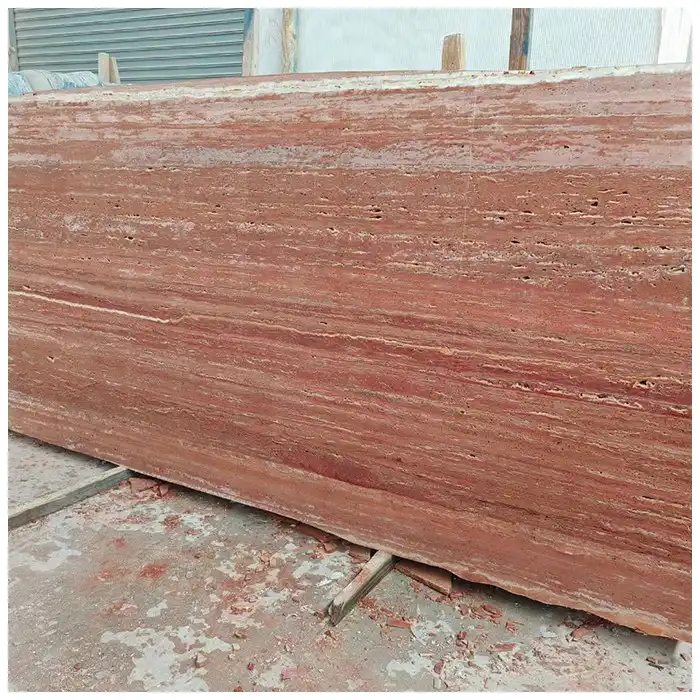
Травертин Россо плоча
Persian red travertine with burgundy and cream mineral layers for bathroom walls and decorative tiles.

Silver Travertine Slabs
Silver-grey travertine for decorative interior panels, wall cladding and coordinated flooring.

Light Grey Travertine
Pale grey travertine for lighter interior walls, bathroom surfaces and natural stone flooring.

Titanium Travertine for Silver-Grey Facade Panels and Flooring
Titanium Travertine is most distinctive when its charcoal and silver layers remain legible across finished architectural surfaces. Exterior wall projects require the vein direction, pore treatment and panel fixing system to be considered together. Floor installations involve a different set of choices, particularly tile dimensions, surface texture and expected traffic. The result depends on using the selected stone in a construction system appropriate to its natural structure.
Titanium Travertine Project Enquiry
Send your slab sizes, exterior wall elevations, floor tile schedule or required brushed finish for a Titanium Travertine quotation.