Arabescato Corchia Marble: Why One Slab Can Carry an Entire Room
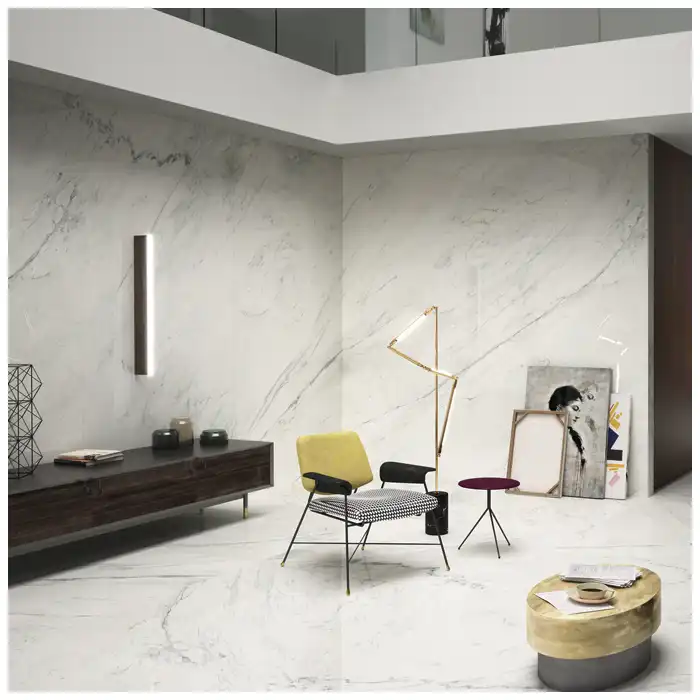
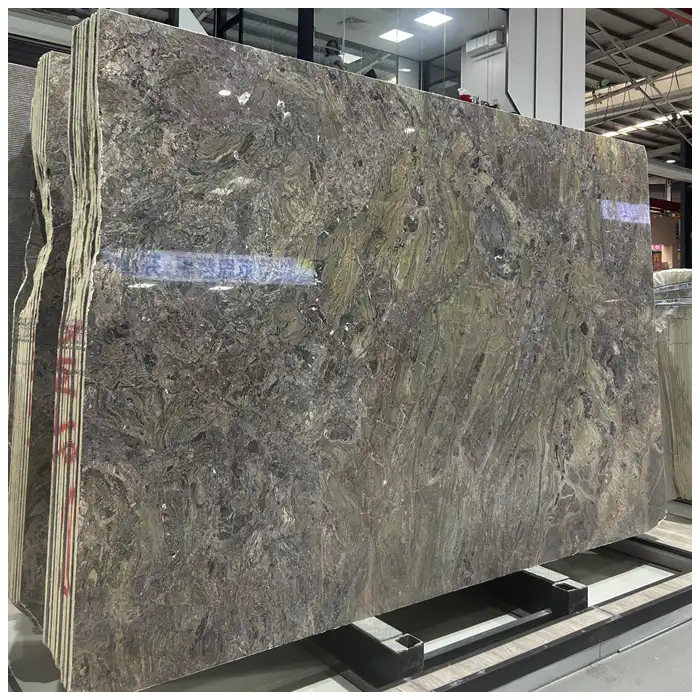
I start with the white pause. A broad calcite-white field usually holds the centre of an Arabescato Corchia face while the charcoal drawing gathers around it in lines of different speed. Under raking light that quiet area is not empty; the calcite crystals pick up the lamp and give the surface a faint internal glow that a single photograph rarely records.
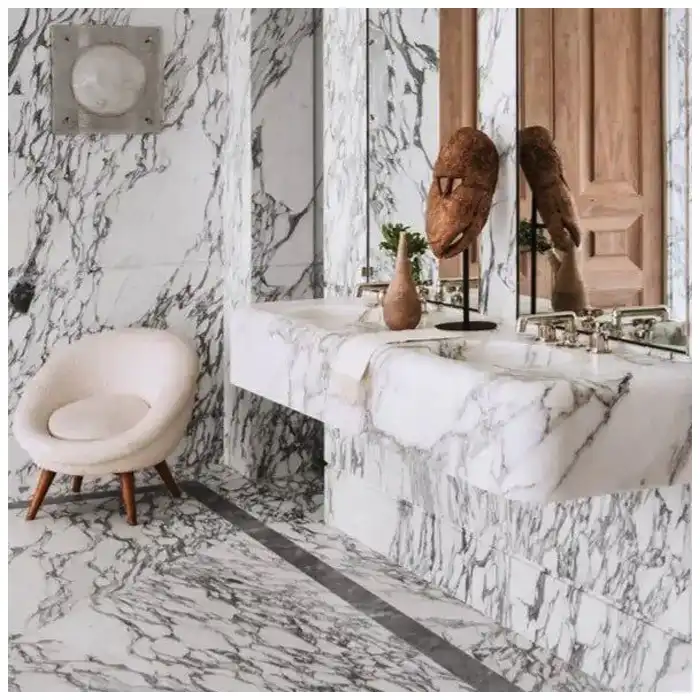
That is why I read Arabescato Corchia marble the same way each time: stand at the far end of the space, walk the full length of the face, then lower the light and watch where the mineral movement gathers or rests. Only after that pass do I draw a crop.
The destination decides the reading. Whether this face becomes a wall, a fireplace surround, a reception desk, or a table seen at arm’s length changes how much of the drawing must survive, so the application question comes before the vein question.
Give the White Pause Its Own Reading in Arabescato Corchia Marble
White space is the scale reference of the face. A dark band that looks commanding in a cropped photograph becomes one line among many once the full pale field around it is visible, and the same band can look stranded when a panel trims the field back too far. I mark the calm areas, their position, and their width, then compare them with the area covered by the darkest mineral passages.
The deliverable is a white-space sketch, not a verbal preference. I check which pale interval the eye will rest on from the principal approach and whether an opening, a door swing, or a light fitting will claim that interval in the finished room. When the rest point survives only in a corner, the crop needs another reading.
I also note which white pauses belong to the same drawing. A field that runs behind a planned opening can be kept whole by moving the opening, while a second field that only appears once the panel is cut is of no use to the layout. The sketch separates fields that can carry a room from fields that merely look restful on paper.
Trace the Movement across the Full Slab Face
The drawing in this stone is directional. Some charcoal lines run as one continuous sweep across most of the slab; others swell, thin, and branch within a short distance. I walk the full length of the face at a fixed eye height and note where the tempo changes, because a seam can cut the only continuous line or, placed well, fall exactly where the drawing already pauses.
I record the movement map directly on the slab photograph, with direction arrows, mineral band positions, and the locations of natural lines, fills, and repaired zones. When the architectural crop is overlaid later, I can see which vein reaches an edge and which one a joint will interrupt. The current faces in the Arabescato Corchia Marmorplatten range are read this way before anything is reserved.
Asymmetry is common and often useful in this stone. A face with movement concentrated along one side leaves the other side calm, which suits an elevation where furniture or an opening already occupies the active zone; the danger appears only when a crop isolates the busiest passage without its balancing field. I test two or three crop positions before the composition is fixed.
Set the Viewing Distance before the Application
Distance governs how much of the drawing the eye can hold. At several metres, separate veins merge into one architectural gesture; at arm’s length, the same face reads as individual mineral lines with visible crystal. I fix the distance before judging composition, check the crop at that distance, then come close to inspect repairs and terminations that the far view forgives.
The rule carries across scenes without changing its order. A wall, a table top, a fireplace, and a piece of furniture all start with the same step: define the approach, stand there, and decide whether the face earns its place. What changes is the scale of the crop and the eye height, not the sequence of checks.
Height belongs to the distance test as much as length does. A full wall is judged from standing and seated positions and from whatever floor level will actually see it, while a table or desk surface is judged from the chair height where it will be used for years. I move the viewing mark on the elevation until the composition holds from every position that matters, not only from the render angle. The decision path in How to Choose Statement Slabs for Countertops, Walls, and Furniture pairs well with this reading when an object rather than a wall is the destination.
Let Finish Control Depth and Reflection
Polish gives the calcite an optical body and turns window light into sharp moving reflections across the face. Honing removes most of that glare and quiets the drawing, but it can also flatten a delicate grey wash or a fine crystal passage. I do not choose between them from memory, because current material varies. I shortlist faces from the Arabescato Corchia marble range, then let finish samples cut from the reserved face settle the question.
I compare those samples on three zones: an active vein, a white pause, and any repaired passage, under the light the room will actually use. A repair that disappears under polish can become visible under honing, which matters when the chosen application brings the surface close to the eye. The lighting plan sets the finish, and the fabricator confirms what the selected slab can deliver.
Light moves through the day, and a finish approved under one lamp can mislead. I view the samples in daylight, under the planned ceiling lights, and with a window reflection crossing the face, then photograph the results under known conditions so the record shows the same stone the room will show.
Place Seams Where the Drawing Can Pause
A seam is the first fabrication act that changes the composition. Cut across a strong continuous vein, it interrupts the line; placed where the vein field narrows or rests, the same joint almost disappears. I overlay the real panel widths on the slab image and move the seam lines until each panel keeps a balanced field of its own.
Bookmatching is one option, not the default. A mirrored pair can give a long elevation a strong central figure; a flow match lets the drawing continue quietly from panel to panel. I compare the actual sequential faces before choosing and keep the pair’s slab numbers in the record. The review steps in Bookmatched Stone Walls: What to Confirm before Fabrication apply whenever a mirror pair is under discussion.
Seams around openings deserve their own pass. When a panel stops at a door, a niche, or a window, the edge of the stone becomes a drawn line in the composition, and a vein that runs parallel to that line reads differently from one that meets it at an angle. I mark every opening edge on the layout before the panel split is accepted.
Carry the Vein Field through Edges and Returns
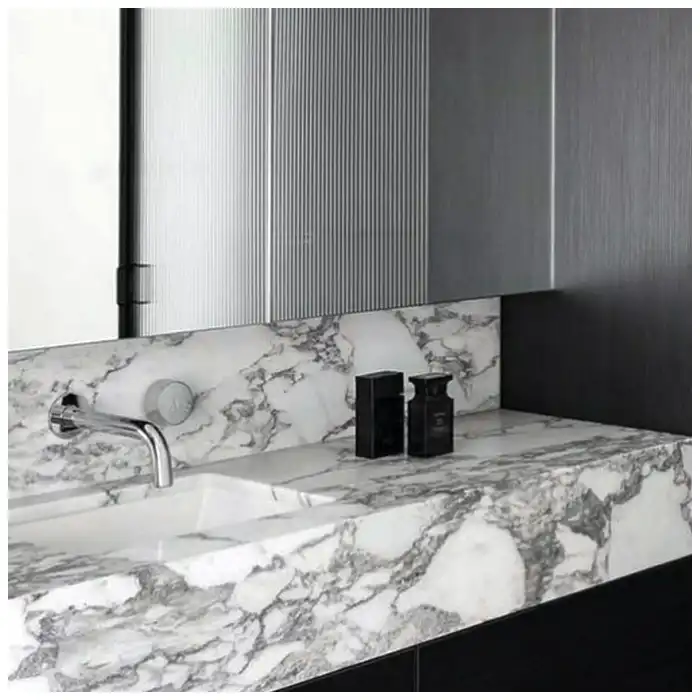
Edges bring the stone within touching distance, where vein terminations and the finish become the story. I inspect how the selected line meets the perimeter: a sweep that runs into an outside corner can double back across a mitred return or stop abruptly at a polished edge, and either outcome deserves a decision made at the slab, not discovered during installation.
Where the face wraps a corner or meets an opening, the return strip is planned from the same vein family and its orientation is marked on the drawing. Edge build-up, fabrication tolerance, and the support plan belong to this same review. The Luxury Natural Stone Slabs Guide keeps those handover conditions together for the whole project, and I read it beside the shop drawing before the crop is released.
An edge mock-up is part of the deliverable. A short sample with the proposed profile, finished as planned, lets me see the vein termination, the crystal response, and the hand feel at the real scale before the full edge is cut, and it costs far less than reworking a long return.
Judge Companion Faces by Rhythm, Not Colour Alone
Companion faces are decided side by side. Two slabs can share one background tone yet fight in rhythm when one carries tight mineral bands and the other a few broad sweeps; I lay the full faces together and watch where the eye travels across the seam before approving a sequence.
Tone, crystal scale, and the density of movement matter more than matching a single feature. The reserved faces keep their slab numbers, orientation, and finish in the record, so the approved rhythm can be reproduced at the yard and checked again at delivery. Colour matching is the easy part; rhythm decides whether adjacent faces converse or compete.
The sequence matters as much as the pairing. When more than two faces are needed, I lay the whole run in order and check the rhythm across every adjacent seam, because the room will see the sequence rather than the single pair. The run order is written into the approval record together with the slab numbers.
| Decision point | Evidence to inspect | Release condition |
|---|---|---|
| White space | Position, width, and continuity of calm fields | A viewing axis that keeps one pale field whole |
| Vein movement | Direction, density, branching, and interruption points | A crop that protects the principal line |
| Crystal and finish | Depth, sparkle, and reflection under moving light | Polish or honed samples on the reserved face |
| Fabrication | Joints, returns, edges, repairs, and support zones | An overlay showing what survives cutting |
| Companion faces | Tone, rhythm, and mineral intensity side by side | A sequence agreed for the wider room |
The Hard-Won Lesson: Do not let yield optimization choose the room’s focal point
When nesting runs first, an opening can be dropped through the broadest white pause to recover area. The numbers improve, while the remaining panel becomes all vein and no rest, and the room loses the balance that justified the slab in the first place. That sequence fails in layout, not in stone, and it is cheaper to catch at the full-face stage than after cutting.
The Lesson: Fix the visual crop and the principal viewing axis before optimizing the remaining yield.
The acceptance file for Arabescato Corchia marble pairs the movement map with the scaled crop: one records the approved composition, the other shows how the decision reached production and installation.
What the Room Asks of the Approved Face
The white field carries the scale
The pale areas are not leftovers; they set the proportion of the room and give the darker mineral lines room to gather and release. When the balance feels wrong, I return to the full face before changing anything else.
Geology explains the depth
Marble forms through metamorphism of carbonate-rich rock, and recrystallized calcite gives the surface its depth while mineral impurities and deformation contribute most of the grey and darker drawing. Trade names describe a visual family rather than a promise that every slab repeats one pattern, so current faces need review for field colour, vein scale, crystal structure, repairs, fissures, and usable dimensions.
Fabrication preserves or erases the first reading
Joints, returns, openings, edges, repairs, and support should remain subordinate to the chosen composition. Before release I return to Arabescato Corchia marble with the full-face study and the reserved-offcut map open together, so the visible result, the technical decision, and the later service record stay connected.
Frequently Asked Questions
1. What is Arabescato Corchia marble known for?
It is known commercially for a white field with expressive grey to charcoal movement. Current slabs vary, so full-face selection matters more than a general description.
2. Is Arabescato Corchia suitable for a feature wall?
It can be, when slab range, finish, joints, fixing, openings, lighting, repairs, and viewing distance are coordinated for the specific wall.
3. Should it be polished or honed?
Polish often deepens contrast and crystal reflection. Hone softens both. Compare current finish samples on representative areas under the intended light.
4. Can Arabescato Corchia be bookmatched?
Some sequential faces can support a bookmatch, but the pair needs direct review for seam behavior, symmetry, repairs, thickness, and available dimensions.
5. What should I do if Arabescato Corchia marble looks different after installation?
Photograph the whole composition under known light, stop surface alteration, then compare slab IDs, finish, orientation, joints, and approval views with the supplier and design team.
Quick-Reference Checklist for Arabescato Corchia marble
- View the complete slab from room distance.
- Map quiet and forceful passages.
- Test polish and hone on current material.
- Overlay openings joints and returns.
- Inspect repairs under grazing light.
- Compare companion faces together.
- Keep the approved full-face map.
Final Conclusion
A slab carries a room when white space, mineral movement, crystalline depth, viewing distance, finish, seams, edges, and companions remain part of one deliberate reading. For Arabescato Corchia marble, the accepted result stays tied to the drawings, samples, measurements, and application records.
This stone has been waiting for millions of years, and MQ STONE would rather preserve its quiet centre than turn every square centimeter into yield.
References
- Marmor, Wikipedia.
- ASTM C119 Standard Terminology Relating to Dimension Stone, ASTM International
- ASTM C503/C503M Standard Specification for Marble Dimension Stone, ASTM International
- ASTM C1721 Standard Guide for Petrographic Examination of Dimension Stone, ASTM International
- Dimension Stone Design Manual, Natural Stone Institute
- Marble and Onyx, Dimension Stone Design Manual, Natural Stone Institute