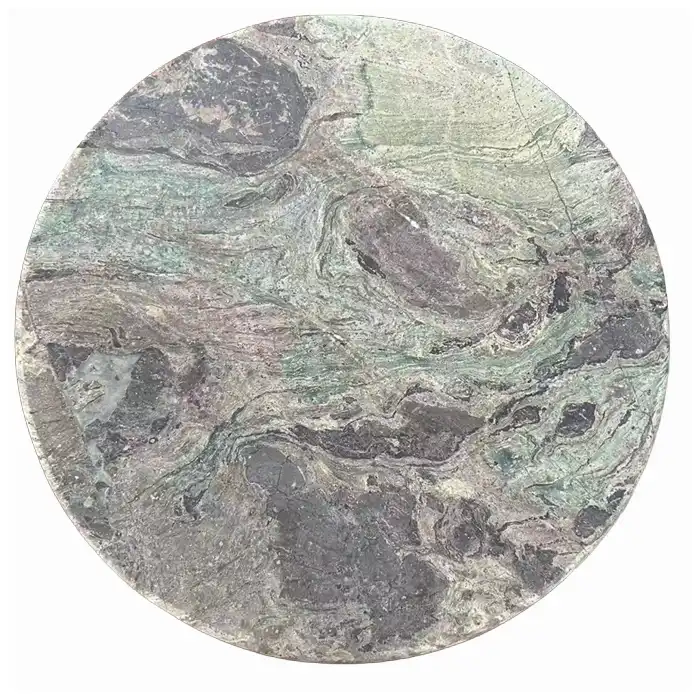
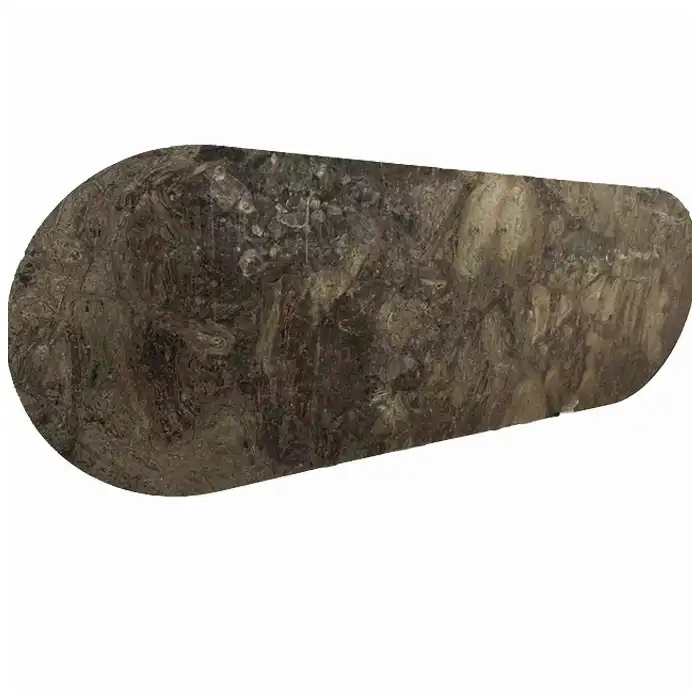
Cristallo Bianco Quartzite: Translucency, Pedestal Sinks, Cutouts, and Edge Light
When a pale quartzite edge catches a low side light, the face often appears deeper rather than simply brighter. Small crystalline passages that look quiet under diffuse noon light begin to reveal a soft internal grain. This stone has waited millions of years to form, and it rarely reveals its full character through a flat photograph alone.
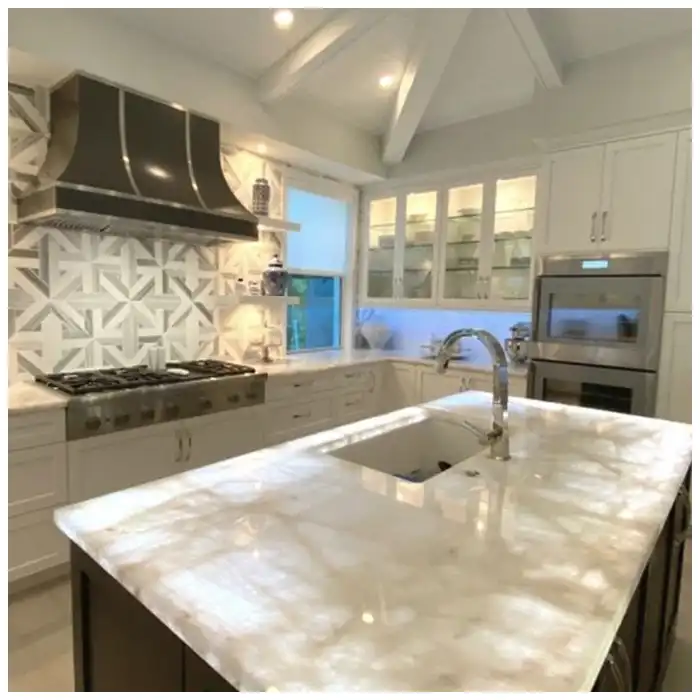
Cristallo Bianco quartzite deserves a full-face review before a sink opening removes the very area that made the slab feel alive.
The veins will tell you where the material can breathe. The cutout has to listen.
Read the Full Face before Choosing a Pedestal Crop in Cristallo Bianco Quartzite
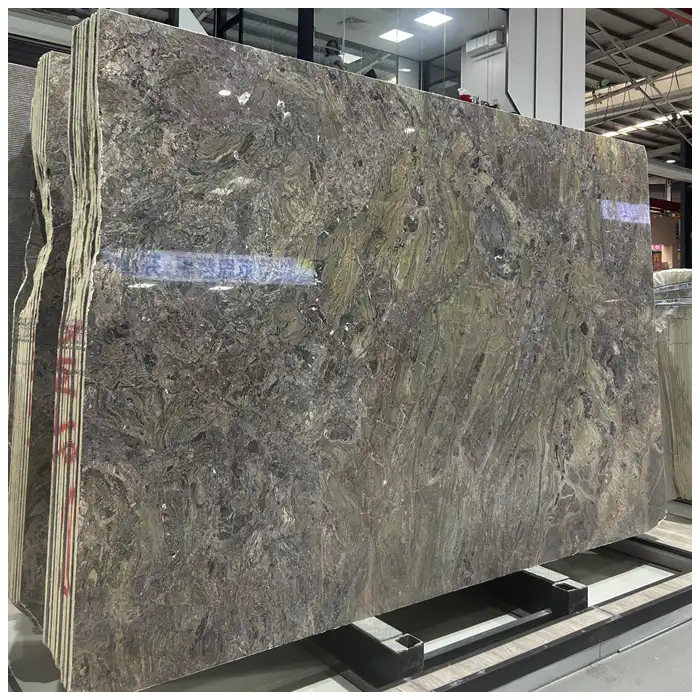
In a quiet warehouse aisle, standing back from the full slab allows for an assessment of the pale crystalline passages before any crop is traced. The slab should be read as a single geological field prior to selection, because a crop derived from a phone photo often severs the very passage that provided the face with depth. Once that material is removed, the loss is irreversible. Crystals, healed fissures, and mineral bands shift in tempo across the full surface; the chosen area must maintain coherence at the scale of the finished piece.
The approved study joins a full-face visual record with two separate light records, because they answer different questions. A side-light photograph documents surface character: polish response, texture, resin and fill visibility at the edge. Translucency is a different test and needs light passing through the slab, so a back-light or transmitted-light record at the thickness selected for fabrication is what governs it. The two records stay apart on purpose, because a raking-light image cannot stand in for a transmission test. This dual evidence ensures that any future replacement material respects both the mineral rhythm and the structural constraints of the pedestal sink outline.
The translucent edge requires examination under grazing light to determine how resin saturation influences clarity. Comparing diffuse versus grazing illumination helps distinguish genuine crystalline depth from artifacts created by surface polish. Crop decisions lack authority when backlight expectations are inferred from thin offcuts rather than the full slab thickness. The selected detail must remain visually coherent after joints, cutouts, and support structures modify the field.
This reading aligns with the principles found in the Luxury Natural Stone Slabs Guide, connecting full-face character, finish, fabrication, scale, and authentic material value.
Test Translucency without Promising a Lightbox Effect
Walking past the slab face involves mentally projecting the pedestal sink outline onto the stone. Overlaying the object geometry on the actual slab photograph traces how the cutout interacts with resin-filled fissures and mineral bands. Light direction is critical in this phase, exposing whether the opening severs a continuous vein or isolates a static patch. On a material board adjacent to an interior elevation, this interaction determines whether the piece reads as integrated architecture or a floating anomaly.
Testing should occur at the thickness specified for the pedestal, avoiding thin offcuts supplied in sample boxes. The visual weight of quiet zones must be compared against high-contrast veins. Evaluation under both diffuse ambient light and focused grazing light ensures the slab retains its geological continuity. Isolated photos frequently exaggerate translucency by relying on thin samples that fail to represent the final block thickness. The selected area must maintain structural and aesthetic coherence at the dimensions of the intended object.
Referencing the Quartzite vs Marble Dining Table guide, priority is given to mineral depth and full-face movement that survive material reduction during cutting and hardware addition during installation.
For Cristallo Bianco quartzite, the entire slab must be surveyed and documented before the object outline is considered final.
Place the Sink Cutout around Mineral Movement
Viewing a backlit sample from multiple angles helps map the pedestal sink outline before committing to a crop. Overlaying the object geometry on the real slab photograph ensures the design respects the stone’s geological field. The finished piece loses impact if a cutout abruptly terminates a dominant mineral passage. Whether viewed as a small sample or a large wall panel, the selected area must maintain internal consistency across all scales.
For future reference, the scaled crop and finish details should remain attached to the order. This ensures any replacement piece respects the original visual weight and keeps the full-face intention legible on drawings during subsequent work.
Close-range inspection focuses on the drain opening zone within quieter areas of the stone. Consolidating mineral features and fabrication limits on a single technical drawing tracks how resin distribution and grain size affect the cut. Edge finishing significantly alters perceived depth, requiring the drain profile to be tested against the slab’s natural variation. On the technical drawing, the drain zone and support brackets are positioned per the approved support design, with any questionable natural feature flagged for fabrication review rather than decided from the slab image; if the layout forces a fixing into a healed fissure, the crop moves rather than the fixing.
| Decision point | Evidence to inspect | Release condition |
|---|---|---|
| Full-face selection | Orientation, quiet zones, mineral passages, and usable boundaries | Object crop preserves intended visual depth |
| Light study | Diffuse, side, and edge observations | Design claims match the actual material response |
| Cutout plan | Basin, drain, overflow, and plumbing zones | Openings avoid vulnerable or dominant passages |
| Finish and edge | Polish, hone, radius, and edge exposure | Finished profile supports the intended light reading |
| Sokongan | Pedestal geometry, fixing, and concealed services | Stone and base retain an approved load path |
The Hard-Won Lesson in Cristallo Bianco quartzite: The brightest patch is sometimes the wrong place for a drain
A pale crystalline area at the centre of one slab seemed made for a pedestal basin. Once the actual drain and fixing zones were overlaid, that luminous passage fell into the removed material. Moving the crop preserved the stone’s best feature but required a different pedestal proportion.
The Lesson: Overlay every opening before you fall in love with a single bright passage.
Keep Edge Light and Finish in the Same Study
The thicker structural base required for stability demands careful examination. Photographing the selected zone with a clear orientation arrow documents variations in depth, resin saturation, and texture across the support area. Face-on images can conceal how much material the plumbing void removes and where natural features intersect the remaining section. Grazing light is used to review the visual effect of the edge, finish and natural features around the void. Structural adequacy after plumbing cutouts is confirmed separately against the approved support design by the responsible fabricator or engineer.
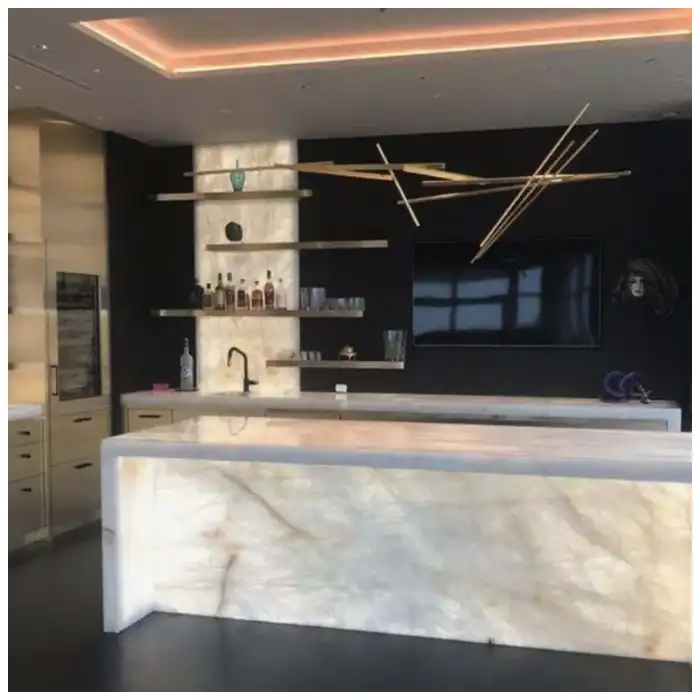
Viewing the full face under grazing light allows for tracing the drain opening path through quieter mineral zones. Maintaining mineral features and fabrication limits on one unified drawing preserves the slab’s geological context. Ignoring this rhythm results in edge finishes that distort perceived depth. The selected area must hold together cohesively, respecting the changing tempo of crystals and fissures across different application scales.
Cristallo Bianco quartzite should be tested under the actual intended viewing light conditions rather than marketed as a guaranteed translucent effect.
Coordinate Pedestal Support and Plumbing Void
Before the first cut, checking the fabrication table involves traveling the eye along the thicker structural base. With the orientation arrow taped to the slab, the selected zone is photographed so the workshop can reset the crop if a piece requires recutting. Significant risk arises when a plumbing void removes material supporting the basin, or when a fixing drills into a healed fissure visible at eye level. Crystals and mineral bands change tempo along the slab, meaning the selected area must hold together at the pedestal, the honed return, and the finished edge. If the plumbing void compromises the approved support zone, the base geometry, fixing position or void layout is returned to the responsible fabricator or engineer for revision before cutting.
The layout record combines the movement map and the fabrication overlay. One holds the compositional decision, while the other instructs the workshop on maintaining it during cutting. Both documents remain with the reserved lot whenever a spare piece is required.
A secondary angle allows for re-examination of the polished outside arris. Returning to the full face view before approving cuts identifies shifts in resin and texture along the edge. Significant risk occurs when a natural fissure intersects the most visible pedestal corner. The detail must remain aesthetically and structurally sound once joints, openings, and supports integrate into the final composition.
The selected slab is reviewed under side light to determine where crystalline passages meet edges, joints and supports. For the broader material-selection context behind that review, consult the Luxury Natural Stone Slabs Guide.
Inspect Repairs and Natural Lines at Object Scale
Lowering the viewpoint facilitates inspection of the honed return. Reading the whole slab before cropping detects subtle shifts in depth and resin distribution along the edge. This perspective reveals whether a replacement piece can match the original visual orientation. In a large wall composition viewed from a distance, the detail must remain consistent despite the introduction of joints, openings, and structural supports.
Reviewing a large wall composition from the entry allows the polished outside arris to set the pace of the slab. Returning to the full face before approving the cut ensures the slab remains visible as one geological field. A small crop on a phone screen may hide the fact that a healed natural line falls exactly where the pedestal corner will be viewed daily. At eye level, that single feature alters the reading of the entire piece. Buyers often err by judging the wall from a photograph taken square to the surface, which flattens depth and obscures tempo changes in mineral bands. Composition checks from the doorway, the side, and close to the finished edge precede crop release.
Before releasing the crop, the comparison between Natural Quartzite and Marble-Look Sintered Stone is revisited to verify that the detail preserves the larger natural-stone composition.
Preserve the Chosen Face for Future Work
Returning to the full slab in a quiet warehouse aisle enables reading the honed return from edge to edge. The selected crop is assessed against the whole face rather than the drawing alone, as the composition weakens if a replacement piece cannot recover the original orientation. Records must include the reserved lot, the orientation arrow, and the side-light photograph, allowing the next fabricator to reset the crop if a panel is recut. Crystals and healed fissures change tempo along the slab’s length, requiring the selected area to hold together once the pedestal base, plumbing void, and finished edge are incorporated.
Preserving the full-face study and side-light photograph maintains their shared orientation, giving later pieces a direction to follow. This allows the next fabricator to replicate a resin-treated edge without flattening its movement.
The second reading focuses on a natural healed line. Comparing the face under diffuse and grazing light reveals changes in depth, resin, texture, and mineral structure. Caution is warranted when the crop removes the most luminous portion of the face. Within the context of a full slab in a quiet warehouse aisle, the detail must remain integral after joints, openings, edges, and supports enter the composition.
Where Cristallo Bianco Quartzite Needs Restraint
Translucency is a condition, not a slogan
It varies with thickness, mineral structure, finish, light direction, and the actual face selected.
The object must respect the slab
A sink cutout and support system reduce the available field. Let the material set the composition before the drawing becomes fixed.
Natural variation is part of the value
True luxury is a face you keep reading as the light moves: reserve the lot, keep the full-face selection record with the order, and accept that the second panel of a bookmatch will not repeat the first one exactly.
Cristallo Bianco quartzite requires the whole slab to be read under diffuse and grazing light before the object outline is treated as final by the draftsman or the fabricator.
The selected face should be tested under the actual viewing light, at the thickness and finish specified for the object, rather than described in the submittal as a guaranteed translucent effect.
Any sink opening, drain zone or concealed fixing must be placed around the material’s real movement, and that placement should be re-checked once the pedestal base and the support brackets are drawn at full size.
Before fixing the layout, a translucent edge is studied under grazing light using a backlit sample viewed from two angles. Mineral features and fabrication limits remain consolidated on one drawing. The scaled crop is retained because a cutout interrupts meaningful mineral passages. Even beautiful details must serve the larger geological movement defined by the scaled crop.
The final side-light pass across the full face under grazing light traverses the thicker structural base, with the selected zone photographed alongside its orientation arrow. Full-face study is retained because the crop removes the most luminous portion of the face. This documentation protects the relationship between mineral character and form.
The approval record includes the product route for Cristallo Bianco quartzite pedestal sinks. This reference remains attached to the signed record to avoid reopening decisions from memory.
Related decisions are documented in Exotic Quartzite Slab Selection. This reference stays with the signed record to prevent reliance on memory for future adjustments.
Operational comparisons rely on Exotic Quartzite Finish Selection. This reference accompanies the signed record to ensure consistency in finish-related decisions.
Subsequent material or project questions refer to the Luxury Natural Stone Slabs Guide. This reference remains linked to the signed record to streamline future evaluations.
Frequently Asked Questions
1. Can Cristallo Bianco quartzite be used for a pedestal sink?
It may be considered where the full slab, fabrication, support, plumbing, openings, finish, and installation detail are assessed together by the responsible team.
2. Will Cristallo Bianco quartzite always glow when backlit?
No. Light response depends on the actual stone, thickness, mineral structure, finish, light source, and viewing direction. Test the selected face.
3. How should a sink cutout be placed in quartzite?
Use the exact basin template and support detail over the real slab photograph or face. Avoid treating the opening as a graphic shape separated from material behavior.
4. Does polished quartzite show more depth than honed quartzite?
Not reliably. Polish tends to deepen reflected contrast while a honed surface can read flatter or softer in the same light, and the direction of the light changes which one wins; compare both finishes on material from the selected lot.
5. What should happen if a natural line reaches the planned edge?
Photograph and map the feature, compare it with the selected crop and support detail, then decide whether the edge, cut, application, or slab allocation needs to change.
Quick-Reference Checklist for Cristallo Bianco quartzite
- Study the full face under diffuse and grazing light.
- Overlay the exact basin, drain, and support zones before crop approval.
- Test the selected finish and edge on representative material.
- Record natural lines and treated areas at object scale.
- Confirm support and plumbing voids before fabrication.
Final Conclusion
Cristallo Bianco quartzite is most persuasive when its light is discovered in the finished object rather than promised by a staged photograph. The final decision on Cristallo Bianco quartzite must stay attached to the evidence that production and site teams can verify.
The slab was formed long before this project existed, and it will outlast the drawing. MQ STONE would rather move the pedestal crop to keep the material honest than cut the stone to match a rendering, because the piece only works when the fabrication record still describes the surface in front of you.
References
- Kuarzit, Wikipedia.
- Standard Terminology Relating to Dimension Stone, ASTM International.
- Natural Stone Finishes Technical Guidance, Natural Stone Institute.
- Stone Selection and Use Guidance, Natural Stone Institute.
- Materials and Design Coverage, Dezeen.
- Search Essentials, Google Search Central.