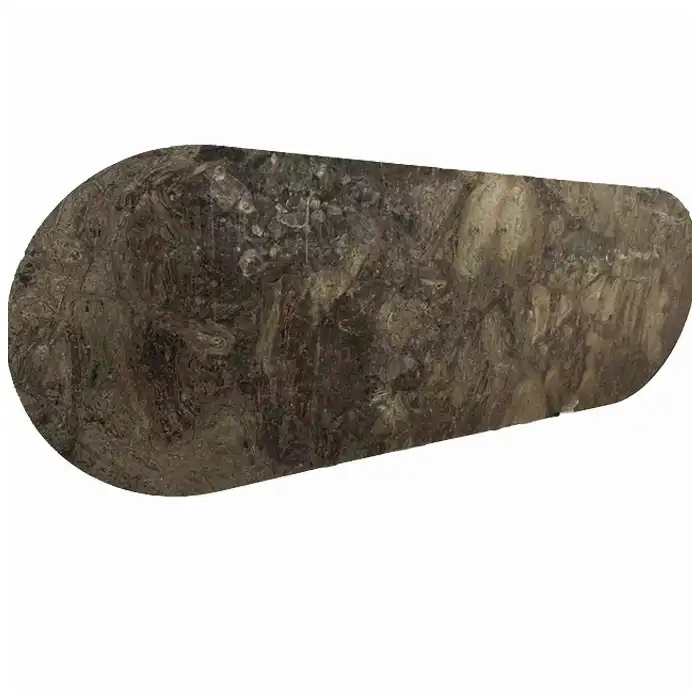
Exotic Quartzite Finish Selection under Real Interior Light
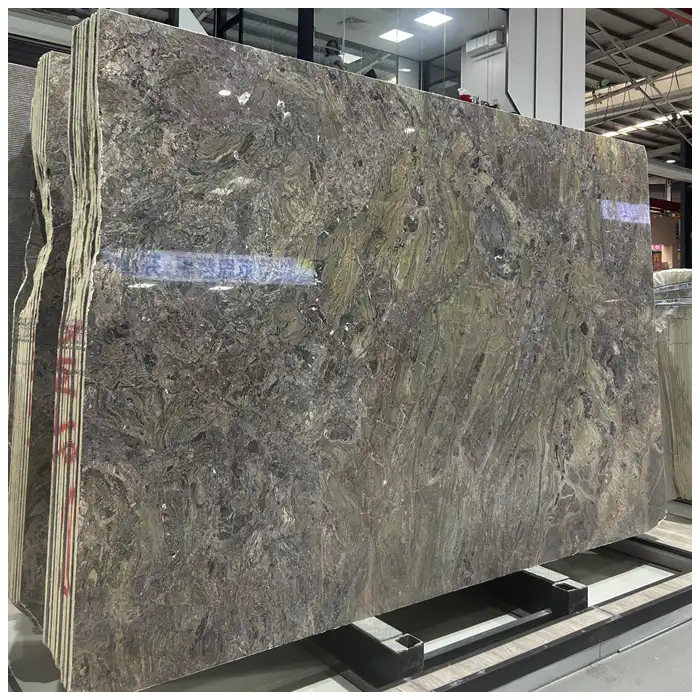
The most revealing finish test I know begins when a slab is stood upright and the light moves across it. Clear quartz opens slowly, almost like ice viewed from the side. Mica flashes and disappears. Iron-rich lines stay dark. Lay the same piece flat beneath ceiling lamps and much of that evidence vanishes. That change is the starting point for exotic quartzite finish selection.
I do not begin by asking whether polished, honed, leathered, or brushed is fashionable. I ask where the stone and viewer will stand, and whether a hand, cloth, plate, or suitcase will cross the surface. Those answers remove unsuitable finishes before personal preference enters the room.
Start Exotic Quartzite Finish Selection with the Viewing Position
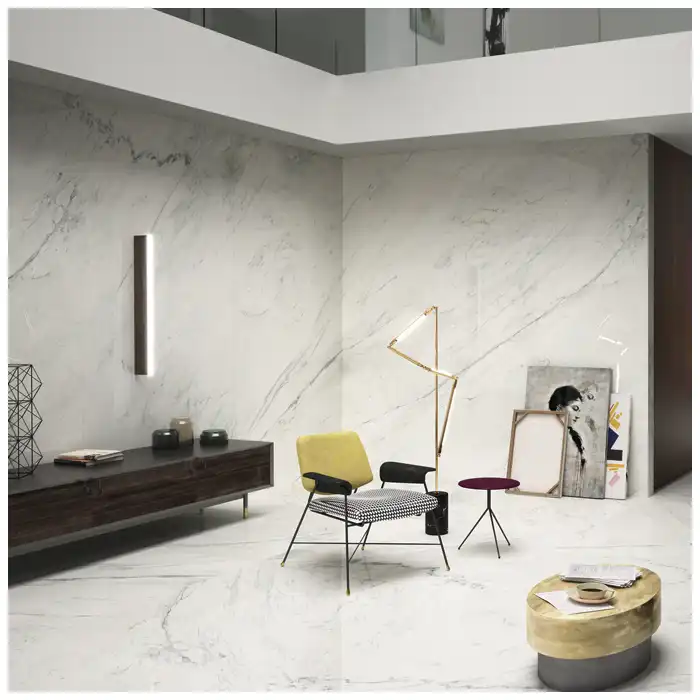
A feature wall is read from a distance, then again as someone walks past it. A dining table is seen from above but judged for hours from a low seated angle. A console top catches hands near the edge, while a reception face may receive strong grazing light and almost no touch. I map those conditions before asking for samples.
For a vertical installation, I mount the trial vertically. For furniture, I place it at the proposed height and walk around it. This sounds obvious, yet a flat sample under diffuse office light remains one of the easiest ways to choose the wrong reflection. Good exotic quartzite finish selection makes the surface meet the room on the room’s terms.
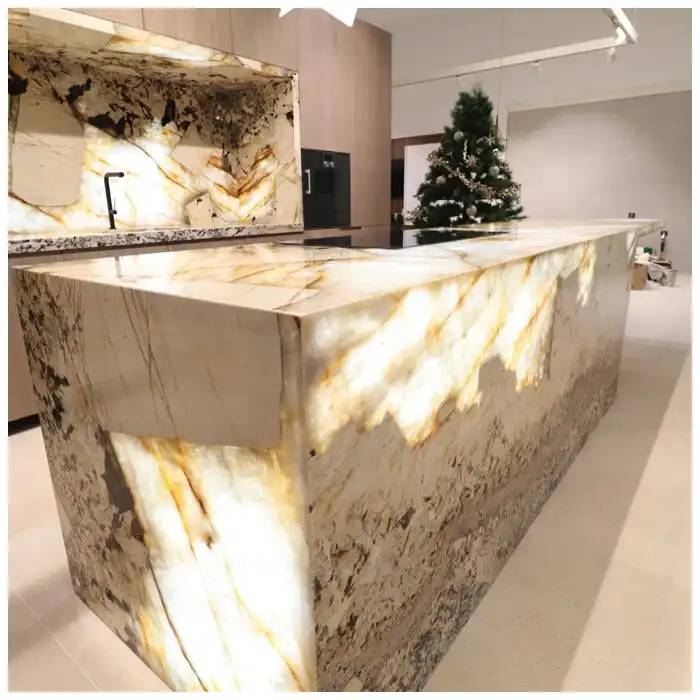
The broader comparison in Natural Quartzite vs Marble-Look Sintered Stone: The Definitive Comparison for Premium Interiors separates natural crystalline depth from a manufactured image. A finish can either reveal that depth or cover it with glare. The material remains authentic in both cases, but the experience is not the same.
Distance changes which detail matters
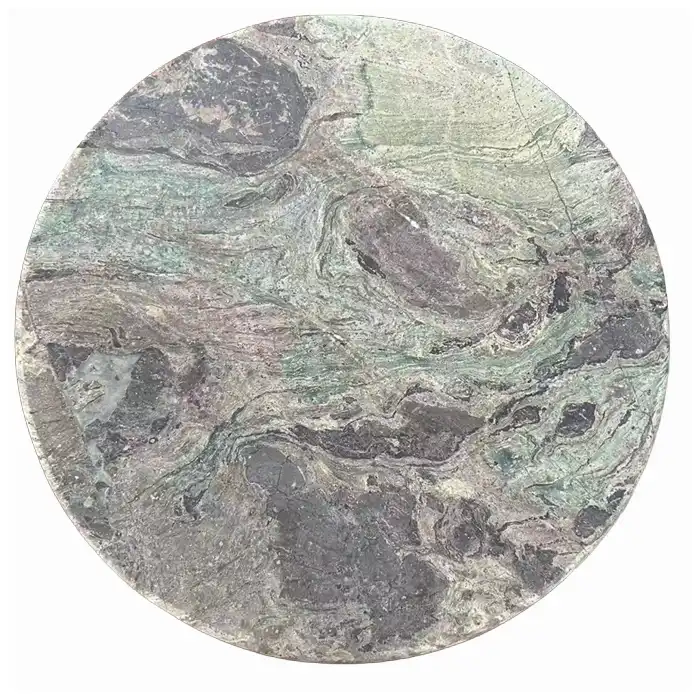
This is where a labeled quartzite surface sample becomes useful. Its value comes from knowing which slab zone it represents and which viewing condition it is meant to answer. An attractive anonymous offcut cannot do that work.
Read the Slab before Cutting Finish Samples
Quartzite develops when quartz-rich sandstone recrystallizes under heat and pressure. Interlocking quartz grains account for much of its hardness, while other minerals and natural structures create the colors, lines, translucent pockets, and changes in texture that distinguish one slab from another. Finishing does not act on a perfectly uniform sheet.
I divide the slab visually before any trial is made. One sample should cross a quiet field. Another should include a strong vein or mineral island. A third should include a natural fissure, resin-treated line, or other accepted feature if that area will enter a finished piece. The goal is not to collect pretty chips. It is to expose different responses.
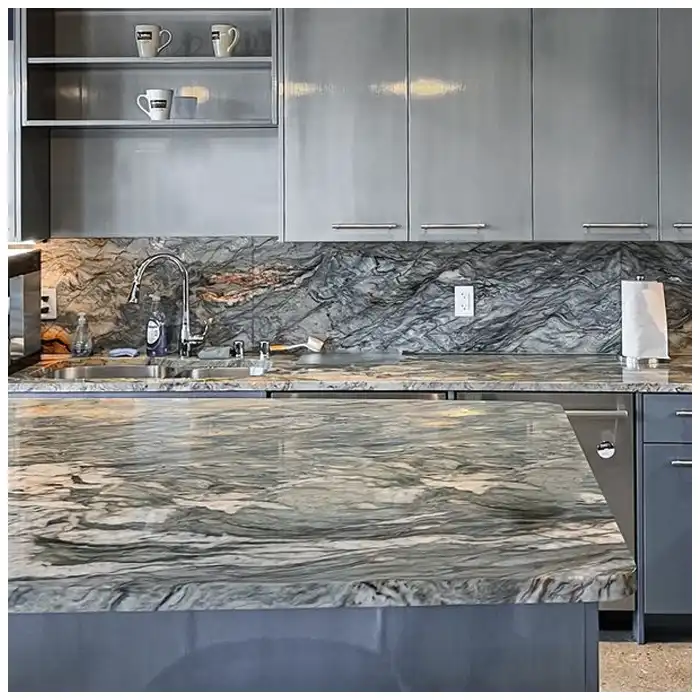
On Patagonia quartzite, pale crystalline windows can sit beside dense black and ochre formations. Polish may deepen the apparent space inside the clear areas, while a textured process can separate neighboring minerals by relief. I would never let one calm corner represent that entire face.
A finish name cannot describe local mineral response
Machine type, abrasive sequence, brush stiffness, pressure, feed rate, resin, and the stone itself all influence the result. One workshop’s leathered surface can differ noticeably from another’s. I approve a physical result linked to a process reference, not a word written alone on a drawing.
| Decision condition | Polished response | Honed response | Textured response | What I approve |
|---|---|---|---|---|
| Long wall opposite glazing | Deep color with possible broad glare | Quieter image with softer internal depth | Broken highlights may emphasize mineral bands | Vertical samples viewed from the normal approach |
| Dining top under pendants | Clear pattern but visible lamp reflections | Lower glare and a drier visual surface | Relief may collect residue around active zones | Full-thickness corner at seated eye level |
| Console touched at the edge | Smooth hand and crisp profile | Smooth hand with subdued sheen | Face-to-edge texture can feel abrupt | Repeated hand and cloth test across the edge |
| Bookmatched composition | Strong mirrored image when gloss aligns | Center joint may read more softly | Relief can interrupt reflected symmetry | Paired trials crossing the intended center line |
| Mixed mineral field | Gloss may vary around fill and soft bands | Treatment can become easier to see | Different minerals may recess unevenly | Samples from every representative zone |
| Maintenance-sensitive use | Residue is visible but the face is smooth | Marks may darken until fully dry | Recesses need a cleaning test | Written method tested on the retained sample |
Compare Polished vs Honed Quartzite without Losing the Composition
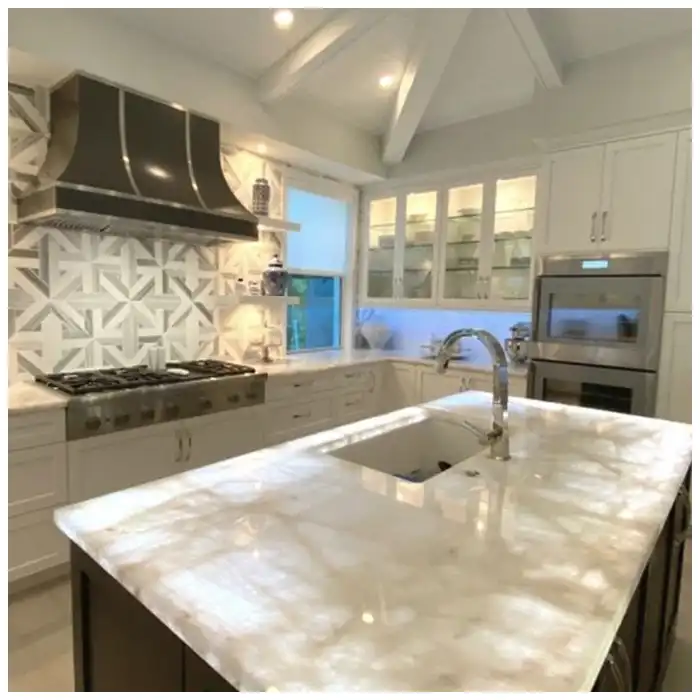
Polish can make color look saturated and can open apparent depth behind the face. It also reflects windows, lamps, moving people, and bright objects. Honing usually reduces that mirror effect, but it can quiet the very crystalline depth that led the designer to select the slab. Neither result is automatically better.
When I compare polished vs honed quartzite, I keep the sample location identical. Two finishes cut from unrelated areas create a false comparison because mineral variation becomes mixed with surface variation. Each piece is marked before finishing and returned to the slab photograph afterward.
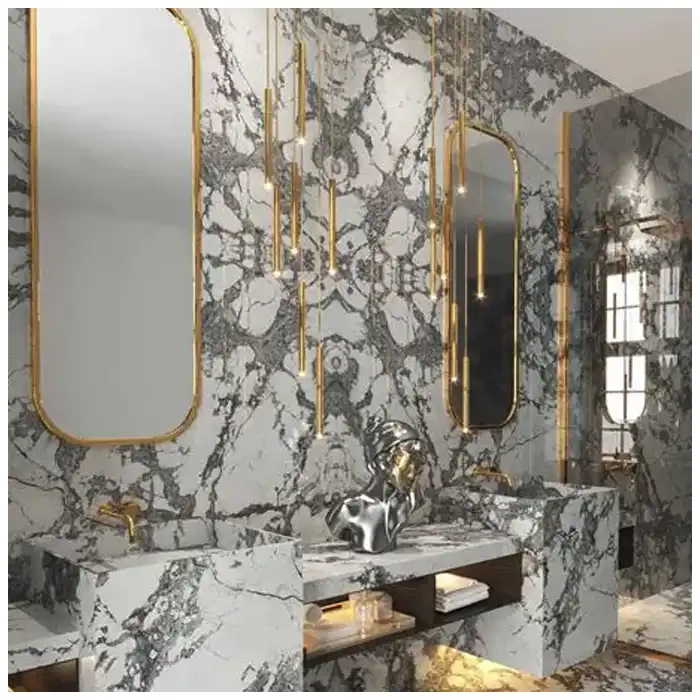
Blue Roma quartzite can carry pale blue fields, brown-gold movement, and white crystalline passages. A high polish may make those colors read in separate layers. Honing can bring them closer together visually. The correct result depends on whether the room needs distance and drama or a calmer continuous plane.
The lighting method in How Lighting Changes Colorful Marble, Quartzite, and Onyx Slabs applies directly. I photograph the samples from the entrance and principal seating position. One front photograph is not enough.
Reflection has direction
A bright patch travels as the viewer moves. I watch whether it crosses a bookmatch center, hides a crystalline window, or sits at eye level. Sometimes changing the lamp angle solves more than changing the finish.
For exotic quartzite finish selection, I record the orientation of every trial. Rotating a strongly directional slab by ninety degrees can change where veins catch the light and make an honest comparison look inconsistent.
The Approval Error That Begins on a Flat Table
Put a polished trial flat beneath diffuse ceiling light and it may look rich without showing much glare. Stand it upright opposite glazing, then move to the expected entrance angle. The window can erase the central vein for several steps. Turn to the honed piece and the vein returns, although some crystalline depth disappears. Nothing about the stone changed; the approval position was wrong.
Mount every trial in its final orientation and judge it from the real viewing path before naming an accepted finish.
Decide Whether Texture Belongs on the Face
Leathering and brushing break continuous reflection by creating relief. Hard quartz-rich bands may remain higher while other zones recess. Under grazing light, the surface can resemble a contour drawing: thin ridges glow, dark fields absorb the light, and a line that looked painted under polish becomes physically legible.
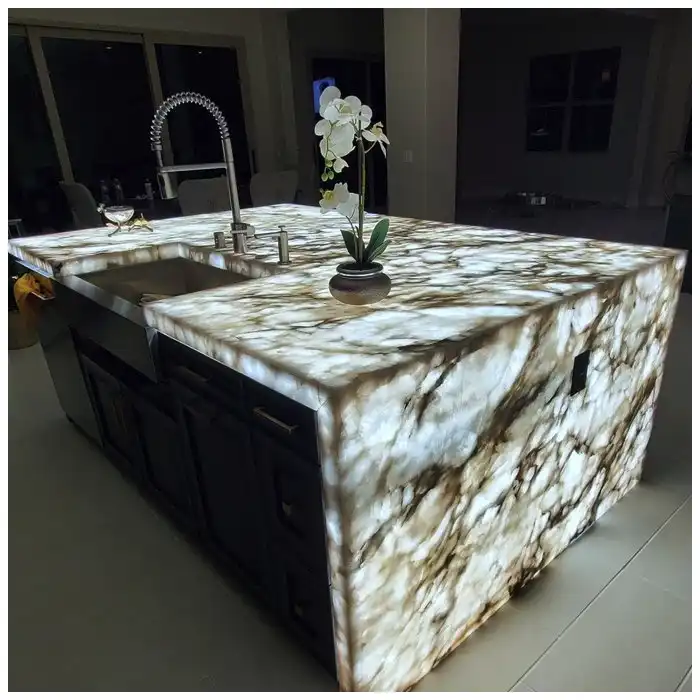
That effect can be beautiful, but I do not treat a leathered quartzite finish as a universal upgrade. Relief can expose repairs, exaggerate a mixed mineral transition, catch cloth fibers, or make a table edge uncomfortable. The application decides whether texture adds meaning or merely adds work.
Negresco leathered quartzite shows broken highlights across a dark field. Pale bands can rise as silver lines while charcoal areas remain quiet. I still need a trial with the actual edge and a representative filled zone.
The companion Leathered Quartzite Slabs: Texture, Mineral Color, Edge Detail, Lighting, and Daily Care follows this finish into detailed production control. Within a broader exotic quartzite finish selection, its main question is simpler: does the room benefit from physical relief enough to accept the extra sampling and maintenance work?
Touch is evidence, not an informal preference
I move a dry hand across the grain, then against it, and repeat with a clean damp cloth. Furniture should not snag fabric or retain residue around deeper pockets. A wall can accept more texture because it receives less contact.
Make the Edge Part of Exotic Quartzite Finish Selection
A face-only sample leaves the most frequently touched part of a table unresolved. The edge can remain polished, receive the same texture as the face, or use a controlled transition between the two. Each choice changes the shadow line and reveals different details around fills or natural fissures.
I ask for a full-thickness corner rather than a thin face chip. It shows how the profile meets the top, whether the texture wraps consistently, and whether the arris feels sharp or irregular. On a dining top, I inspect it from the seated position because that low angle makes the edge visually dominant.
The future Luxury Natural Stone Slabs for Walls, Furniture, and Light places finish beside support and use. A projected edge, a built-up profile, and a wall return cannot share one automatic detail.
Bookmatching adds a second approval
Polished bookmatched panels can read as one luminous drawing when gloss aligns. Honing softens reflections. Texture can break mirrored light even when veins meet accurately, so I review both the dry arrangement and finished sample.
For polished vs honed quartzite, the center line is often the decisive area. The question is not whether the veins meet on paper. It is whether both faces carry light in the same way after processing.
Test Cleaning before Approving the Surface
Commercial naming does not predict every practical behavior. Natural fissures, fill, resin, finishing, sealing, and use still affect the piece. I avoid promising that one finish removes every maintenance risk.
A second quartzite surface sample should be reserved for controlled cleaning tests. Mark the product, contact time, method, rinse, drying period, and visible result. A photograph taken while the surface is still damp can hide a temporary darkening pattern that appears obvious after the rest has dried.
The English overview of quartzite describes the metamorphic material in general terms. It cannot replace testing of the selected slab and finish process.
On a leathered quartzite finish, I inspect low points for retained residue and raised points for uneven sheen. On a honed face, I watch how touch marks and damp areas disappear. On polish, I inspect smears and fine surface disturbance in reflected light rather than only from the front.
Write a Finish Record That Production Can Repeat
A signed sample without identity is weak evidence. My record includes the material, slab code, sample location, orientation, process reference, edge, cleaning test, approval date, and storage location. The physical sample remains the controlling visual reference.
The specification for exotic quartzite finish selection must also say where the finish changes. If the face is leathered and the edge polished, the junction needs a clear sample. If wall returns or cutouts expose thickness, those surfaces need an instruction rather than an assumption.
I keep one approved piece with the supplier and ask the project team to retain its match. A repeatable exotic quartzite finish selection record gives both sides physical evidence when later photographs differ in color or angle.
Do not average away natural variation
Repeatability does not make every mineral zone identical. I accept variation that follows the stone and reject abrupt changes caused by machine passes, incomplete brushing, contamination, or an unapproved transition.
This stone has been waiting for millions of years. My job is not to erase that history under one uniform label, but to make sure the finishing work reveals it deliberately.
If the Production Finish Does Not Match
First, photograph the full piece, its code, the disputed area, and the approved reference under the same light and orientation. Include close views and normal viewing distance. Second, stop additional finishing or installation so the original condition remains available. Third, send the supplier the sample record, slab map, process reference, edge detail, and inspection photographs for side-by-side review.
Evidence may lead to cleaning, controlled refinishing, reassignment, replacement, or acceptance. I do not alter the piece first because correction can remove the texture needed to identify the cause.
Frequently Asked Questions
1. What should exotic quartzite finish selection begin with?
Begin with the slab’s final orientation, normal viewing positions, light direction, frequency of touch, and cleaning method. Then take finish samples from several identified mineral zones rather than choosing from an unrelated sample rack.
2. Is polished or honed quartzite better for a feature wall?
Neither finish wins automatically. Polish can reveal crystalline depth but may reflect glazing or lamps across the composition. Honing can calm glare but may reduce apparent depth. Compare paired samples vertically from the real approach path.
3. When does a textured quartzite finish make sense?
Texture can work where broken reflection and tactile mineral relief support the design. Test it carefully on tables and frequently cleaned surfaces because deeper zones, repairs, edges, and mixed minerals may behave differently.
4. Why should the approval sample include a full-thickness edge?
The edge reveals face-to-profile transition, tactile comfort, fill visibility, shadow, and whether the chosen process can wrap consistently. A thin face chip cannot answer those furniture and countertop questions.
5. What is the first response to a finish mismatch?
Photograph the piece and approved reference in the same orientation and light. Stop further finishing or installation, then compare the slab map, process record, edge sample, and inspection photographs with the supplier.
Quick-Reference Checklist for Quartzite Finish Approval
- Select sample locations that cross representative light, dark, crystalline, and treated mineral zones.
- Prepare each candidate finish from the actual selected material and label its slab location.
- Include the proposed edge profile and face-to-edge transition on the approval sample.
- View samples vertically or horizontally in the intended project orientation.
- Test dominant natural and artificial light paths from the normal approach distance.
- Record the accepted physical sample, process reference, cleaning method, and permitted variation.
Final Conclusion
Exotic quartzite finish selection starts with where the stone will stand and how people will encounter it. Read the slab, sample its different mineral zones, compare reflection from the real viewing path, make the edge at full thickness, and test the maintenance method before the physical reference becomes the production standard.
At MQ STONE, I would rather let the room challenge a sample now than let the finished quartzite spend years fighting the wrong light.

References
- Dimension Stone Design Manual, Natural Stone Institute.
- Natural Stone Institute Technical Bulletin: Natural Stone Finishes, Natural Stone Institute.
- ASTM C616 Standard Specification for Quartz-Based Dimension Stone, ASTM International.
- ASTM C97 Standard Test Methods for Absorption and Bulk Specific Gravity of Dimension Stone, ASTM International.
- ASTM C880 Standard Test Method for Flexural Strength of Dimension Stone, ASTM International.
- Manual for Stone Furniture and Interior Applications, Stone Federation Great Britain.
- Quartzite, Wikipedia, Wikimedia Foundation.